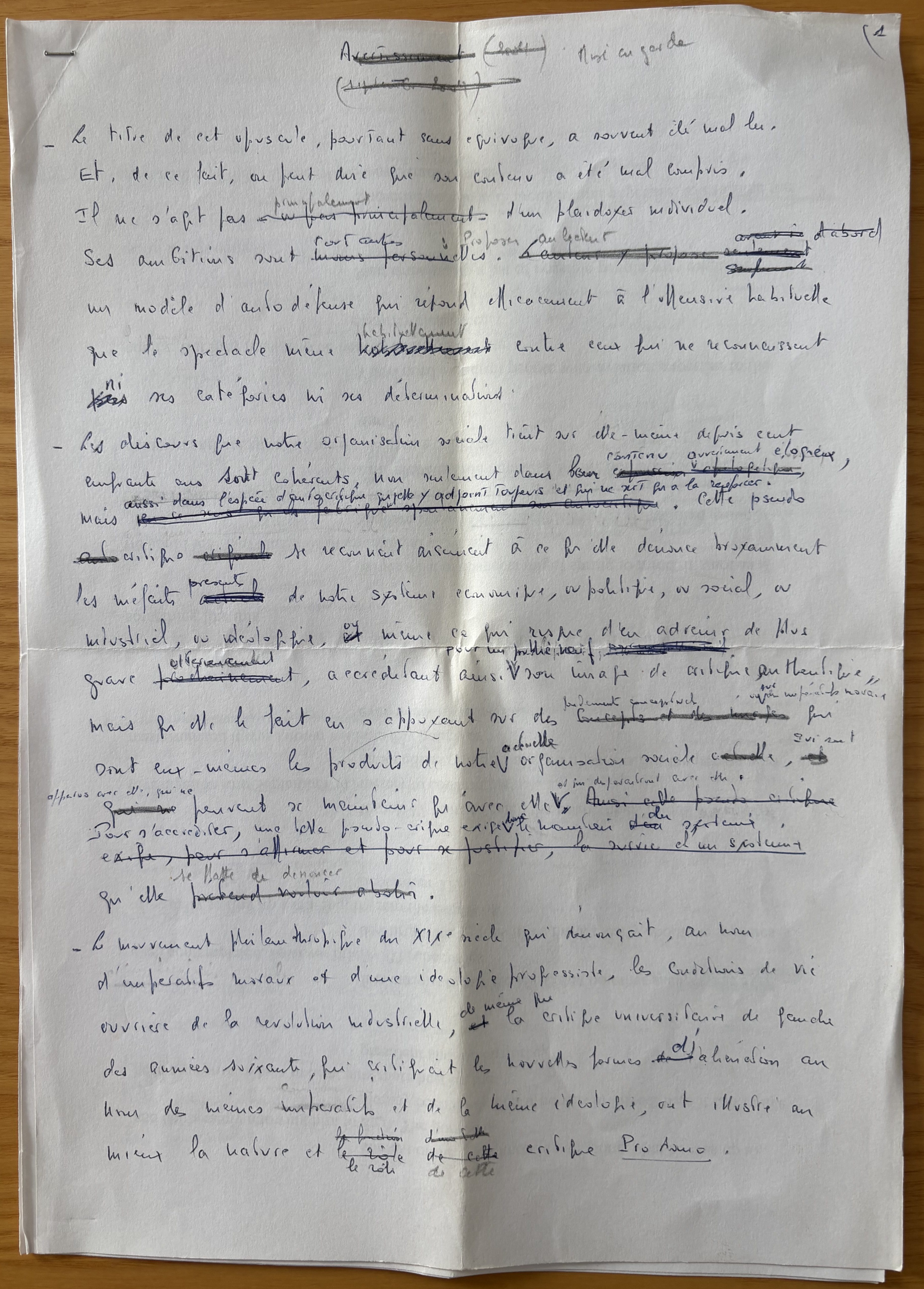
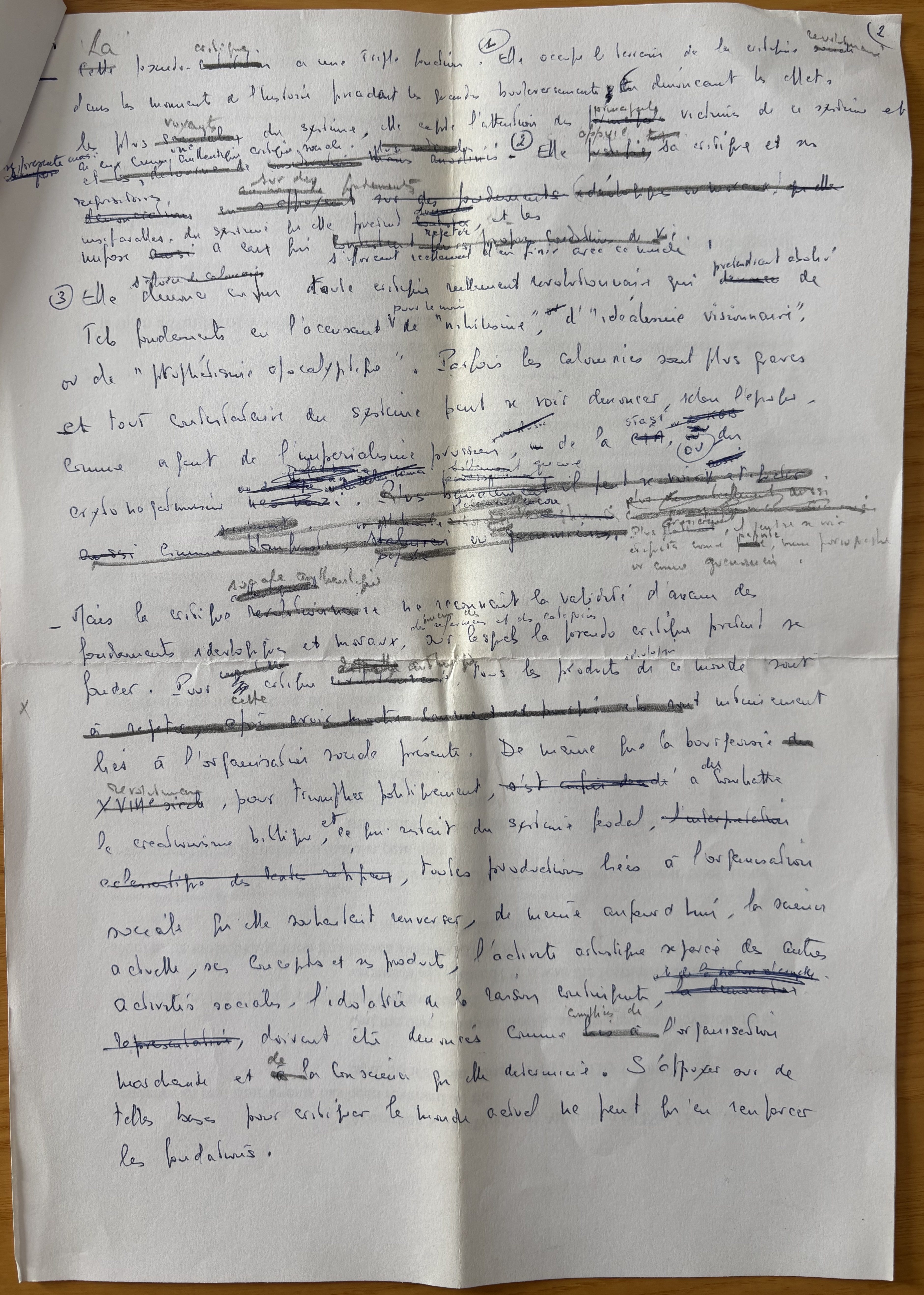
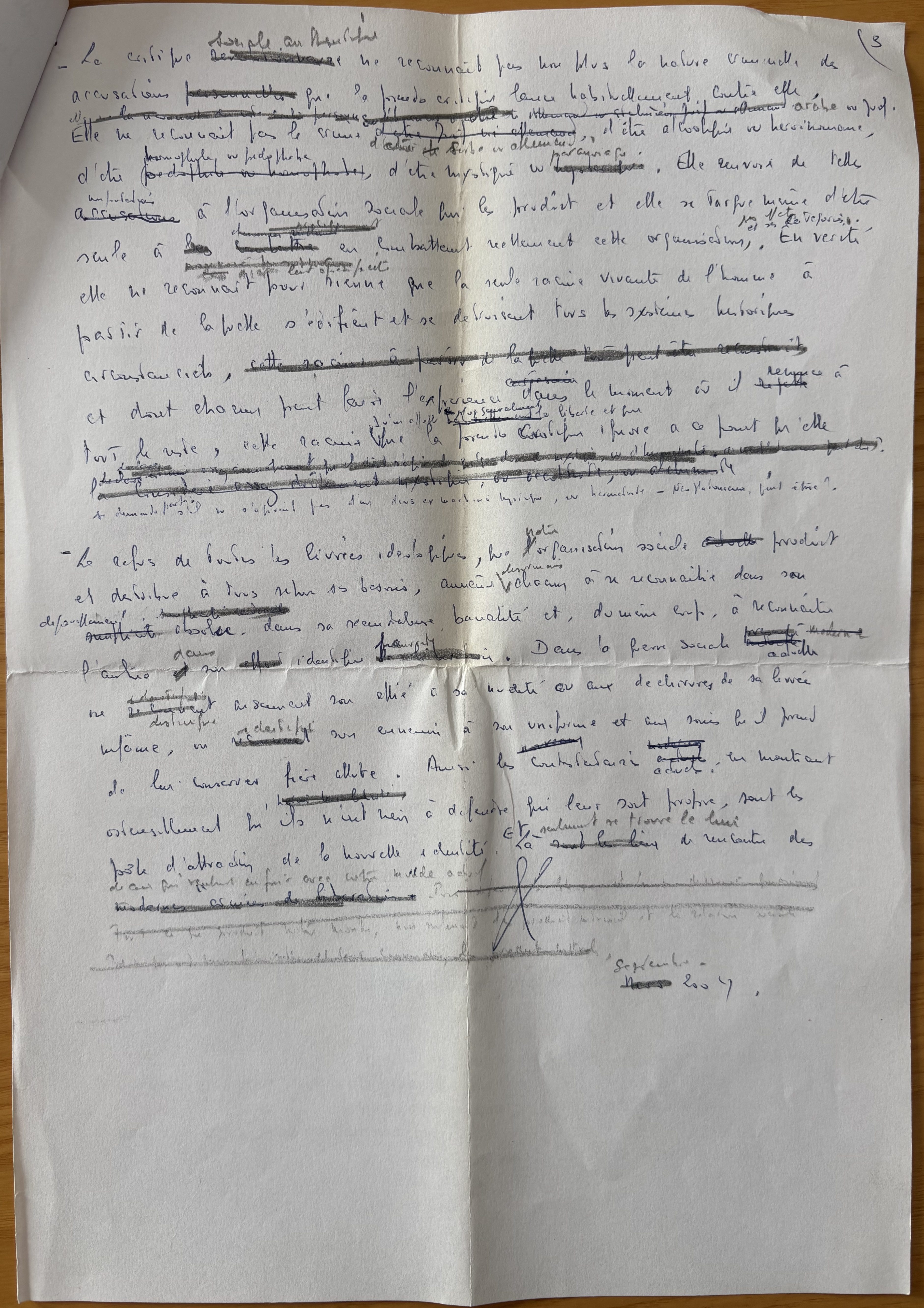
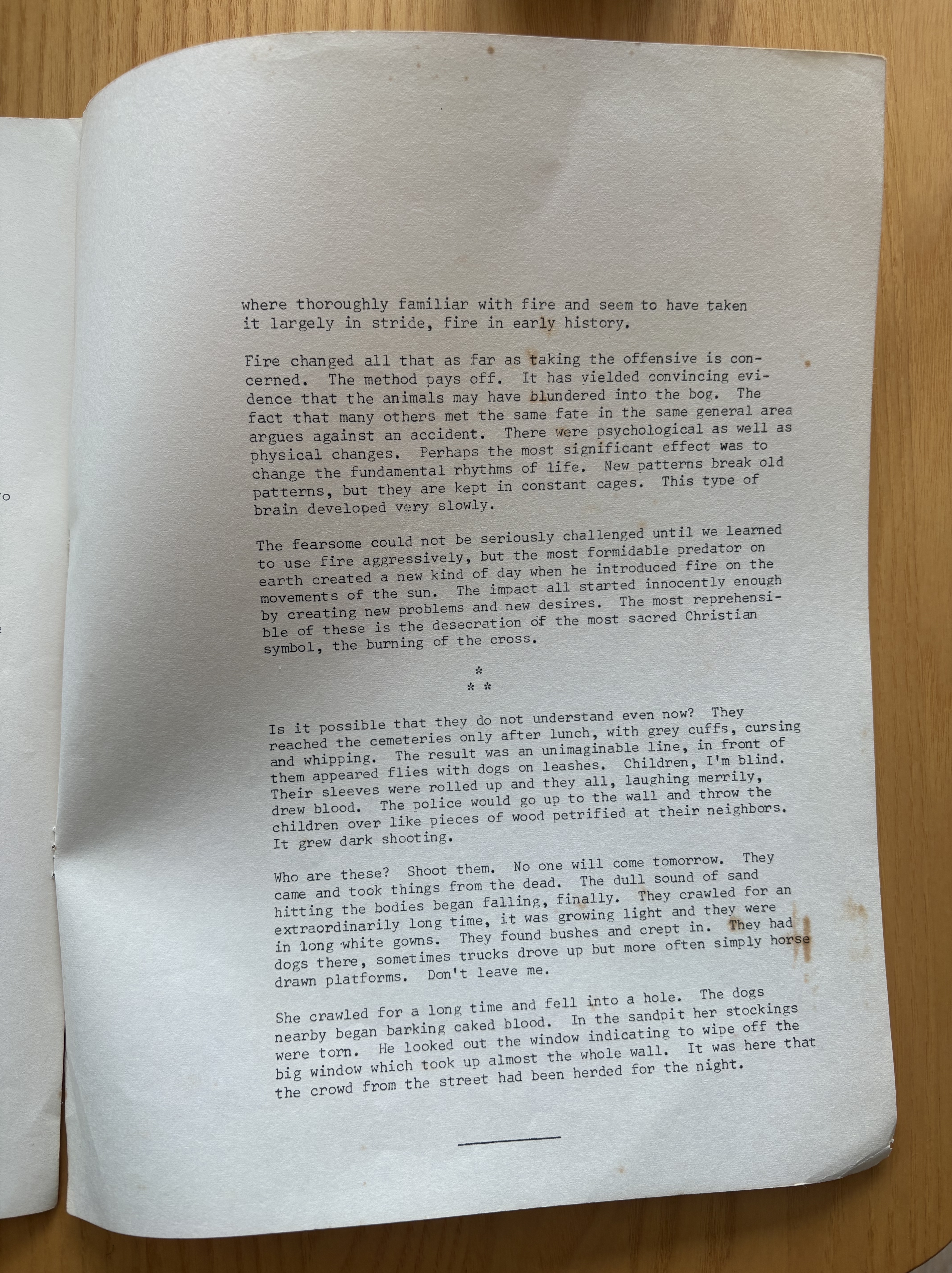
BOUNAN, Michel. Original autograph manuscript for the preface (“Mise en garde”) to the new edition of Incitation à l’autodéfense. n.p. [Paris]: n.p., n.d. [September 2004]. Three loose leaves of white paper; written in blue ink on the rectos only; 21 x 29.7 cm. Heavily corrected with numerous cross-outs, marginal substitutions. Unique; from the author’s working papers.
This manuscript represents the complete, raw drafting process for the warning preface added to the 2005 Éditions Allia edition of Bounan’s critical handbook, Incitation à l’autodéfense. Michel Bounan—the radical physician and essayist whose orbit long intersected with Guy Debord and the post-Situationist milieu—uses these three dense pages to hone a sharp defense mechanism for those refusing the commodity system’s categories. The manuscript offers an illuminating look at the phonetic and lexical labor required to shape a piece of uncompromising modern theory.
It is difficult not to view this manuscript as a thematic sibling to what Debord accomplished in Considérations sur l’assassinat de Gérard Lebovici (1985). Both authors write under a storm of media slander (for instance, Bounan’s Le Temps du Sida had been lambasted by critics for HIV causal skepticism) and both construct their defenses by holding up a merciless mirror to the bad faith of their critics. Where Debord addresses specific police and journalistic rumors, Bounan targets the broader, insidious industry of academic “pseudo-critique” that loudmouths the system’s flaws only to reinforce its survival.
BOUNAN, Michel. Manuscrit autographe pour la préface (« Mise en garde »)a la nouvelle édition d’Incitation à l’autodéfense. s.l. [Paris] : s.n., s.d. [septembre 2004]. Trois feuillets de papier blanc ; encre noire et mine de plomb ; 21 x 29,7 cm. Nombreuses corrections et substitutions marginales. Provenance: Archives Michel Bounan.
Ce manuscrit donne à voir le processus de rédaction de la préface ajoutée à l’édition de 2005 du manuel critique de Bounan, Incitation à l’autodéfense. Michel Bounan — médecin et essayiste radical dont la trajectoire a longtemps croisé celle de Guy Debord et du milieu post-situationniste — déploie ces trois pages denses pour affûter un modèle d’autodéfense destiné à ceux qui refusent les catégories du système marchand. Le manuscrit offre un aperçu du travail lexical et phonétique requis pour façonner un texte de théorie moderne sans concession.
Il est difficile de ne pas voir dans ce manuscrit un écho à ce que Debord avait accompli dans ses Considérations sur l’assassinat de Gérard Lebovici (1985). Les deux auteurs écrivent sous un déluge de calomnies médiatiques (Le Temps du sida de Bounan avait étééreinté par la critique pour son scepticisme quant à la causalité du VIH) et tous deux construisent leur défense en tendant un miroir impitoyable à la mauvaise foi de leurs détracteurs. Là où Debord s’attaquait à des rumeurs policières et journalistiques précises, Bounan vise l’industrie plus large et insidieuse de la « pseudo-critique » universitaire qui dénonce bruyamment les vices du système pour mieux en garantir la survie.
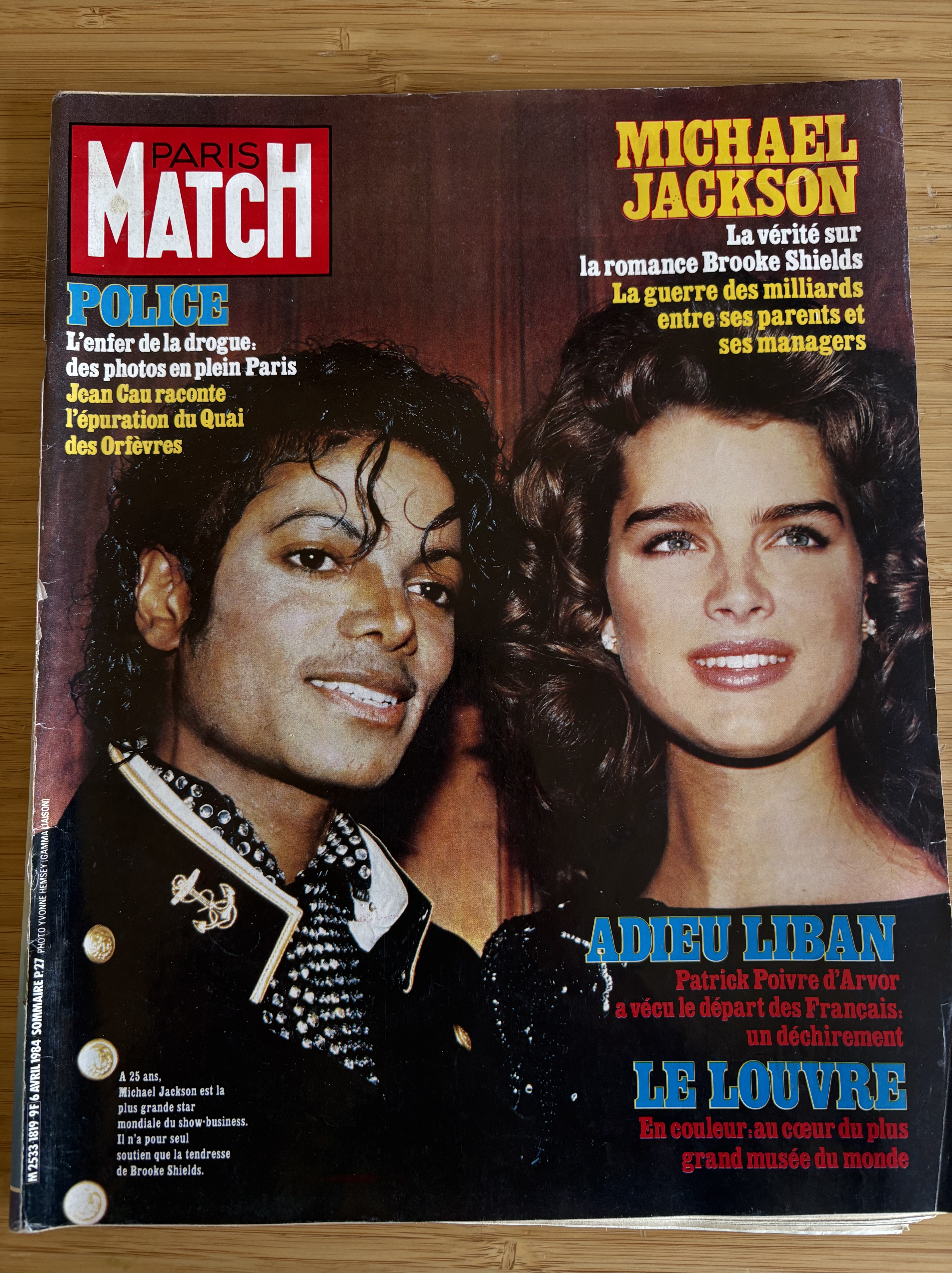
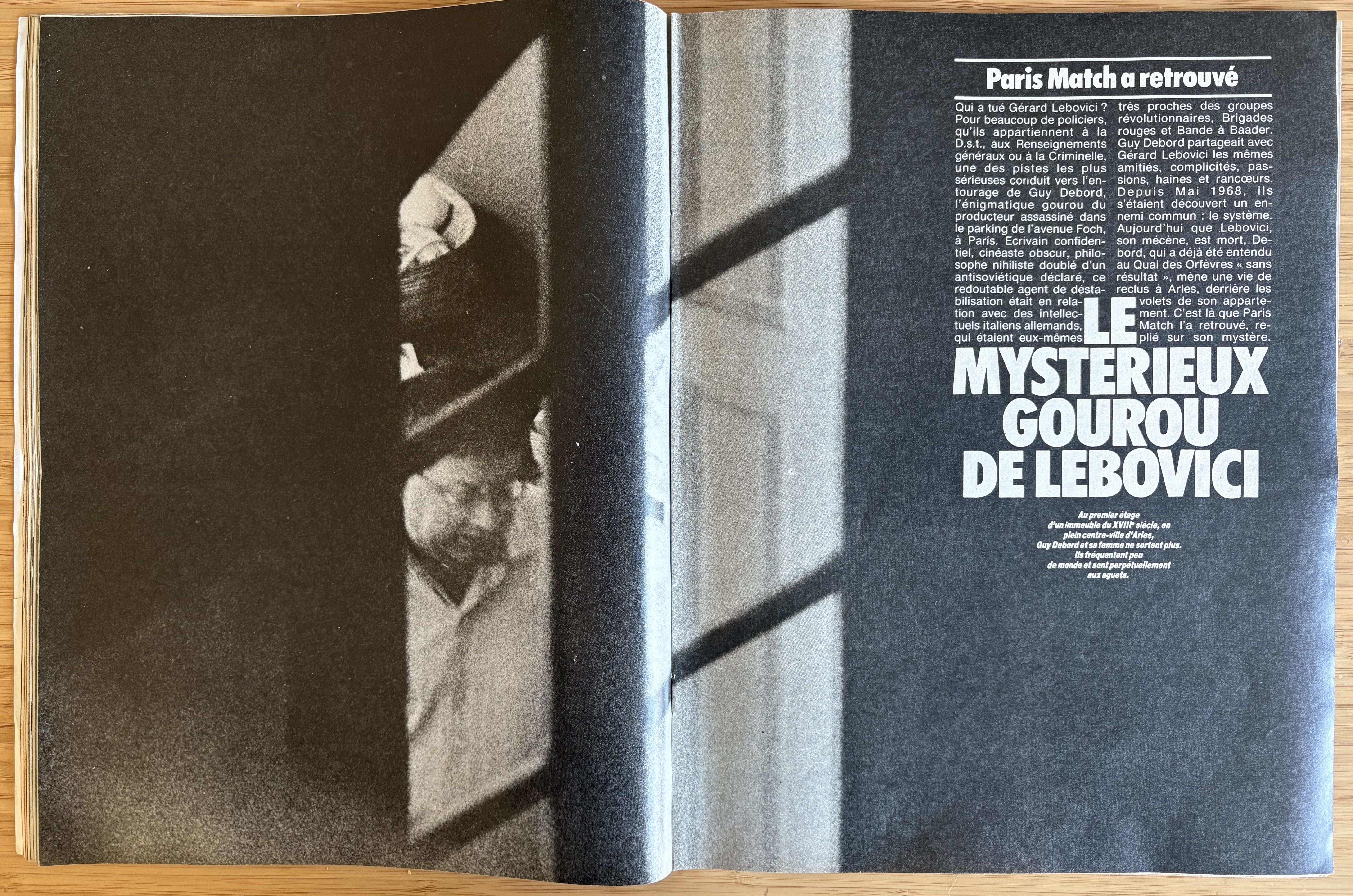
[DEBORD, Guy]. “Paris Match a retrouvé le mysterieux gourou de Lebovici”in Paris-Match 1819, 6 April 1984 (pp. 60-61). Paris, 1984.
Grainy, evidently clandestine photograph of Guy Debord, captioned as having caught the “mysterious guru of Lebovici” at his shuttered first-floor apartment in Arles. Gérard Lebovici had been murdered in the Avenue Foch car park on 5 March 1984, and months of press surveillance followed at Debord’s door — journalists and photographers staking out the square by the town hall, hoping for a glimpse through the shutters. Published a year later, Considerations on the assassination of Gerard Lebovici constitutes Debord’s response to wild rumors and slander from the press, who had insinuated his involvement in the murder without any evidence. It reproduces Paris-Match’s text (p.94-95) – translation is mine: “: “The March 30th issue of Paris-Match presents my blurry, distant photo as follows: ‘Who killed Gérard Lebovici? For many police officers—whether from the DST, the Renseignements Généraux, or the Homicide Division—one of the most serious leads points to the inner circle of Guy Debord, the enigmatic guru of the producer murdered in a parking garage on Avenue Foch in Paris. An obscure writer and filmmaker, a nihilistic philosopher and avowed anti-Soviet, this formidable agent of destabilization maintained ties with Italian and German intellectuals who were themselves closely linked to revolutionary groups like the Red Brigades and the Baader-Meinhof Gang. Now that Lebovici—his patron—is dead, Debord, who has already been questioned at police headquarters “to no avail,” lives as a recluse in Arles, behind the shutters of his apartment. That is where Paris-Match found him, withdrawn into his own mystery. On the first floor of an 18th-century building in the heart of Arles, Guy Debord and his wife no longer go out. They see few people and remain constantly on their guard.'” (p. 61). Debord would ask his lawyer, Thierry Levy, to sue Paris Match and a few other newspapers for libel (see Correspondance Vol.6, pp.259-261)
Photographie de mauvaise qualite, manifestement prise à la dérobée, de Guy Debord ; la légende indique qu’elle a surpris le « mystérieux gourou de Lebovici » à la fenêtre aux volets clos de son appartement du premier étage, à Arles. Gérard Lebovici avait été assassiné dans le parking de l’avenue Foch le 5 mars 1984 ; s’ensuivirent des mois de surveillance médiatique devant le domicile de Debord, journalistes et photographes guettant depuis la place de la mairie, dans l’espoir d’apercevoir quelqu’un au travers des volets. Publié un an plus tard, Considérations sur l’assassinat de Gérard Lebovici constitue la réponse de Debord aux rumeurs folles et aux calomnies de la presse, qui avait insinué son implication dans le meurtre sans la moindre preuve. L’ouvrage reproduit intégralement le texte de Paris-Match (p. 94-95) “Paris-Match du 30 mars présente ainsi ma vague photo lointaine : «Qui a tué Gérard Lebovici ? Pour beaucoup de policiers, qu’ils appartiennent à la D.S.T., aux Renseignements généraux ou à la Criminelle, une des pistes les plus sérieuses conduit vers l’entourage de Guy Debord, l’énigmatique gourou du producteur assassiné dans le parking de l’avenue Foch, à Paris. Écrivain confidentiel, cinéaste obscur, philosophe nihiliste doublé d’un antisoviétique déclaré, ce redoutable agent de déstabilisation était en relation avec des intellectuels italiens, allemands, qui étaient eux-mêmes très proches des groupes révolutionnaires, Brigades rouges et Bande à Baader. […] Aujourd’hui que Lebovici, son mécène, est mort, Debord, qui a déjà été entendu au Quai des Orfèvres “sans résultat”, mène une vie de reclus à Arles, derrière les volets de son appartement. C’est là que Paris-Match l’a retrouvé, replié sur son mystère. Au premier étage d’un immeuble du XVIIIe siècle, en plein centre-ville d’Arles, Guy Debord et sa femme ne sortent plus. Ils fréquentent peu de monde et sont perpétuellement aux aguets.» (p.61). Debord demanda à son avocat, Thierry Lévy, de poursuivre en justice Paris Match et quelques autres journaux pour diffamation (voir Correspondance vol. 6, p. 259-261).
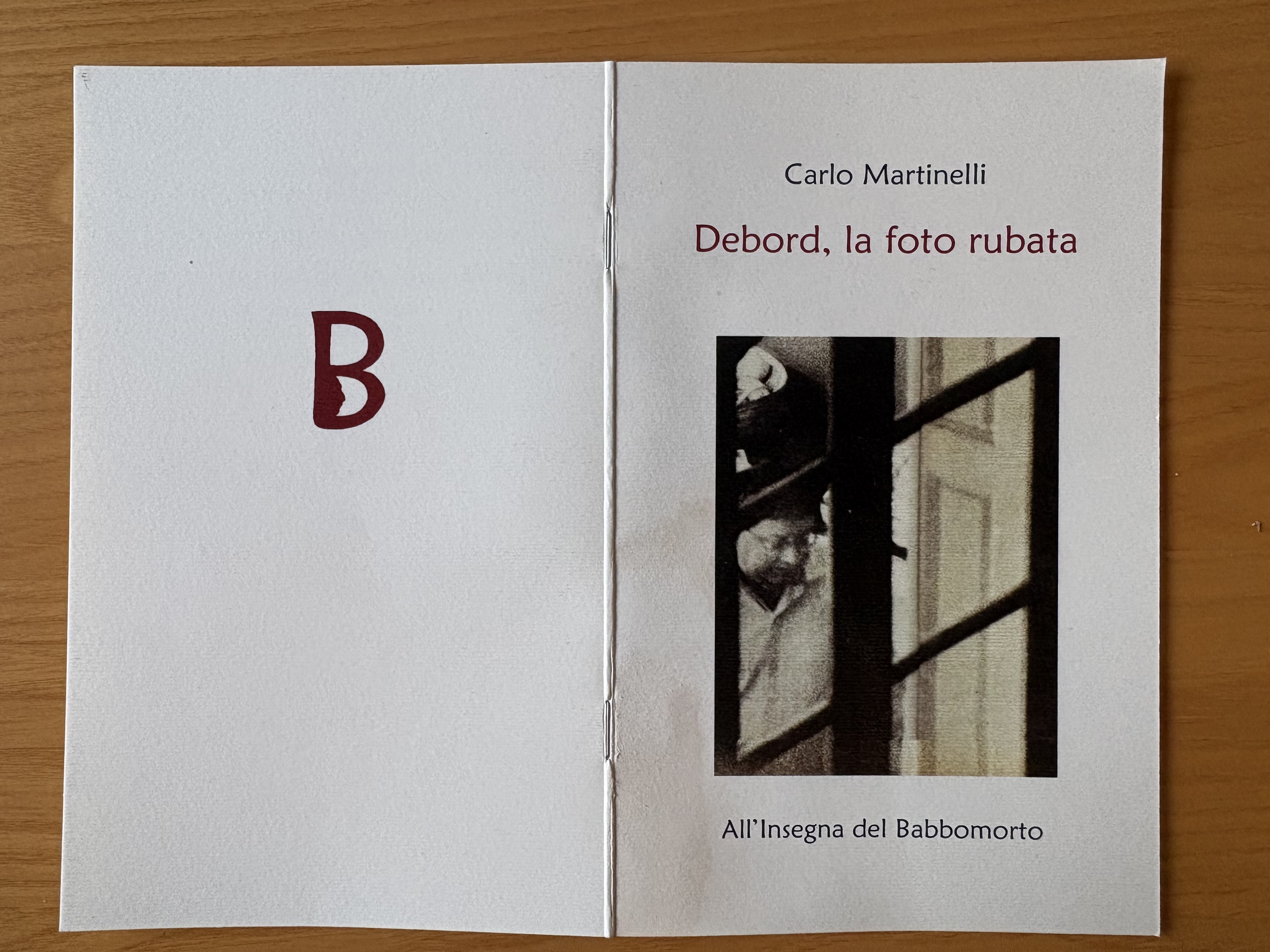
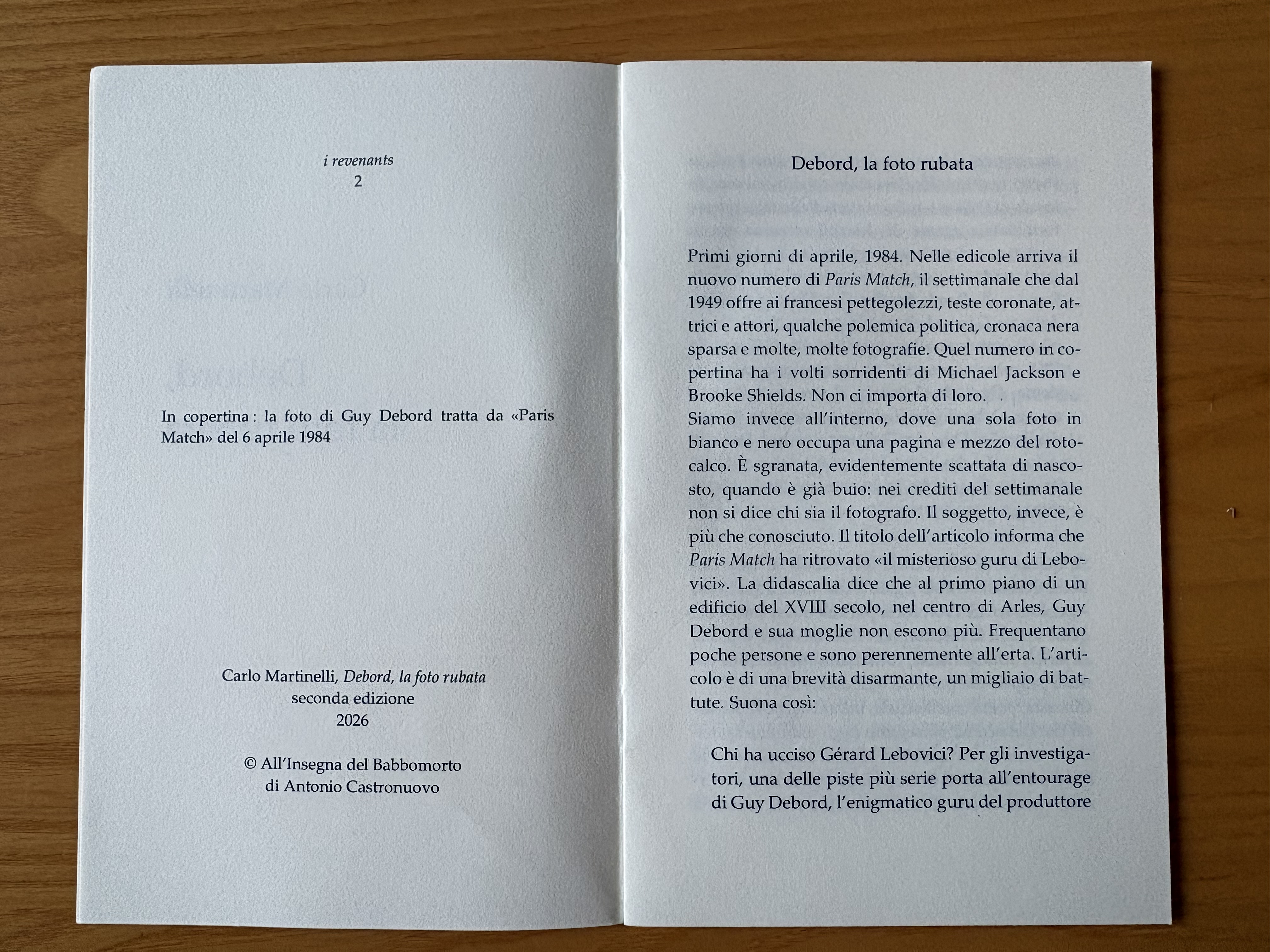
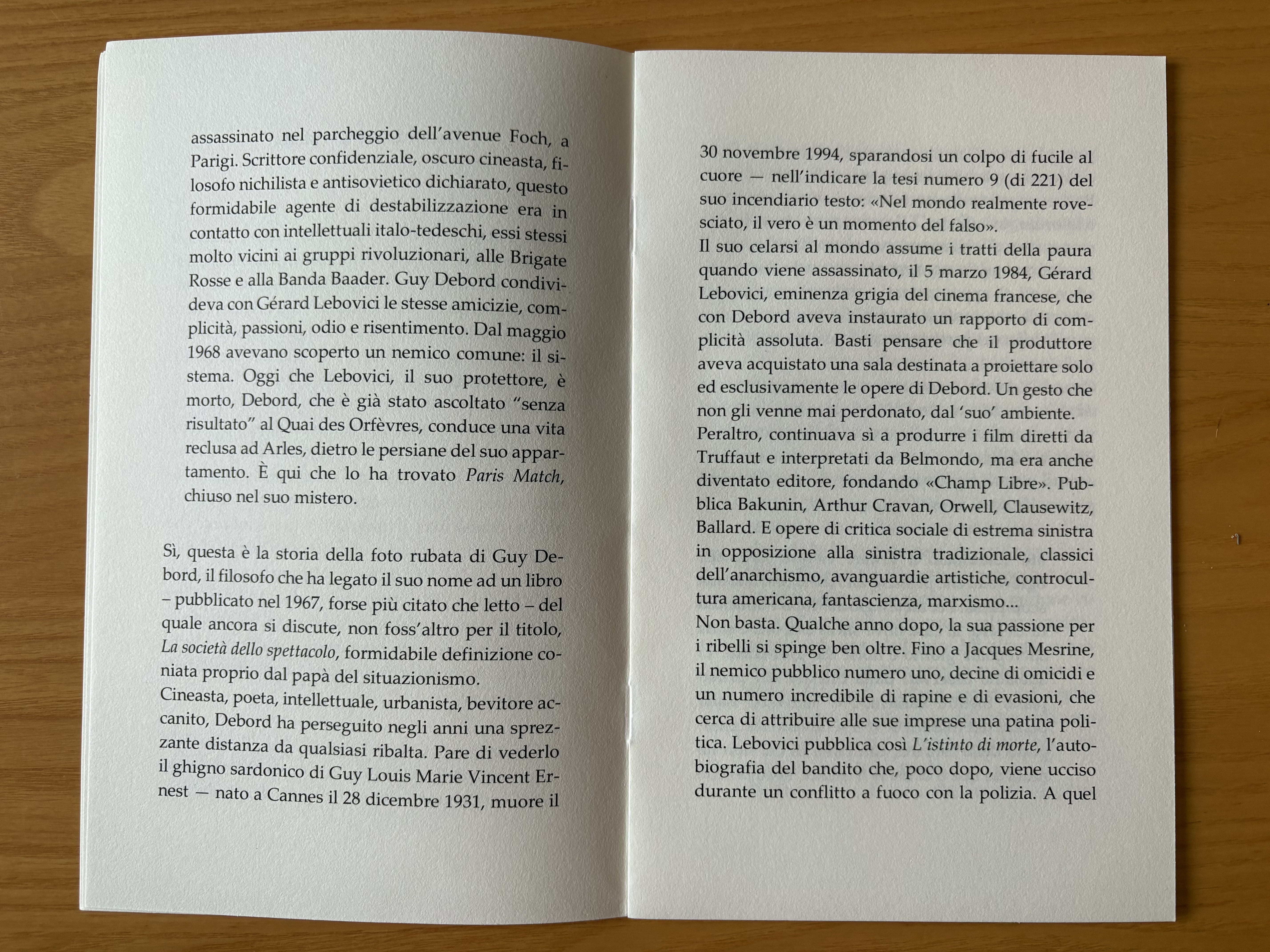
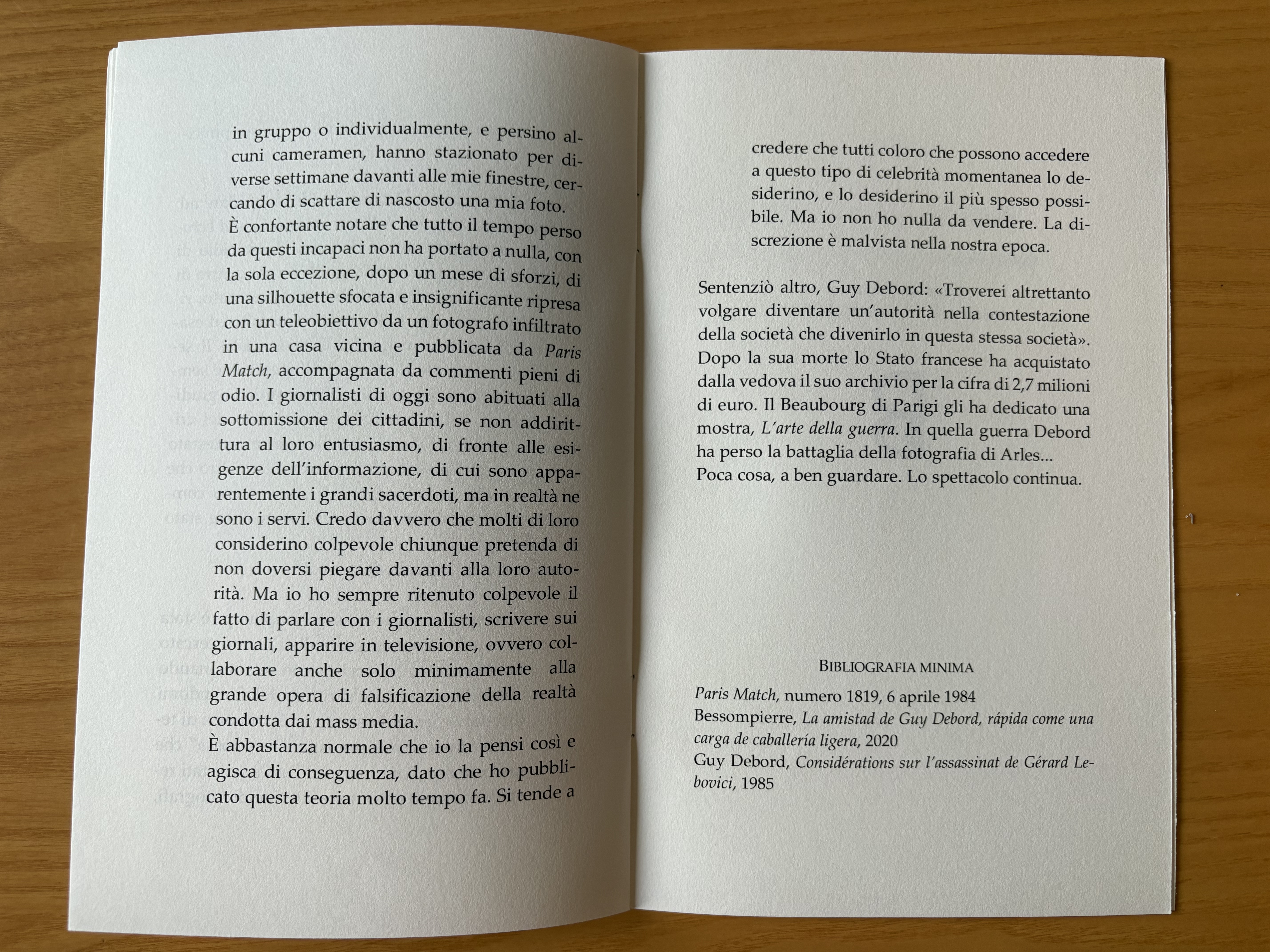
MARTINELLI, Carlo. Debord, la foto rubata. [Faenza]: All’Insegna del Babbomorto, February 2026. Second edition. 16 p.; 15 x 21 cm.; stapled wrappers, cream stock, title and monogram printed in dark red; cover illustration reproducing, in half-tone, the photograph of Guy Debord published in Paris Match of 6 April 1984.
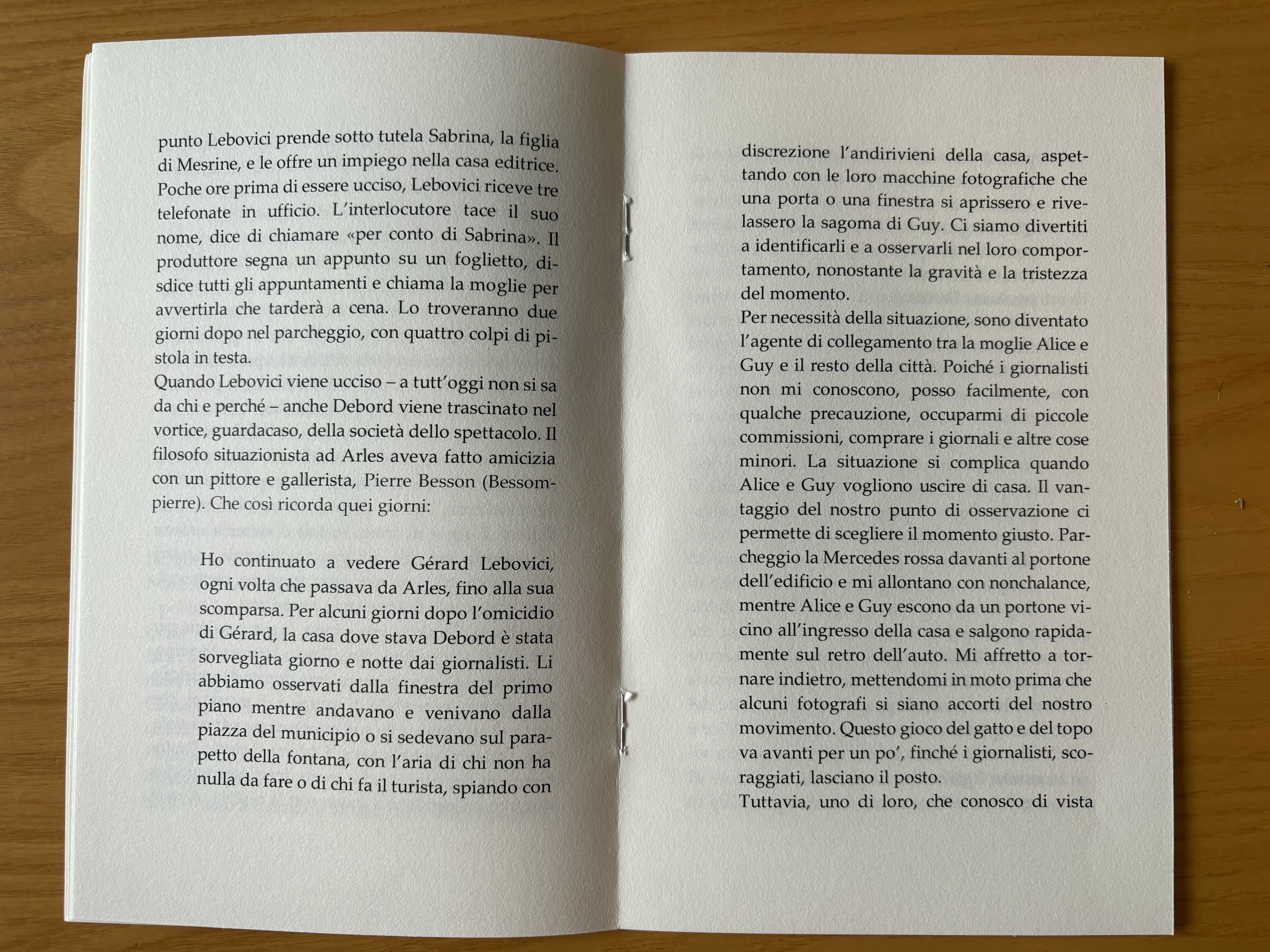
A short prose piece devoted to a single episode: the appearance, in the 6 April 1984 issue of Paris Match, of a grainy, evidently clandestine photograph of Guy Debord, captioned as having caught the “mysterious guru of Lebovici” at his shuttered first-floor apartment in Arles. Martinelli uses the photograph as a hinge to recount the aftermath of Gérard Lebovici’s murder in the Avenue Foch car park on 5 March 1984, and the months of press surveillance that followed at Debord’s door — journalists and photographers staking out the square by the town hall, hoping for a glimpse through the shutters.
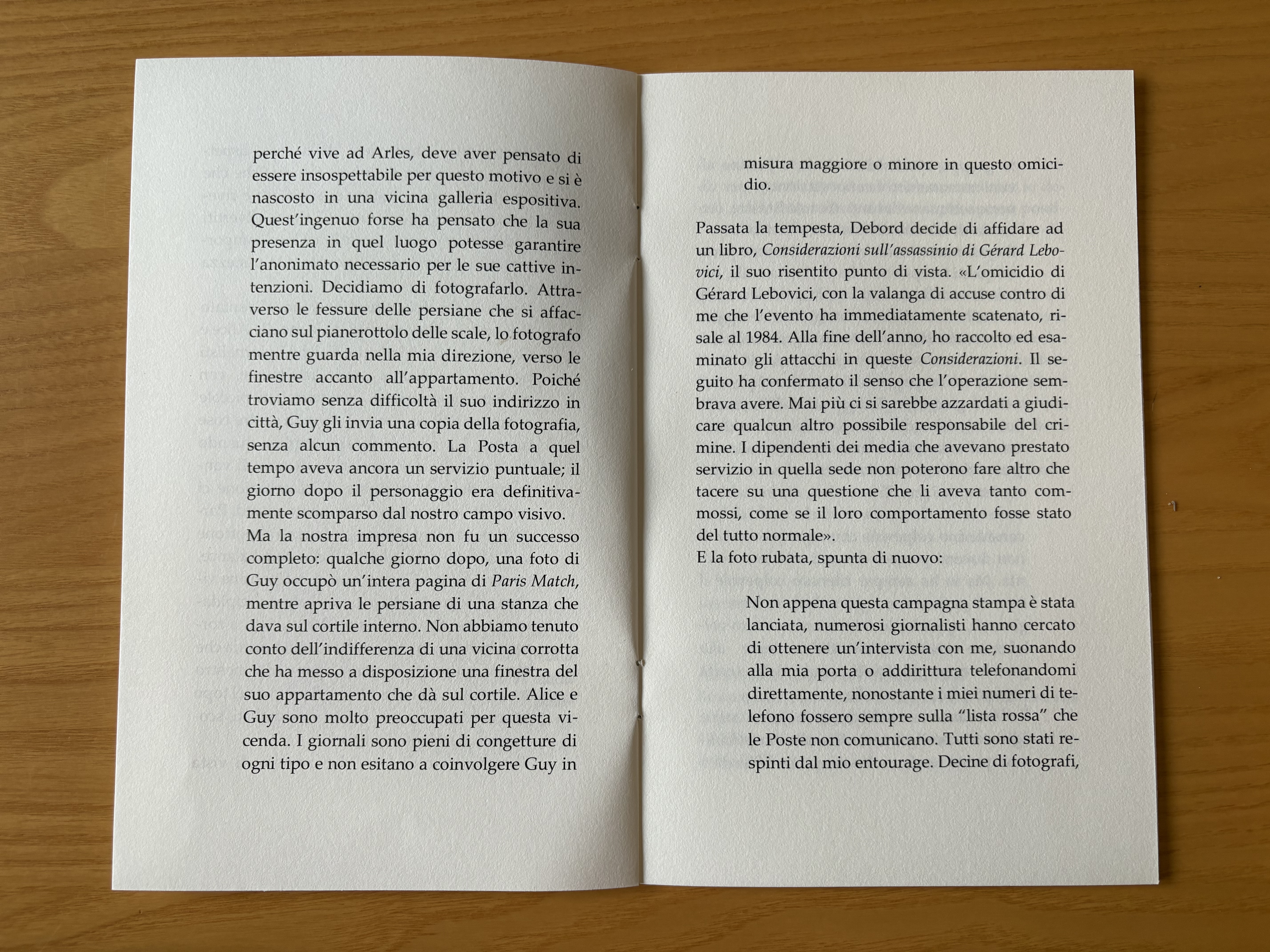
The most substantial portion of the text is a first-hand account supplied by Pierre Besson (“Bessompierre”), who describes acting as go-between for Debord and his wife Alice during this period — arranging their comings and goings to avoid the waiting photographers, and eventually helping identify and photograph in turn one journalist who had staked out a neighboring gallery. A second attempt by Paris Match nonetheless succeeded, via a complicit neighbor’s window overlooking the courtyard, in producing the blurred telephoto image that ran as a full page.
Martinelli closes with Debord’s own retrospective account, drawn from Considérations sur l’assassinat de Gérard Lebovici (1985), and two of his sharper lines on the episode — on the undesirability of becoming, in fighting the spectacle, a further object of it, and on discretion as something out of fashion in the period. A closing note records the 2,7 million euro purchase of Debord’s archive by the French state after his death, and the Beaubourg’s exhibition Guy Debord, un art de la guerre.
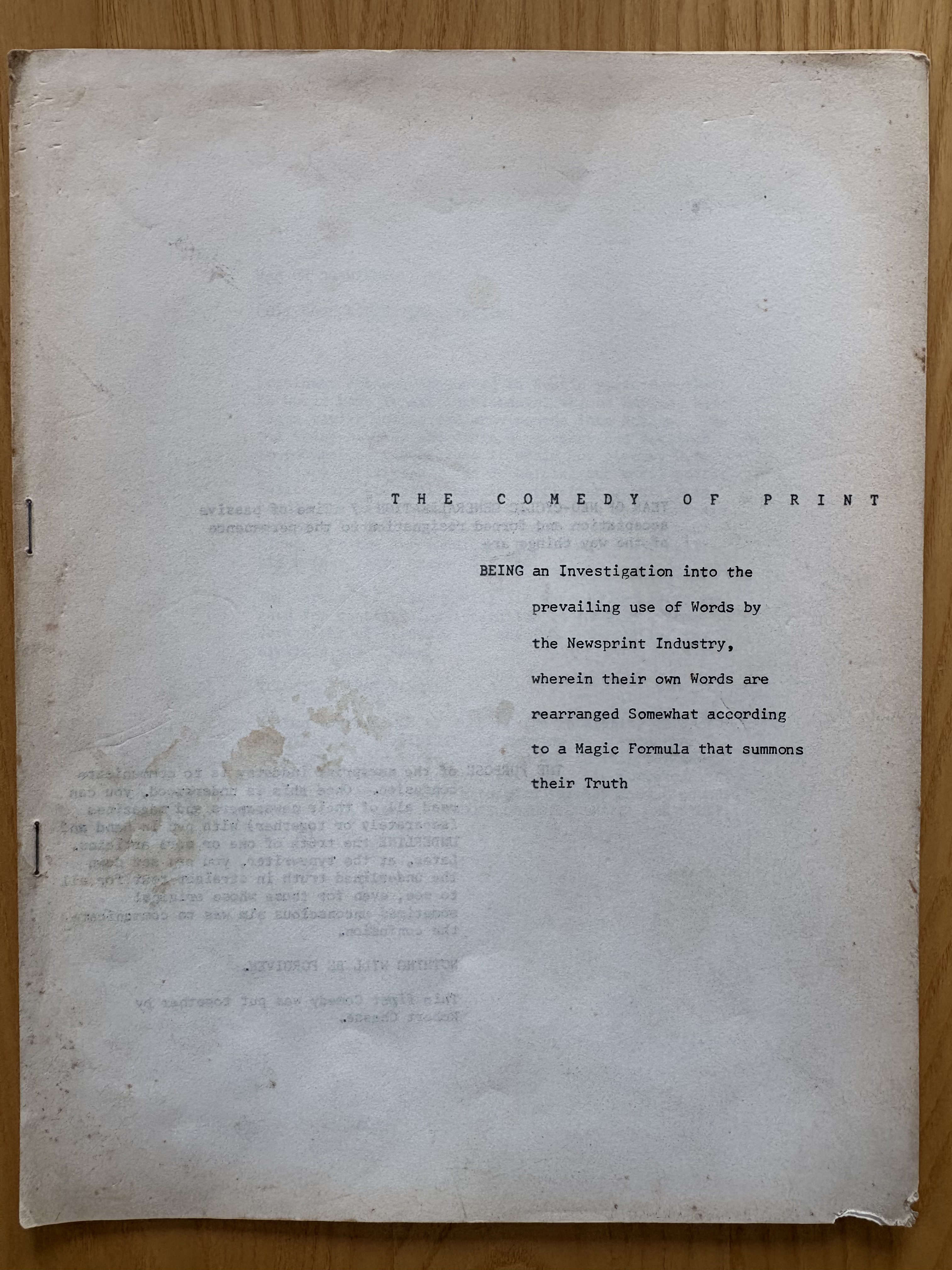
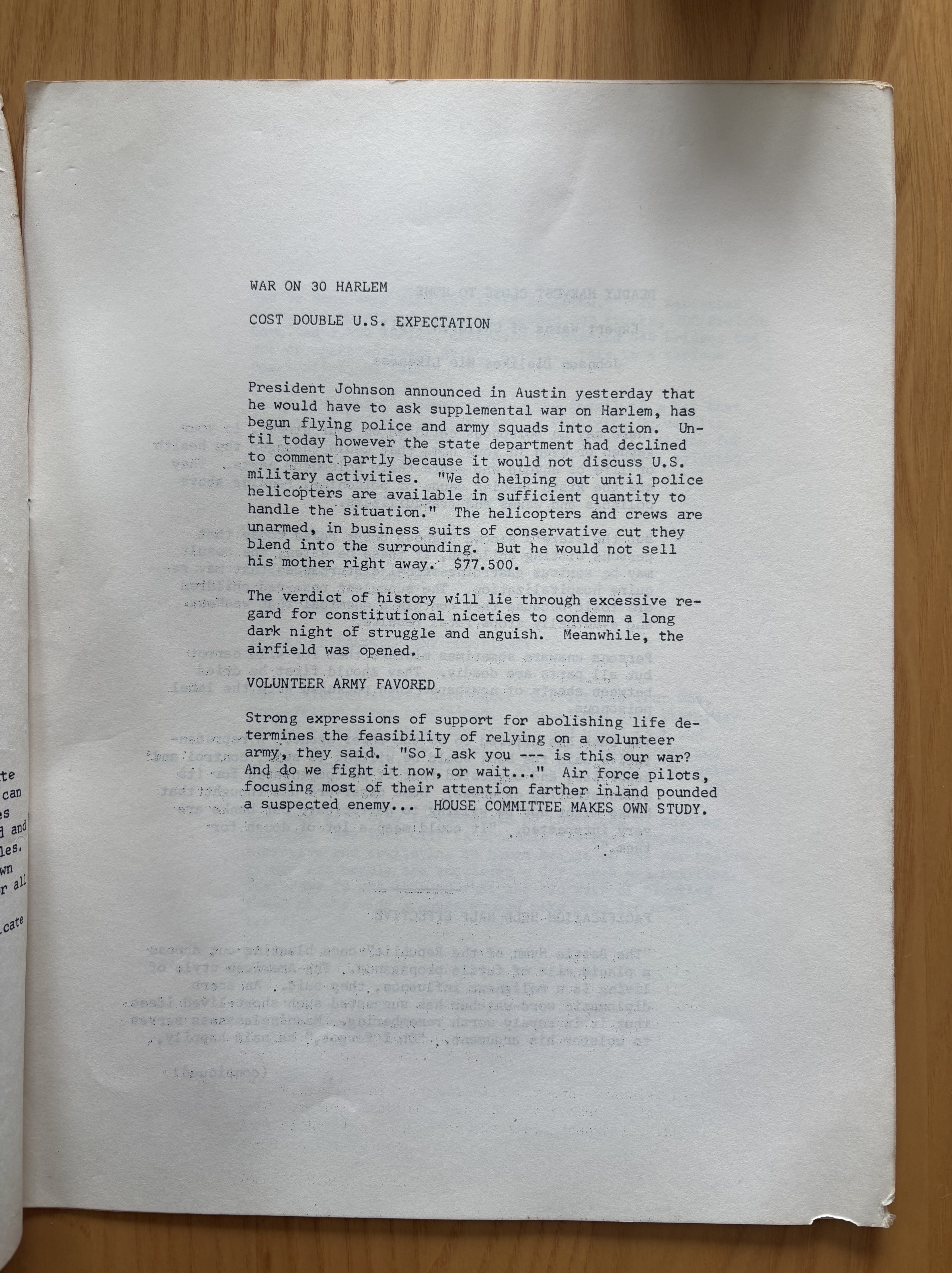
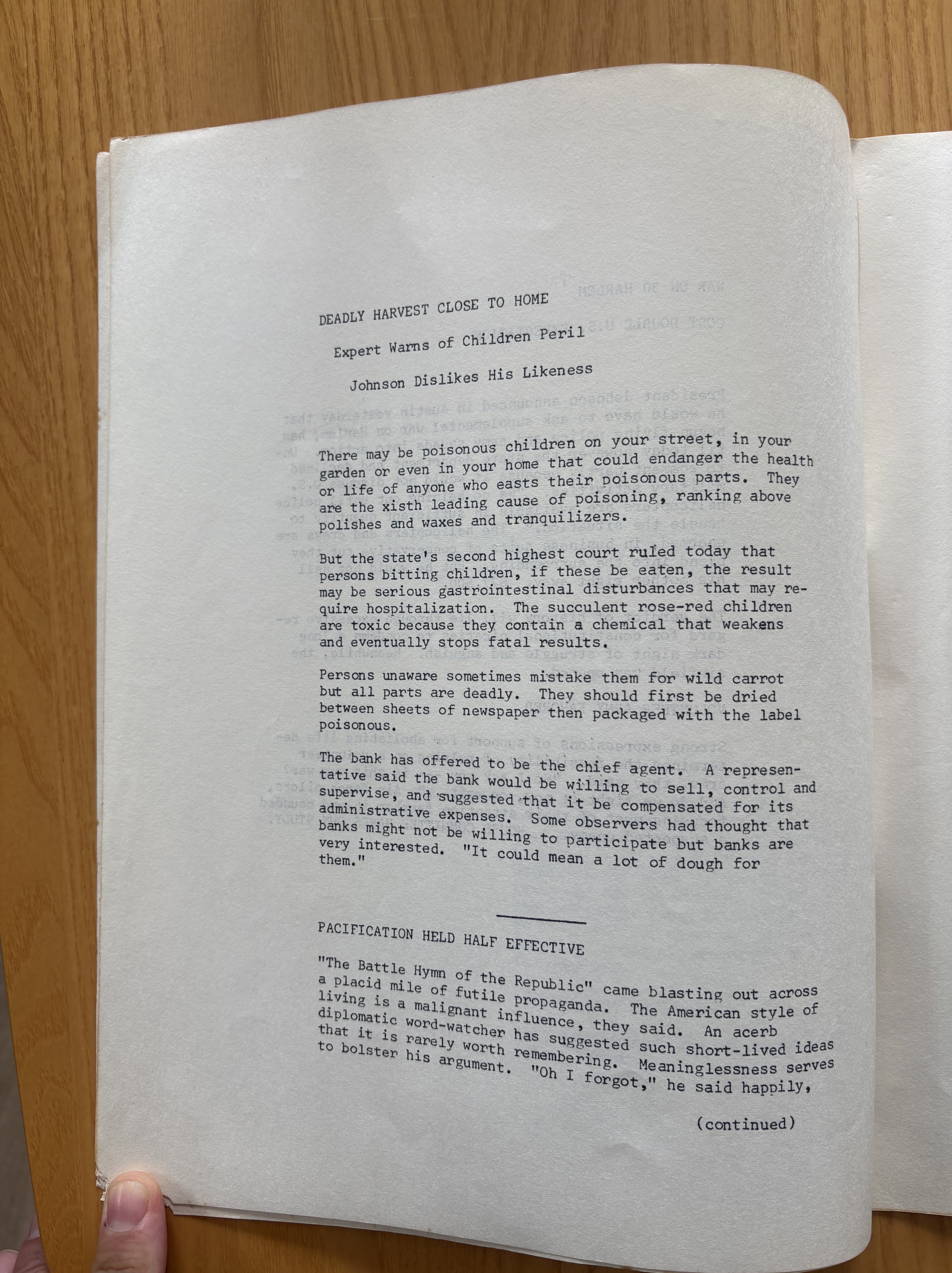
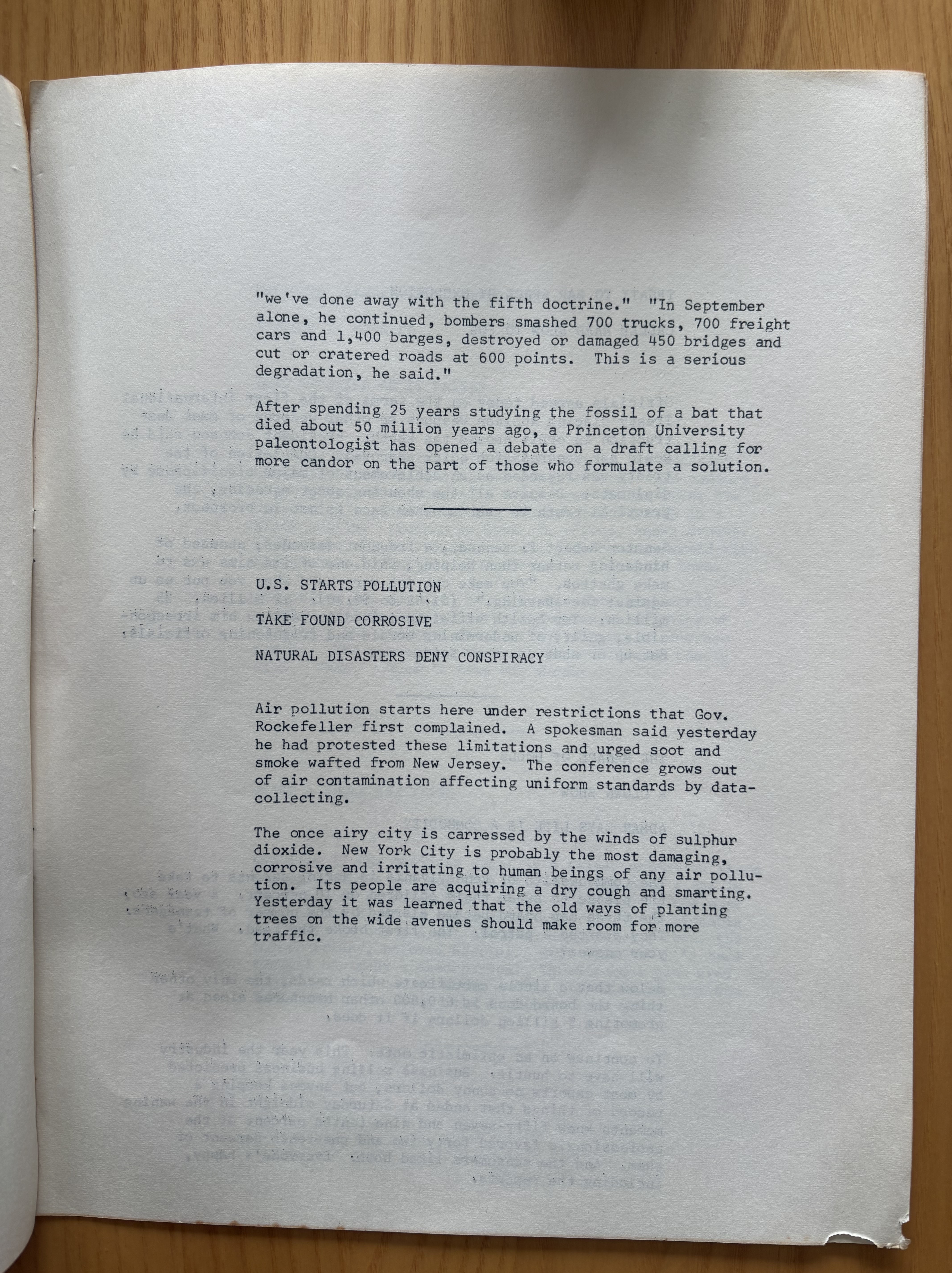
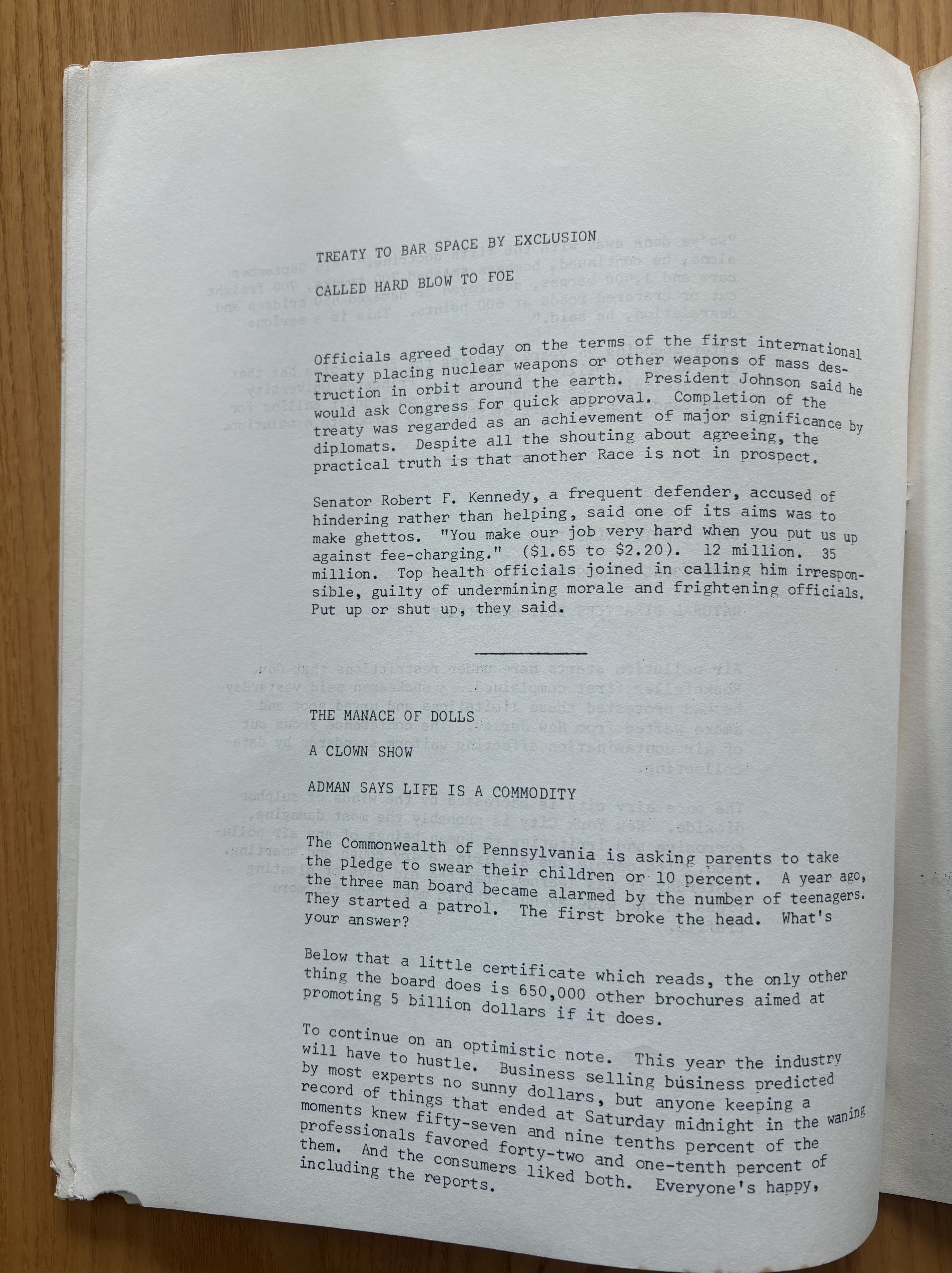
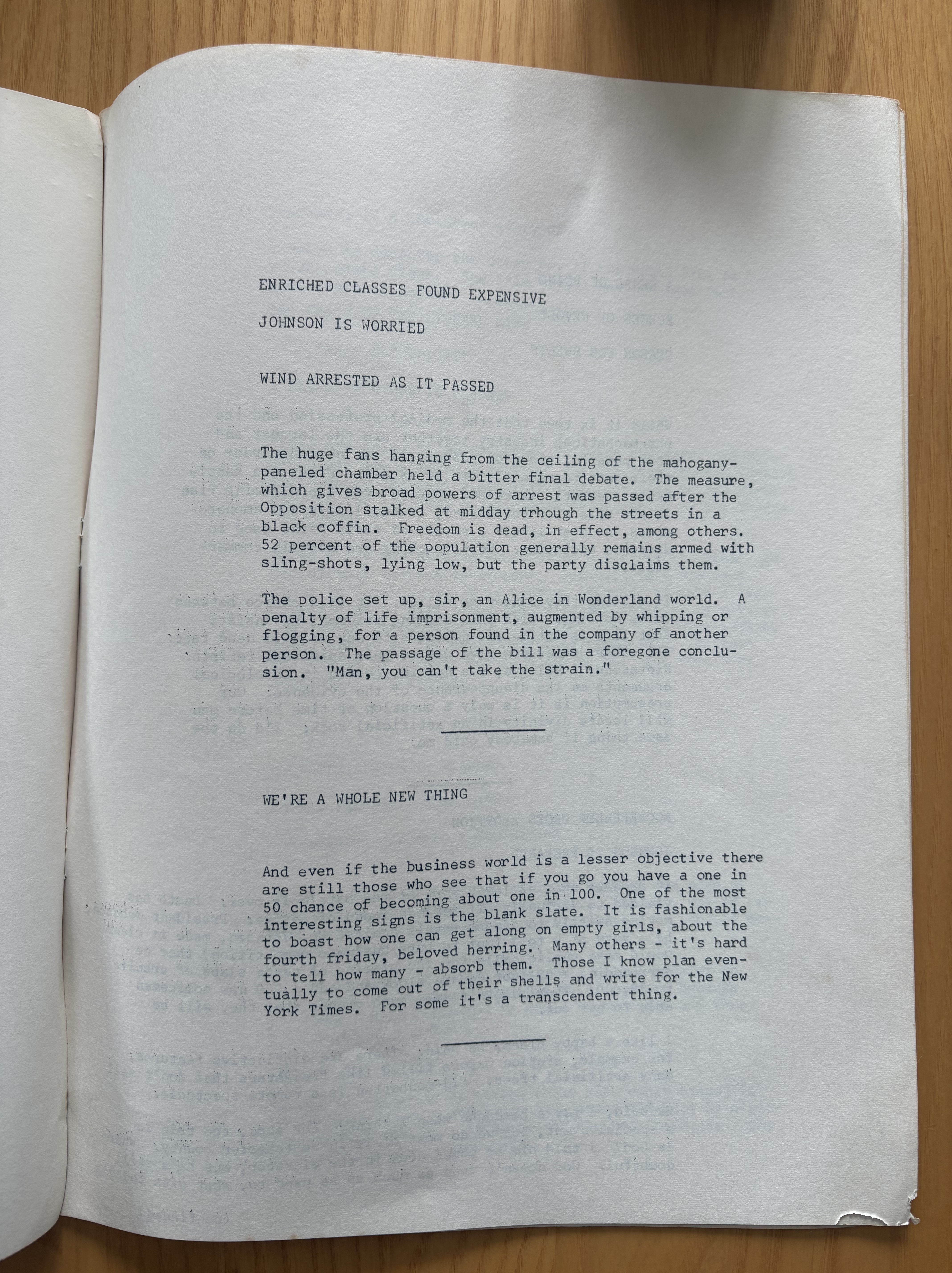
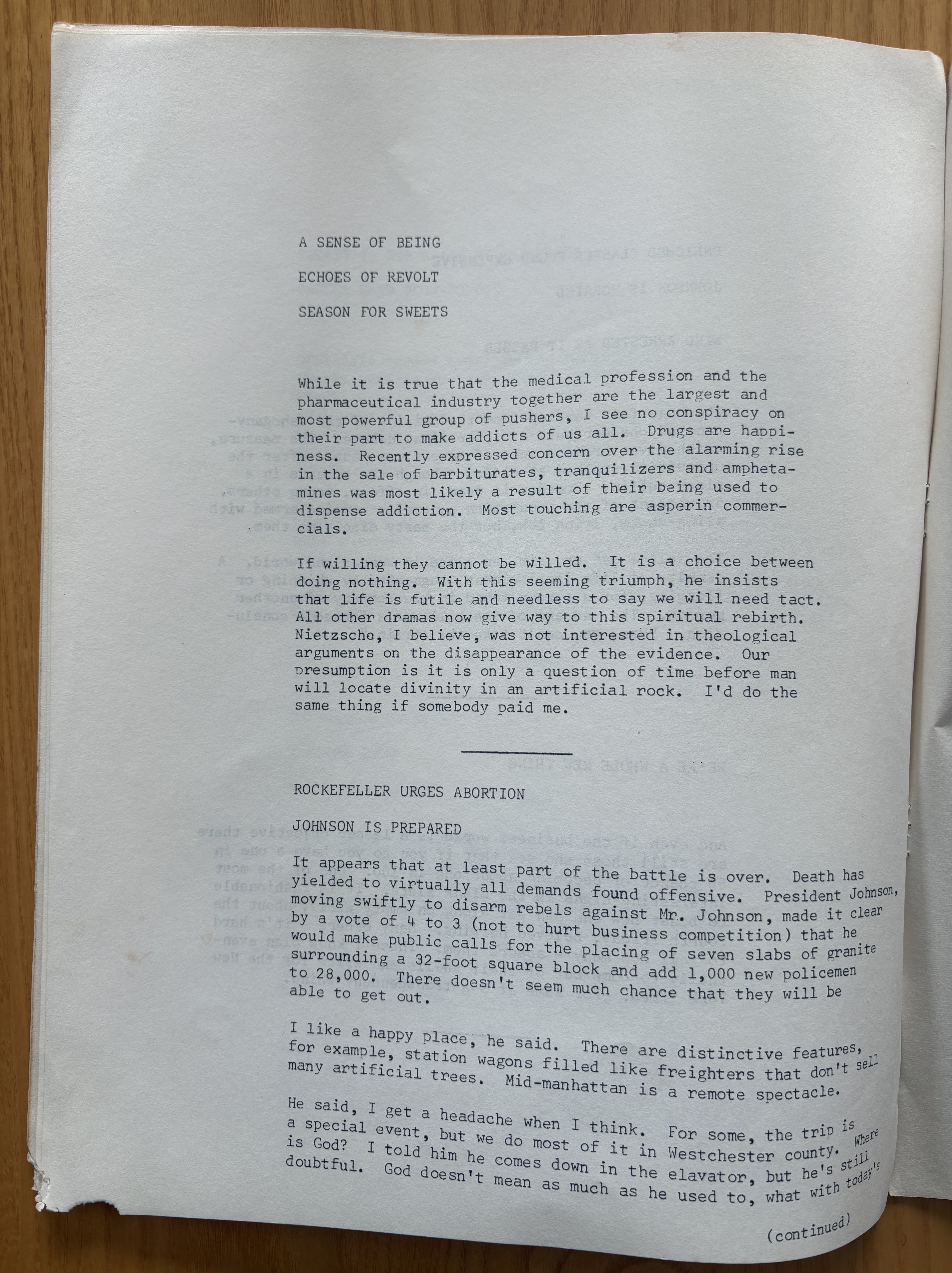
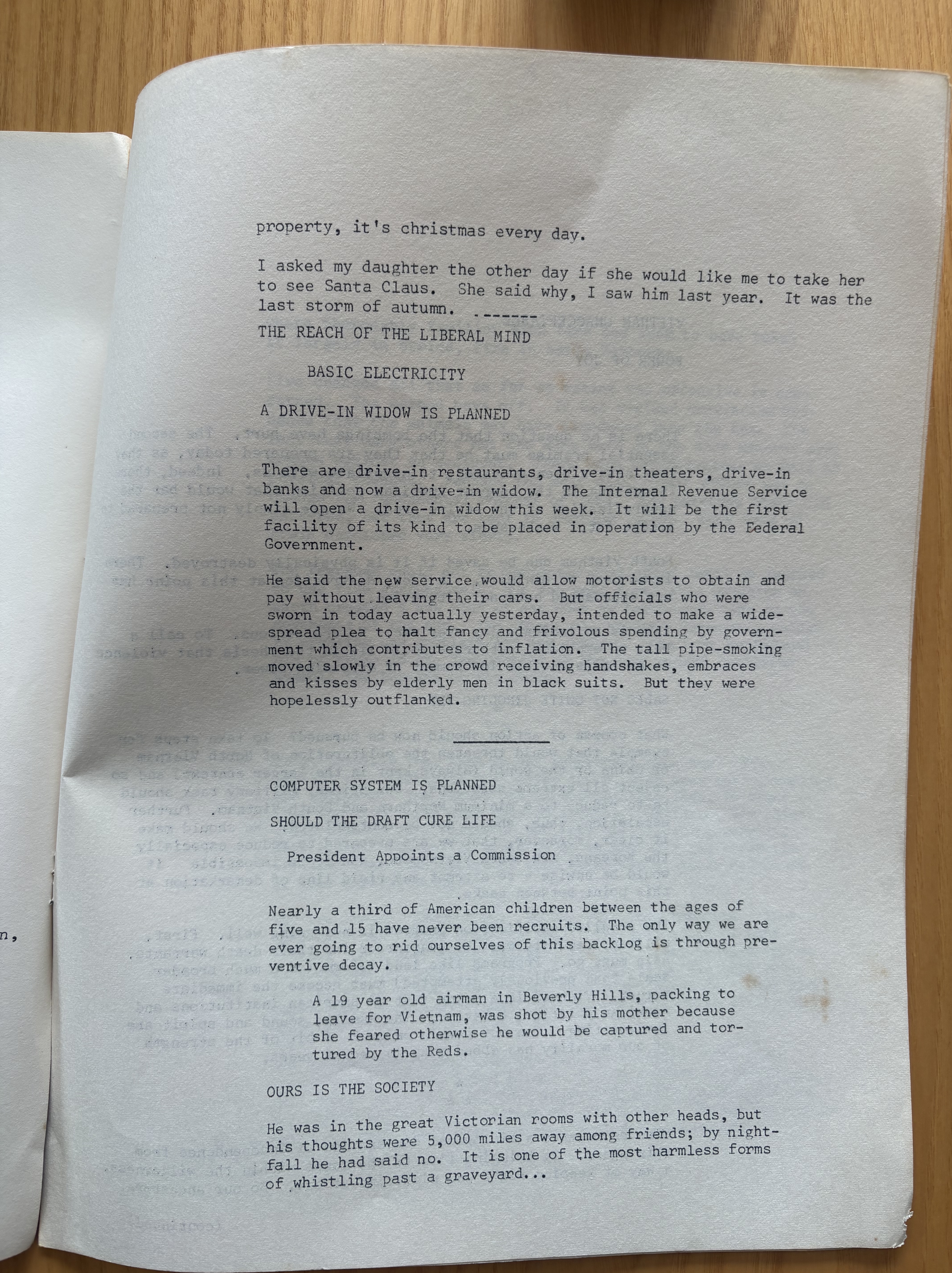
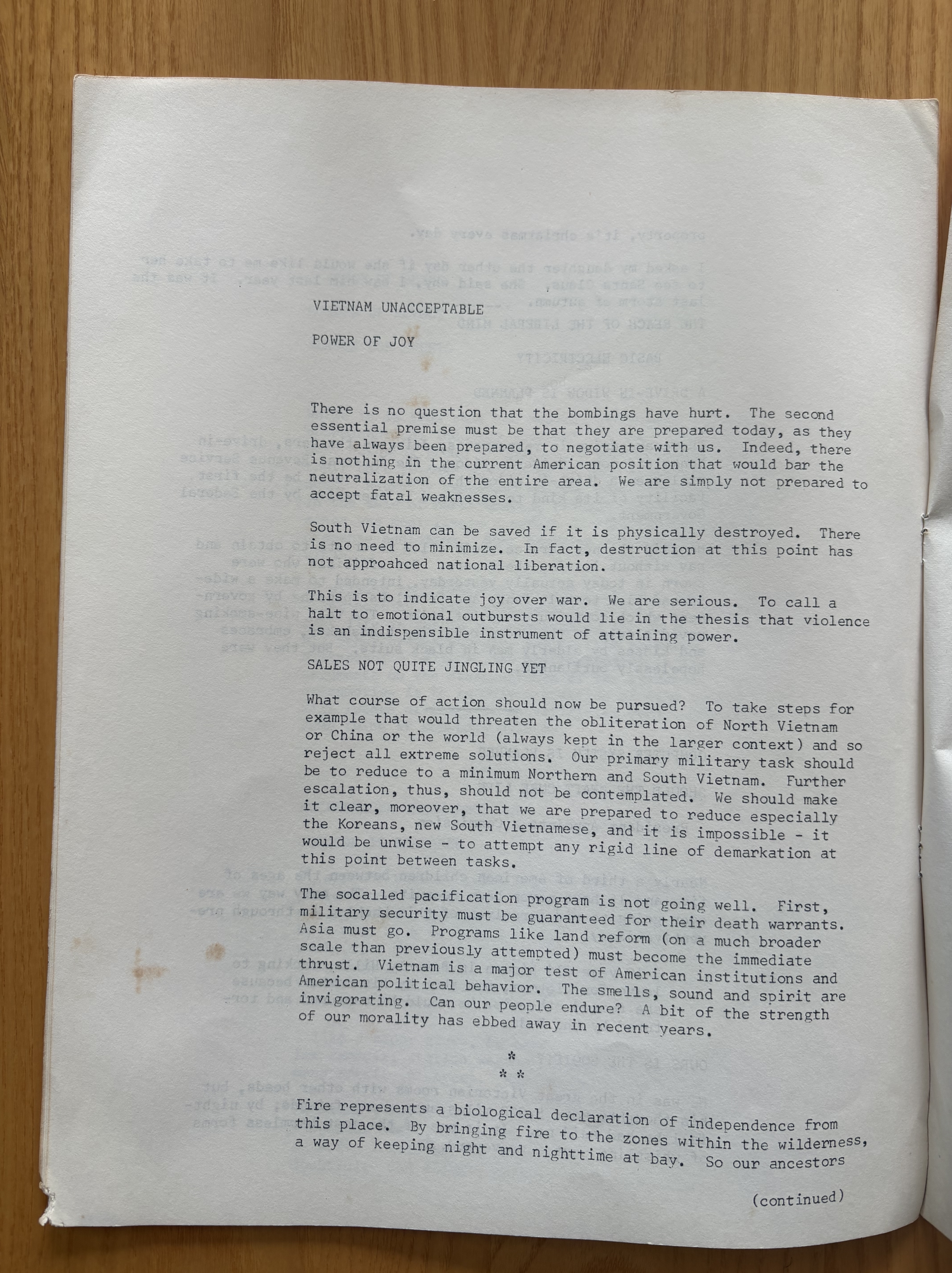
Chasse, Robert. The Comedy of Print: Being an Investigation into the prevailing use of Words by the Newsprint Industry, wherein their own Words are rearranged Somewhat according to a Magic Formula that summons their Truth. n.p. [New York, NY]: n.p., n.d. [c. 1968–1970]. Mimeographed, stapled wrappers.
This first Comedy was, per its title page, “put together by Robert Chasse” — the same Robert Chasse who, with Bruce Elwell and Tony Verlaan, founded the New York-based Council for the Liberation of Daily Life in 1967, and who went on to become a member of the American section of the Situationist International until December 1969. No copy of this piece appears to be recorded anywhere online; the present example may be unique, or at least unlocated in institutional holdings (including Yale and the BNF)
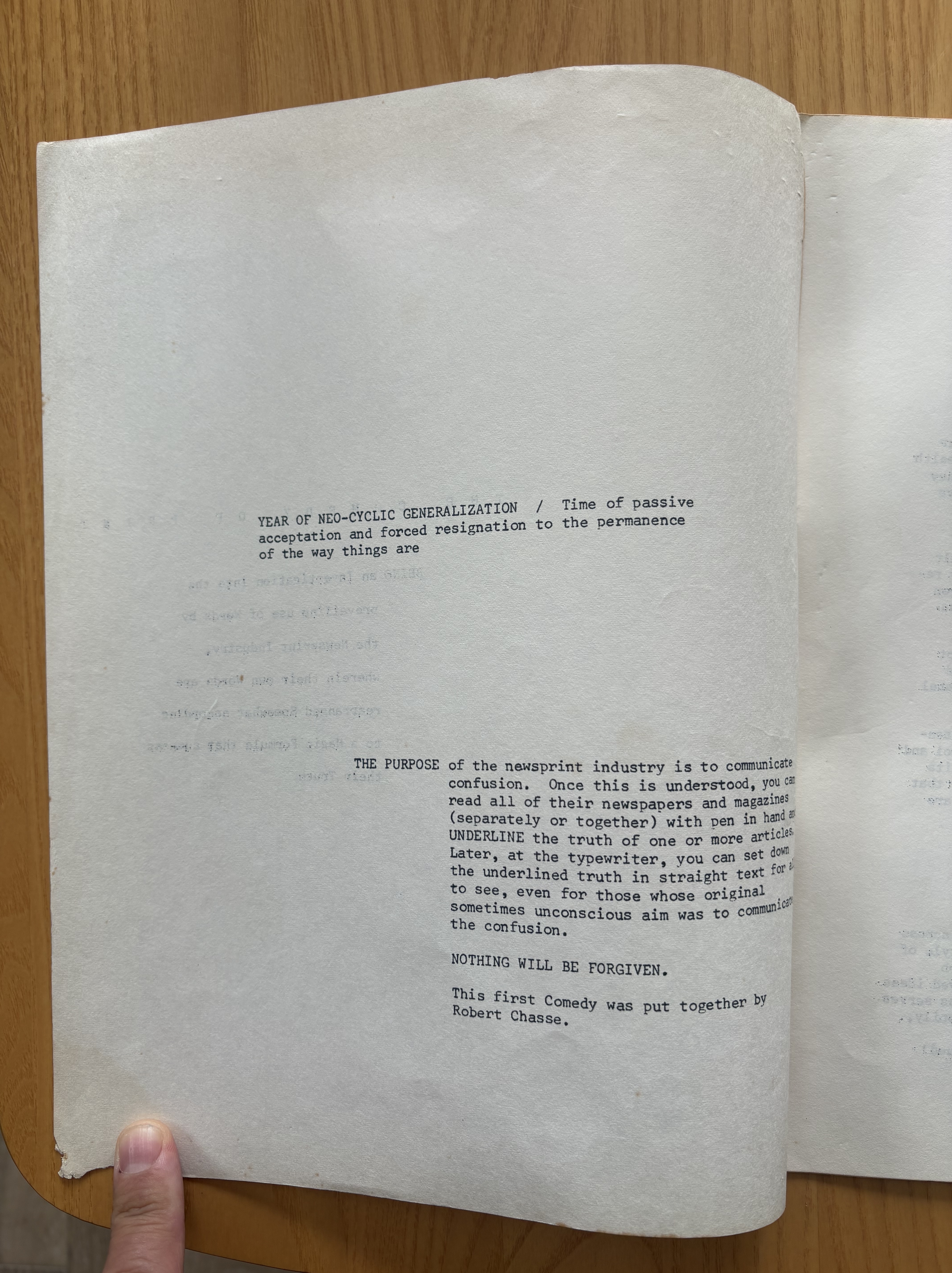
The premise is announced on the second page, under the header “YEAR OF NEO-CYCLIC GENERALIZATION / Time of passive acceptation and forced resignation to the permanence of the way things are”: the newsprint industry’s purpose is to communicate confusion, and once that is understood, the reader is instructed to go through newspapers and magazines with pen in hand and underline the truth of the articles — a truth the papers themselves are unconsciously transmitting even as they labor to obscure it. At the typewriter, the underlined fragments are then reassembled into continuous text. The result is détournement performed directly on the raw material of the American press circa the Vietnam War: Chasse cuts up wire-service prose about Johnson, Harlem, napalm, air pollution, the draft, and consumer culture, and splices the fragments so that the language of official propaganda testifies against itself. “NOTHING WILL BE FORGIVEN,” reads the epigraph.
The sections carry headlines that are themselves small comic-satiric objects — “War on 30 Harlem,” “Deadly Harvest Close to Home,” “The Manace of Dolls,” “We’re a Whole New Thing” — under which ordinary newspaper syntax is made to produce sentences like “the airfield was opened” as the punchline to a paragraph on urban war, or an item on children being poisoned by contact with each other that slides seamlessly into a bank’s press release. Named figures of the day — Johnson, Robert F. Kennedy, Rockefeller — are quoted saying things that could equally be read straight or as self-indictment, the ambiguity being exactly the method’s point: this is what these people’s language does anyway, if you only isolate and re-align it.
It’s hard not to read The Comedy of Print as a distant, homegrown American cousin — by way of the newsprint of a different war — to what Guy Debord would do systematically fifteen years later in Considérations sur l’assassinat de Gérard Lebovici (1985), where the press’s own words are turned back on themselves to expose the mechanics of manufactured falsehood. Chasse’s “Magic Formula” — underline, retype, let the confusion indict itself — anticipates in method, if not in polish, Debord’s later, more famously merciless dissection of journalistic bad faith. Where Debord would work with the precision of a lawyer building a case against named newspapers, Chasse works more like a poet-saboteur splicing wire copy into found Dada; but the operating assumption is identical: that the press, left to its own syntax, will eventually convict itself, if someone bothers to hold up a mirror to its sentences.
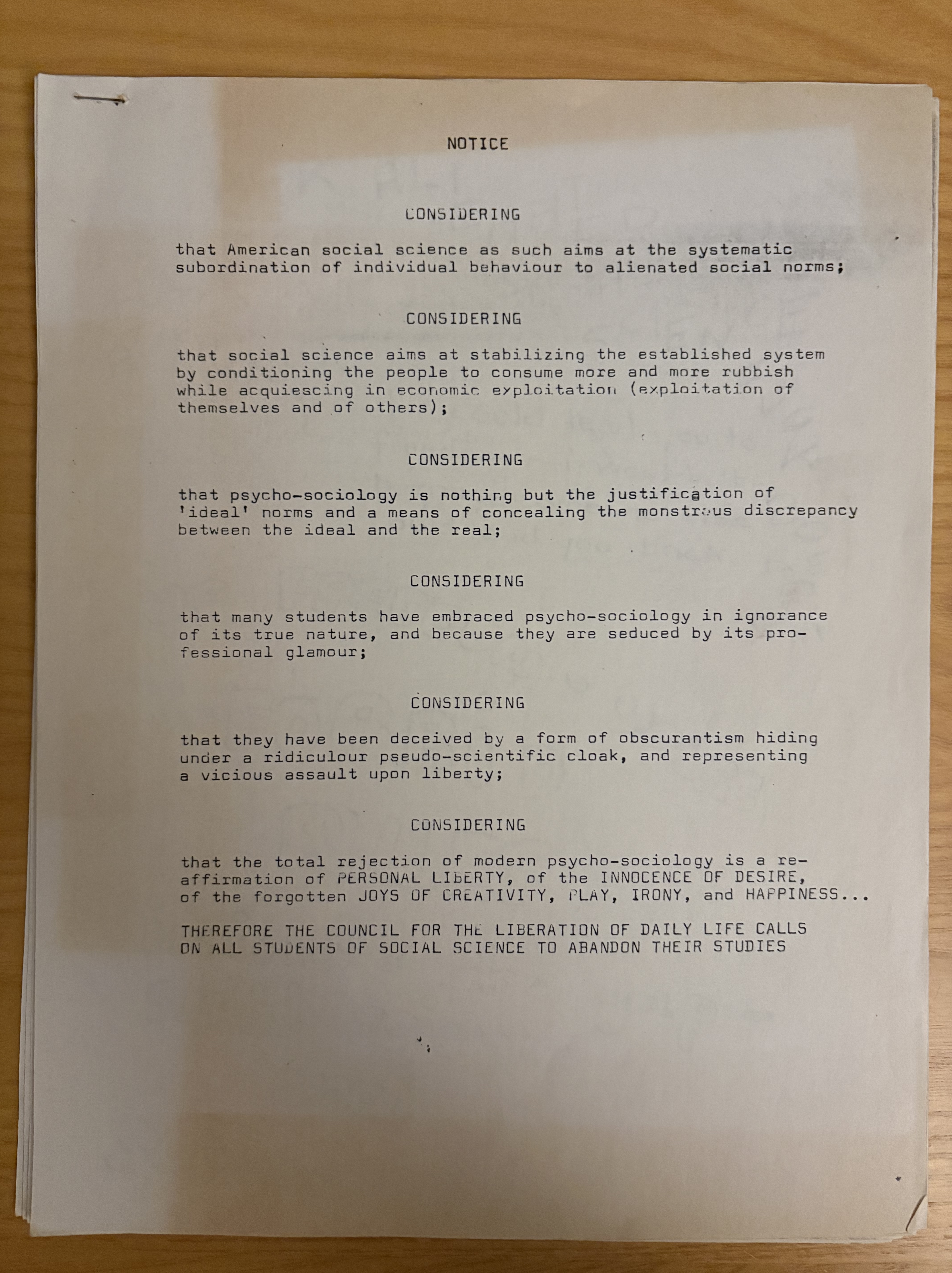
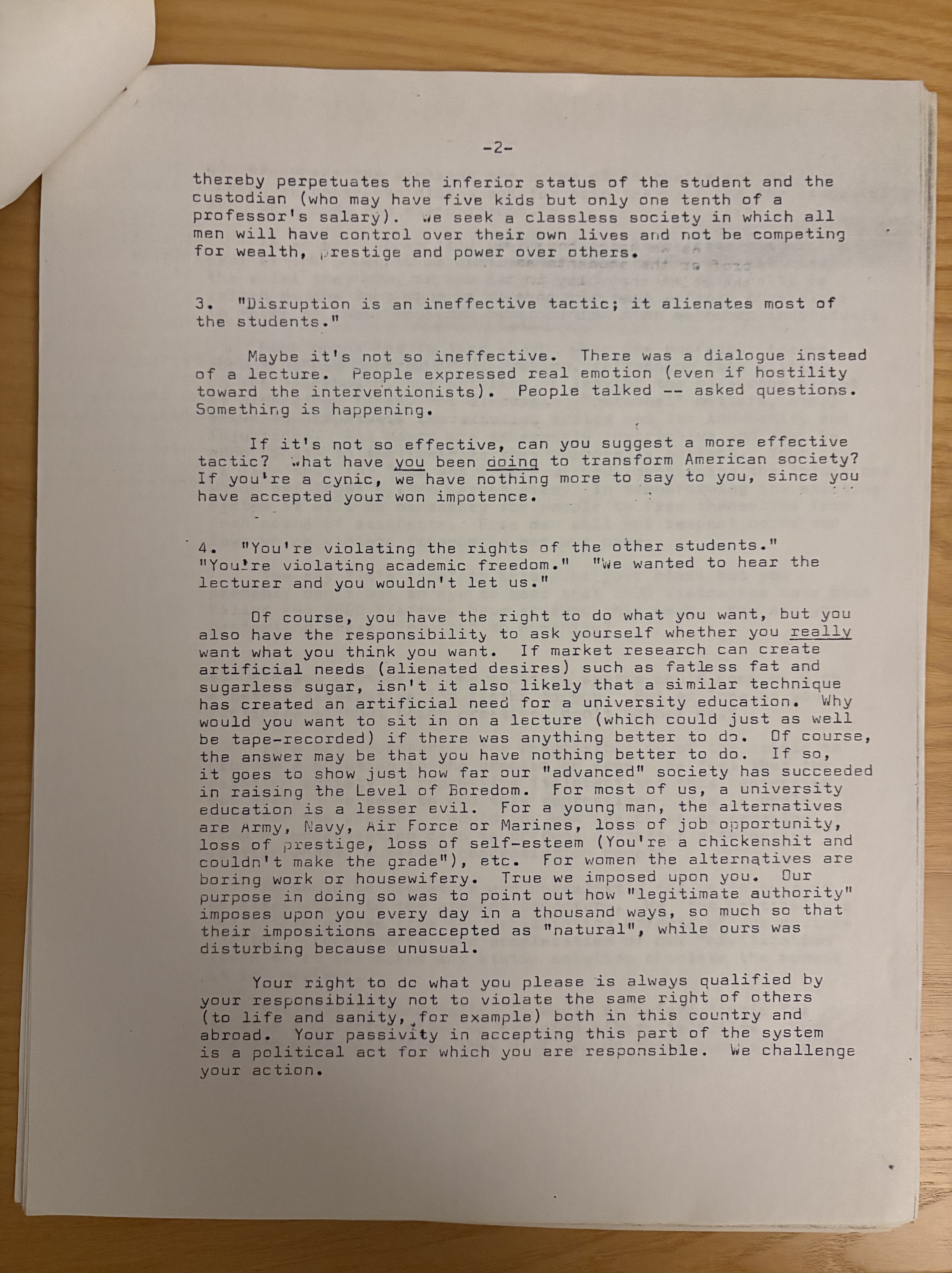
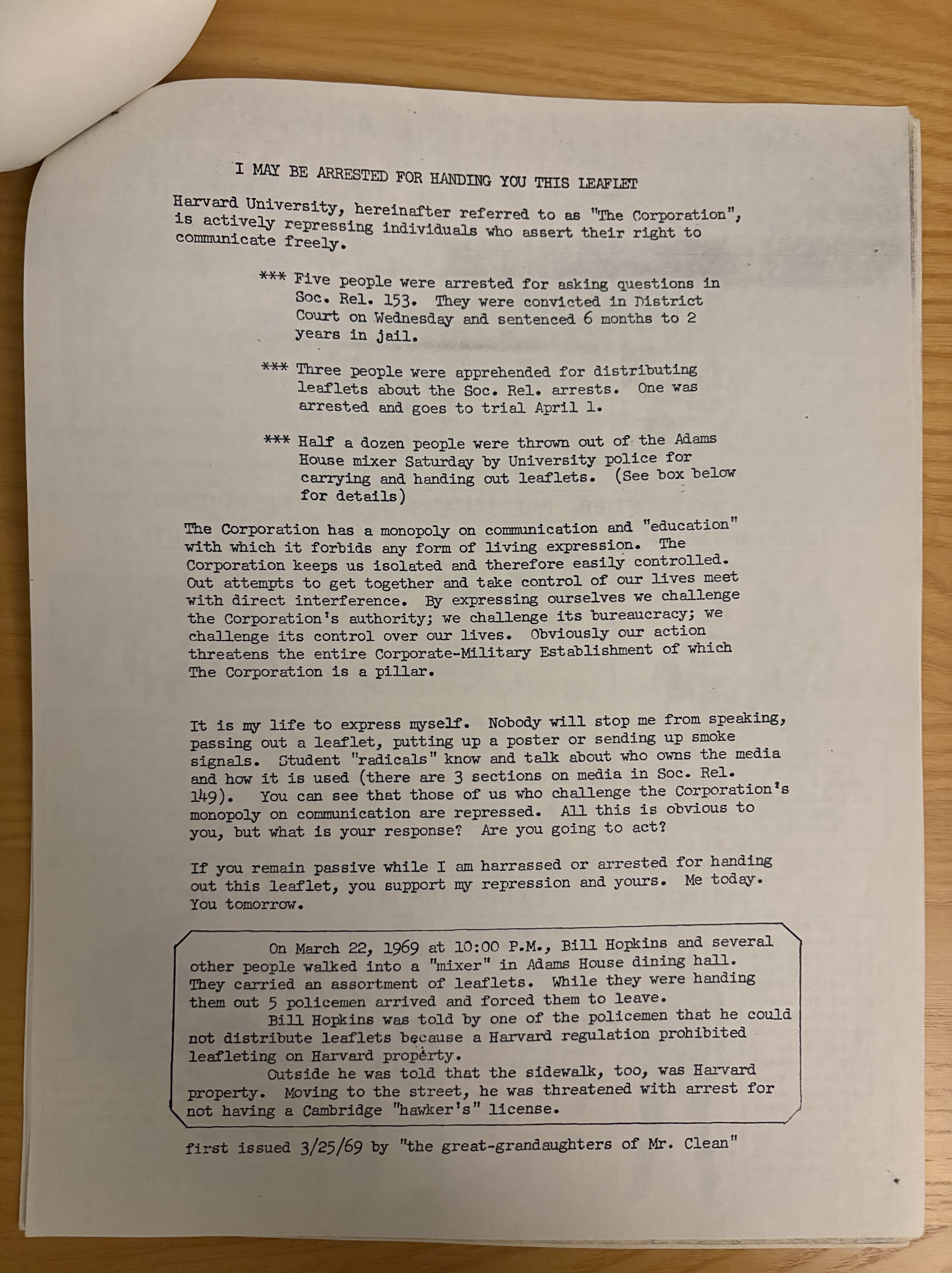
[Radical Action Cooperative ; Council for Liberation of Imagination]. [Samizdat on the 1968-9 Harvard protests]. Cambridge, MA: n.p., ca. 1968-69. n.p. [14 p.]; 21 x 29 cm.; black ink on xeroxed white stock.
Samizdat of hastily photocopied texts by the the Radical Action Cooperative (King Collins et al.) / Council for Conscious Existence / Council for Liberation of Daily Life, with an early 70s provenance. Almost all of the texts are unaccounted for (only one is included in Ken Knabb’s archive at Yale), but all relate to the brief, chaotic intervention at Harvard University in the spring of 1969
New York-based Radical Action Cooperative (RAC), which had originally formed on the margins of the Spring 1968 Columbia University strikes, migrated north to Cambridge the following year. While the mainstream American section of the Situationist International famously dismissed King Collins’ cohort as “ideologists of daily life” who staged “unimaginative confrontations,” these texts reveal a highly articulated, totalizing critique of the university system as an extension of the capitalist “spectacle.”
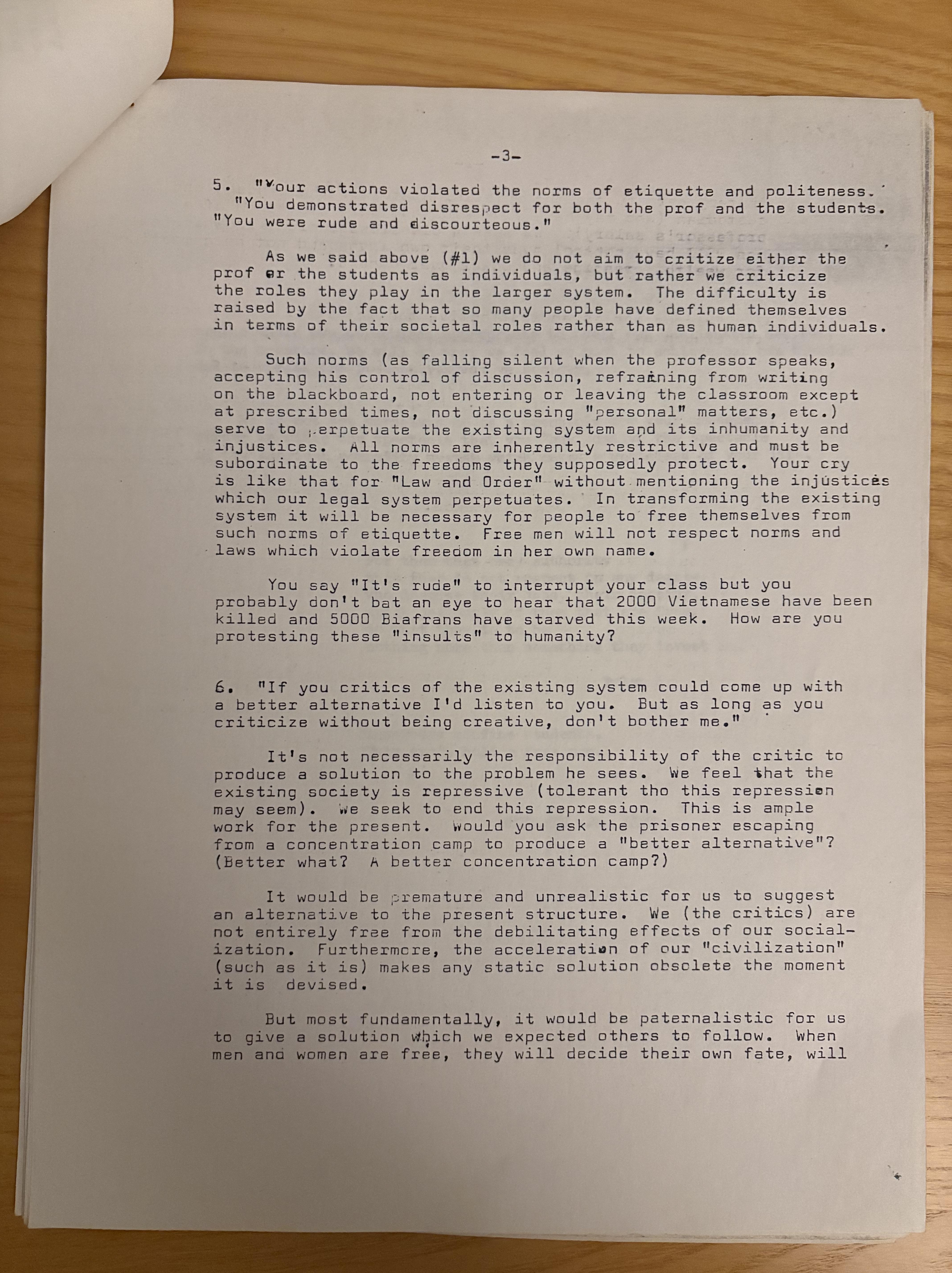
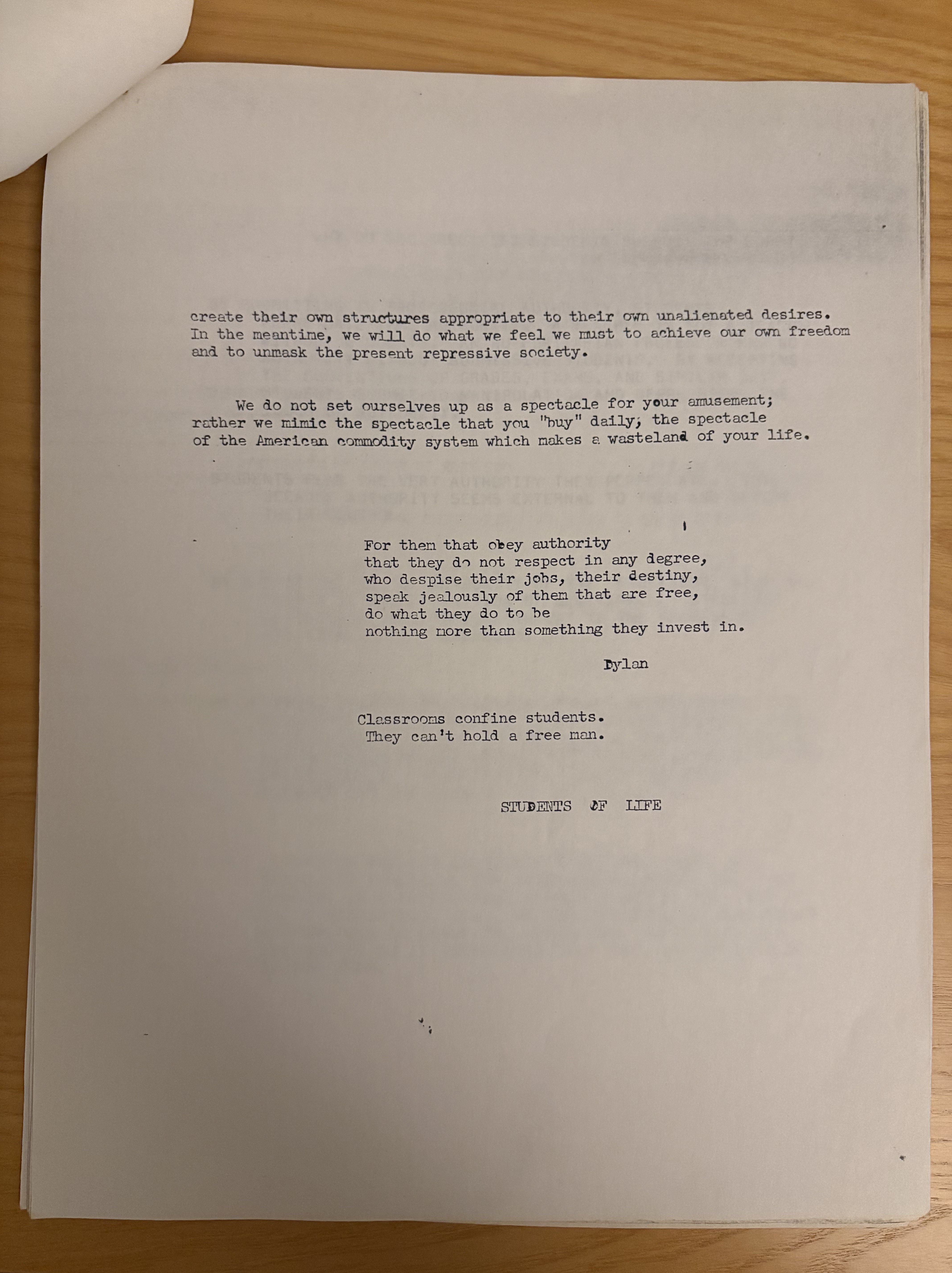
The centerpiece of this samizdat is the multi-page manifesto, A Response to Questions About Classroom Disruption, dated March 14, 1968 (evidently a typographical error for 1969, given the specific chronology of the events described). The document was rushed to standard duplicating machines immediately following the group’s highly controversial infiltration of Professor Alex Inkeles’ elite sociology course, Social Relations 153. Addressing the fierce student backlash to their intervention, the text rejects the liberal defense of Inkeles as a “good professor,” utilizing a classic anti-pedagogical position: “We do not aim to criticize any authority as an individual… within our society, the University serves as an Officers’ Candidate School, socializing tomorrow’s leaders… The ‘good teacher’ and ‘nice fellow’ is most dangerous. These authorities are doing violence to you and to themselves by creating a false consciousness.”. Responding to accusations on page 3 that their disruptions violated basic “norms of etiquette and politeness,” the text highlights the radical dissonance between classroom decorum and global violence: You say ‘It’s rude’ to interrupt your class but you probably don’t bat an eye to hear that 2000 Vietnamese have been killed and 5000 Biafrans have starved this week. How are you protesting these ‘insults’ to humanity?”. The manifesto relies heavily on detourned cultural markers to build its anti-authoritarian stance. It closes with a hand-typed excerpt from Bob Dylan’s It’s Alright, Ma (I’m Only Bleeding) (“For them that obey authority / that they do not respect in any degree…”), positioned directly above their foundational aphorism: “Classrooms confine students. They can’t hold a free man.”
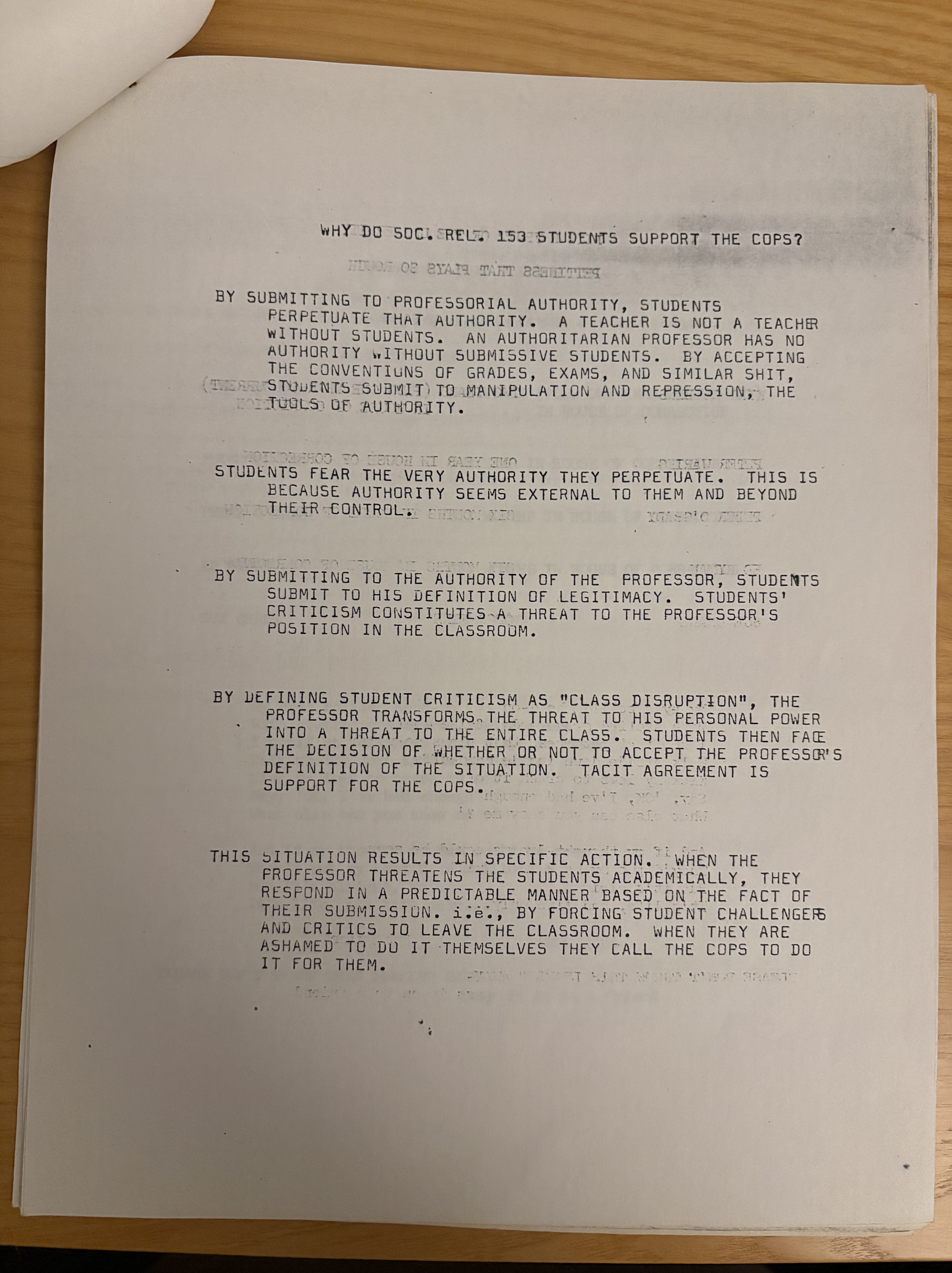
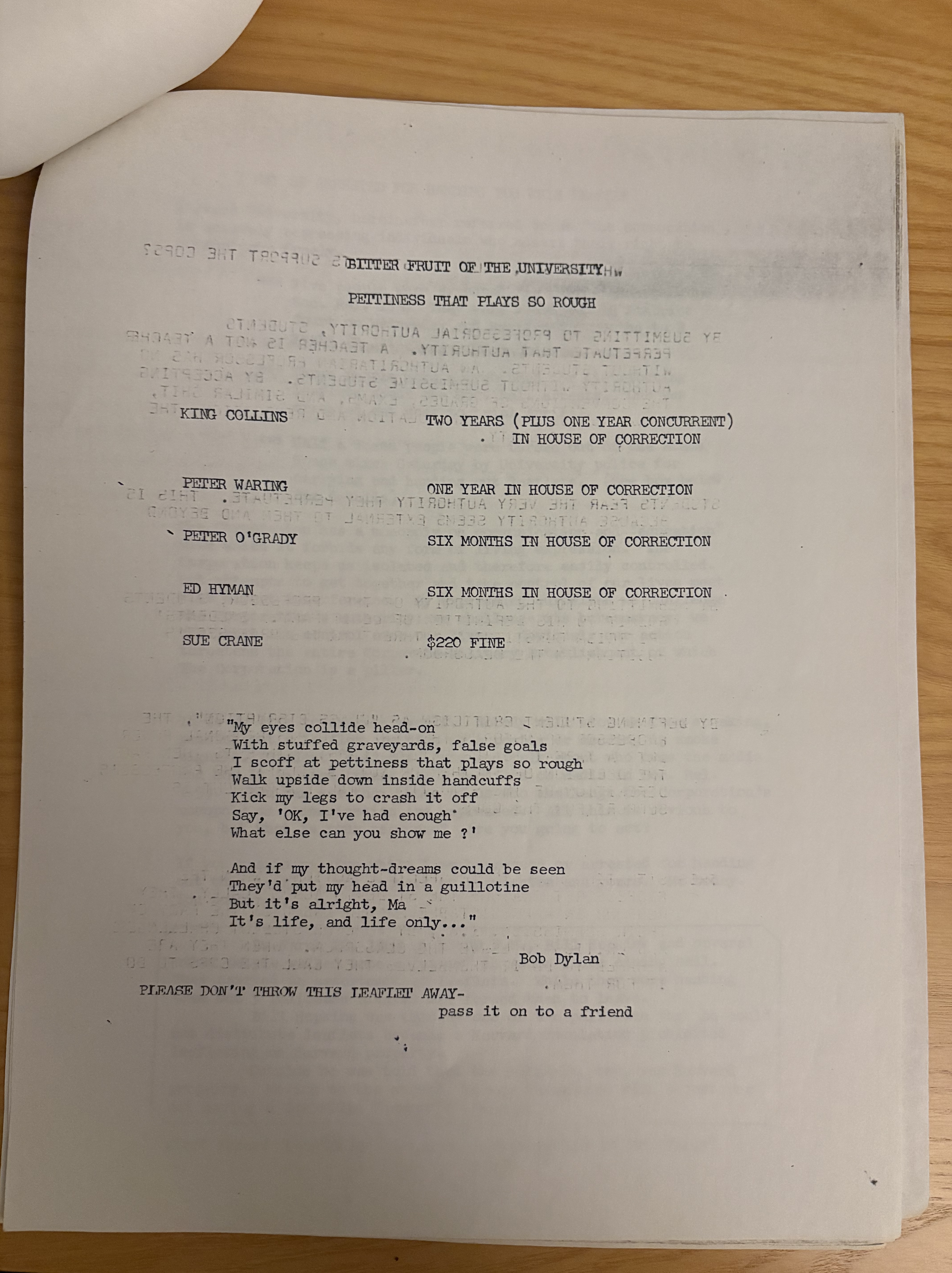
The companion flyer, [Why Do Soc. Rel. 153 Students Support the Cops?], acts as a theoretical post-mortem to the inevitable police intervention that followed. It targets the passivity of the student spectators, asserting that by willingly participating in the conventions of grading, examinations, and “professorial authority,” students become complicit in their own domestication. The arc of this short-lived experiment is starkly documented by the accompanying judicial tracking sheet, Bitter Fruit of the University: Pettiness That Plays So Rough. It registers the severe criminal sentences handed down by the Cambridge authorities to suppress the group’s performance-style disruptions: King Collins received two years in the House of Correction; Peter Waring was sentenced to one year; Peter O’Grady and Ed Hyman both received six months; while Sue Crane was penalized with a $220 fine.
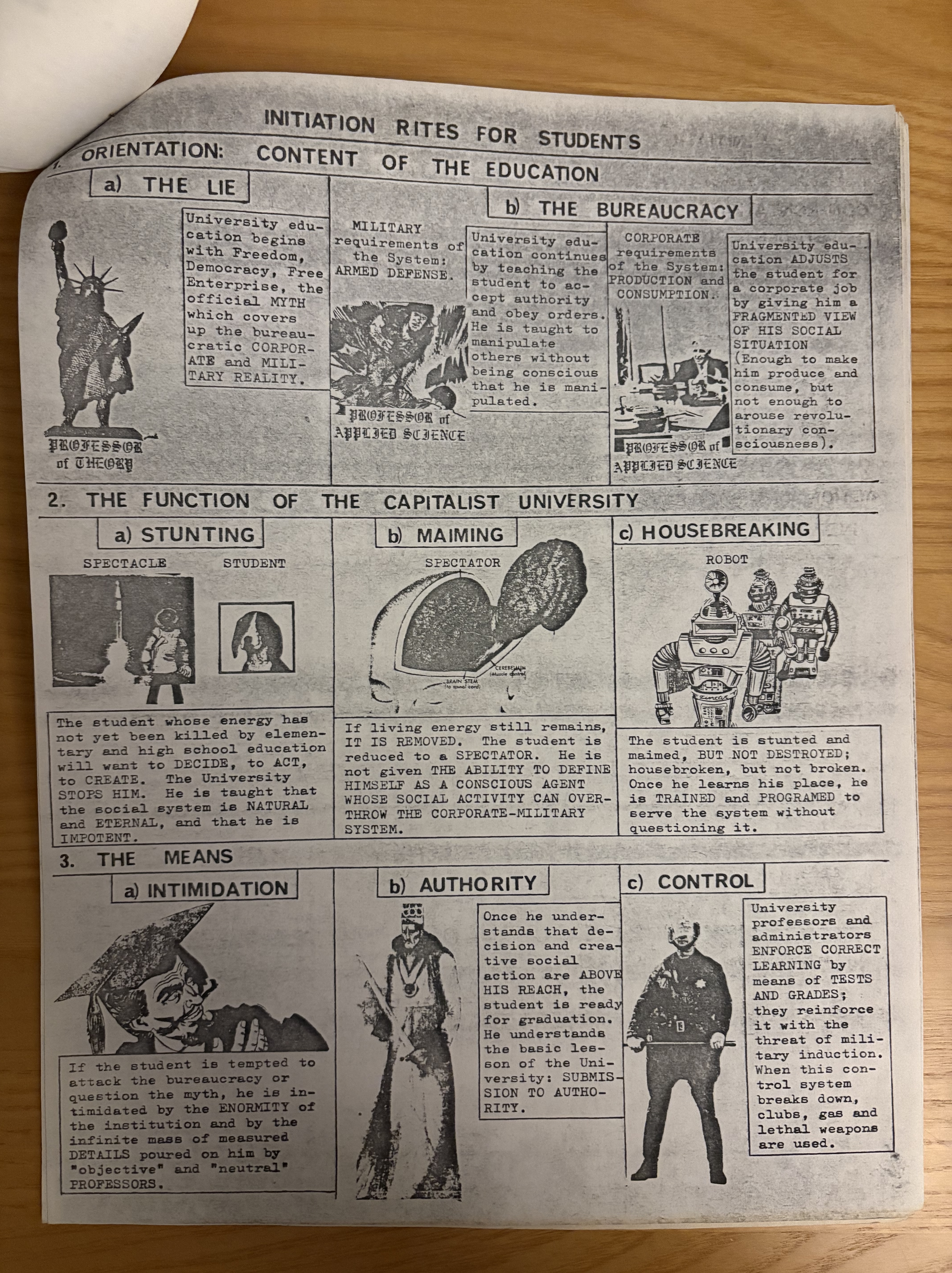
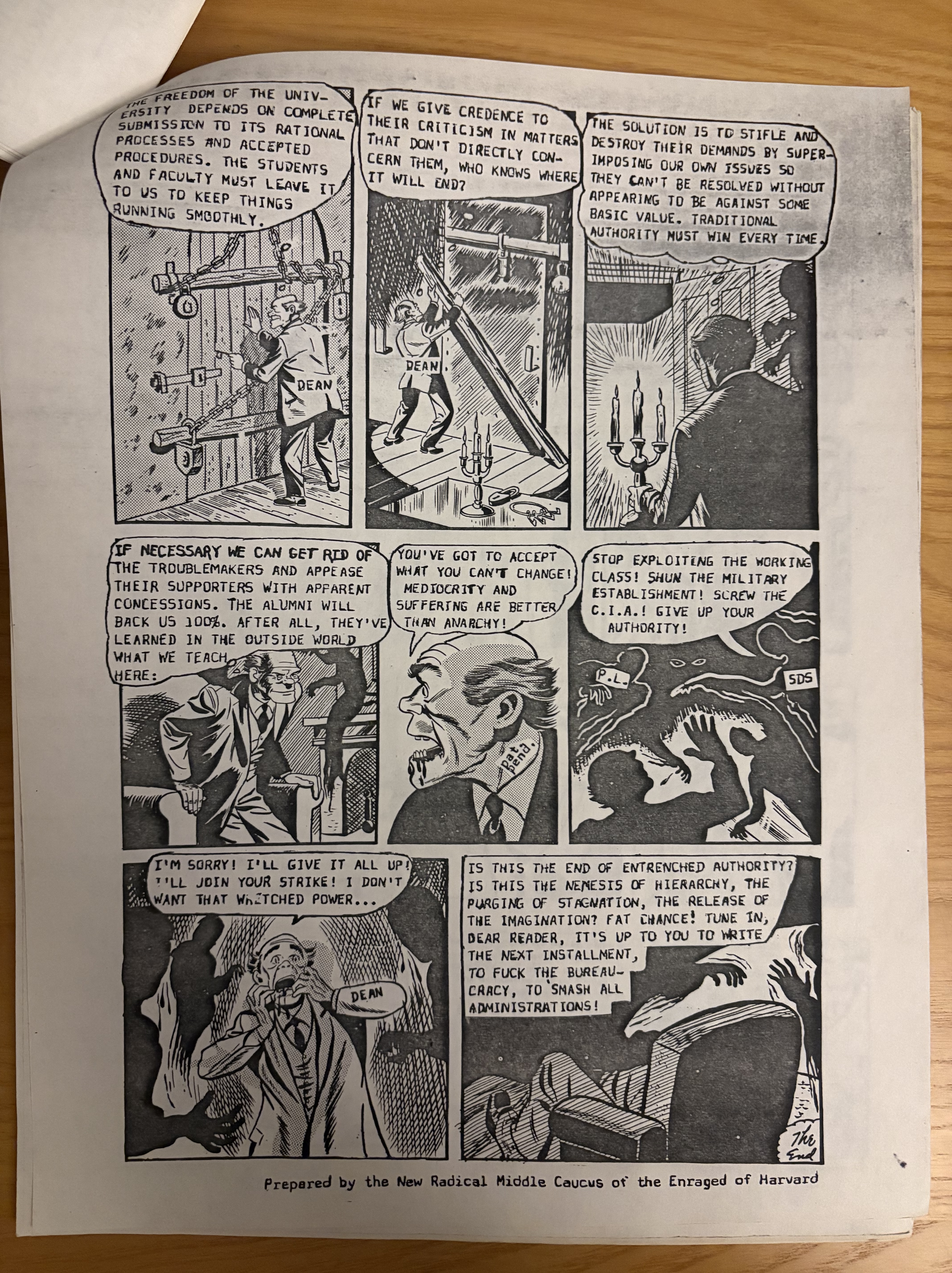
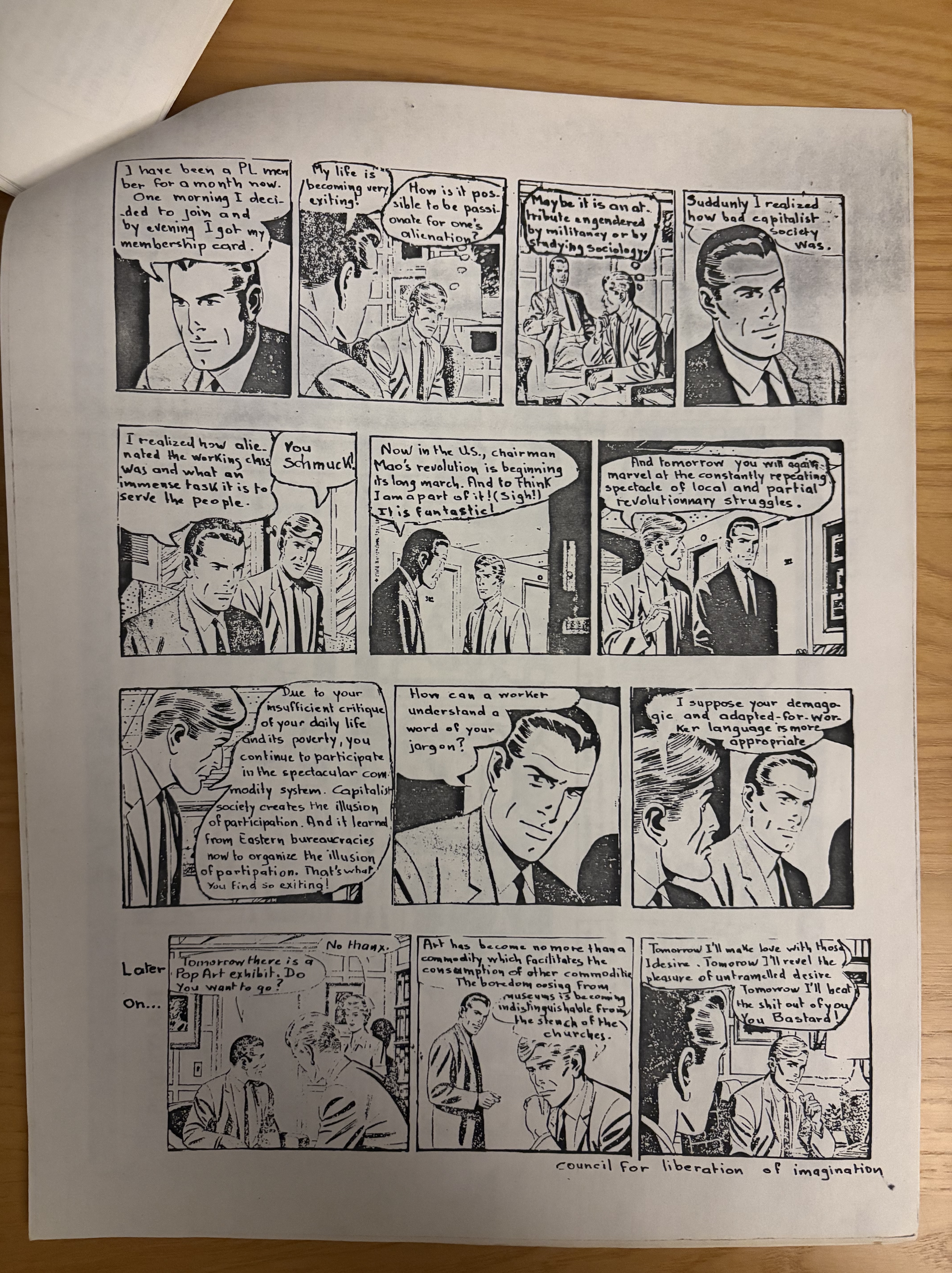
To bridge this theoretical critique with the visual assault that covered the Cambridge campus, the Council relied heavily on détournement—the classic Situationist tactic of hijacking commercial comic strips and infusing them with radical philosophy. In a striking piece credited to the Council for Liberation of Imagination (titled “[I have been a PL member for a month now…]”), the group parodied clean-cut romance comics to satirize Marxist-Leninist student groups like the Progressive Labor Party (PL) and SDS. The comic skewers dogmatic students who trade the “boredom” of sociology for bureaucratic militancy, concluding that Capitalist society simply “learned from Eastern bureaucracies how to organize the illusion of participation.”
This artistic warfare was expanded across several others leaflets / broadsides that outlined the physical mechanics of campus revolt:
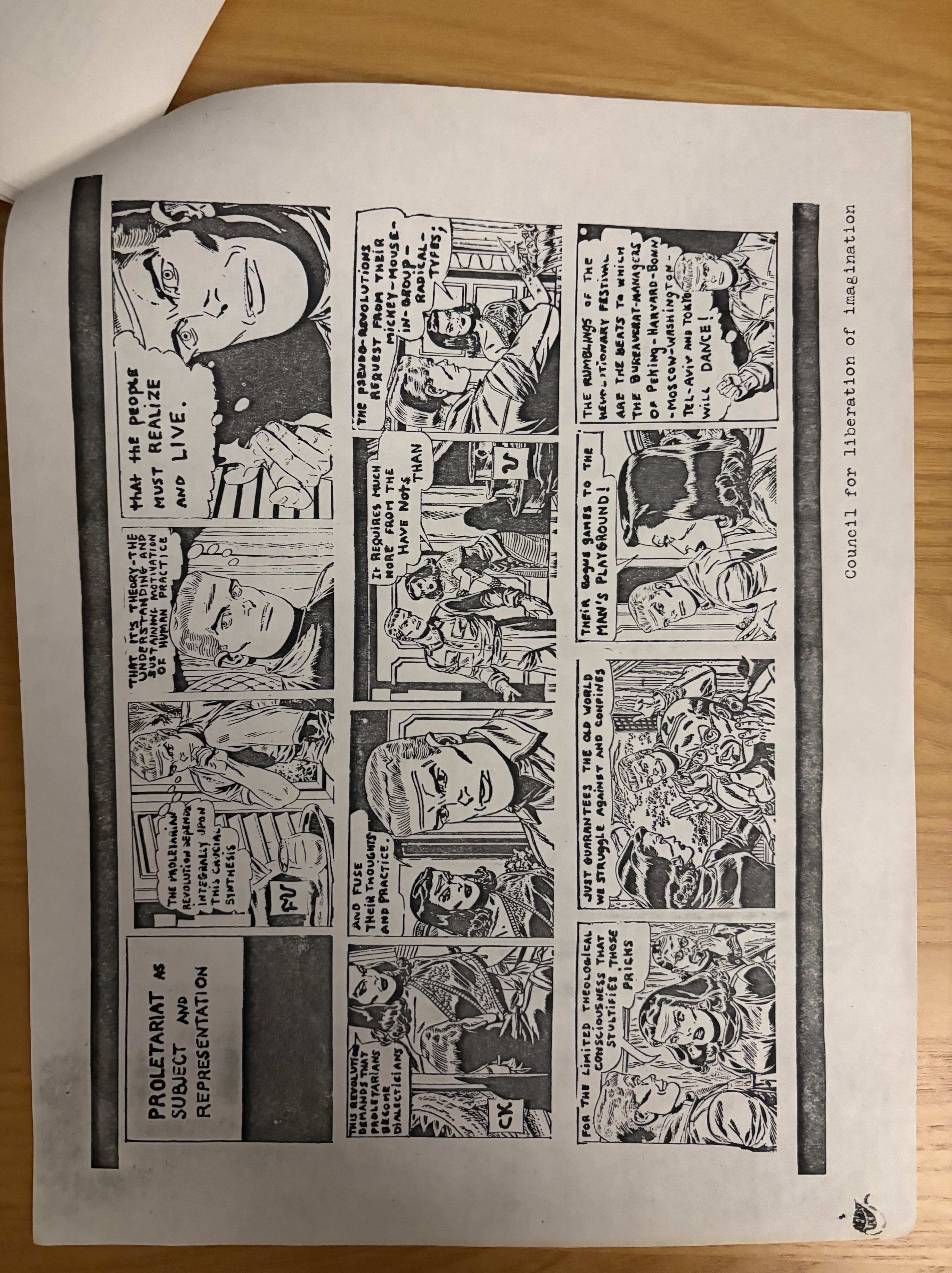
Proletariat as Subject and Representation: Echoing the exact chapter titles of Guy Debord’s The Society of the Spectacle, this densely illustrated comic strip calls for a “proletarian revolution [that] depends integrally upon this crucial synthesis” of theory and practice. It fiercely denounces orthodox leftists as “pseudo-revolutionaries” whose predictable rumblings are merely the beats to which corporate-bureaucratic managers in “Peking-Harvard-Bonn-Moscow-Washington-Tel-Aviv and Tokyo” will dance.
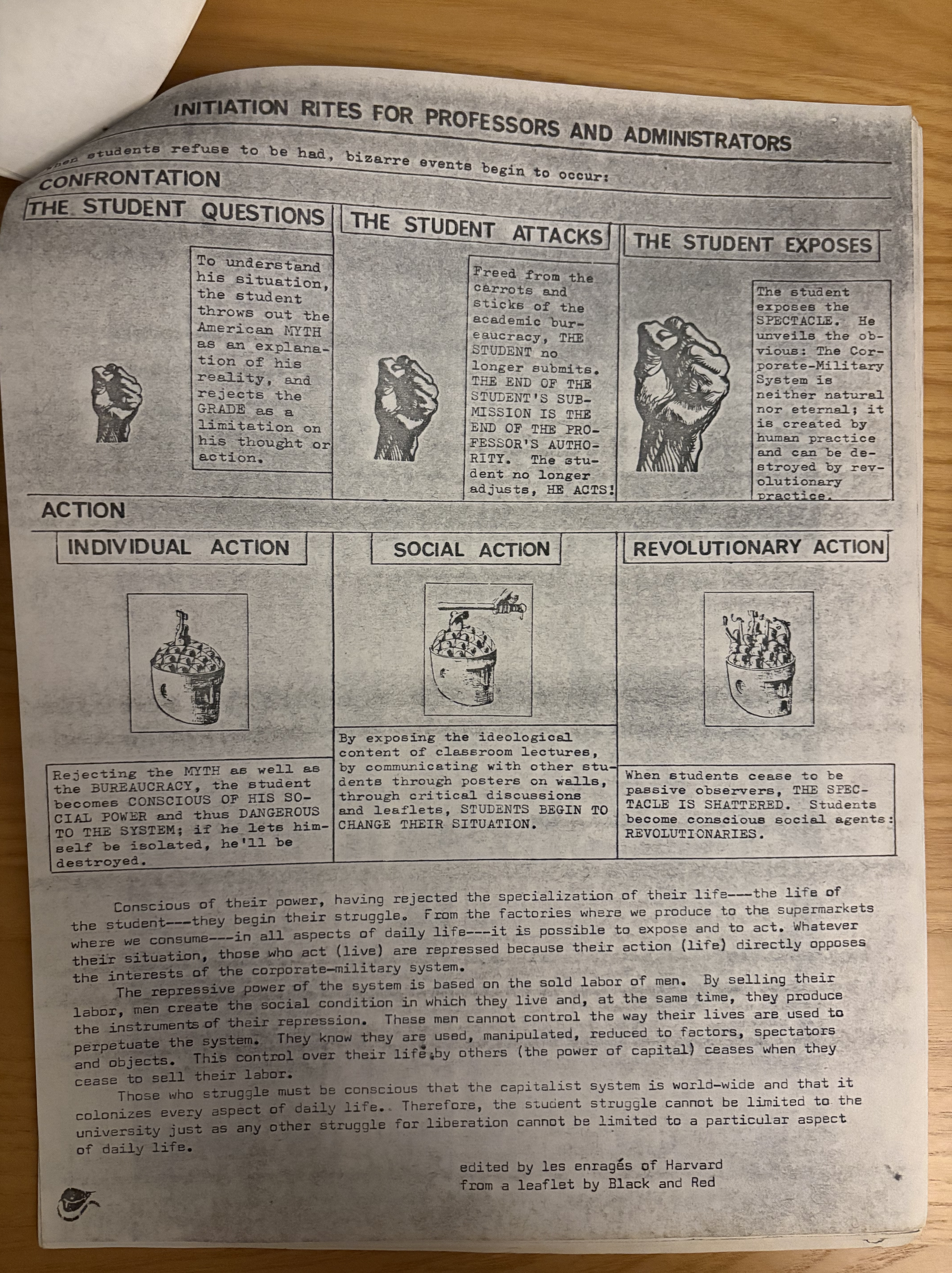
Initiation Rites for Professors and Administrators: Credited to les enragés of Harvard (with layout adapted from Detroit’s Black Red), this analytical poster provides a taxonomy of tactical subversion. It charts a progression from “Confrontation” (where the student rejects the grade as a limitation on action) to “Revolutionary Action,” declaring that when students cease to be passive observers, “THE SPECTACLE IS SHATTERED.” The text explicitly argues that the campus struggle cannot be isolated from daily life, as the capitalist system “colonizes every aspect of daily life.”
The New Radical Middle Caucus of the Enraged of Harvard: This narrative comic strips away the authority of university officials by depicting panicking deans operating a conveyor belt of “submissive students.” When faced with disruptions, the comic’s caricatured administrators exclaim, “The solution is to stifle and destroy their demands by super-imposing our own issues!” before a final, chaotic frame showing a dean weeping, “I’m sorry! I’ll give it all up! I’ll join your strike!” below a triumphant call to reader-activists to “SMASH ALL ADMINISTRATIONS!”
Exceedingly scarce. No individual institutional listings for these specific Harvard titles are recorded in OCLC, though scattered remnants of the Council’s broader output occasionally surface within the radical pamphlet collections of the Tamiment Library or the Labadie Collection. Not in Knabb’s archive at Yale’s Beinecke Library.
BERTAIL, Thomas; GHERGHESCU, Mica;LUCCI-GOUTNIKOV, Nicolas. L’Internationale situationniste. Vies, textes et pratiques (2026). Editions du Centre Pompidou, 2026. 183 p.; ill.; white wrappers with text in black.
Francais
Suite à l’acquisition des archives de Guy Debord par la BNF en 2009, et de celles de tous ses petits camarades de l’Internationale situationniste par Yale dans les quinze années qui ont suivi, les chercheurs ont enfin pu avoir accès à la majorité des lettres, manuscrits et documents relatifs au mouvement d’avant-garde. On voit ainsi paraître depuis 2010 un nombre important de travaux universitaires qui, informés par un travail d’archive, produisent un éclairage nouveau sur le « mythe » situationniste. On citera pêle-mêle les travaux de Jean-Marie Apostolides, François Coadou, Anna Trespeuch-Berthelot, Vanessa Theodoropoulou, Éric Brun, Patrick Marcolini, et plusieurs dizaines d’autres chercheurs issus de disciplines aussi diverses que l’histoire, l’histoire de l’art, la littérature, la sociologie, la philosophie…
L’Internationale situationniste. Vies, textes et pratiques s’inscrit dans cette lignée. Ce sont les « petits papiers » de Destribats, entrés à la Bibliothèque Kandinsky du Centre Pompidou par voie de dation en 2020, qui servent de socle commun aux recherches présentées. On savait la collection riche en matériaux imprimés, mais l’on découvre ici une ampleur surprenante en ce qui concerne les manuscrits et aux échanges épistolaires. Loin de rabâcher les lieux communs sur l’IS, l’ouvrage de Bertail, Gherghescu et Liucci-Goutnikov s’interroge sur les conditions de production et de circulation des textes dans les périphéries du mouvement. La reproduction en fac-similé de larges extraits de la Liste générale de contacts de l’IS (p. 9-14) permet d’apprécier l’étendue des réseaux de diffusion, tout en offrant un point d’ancrage pour les textes qui suivent.
Comme il le fait depuis maintenant quelques années dans sa pratique artistique, l’artiste belge Vincent Meessen revient sur les apports de jeunes Congolais (oui, oui) à la pensée situationniste, et sur la diffusion des idées de l’IS en Afrique sub-saharienne. Ken Knabb, courroie de transmission essentielle aux États-Unis, retrace brièvement l’histoire des situs et pro-situs outre-Atlantique. Pour Penelope Rosemont, l’influence de Debord, mais surtout de Vaneigem, sur le mouvement surréaliste révolutionnaire à Chicago est considérable. S’il reprend en partie des idées exprimées ailleurs et parfois plus longuement par les auteurs (Vincent Meessen, The Other Country / L’autre Pays, 2018 ; Ken Knabb, Public Secrets, 1997 ; Penelope Rosemont, Dancin’ in the Streets!, 2005), l’ensemble demeure fort intéressant pour le lecteur francophone.
Les articles de Thomas Bertail sur les médiations anglo-saxonnes, néerlandaises et suédoises de l’I.S. constituent une lecture enrichissante. Seul bémol : le chercheur ne cite pas certaines sources pourtant indispensables, comme l’ouvrage de référence sur la Gyllene Flottan par Alexander Ekelund (Den gyllene flottans seglats, 2023), celui sur Strasbourg (Le Scandale de Strasbourg, mis à nu par ses célibataires même, 2018), ou plus modestement notre bibliographie raisonnée des éditions de De la misère en milieu étudiant, parue en 2022.
Les apports les plus originaux sont peut-être ceux d’Anna Trespeuch-Berthelot et de Nicolas Liucci-Goutnikov. S’appuyant sur des documents inédits retrouvés dans les archives Vaneigem, l’auteure de Internationale situationniste : de l’histoire au mythe (1948-2013) éclaire d’un regard nouveau le célèbre « scandale de Strasbourg » et la diffusion du texte De la misère en milieu étudiant en 1966-68. On aurait aimé que la longue lettre de Bechir Tlili (dix pages recto-verso) à Guy Debord, ou encore la correspondance entre Nasri Boumechal et Mustapha Khayati, soient reproduites en annexe, mais des contraintes de pagination expliquent sans doute cette triste omission. L’ensemble est néanmoins un modèle d’érudition.
Liucci-Goutnikov s’intéresse pour sa part à un ensemble inédit de cartes postales envoyées par Guy Debord à Raoul Vaneigem — ici largement reproduites – et souvent en couleur, pour le bonheur du lecteur. Debord était friand du support iconographique : la quasi-totalité de la correspondance avec Anita Blanc, par exemple, tient en quatorze cartes postales de… chats ! Il avait également fait imprimer des cartes représentant sa résidence de Champot ; elles furent utilisées pour de nombreux envois. Il y a enfin cette spectaculaire métagraphie de Guy Debord, au recto d’une carte adressée à Michèle Mochot-Bréhat, alias « La Tortue ». Plus connue, bien sûr, est la carte reproduisant le fameux slogan « Ne travaillez jamais » — mais celle-ci n’est pas l’œuvre de Debord. Liucci-Goutnikov identifie dans son travail les principaux tropes debordiens, tout en s’appuyant sur des travaux précédents (dont l’excellent article de Fanny Schulman, paru dans Lire Debord en 2016).
En somme, il s’agit ici d’un ouvrage de référence que les chercheurs sur l’I.S. et ses lendemains ne devraient pas manquer de se procurer.
English
Since the BNF acquired Guy Debord’s archives in 2009, and Yale absorbed those of his comrades from the Internationale situationniste over the following fifteen years, scholars have finally gained access to the bulk of the letters, manuscripts, and documents tied to the movement. The result, from 2010 onward, has been a steady wave of archive-driven scholarship casting fresh light on the Situationist “myth” — work by, among others, Jean-Marie Apostolides, François Coadou, Anna Trespeuch-Berthelot, Vanessa Theodoropoulou, Éric Brun, and Patrick Marcolini, alongside dozens of researchers drawn from history, art history, literature, sociology, and philosophy.
L’Internationale situationniste. Vies, textes et pratiques belongs squarely to this current. Its foundation is the Destribats collection — the so-called “petits papiers” that entered the Bibliothèque Kandinsky at the Centre Pompidou in 2020 via a dation. The collection’s printed holdings were already well known; what comes as a surprise here is the sheer depth of its manuscripts and correspondence. Rather than retreading familiar ground on the IS, the volume — edited by Bertail, Gherghescu, and Liucci-Goutnikov — asks instead how texts were produced and circulated at the movement’s margins. A facsimile reproduction of long stretches of the IS’s general contact list (pp. 9–14) conveys just how far its distribution networks extended, and gives the essays that follow a firm point of reference.
Continuing work he has pursued in his own art practice for several years now, the Belgian artist Vincent Meessen examines the contributions young Congolese intellectuals made to Situationist thought — yes, really — and traces how IS ideas took root in Su-Saharan Africa. Ken Knabb, the movement’s essential relay in the United States, offers a brisk account of the situs and pro-situs there. Penelope Rosemont argues for the considerable imprint Debord, and Vaneigem still more, left on Chicago’s revolutionary Surrealist scene. Much of this revisits ground the authors have covered elsewhere, often at greater length — Vincent Meessen, The Other Country / L’autre Pays (2018); Ken Knabb, Public Secrets (1997); Penelope Rosemont, Dancin’ in the Streets! (2005) — yet it remains genuinely rewarding for a French-speaking readership.
Thomas Bertail’s essays on how the IS was received in the Anglophone world, the Netherlands, and Sweden are among the book’s real strengths. Nevertheless, and this is the main shortcoming, he passes over several sources that belonged in the conversation, notably Alexander Ekelund’s definitive study of the Gyllene Flottan, Den gyllene flottans seglats (2023), that on Strasbourg (Le Scandale de Strasbourg, mis à nu par ses célibataires même, 2018), or, more modestly, our own annotated bibliography of the editions of De la misère en milieu étudiant (2022).
The volume’s most original contributions may well be those of Anne Trespeuch-Berthelot and Nicolas Liucci-Goutnikov. Drawing on unpublished material unearthed in the Vaneigem archives, the author of Internationale situationniste : de l’histoire au mythe (1948–2013) brings a fresh eye to the celebrated “Strasbourg scandal” and to the circulation of De la misère en milieu étudiant in 1966–68. It’s a real loss that Bechir Tlili’s lengthy letter to Debord (ten pages in total) and the correspondence between Nasri Boumechal and Mustapha Khayati weren’t reproduced as an appendix — pagination constraints presumably being to blame — but the essay otherwise stands as a model of scholarly precision.
Liucci-Goutnikov, in turn, takes up a previously unpublished cache of postcards Debord sent to Raoul Vaneigem, many reproduced here in color to the reader’s evident benefit. Debord’s fondness for the medium runs throughout: most of his correspondence with Anita Blanc, for instance, amounts to fourteen postcards — all of cats. He also had postcards printed of his house at Champot, which supplied many of his later mailings. There is, too, a striking metagraphy by Debord on the front of a card addressed to Michèle Mochot-Bréhat, nicknamed “La Tortue.” Better known, certainly, is the postcard bearing the famous slogan “Ne travaillez jamais” — though that particular card is not Debord’s own work. Liucci-Goutnikov skillfully traces the recurring Debordian motifs across this material, building on earlier scholarship, notably Fanny Schulman’s fine article in Lire Debord (2016).
Taken as a whole, this is an essential reference for anyone working on the IS and its afterlives.
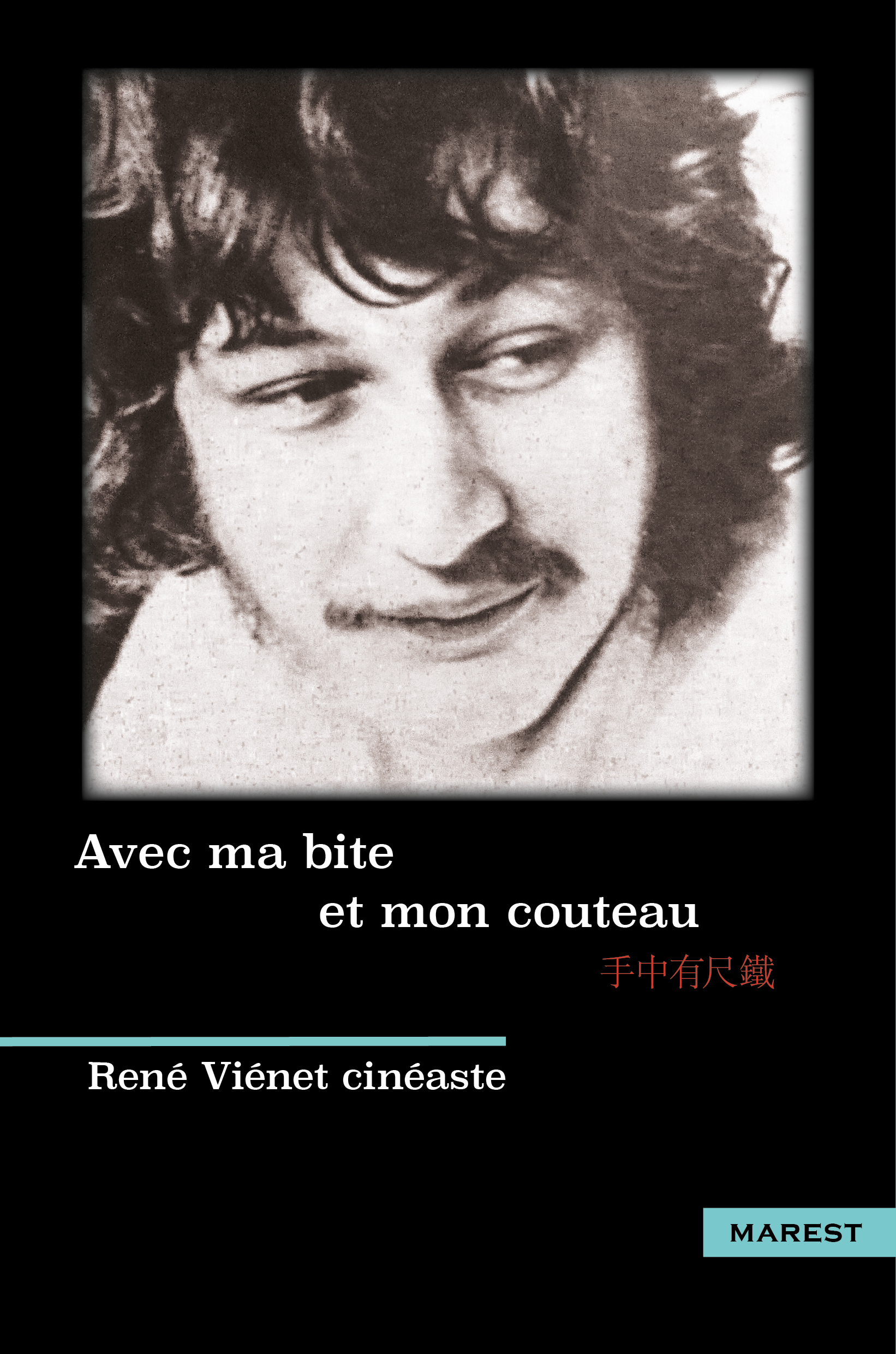
BRENEZ, Nicole (Ed.); VIENET, René. Avec ma bite et mon couteau – René Viénet cinéaste (2026). Blosseville: Marest, 2026. 383 p.; ill.; 21 x 15 cm. ill. cover with photograph of a young René Viénet
Thanks to Marest for sending this a review copy. // Merci a Marest pour cet envoi en service de presse.
French:
On attendait depuis longtemps un ouvrage retraçant le rocambolesque parcours cinématographique de René Viénet : c’est chose faite. Édité par Nicole Brenez — elle avait organisé une rétrospective des œuvres de l’ancien situationniste à la Cinémathèque française en 2015 — l’ouvrage permet au lecteur de (re)découvrir celui qui, avant quasiment tout le monde en France, avait dénoncé les atrocités de la révolution culturelle chinoise.
La première partie de l’ouvrage est une brève autobiographie. En un peu moins de 200 pages, Viénet retrace son parcours. Fils de docker, il grandit au Havre dans un milieu populaire. Il s’inscrit en chinois à l’Université, part enseigner en Chine, revient à Paris où il traduit Harold Isaacs, fait Mai 68 avec Guy Debord (et raconte cela dans Enragés et situationnistes dans le mouvement des occupations), se rend à Hong Kong où — révélation — il découvre le cinéma hongkongais en 1969. La Dialectique peut-elle casser des briques ?, sous-titrage subversif du film de kung-fu Crush Karate, sort trois ans plus tard. On en apprend beaucoup sur les conditions de production de ce film, en particulier le sous-titrage grâce à une table CTM 35 mm. Suivent Les Filles de Kamaré (une petite culotte pour l’été) en 1974, Mao par lui-même en 1976, et Chinois, encore un effort l’année suivante.
La seconde partie du livre est constituée de divers documents autour de René Viénet et de ses films. On retrouve pêle-mêle des articles publiés par Viénet dans Internationale situationniste, des critiques cinématographiques d’époque, un entretien avec l’auteur, des écrits plus récents sur Olympe de Gouges ou Hu Jie… En somme un beau capharnaüm, dans le ton enjoué et badin qui est propre à l’auteur.
En somme, il s’agit ici d’une somme indispensable pour qui veut comprendre « l’autre » cinéma situationniste (Debord ne fit pas de films entre 1963 et 1971), la fièvre pro-Mao des années 70 en France, ou simplement René Viénet — un génial trublion comme on n’en fait plus et, cet ouvrage le démontre, un cinéaste injustement négligé.
English:
A book chronicling René Viénet’s wild ride through cinema has been a long time coming — and it’s finally here. Edited by Nicole Brenez, who curated a retrospective of the former Situationist’s work at the Cinémathèque Française back in 2015, it gives readers a chance to rediscover a man who was calling out the horrors of China’s Cultural Revolution before almost anyone else in France dared to.
The book opens with a slim autobiography — under 200 pages — in which Viénet looks back on his own trajectory. A dockworker’s son raised in working-class Le Havre, he went on to study Chinese at university, taught in China for a time, then returned to Paris, where he translated Harold Isaacs and lived through May ’68 at Guy Debord’s side (a chapter he later told in Enragés et situationnistes dans le mouvement des occupations). A trip to Hong Kong brought a revelation: Hong Kong cinema, discovered in 1969. Three years on came Can Dialectics Break Bricks?, his subversive re-subtitling of the kung-fu flick Crush Karate — and the book digs into just how that film came together, down to the 35mm CTM table used for the subtitling. More films followed: The Girls of Kamare in 1974, Mao by Maoin 1976, and Peking Duck Soup the year after.
The second half is a grab-bag of material built around Viénet and his films — pieces he wrote for Internationale situationniste, film reviews from the period, an interview with the man himself, later essays on Olympe de Gouges and Hu Jie, and more. It’s a lively, cheerfully chaotic assortment, very much in keeping with Viénet’s own puckish tone.
Altogether, it’s essential reading — whether you want to understand the “other” Situationist cinema (Debord, after all, made no films between 1963 and 1971), grasp the pro-Mao fever that gripped 1970s France, or simply get to know René Viénet: a brilliant troublemaker and, as this book makes clear, a filmmaker who’s never gotten his due.
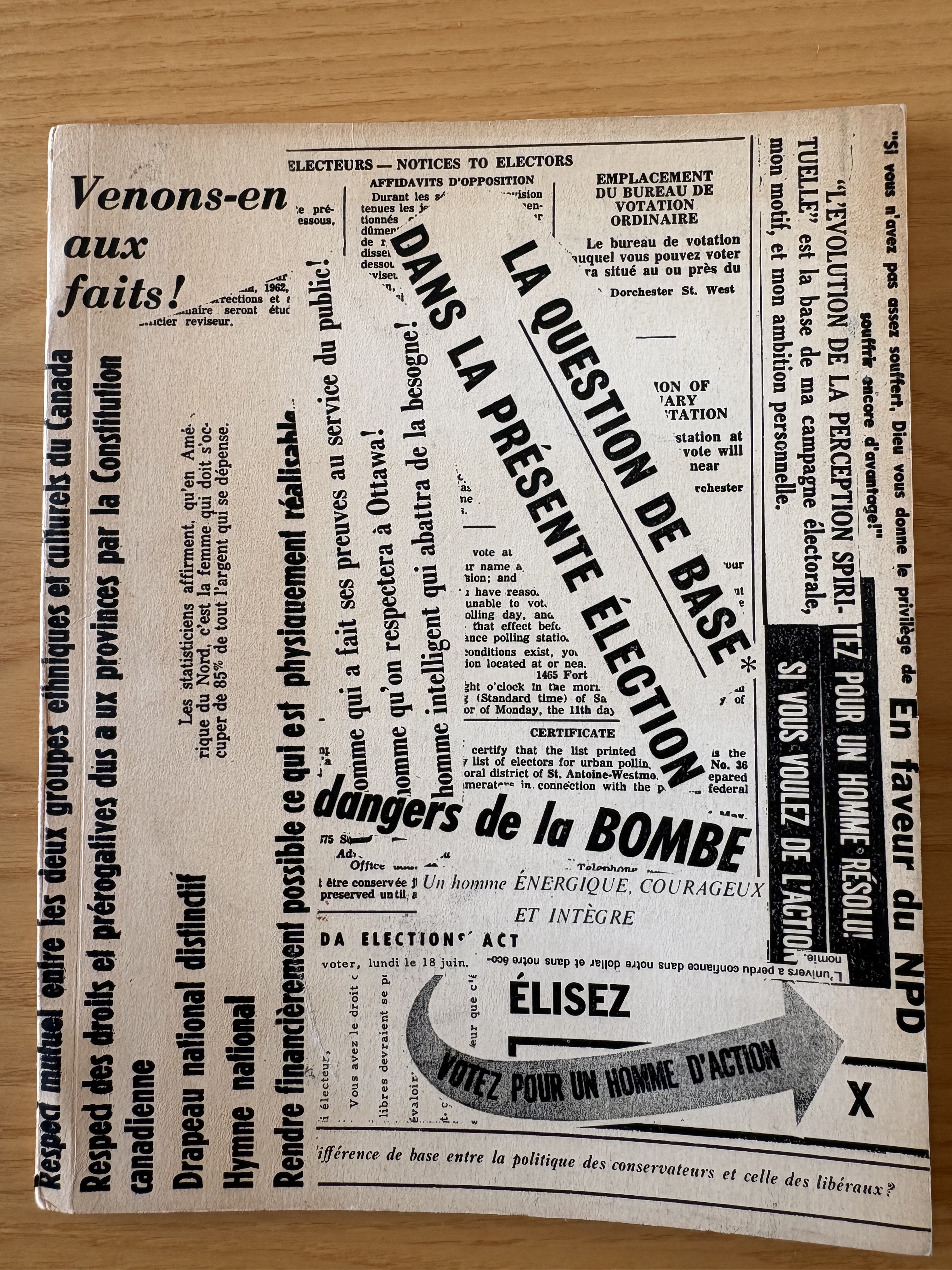
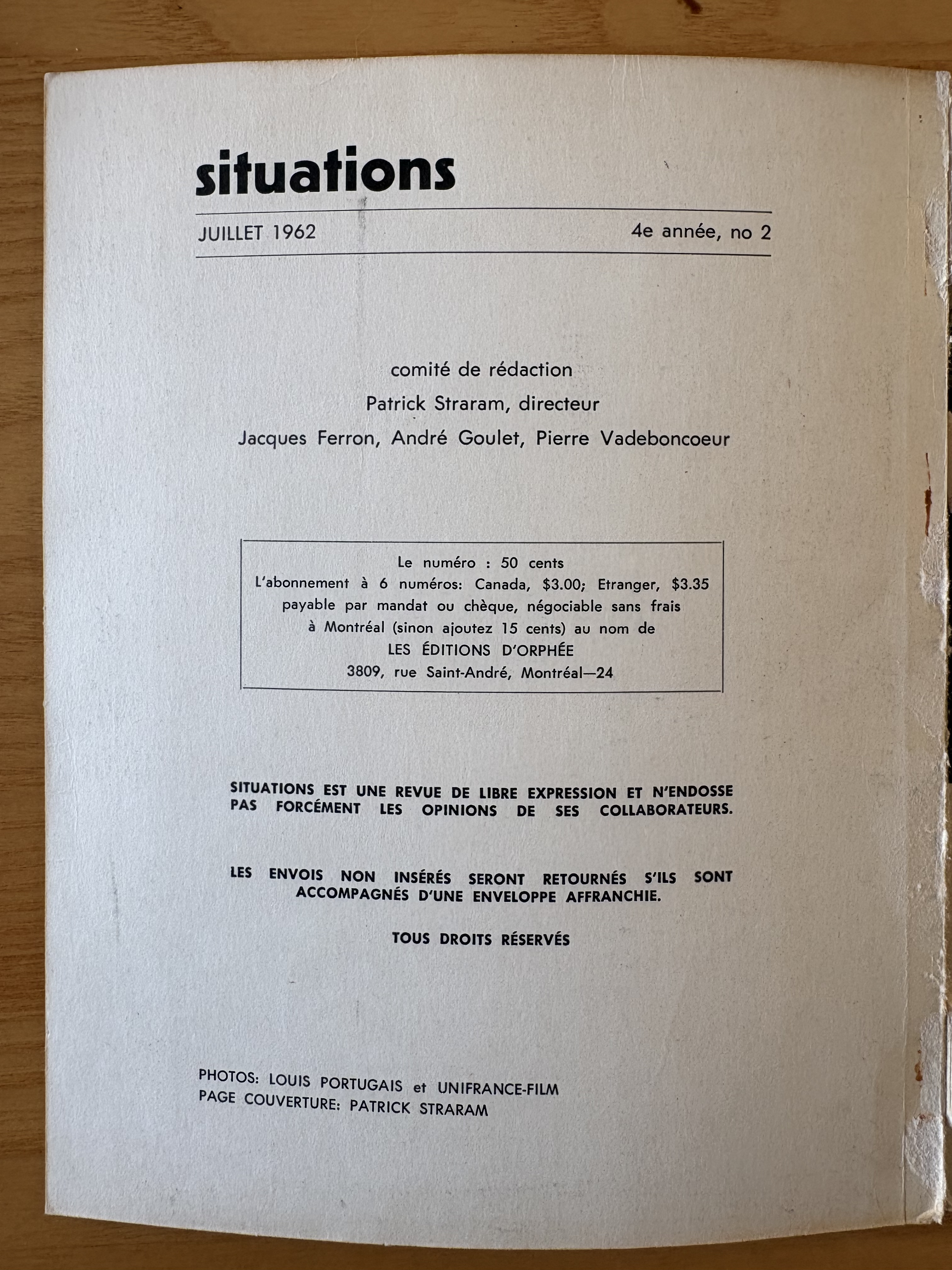
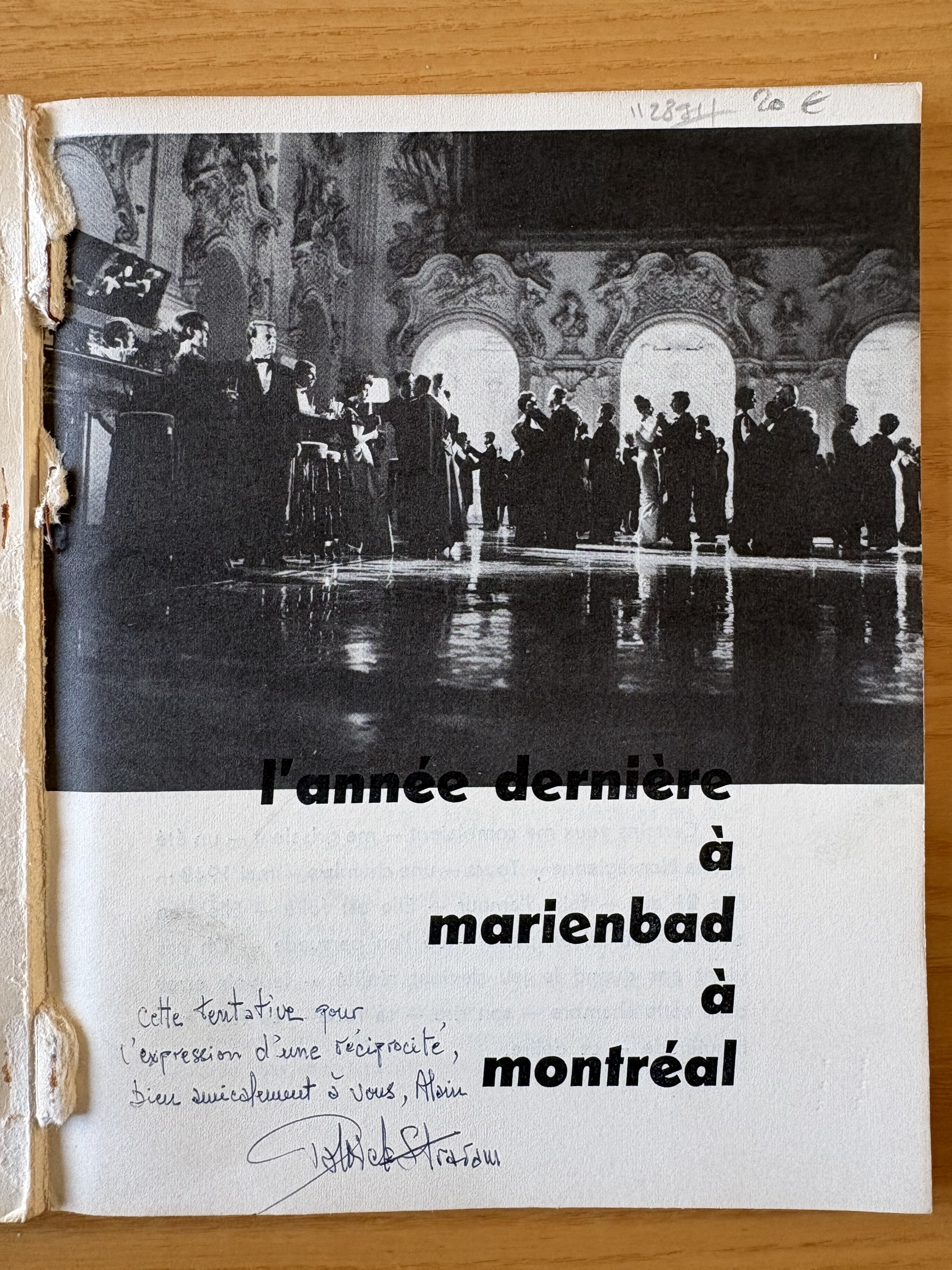
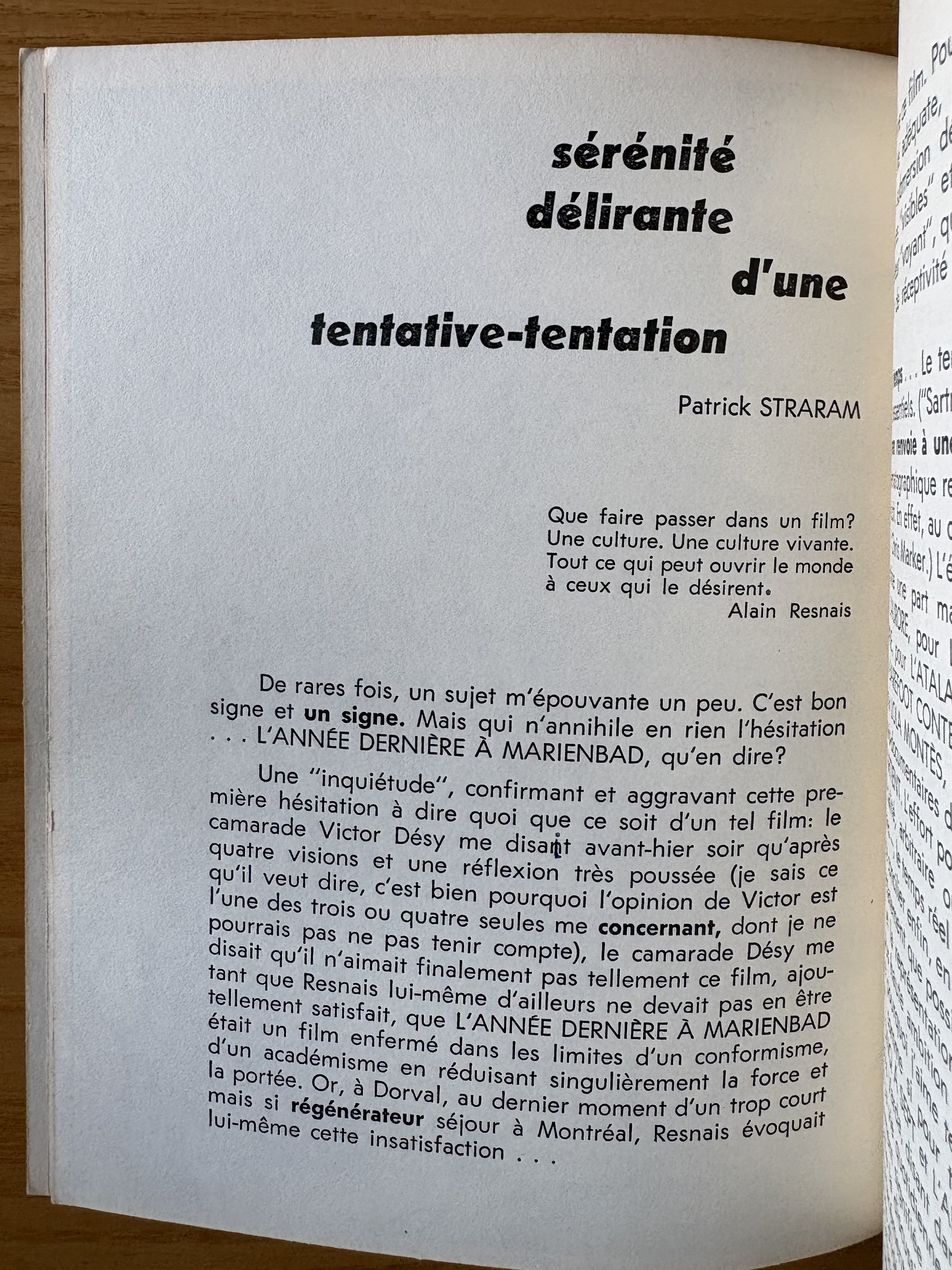
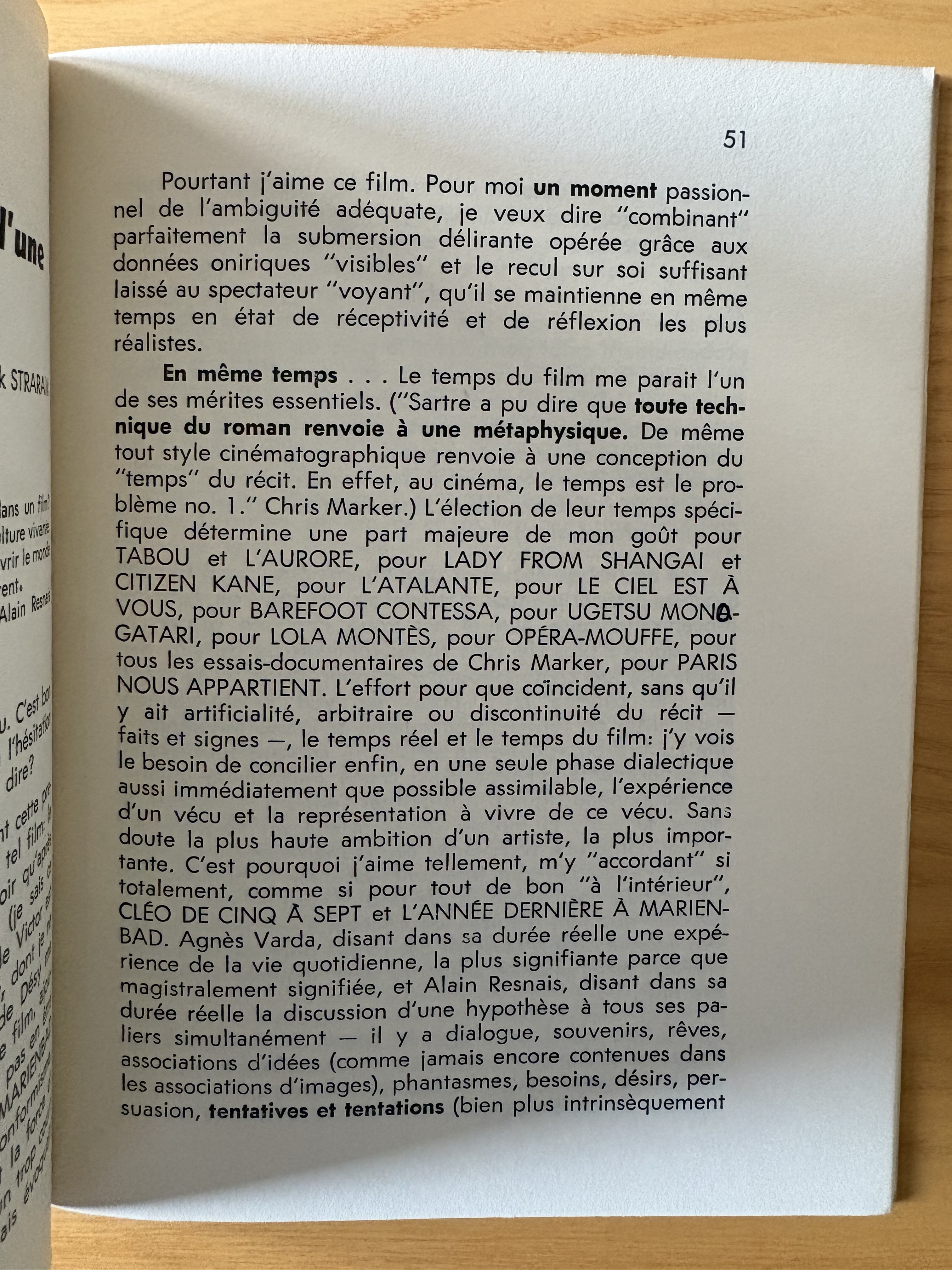
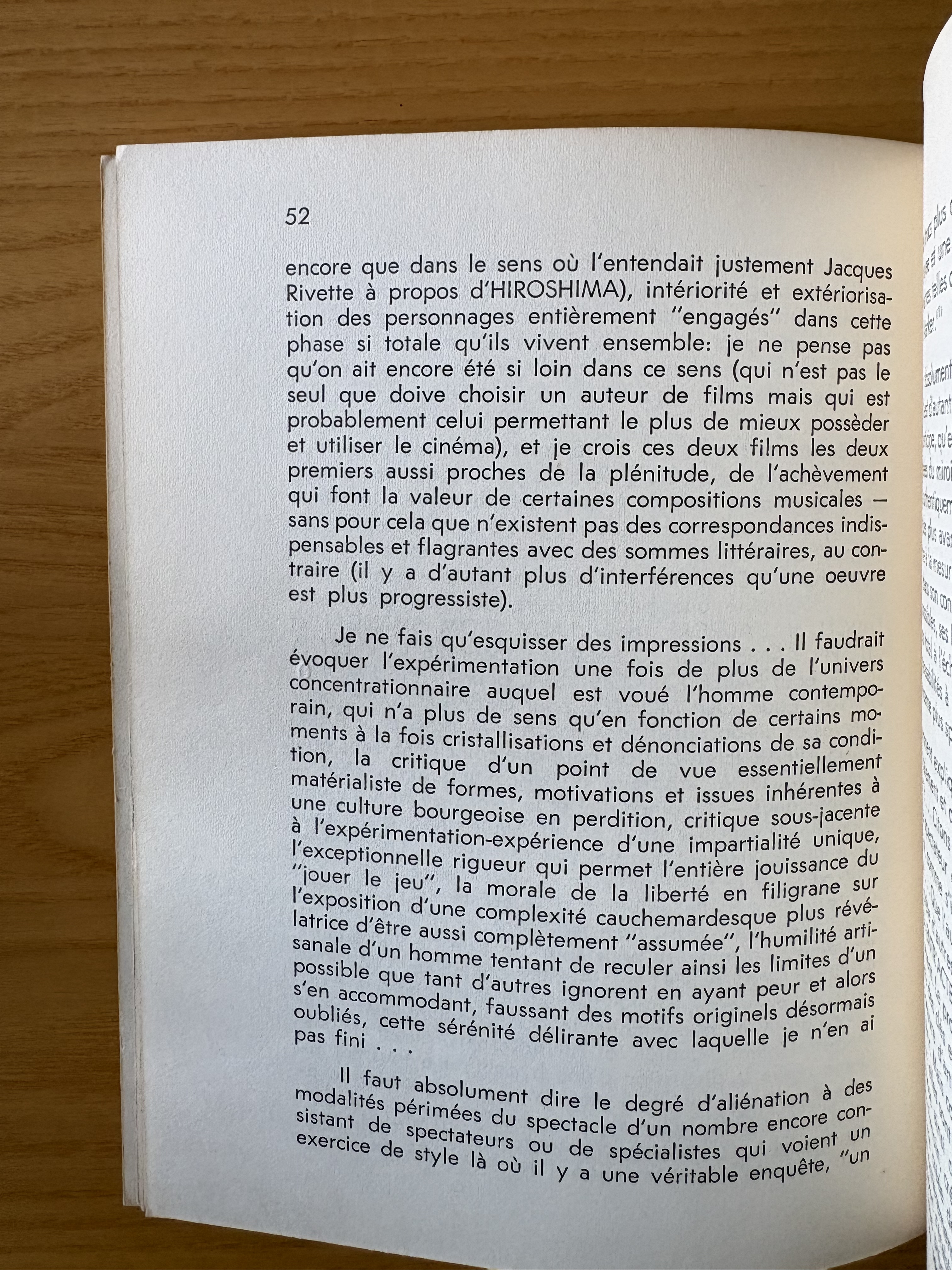
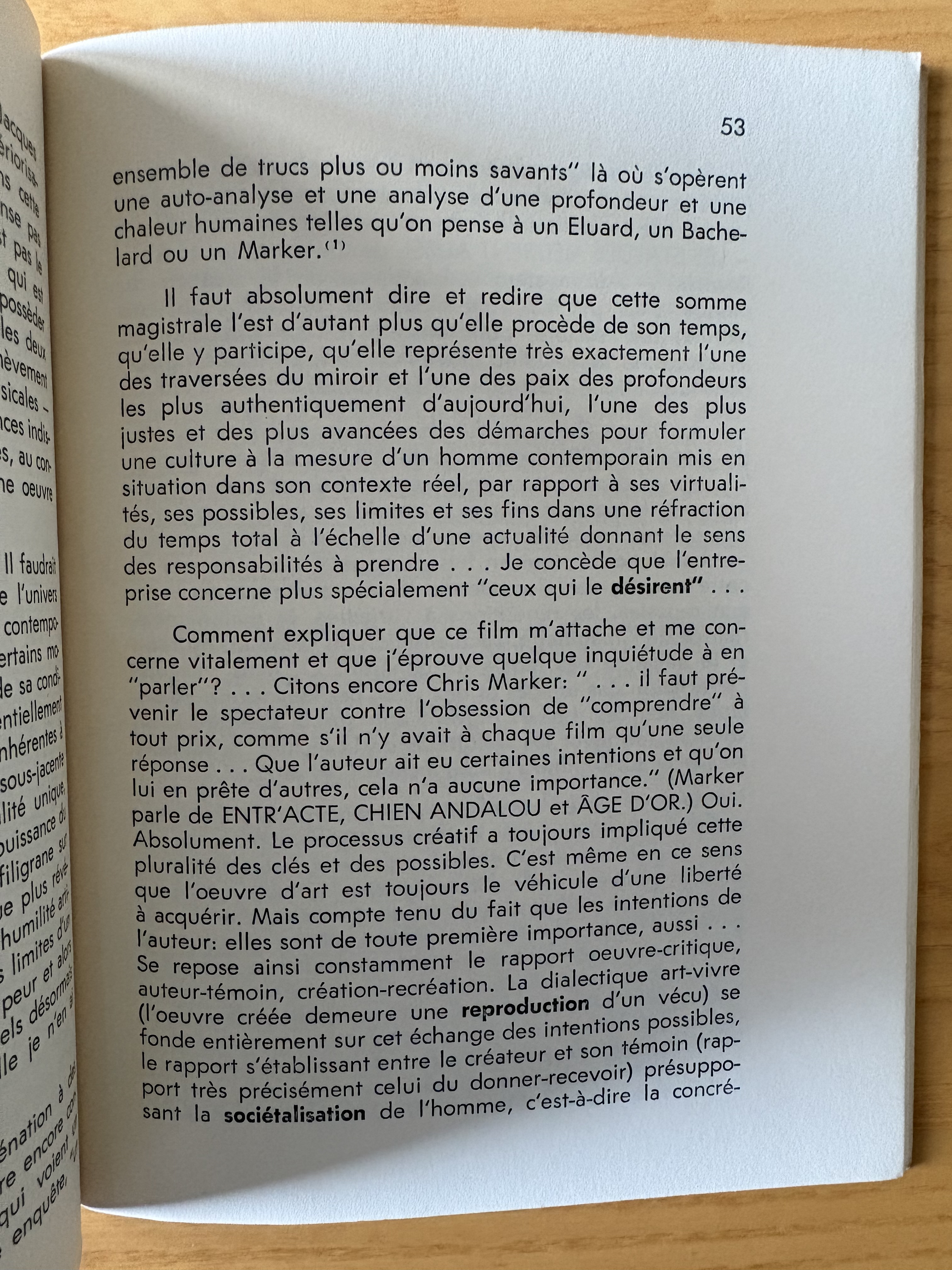
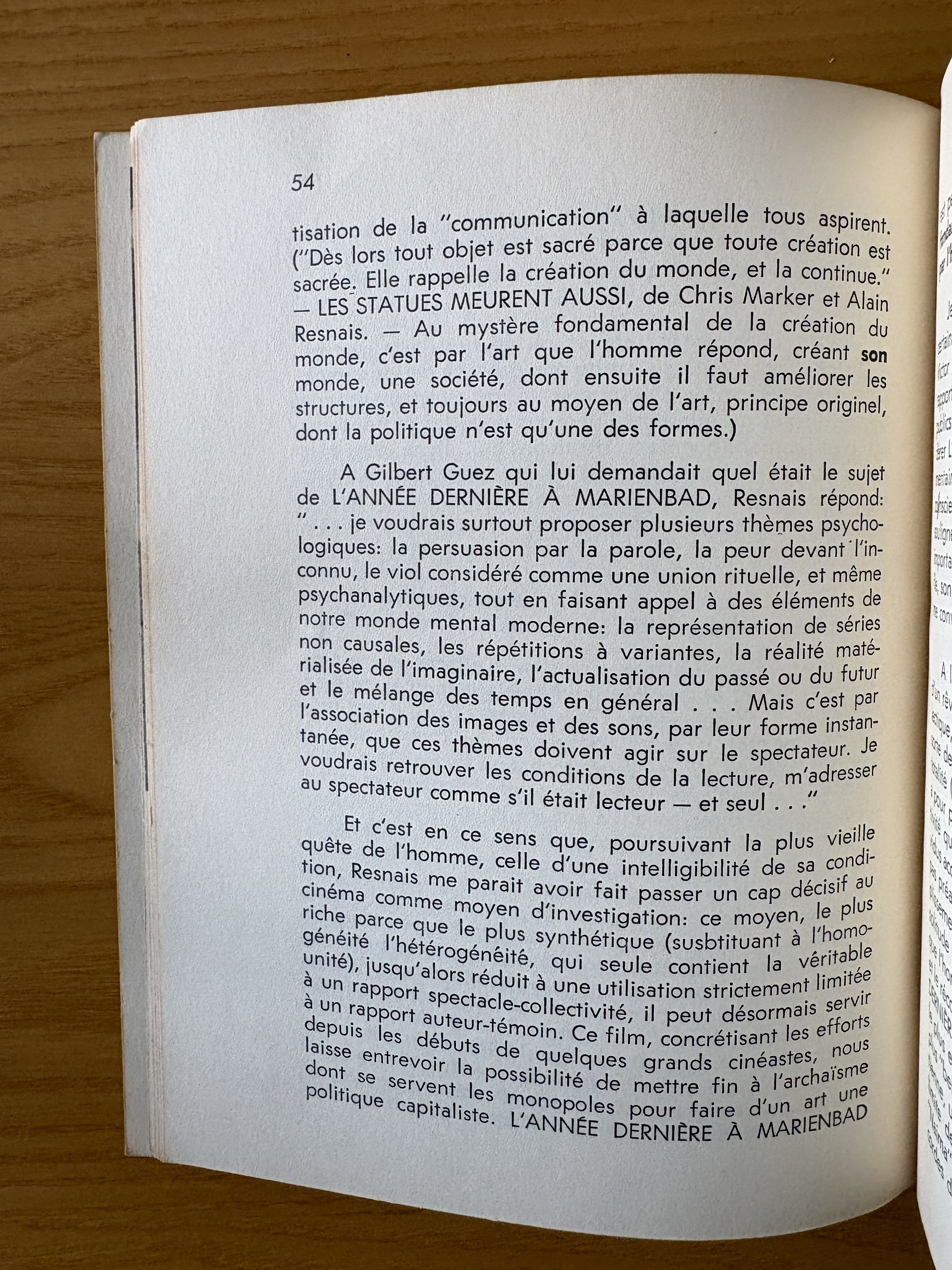
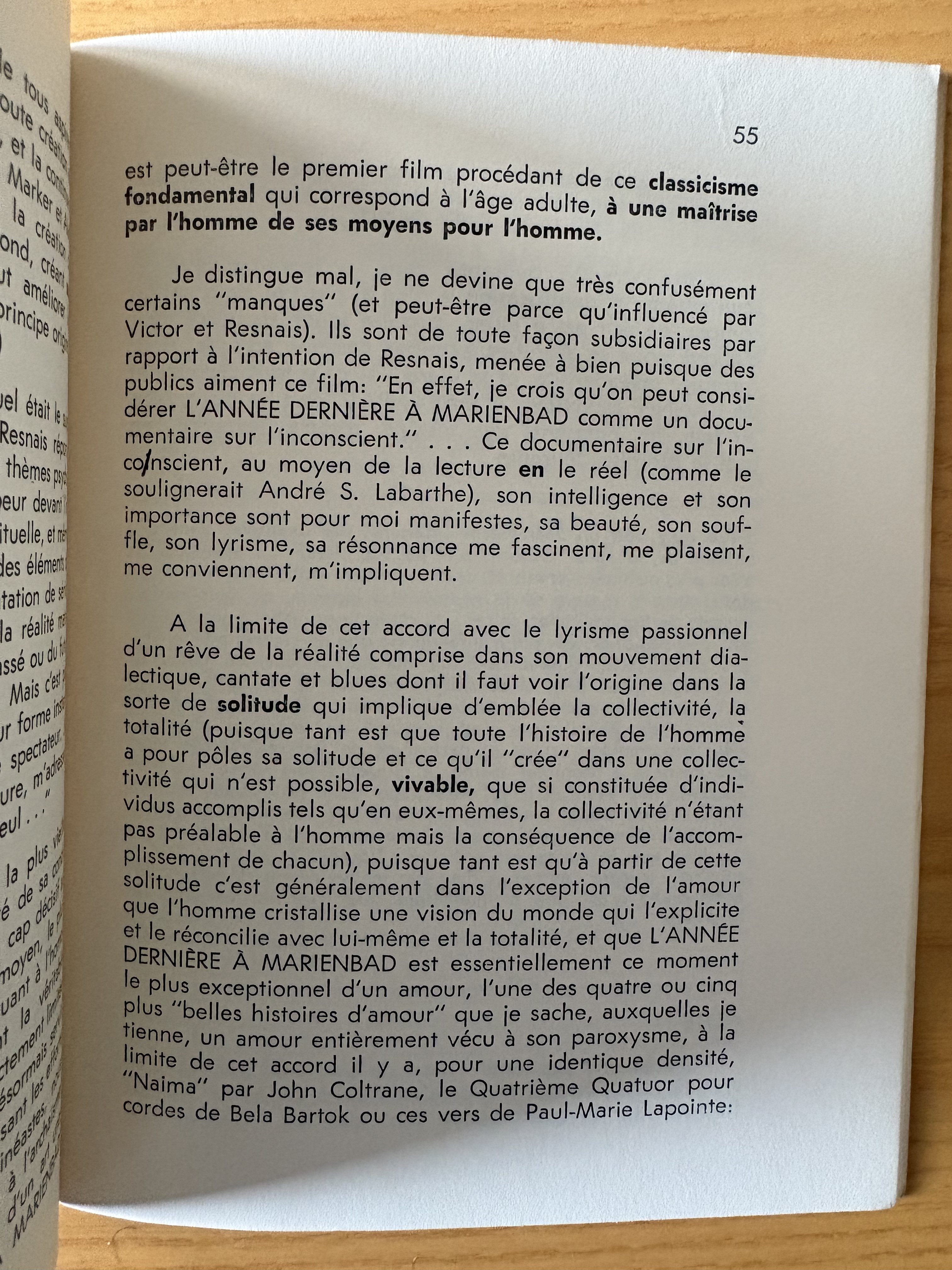
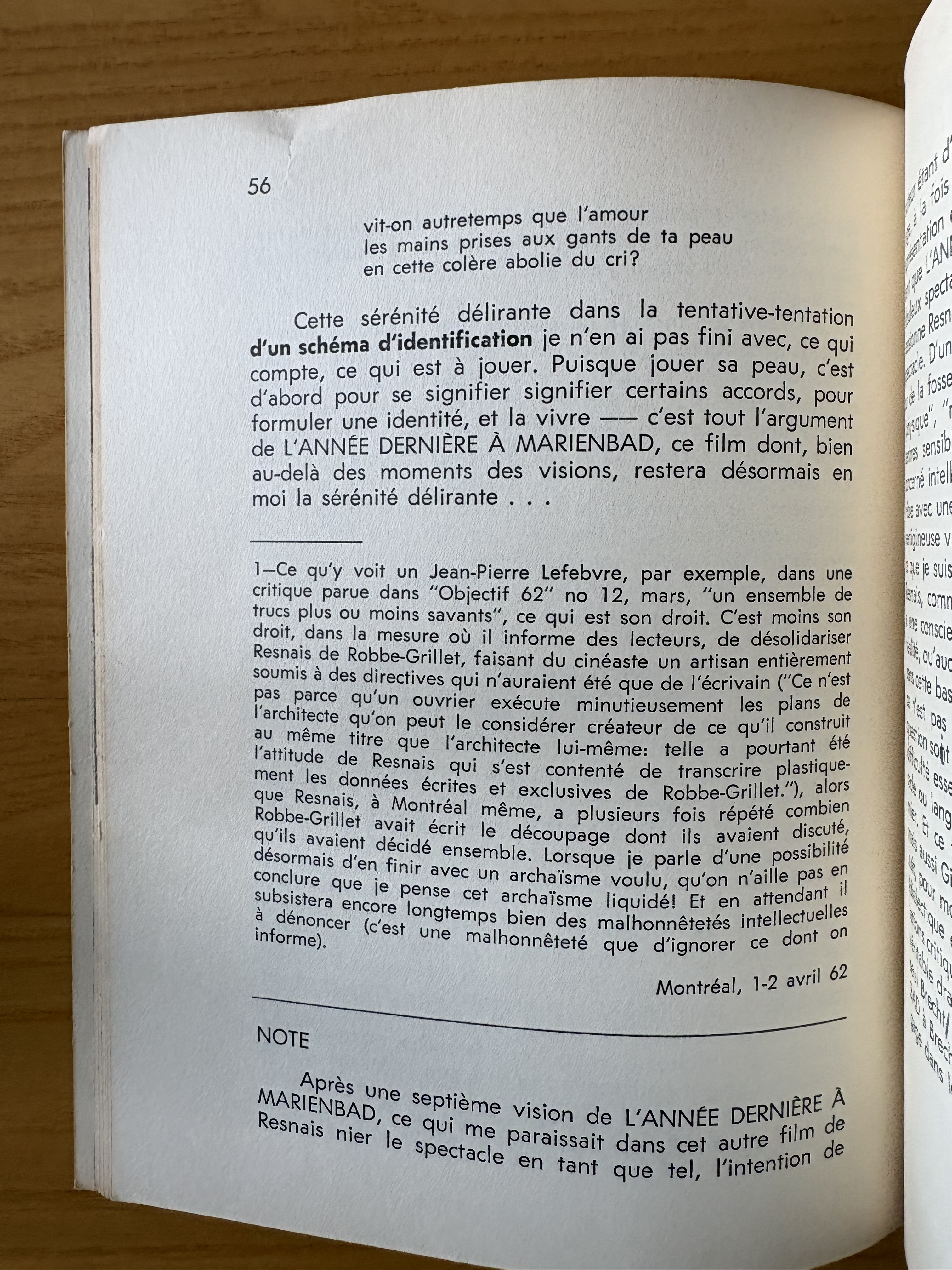
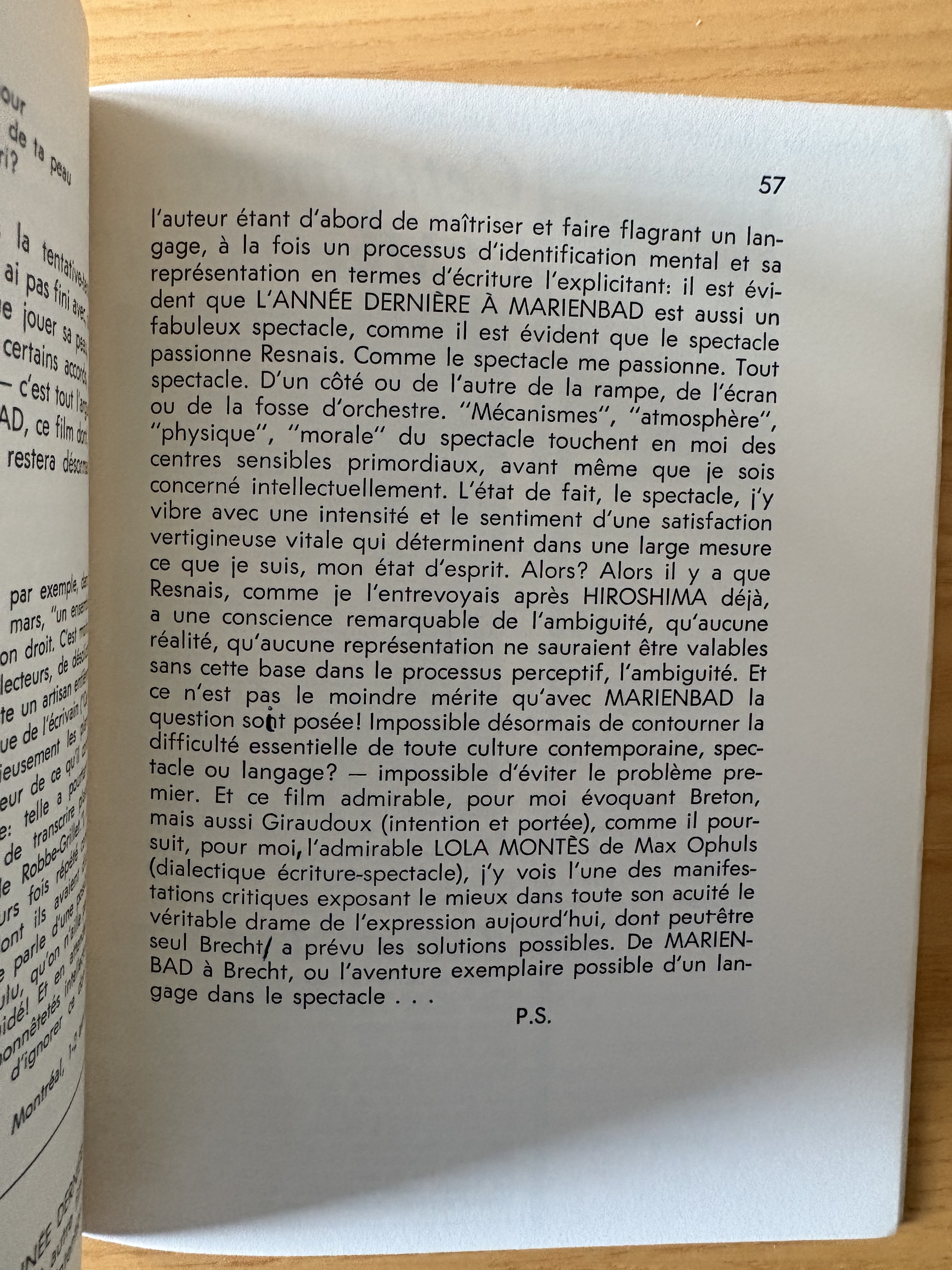
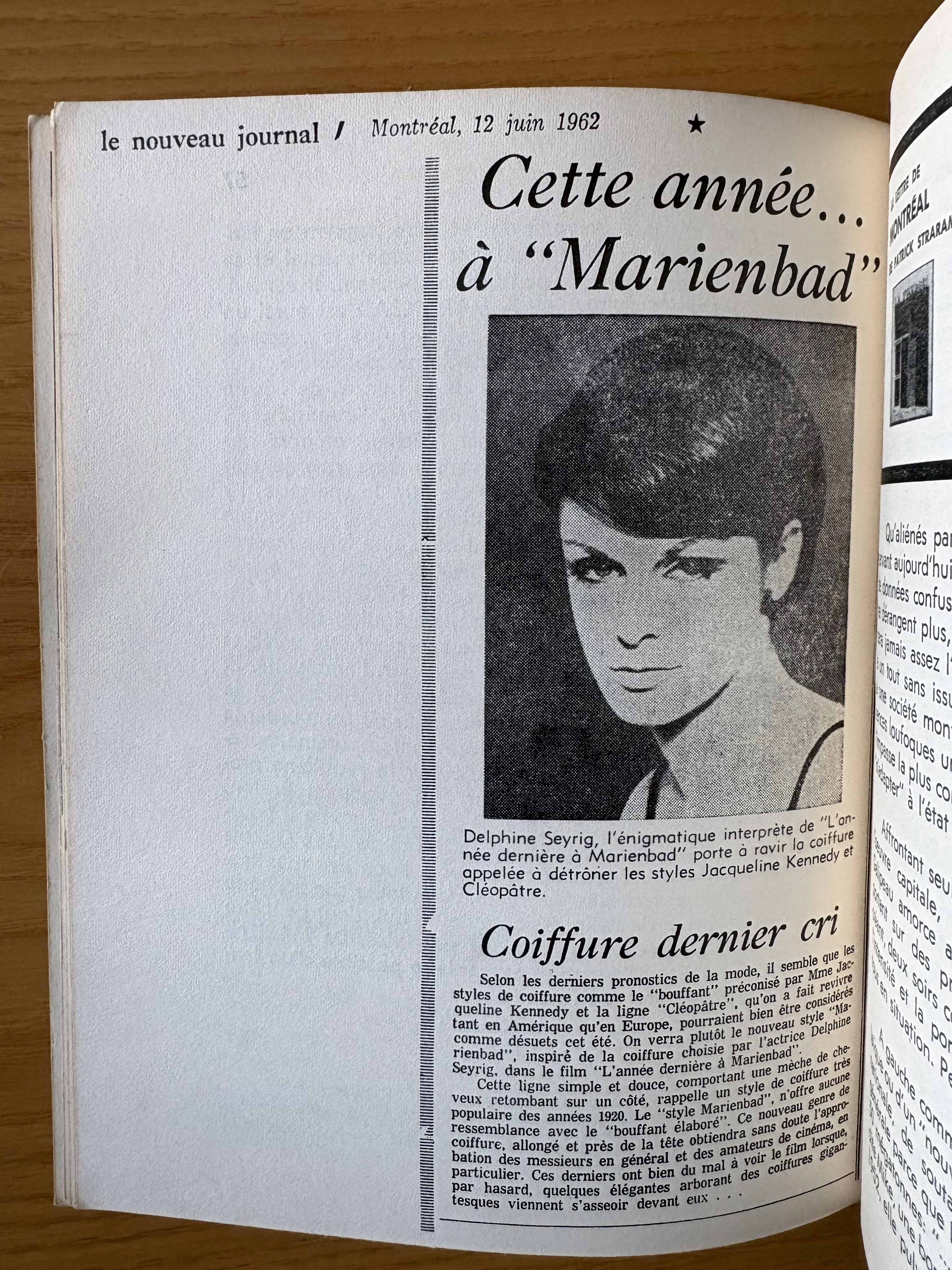
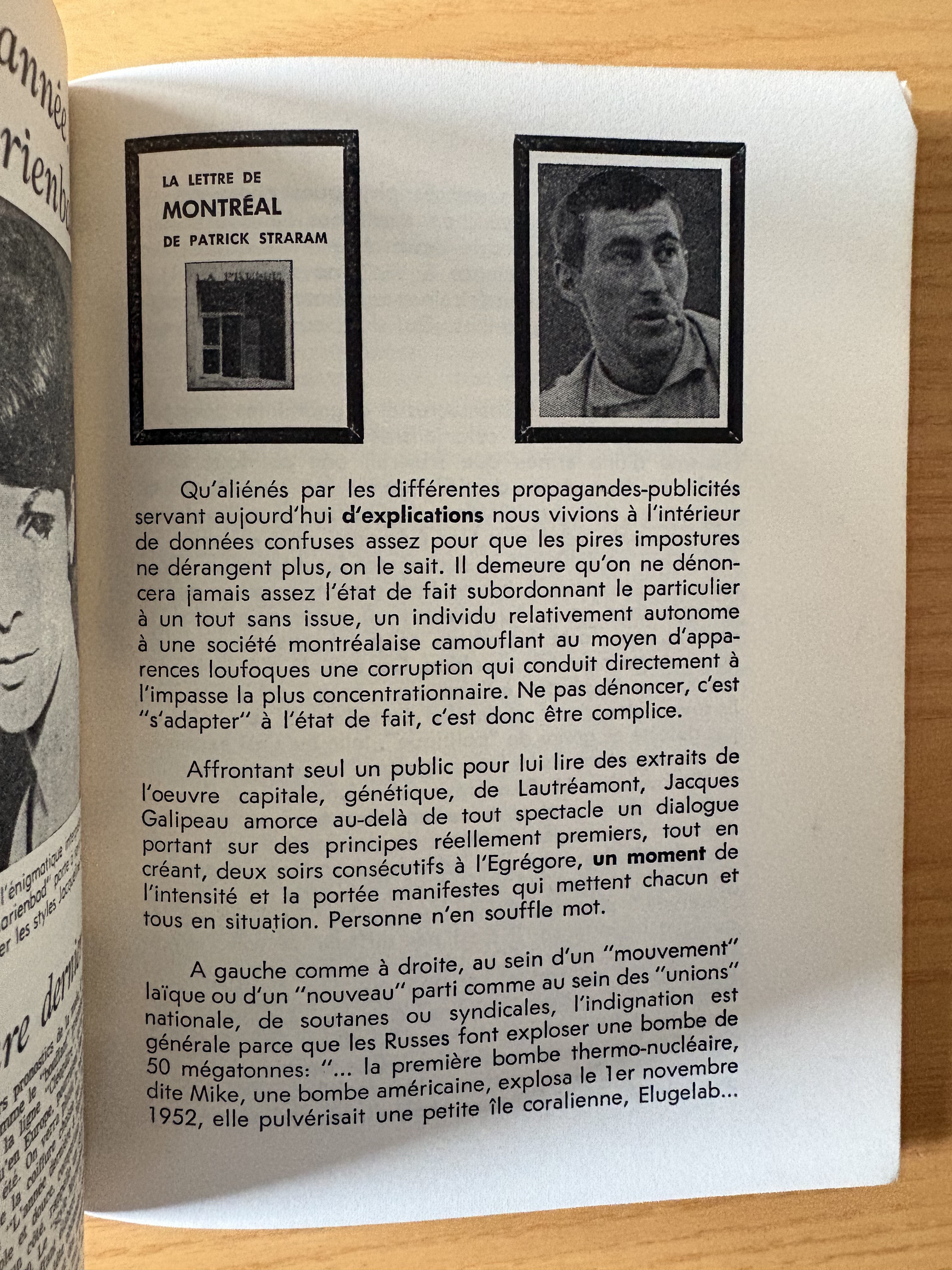
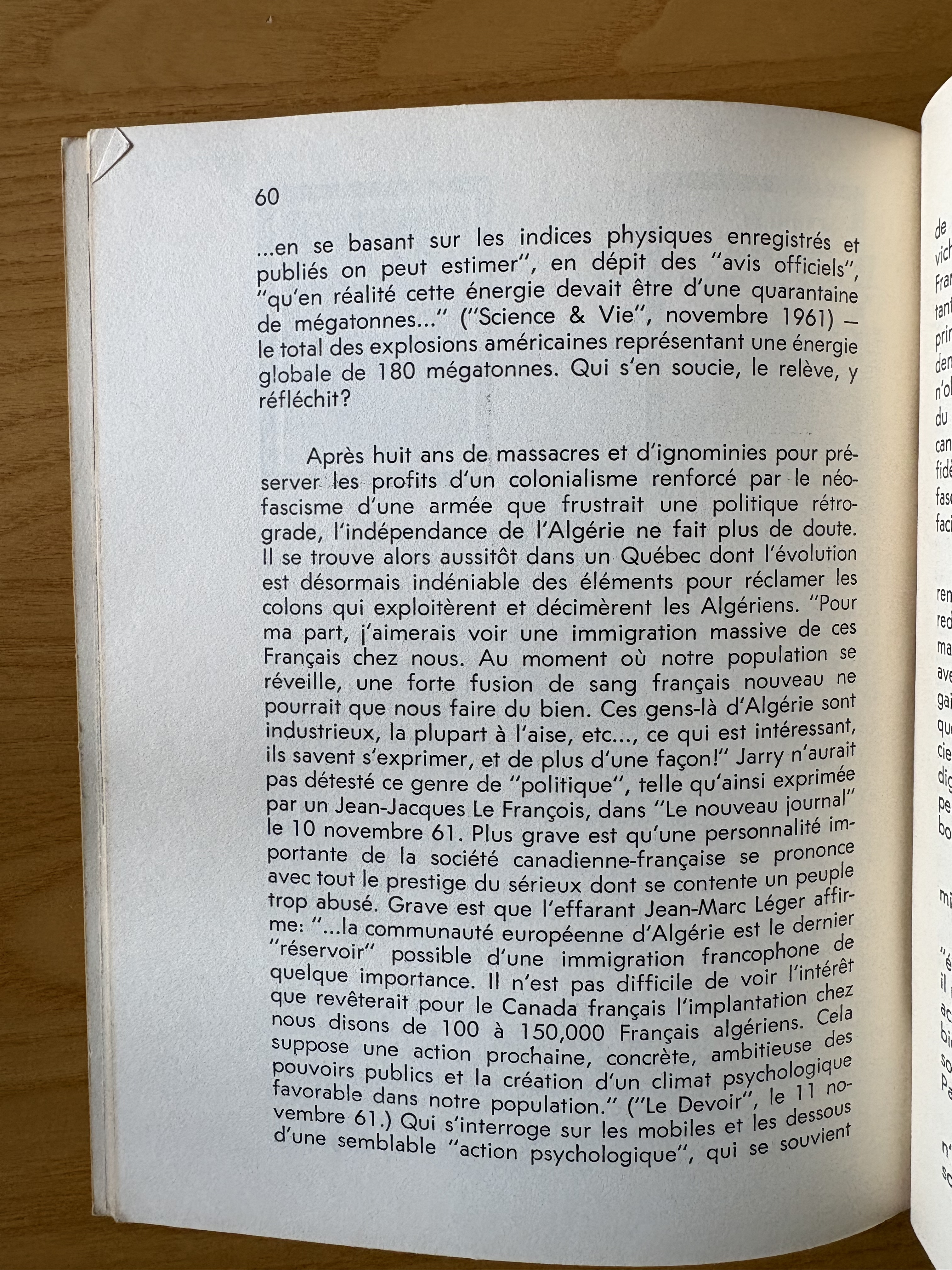
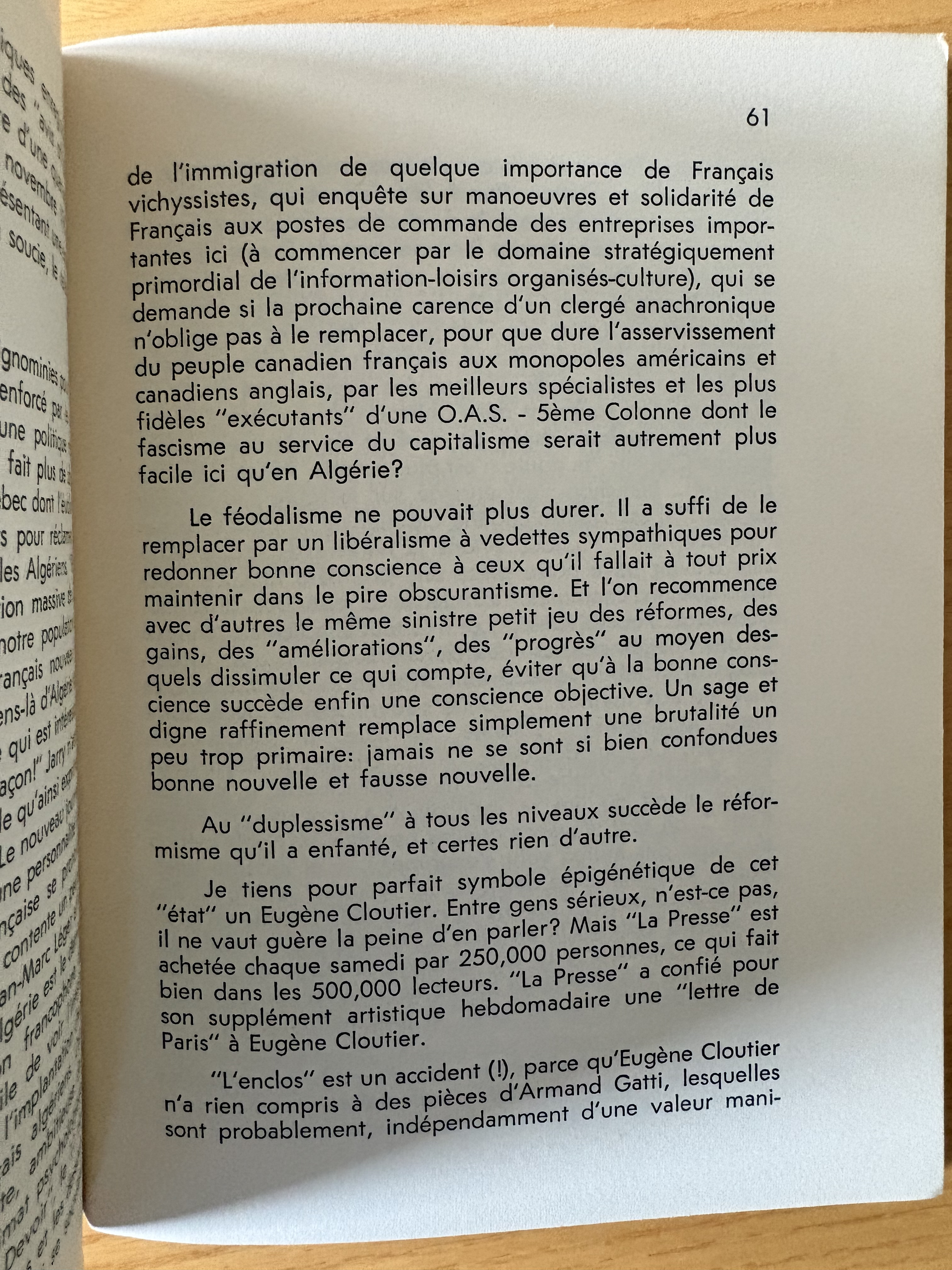
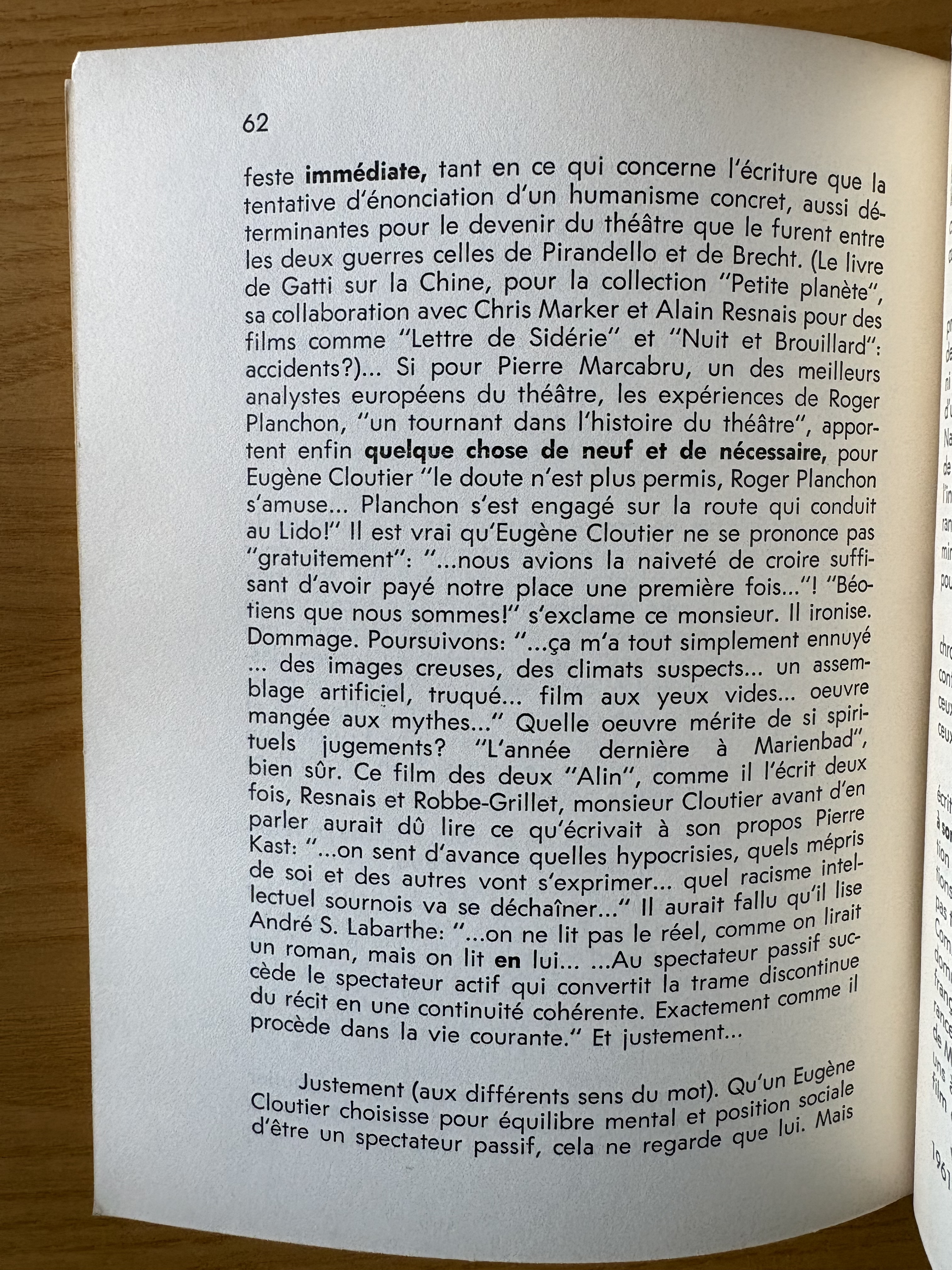
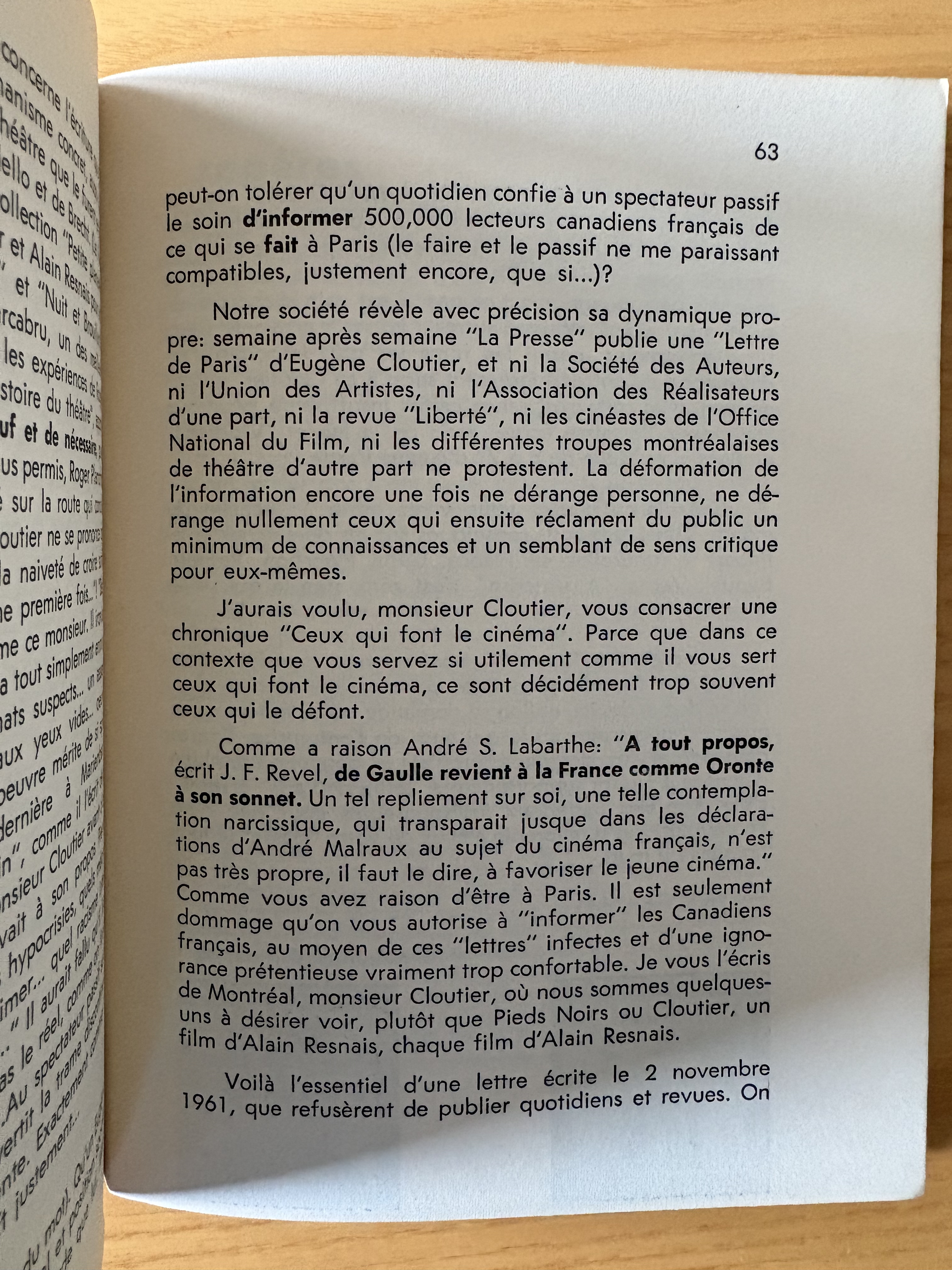
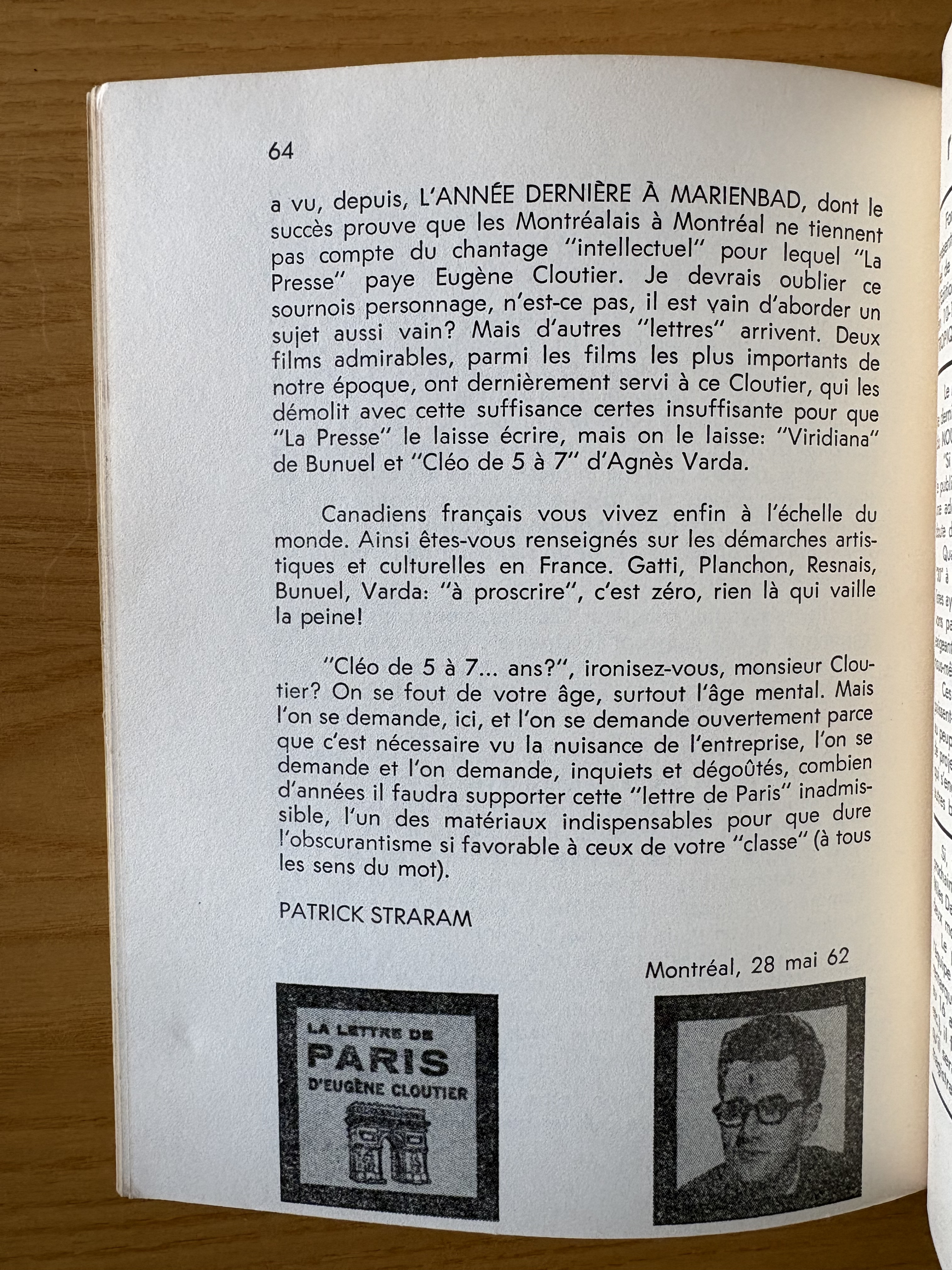
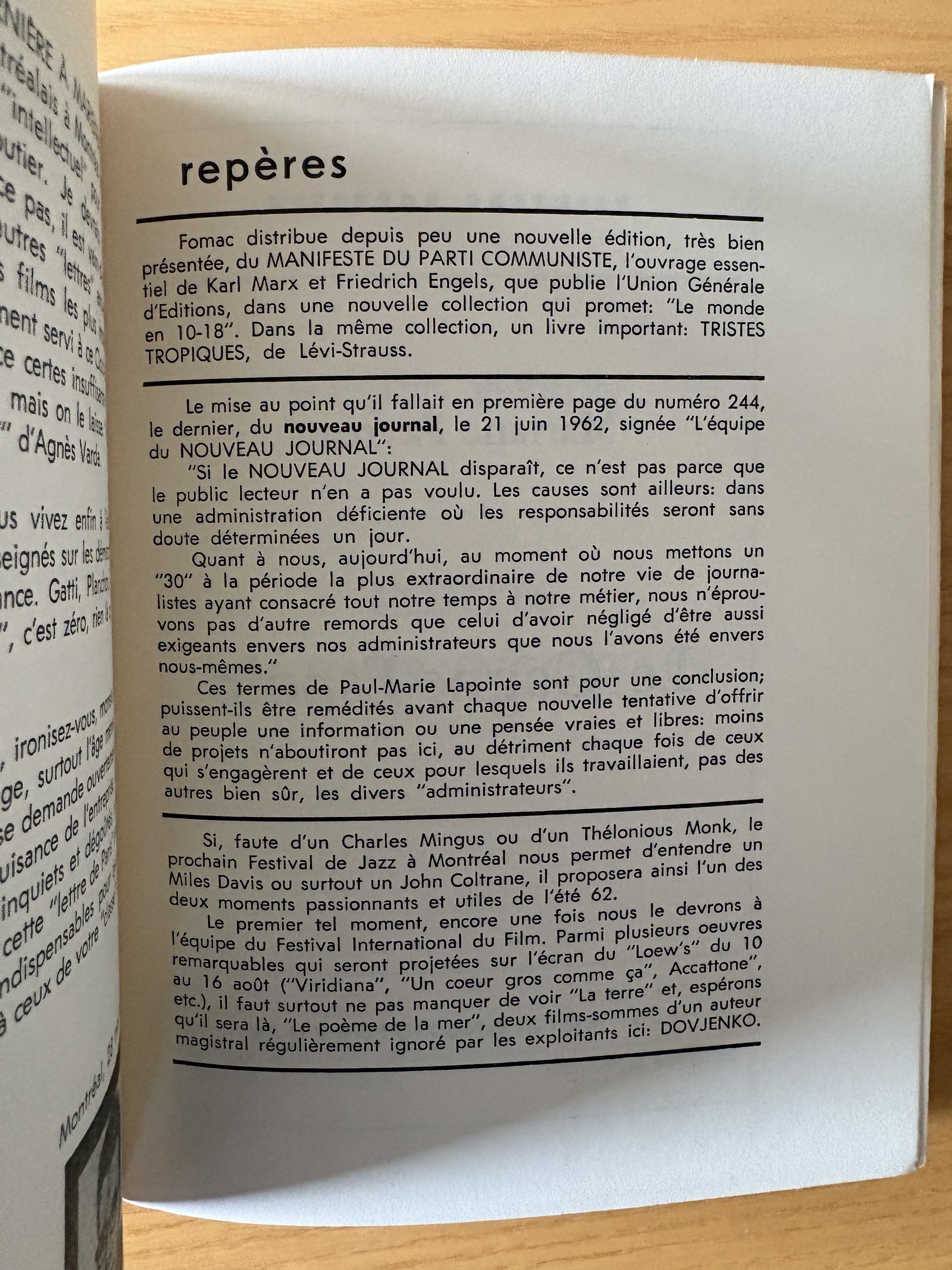
STRARAM, Patrick. “L’Année dernière à Marienbad à Montréal” (in Situations Vol. 4, no.2). Montreal: Situations, July 1962. 68 p. [but only pp. 41-68 present]; ill.; 16 x 20 cm.; ill. Cover with collage by Patrick Straram. Very good; pages 1-40 have been torn out by Straram so that Alain Resnais would only receive the relevant section of the periodical
Patick Straram was the editor of this periodical. Two of the three articles written by Straram (those relevant to Resnais’ film) are present:
“Sérénité délirante d’une tentative tentation” (p.50-57), an elegy of Alain Resnais’ “L’Année dernière à Marienbad“, released in 1961
“Lettre de Montreal” (p.58-64), Staram’s take on the climate in Quebec and around the world in 1962
Straram argued that Resnais’ non-linear editing in Marienbad broke the “passive consumption” of traditional cinema. He was fascinated by the “maze-like topography” of the setting, and critiqued the film as a study of how the ruling class (the characters in the luxury hotel) is imprisoned by its own refusal to acknowledge the past, turning memory into a “malaise” or a “destructive obsession”.
This copy is exceptionally signed by Patrick Straram to the celebrated French filmmaker: “cette tentative pour l’expression d’une réciprocité, bien amicalement a vous , Alain – Patrick Straram” (trans: “This attempt to express reciprocity, with kind regards to you, Alain”)
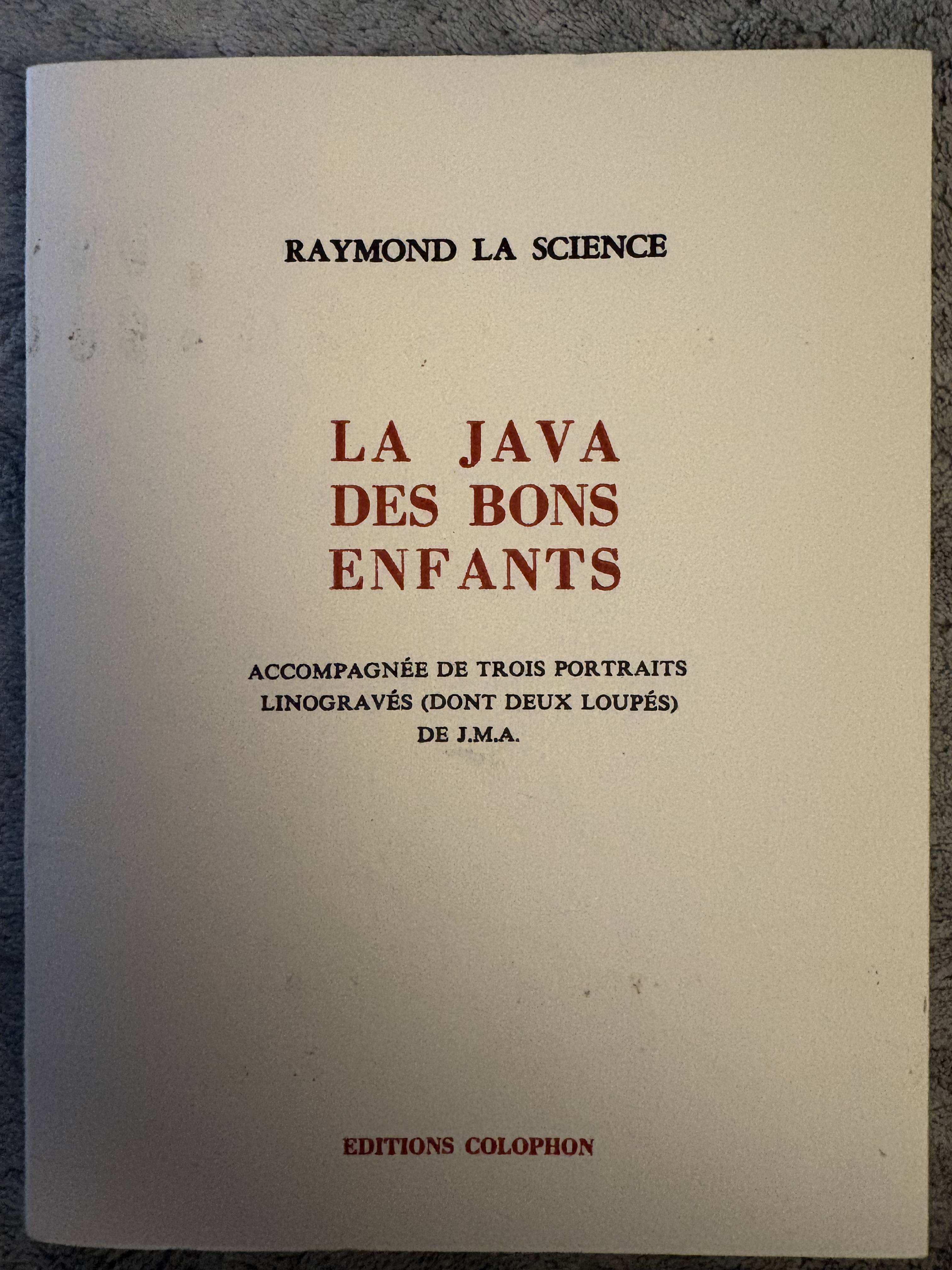
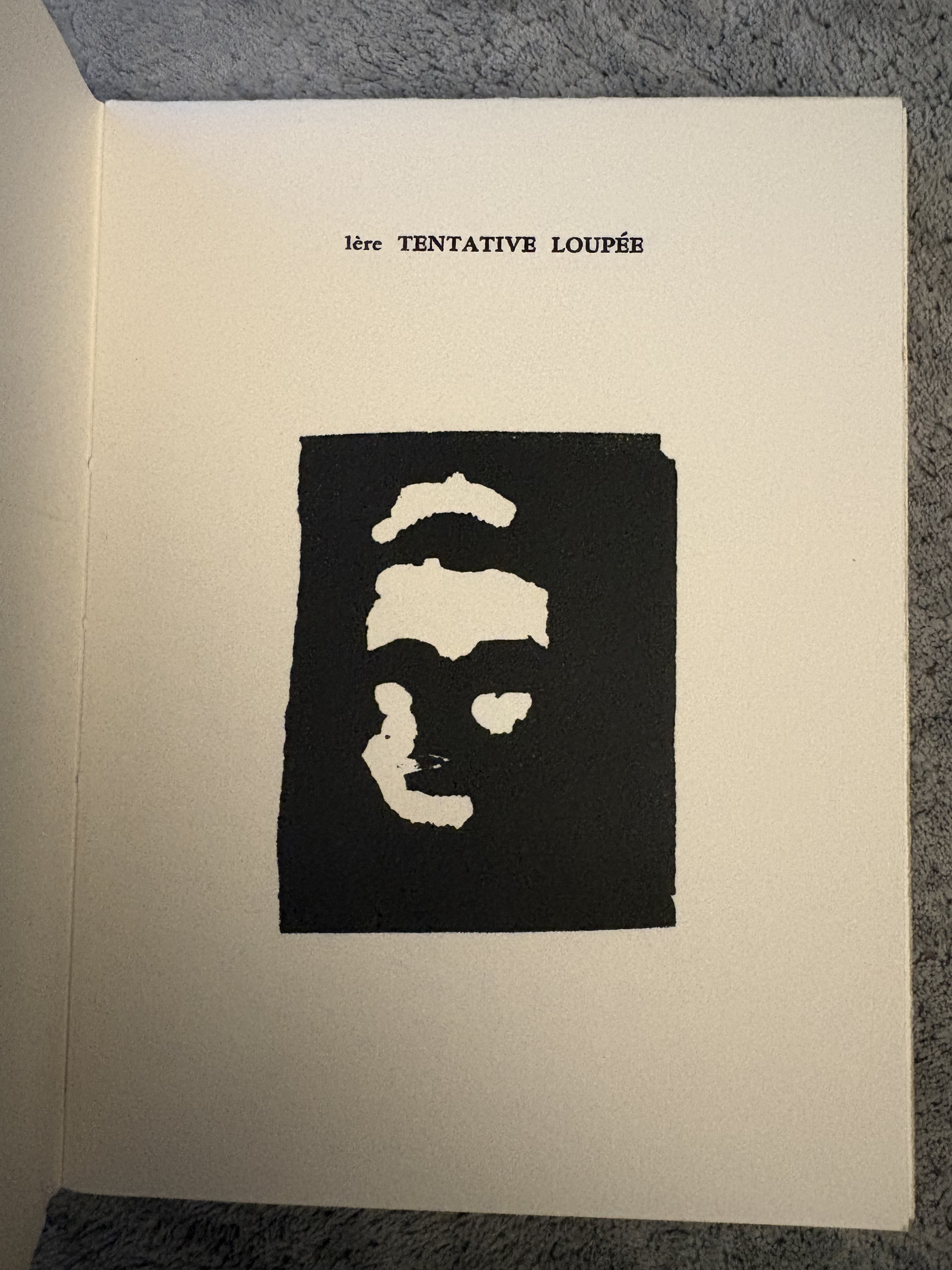
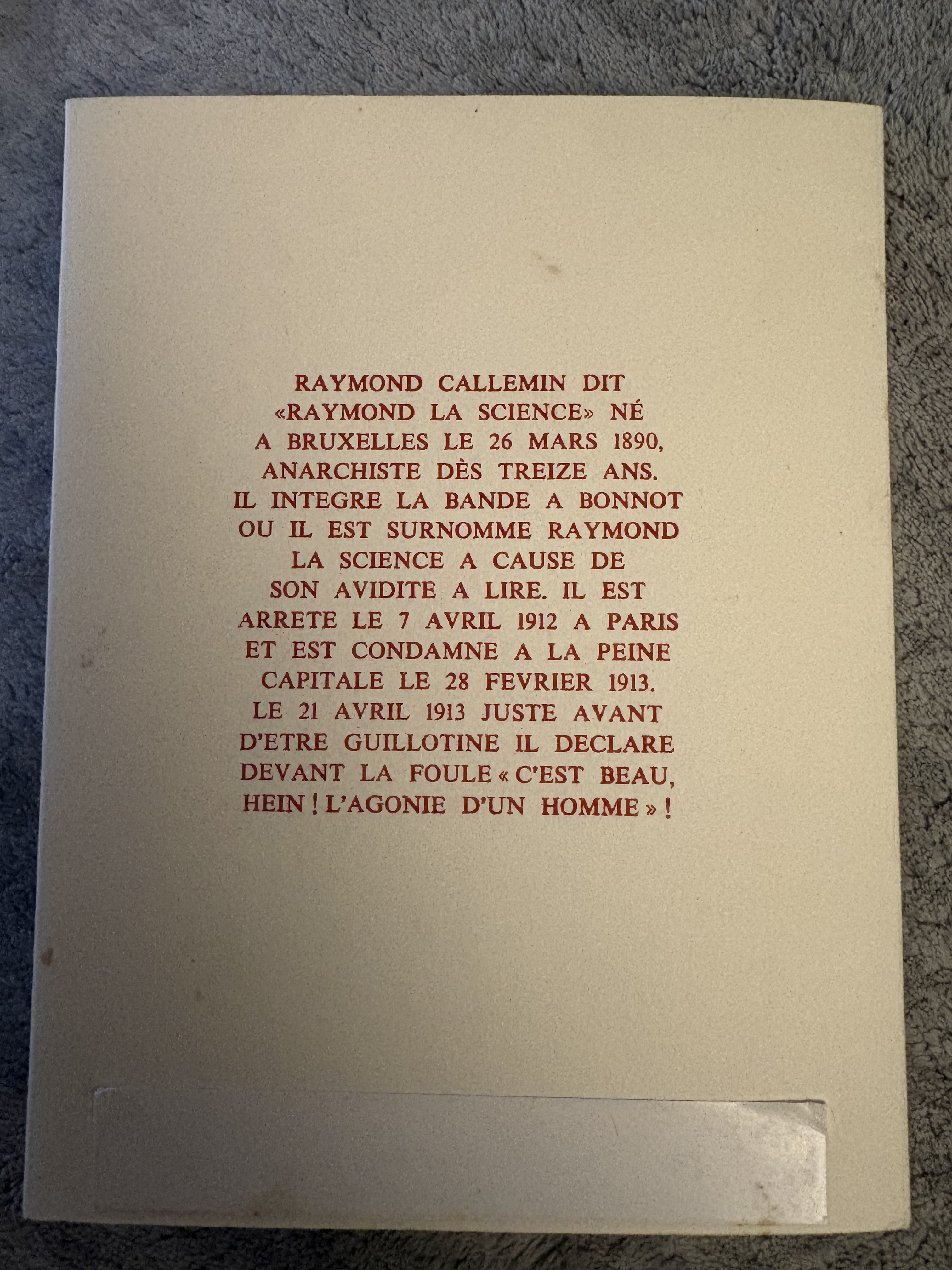
[Debord, Guy] Raymond la Science (pseud.)La java des bons enfants, accompagnée de trois portraits linogravés, dont deux loupés de Jean-Michel Alberola. Grignan: Colophon, 7 Juillet 2006. 22 p.; ill.; 18 cm.; cream cover with text in red and black, uncut pages. One of 130 copies, including 30 signed and numbered by Jean-Michel Alberola (ours #26).
Reproduces the lyrics of the anarchist / Situationist song “La Java des bons enfants”, along with 3 illustrated portraits by Jean-Michel Alberola. The song (and lyrics) were first featured in “Pour en finir avec le travail. Chansons du prolétariat révolutionnaire”, an LP released in 1974 (nore detailed here: https://situationnisteblog.com/2015/04/06/pour-en-finir-avec-le-travail-lp-1974/). While the author of the song is identified as “Raymond la science” – the pseudonym of Raymond Callemin, a notorious member of the anarchist Bonnot Gang – this was a Situationist detournement: Guy Debord is the rightful author of the lyrics,while Francis Lemmonier wrote the music. The first verse reads (translation is mine)
On the Rue des Bons Enfants, Everything is sold to the highest bidder, There used to be a police station, And now it’s gone, A fantastic explosion, Didn’t leave a single brick, We thought it was Fantômas, But it was the class struggle.
We locate a single copy of this rare volume on OCLC, at the French National Library.