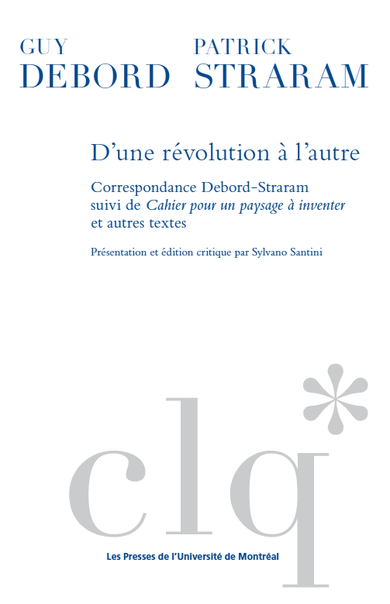
D’une révolution à l’autre. Correspondance Debord-Straram suivi de Cahier pour un paysage à inventer et autres textes [2023]

DEBORD, Guy; STRARAM, Patrick. (Ed. Sylvano Santini). D’une révolution à l’autre. Correspondance Debord-Straram suivi de Cahier pour un paysage à inventer et autres textes. Montréal: Presses de l’Université de Montréal (PUM), 27 March 2023. 416 p.; ill.; 21.5 x 15 cm.; white wrappers with text in blue.

With the exception of perhaps two dozen publications in academic journals, a couple of dissertations, a biography by Marc Vachon (L’arpenteur de la ville : l’utopie urbaine situationniste et Patrick Straram, 2003), Patrick Straram has remained an unjustly neglected figure of the twentieth century avant-garde. Further, and with the exception of Lettre à Guy Debord de Patrick Straram and La veuve blanche et noire un peu détournée (Sens & Tonka, 2006, for both) many of Straram’s writings remain either out-of-print or unpublished.

D’une révolution à l’autre. Correspondance Debord-Straram suivi de Cahier pour un paysage à inventer et autres textes, released last month by the Presses de l’Université de Montréal, attempts to remedy this gap. The book focuses on Straram’s intellectual development in the years following his immigration to Canada (1954) through the publication of the Cahier pour un paysage à inventer (1960).

D’une révolution à l’autre is structured in five sections:

  1. A critical text by Sylvano Santini
  2. A reproduction of the letters between Guy Debord and Patrick Straram (1954-1963)
  3. A reproduction of the full text of the Cahier pour un paysage à inventer
  4. A reproduction of a select number of other texts by Straram from the 1953-1963 period
  5. A postface by Guillaume Bellehumeur

Santini’s text is a comparative study of Debord and Straram’s friendship and intellectual development from 1953 to 1963, and contextualizes the two men’s relationship within their respective milieu. Having accessed Straram’s letters to the actor Jacques Blot (1951-1960), Santini sheds a new light on a very poorly understood part of the man’s life: his 4 years working at a lumberjack in British Columbia, prior to his arrival in Montreal in June 1958. For instance, one is surprised to learn about Straram’s interest in Ayn Rand, and the strong influence the character of  Howard Roark in The Fountainhead (1943) had on him at the time. For this reason, and many others, Santini’s article is an innovative and welcome contribution to Situationist scholarship.

The reproduction of the letters between Debord and Straram is useful, though with one exception, those had already appeared in either Guy Debord’s Correspondance or Lettre à Guy Debord de Patrick Straram. It may have been judicious to include the yet-unpublished letters between Straram and Blot instead.

The reproduction of the full text of the Cahier pour un paysage à inventer, should be celebrated. The first and only issue of the Situationist-influenced, Quebec-based periodical has remained extremely scarce, with only three copies on OCLC, all in Canada (Sherbrooke, Montreal, UQAM). This publication includes articles, poems and critical texts by Quebec writers (Gaston Miron, Marie-France O’Leary, Paul-Marie Lapointe, Gilles Hénault, Serge Garant, Marcel Dubé…) and members of the Internationale Situationniste (Asger Jorn, Gilles Ivain, Guy-Ernest Debord…).

The penultimate section of the book includes several hard-to-find texts by Straram. The reprint of Straram’s mythical article in Tremplin, the bulletin of the patients of the psychiatric hospital of Ville-Evrard (where the author was briefly interned), is very worthwhile. Likewise, Quelque part Salt Spring had never been published before, and appears here for the first time. These are important milestones in Straram’s intellectual journey, and help us better understand his personal trajectory.

Finally, a postface by Guillaume Bellehumeur with the tongue-and-cheek title of “De la diffusion de la pensée de l’IS en milieu québécois, considérée sous ses aspects culturel, cinématographique et notamment littéraire, et de quelques figures qui y ont contribué” (a reference to Mustapha Khayat’s pamphlet), demonstrates the ways in which the Situationist International influenced Quebecois intellectual culture, and how a second issue of the Cahier had been well underway.

Overall, D’une révolution à l’autre is an important for those interested in Guy Debord, Patrick Straram, the Quebecois counterculture of the early 1960s, and the intersection of all three.

Note: Our review copy was graciously provided by the Presses de l’Université de Montréal
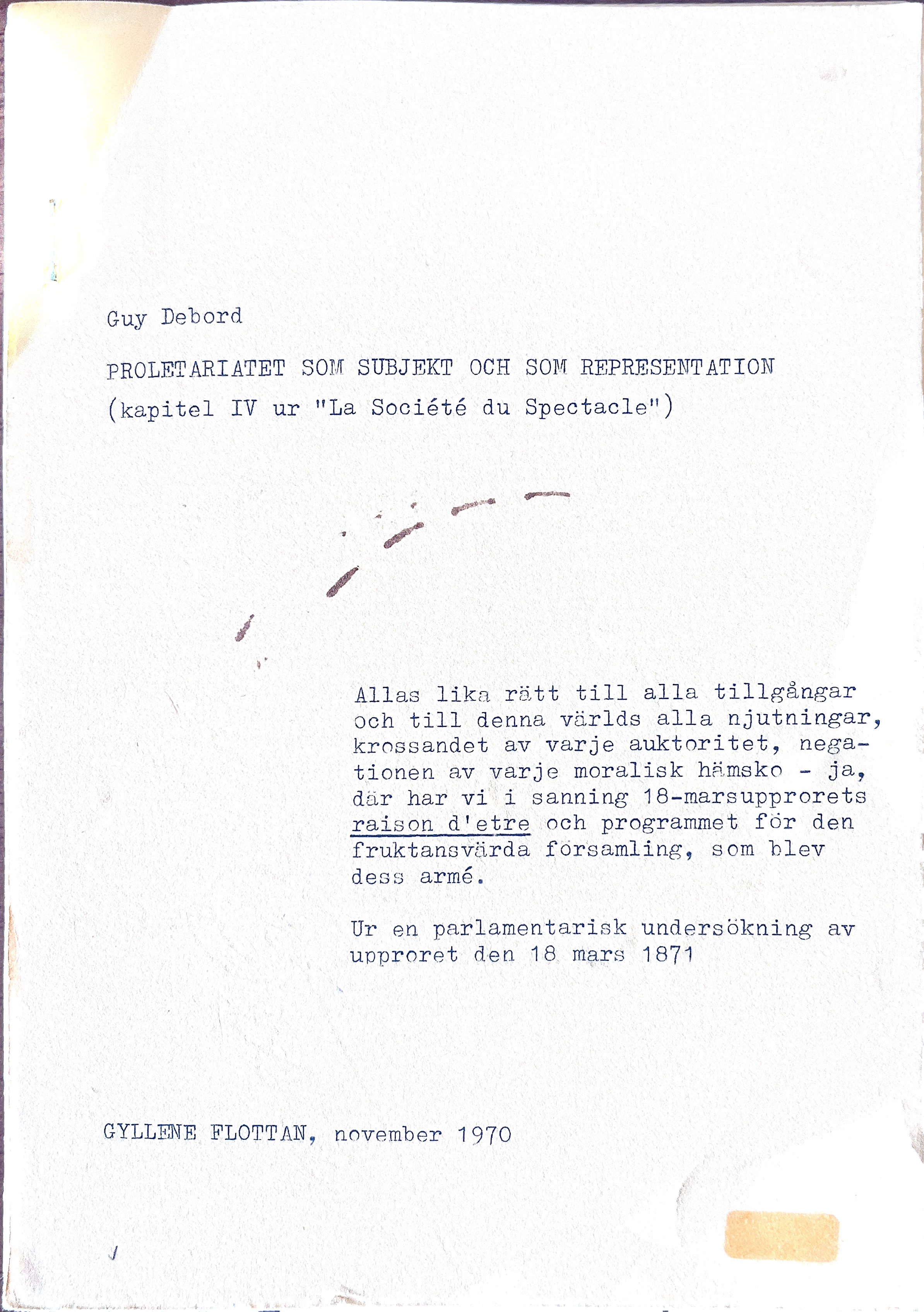
[DEBORD, Guy] Proletarietet som subjekt och som representation (brochure) [1970]

[DEBORD, GUY]. [la Société du Spectacle] Proletarietet som subjekt och som representation. Stockholm: Gyllene Flottan, November 1970. 48 p.; 21 x 14.5 cm.; black ink on yellow stock.

Translation by the Swedish pro-Situationist group Gyllene Flottan (“The Golden Fleet”, a reference to J.V. Martin’s geopolitical paintings) of the fourth chapter of Guy Debord’s La Société du spectacle (theses 73-125). The translation is preceded by a short preface by Gyllene Flottan.

More on Gyllene Flottan (from Wikipedia):

The Golden Fleet (SwedishGyllene Flottan) was a minor left-wing group in Sweden, existing during the end of the 1960s and the beginning of the 1970s. It was ideologically aligned with the Situationist International, an avant-garde revolutionary movement. The Situationists, whose intellectual foundations were derived primarily from libertarian Marxism and the avant-garde art movements of the early 20th century (particularly Dada and Surrealism),[1] initially put its emphasis on concepts like unitary urbanism and psychogeography. Gradually the focus moved more towards revolutionary and political theory. Much like the main organ of that particular ideological current, the Situationist International, the Golden Fleet had its heyday around the protests of 1968, gradually disappearing by the first years of the 1970s.

Extremely little is known about the Golden Fleet, yet still it became notorious, this to such an extent that it has been labelled “legendary”.[2] Nothing is known about its establishment, composition, and disestablishment. The name was most likely taken from an art exhibit in Denmark by the Situationist Jeppesen Victor Martin, which consisted of geopolitical paintings featuring coastlines, strategic arrows and toy battleships sprayed over with metallic paint.[3] The group was centered in the capital Stockholm, although some members appear to have been from Gothenburg. It is primarily notable through the fact that its members were those that introduced situationist writings to Sweden by its brief but hectic work with publishing political texts. Among them were Instruktion i vapendragning in 1970 (a translation of “Instructions for an Insurrection”, originally published 1961), as well as longer translations of texts by Guy Debord and Raoul Vaneigem among others.[4]

The group also produced a number of works on its own, prominent among them the poster “Hang the Stalinists High” (SwedishHäng stalinisterna högt, on the subject of the contemporary left-wing) and the brochure “King Gustaf’s Sardines” (SwedishKung Gustafs sardiner) which discussed the “meaningful meaninglessness of the Swedish students”. Another Situationist group existed in Sweden, the Second Situationist International of Jørgen Nash, but there appears to have been no connection between the Golden Fleet and the Nashists.

We do not locate any reference to this leaflet in any know bibliographies or on OCLC. However, Monoskop refers to it.

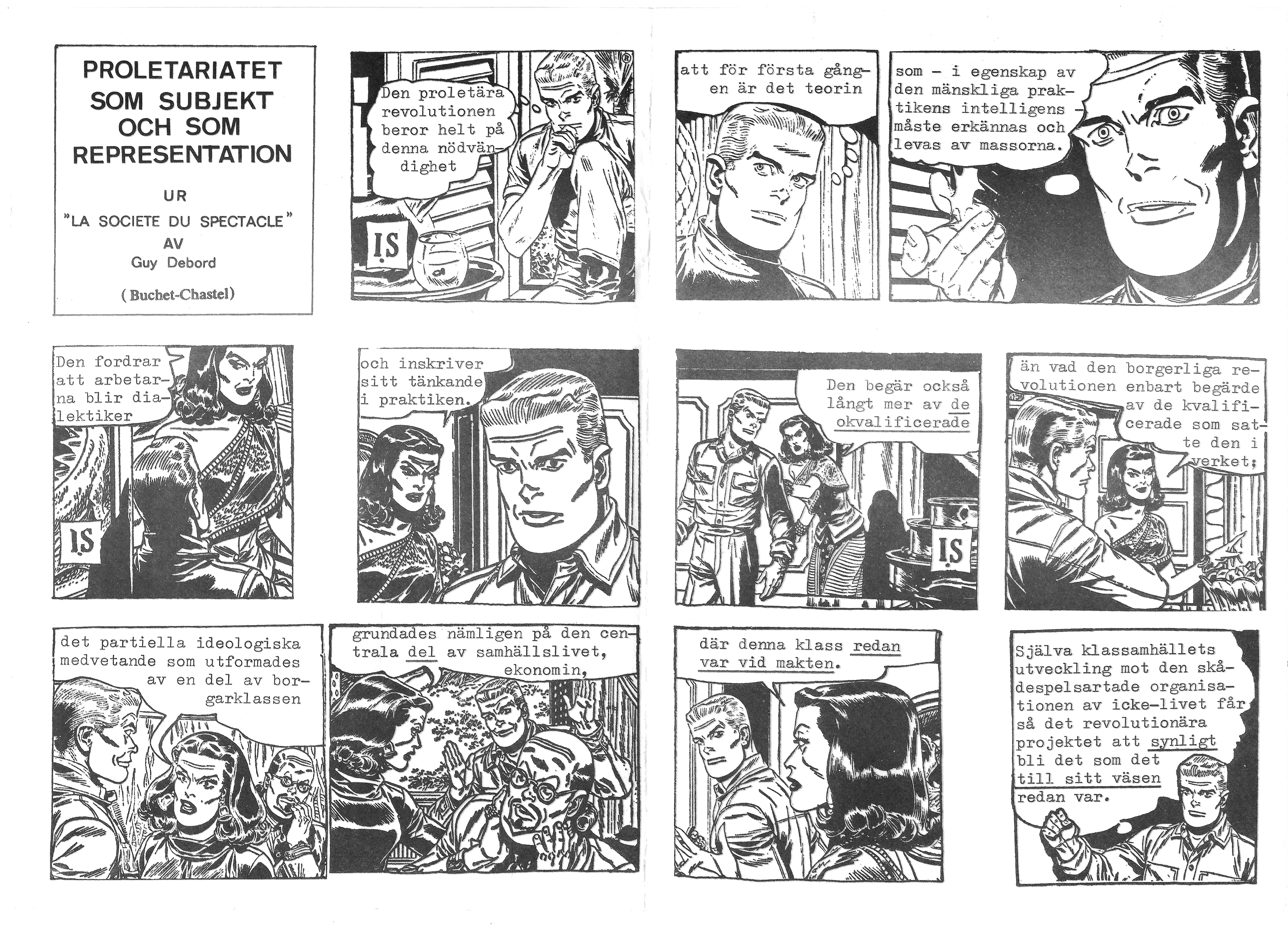
[DEBORD, Guy] Proletarietet som subjekt och som representation (leaflet) [1970]

[DEBORD, GUY]. Proletarietet som subjekt och som representation. n.p. [Stockholm]: n.p. [Gyllene Flottan], n.d. [1970]. 1 p.; ill.; 21 x 29.5 cm.; black ink on white stock.

Translation by the Swedish pro-Situationist group Gyllene Flottan (“The Golden Fleet”, a reference to J.V. Martin’s geopolitical paintings) of a French-language detourned comic that announced the publication of Guy Debord’s La Société du spectacle. The text in is from the fourth chapter, thesis no. 123 of the book. The détourned comic is from the American action-adventure comic strip Terry and the Pirates.

This leaflet was likely released alongside the first partial Swedish language translation of Debord’s book, specifically of Chapter 4 (also titled “Proletarietet som subjekt och som representation”). We do not locate any reference to this leaflet in any know bibliographies or on OCLC.

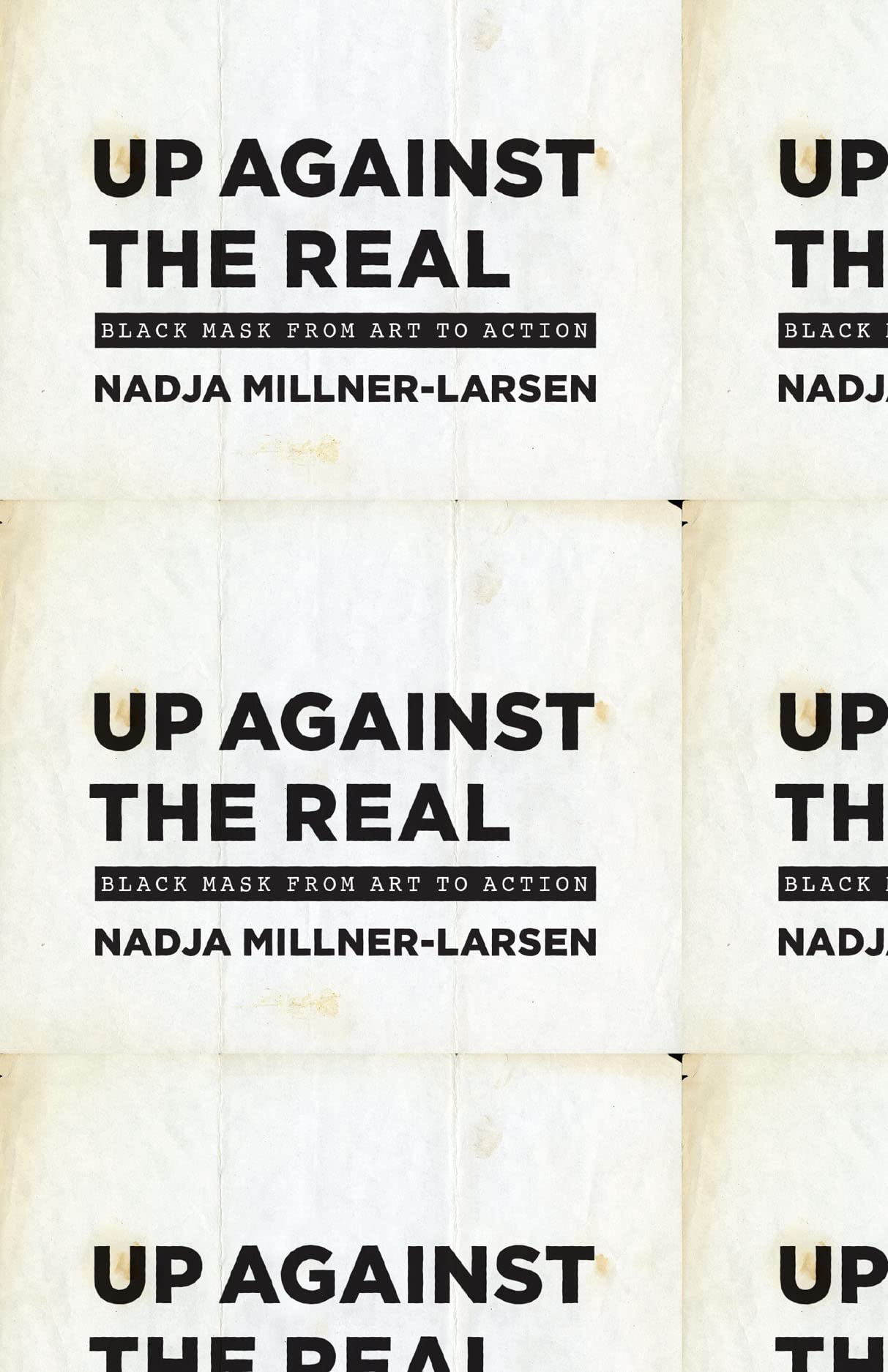
Up Against the Real: Black Mask from Art to Action [2023]

MILLNER-LARSEN, Nadja. Up Against the Real: Black Mask from Art to Action. Chicago: University of Chicago Press, 7 March 2023. 288 p.; ill.; 23 x 15 cm.; ill. Cover with text in black and white.

Art Historian Nadja Millner-Larsen authors the first book-length scholarly study of Black Mask.

“”With Up Against the Real, Nadja Millner-Larsen offers the first comprehensive study of the group Black Mask and its acrimonious relationship to the New York art world of the 1960s. Cited as pioneers of now-common protest aesthetics, the group’s members employed incendiary modes of direct action against racism, colonialism, and the museum system. They shut down the Museum of Modern Art, fired blanks during a poetry reading, stormed the Pentagon in an antiwar protest, sprayed cow’s blood at the secretary of state, and dumped garbage into the fountain at Lincoln Center. Black Mask published a Dadaist broadside until 1968, when it changed its name to Up Against the Wall Motherfucker (after line in a poem by Amiri Baraka) and came to classify itself as “a street gang with analysis.” American activist Abbie Hoffman described the group as “the middle-class nightmare . . . an anti-media phenomenon simply because their name could not be printed.” Up Against the Real examines how and why the group ultimately rejected art in favor of what its members deemed “real” political action. Exploring this notorious example of cultural activism that rose from the ruins of the avant-garde, Millner-Larsen makes a critical intervention in our understanding of political art.” (Publisher)

For more on Black Mask, see https://situationnisteblog.wordpress.com//?s=%22black+mask%22&search=Go

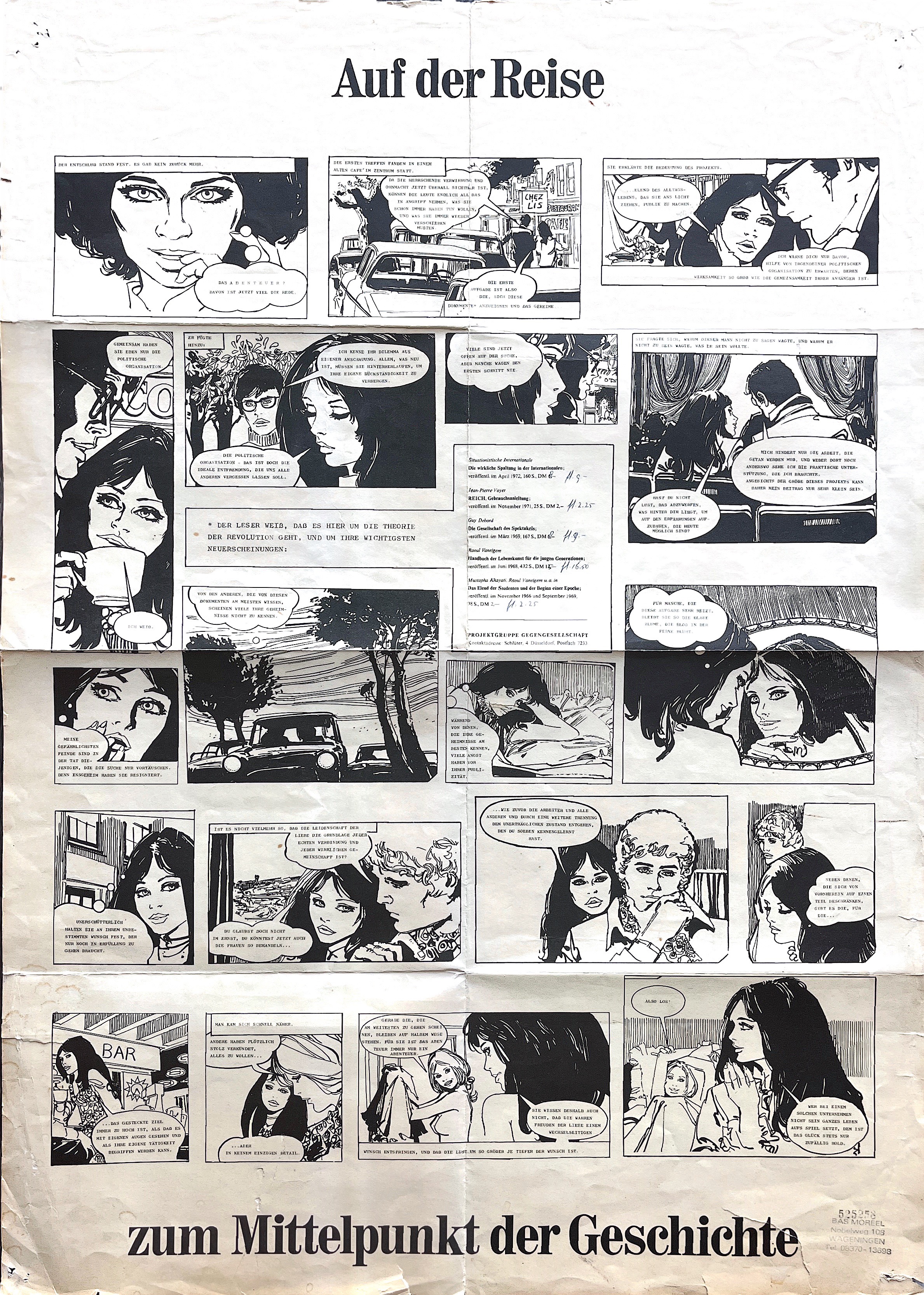
Auf der Reise zum Mittepunkt der Geschichte [1973]

PROJEKTGRUPPE GEGENGESELLSCHAFT. Auf der Reise zum Mittepunkt der Geschichte. Dü̈sseldorf : Projektgruppe Gegengesellschaft, n.d.[1973]. 1 p.; 49.5 x 69.5 cm.; ill. B&W comics on white stock

“Detourned comix style design promoting Situationist publications available through the Projektgruppe Gegengesellschaft in Dusseldorf, with prices in German Mark and Dutch Guilders added in blue handwriting. Contains a stamp on lower right corner of Bas Moreel, a publisher/distributor of anarchist literature in Wageningen” (Zwigelaar)

Projektgruppe Gegengesellschaft was a pro-situ German group that translated and published numerous SI and post-SI texts into German. These include Das Elend der Studenten und der Beginn einer Epoche (translation of De la misère en milieu étudiant from 1966 and “Le commencement d’une époque”, in Internationale Situationniste 12, 1969) , Die Gesellschaft des Spektakels (translation of La Société du spectacle, 1967), Handbuch der Lebenskunst fur die jungen Generationen (translation of Traité de savoir-vivre à l’usage des jeunes générations, 1967), etc. They appear to have published a periodical, Zero : alternativ Zeitung, 11 issues of which were released between 1972 and 1977.

We do not locate any OCLC copies, though Ken Knabb states that a copy is part of his archive at Yale University (see http://www.bopsecrets.org/recent/yale-inventory.htm)

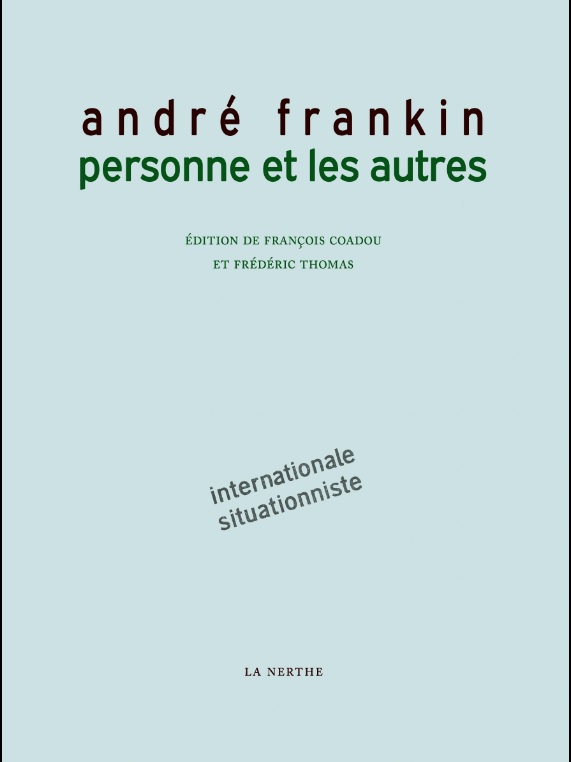
Andre Frankin, Personne et les autres (1960) [2023]

FRANKIN, André. Personne et les autres (1960). Ed. Francois Coadou and Frederic Thomas. Toulon, La Nerthe, March 2023. 116 pages.

We are excited to announce the publication of a previously unreleased text by A. Frankin, one of the most obscure figure of the Situationist movement.

About Andre Frankin.

“André Frankin is not well-known and his impact on the lettrist and situationist movements are hard to measure” states scholar Jean-Marie Apostolides. André Frankin (also know “Robert Rivier” and “Léonard Rankine”) was born on 16 June 1925 in Liege, Belgium and died in the same city on 28 March 1990. Born into a middle class family, he suffered from neurological issues as a child that left him partially disabled – he walked and, at times, spoke with difficulty. Yet, he was viewed as intelligent and well-read. He first met Debord and the Internationale Lettriste through the Metagraphies exhibition in Paris in 1954. He then wrote several articles in Potlatch under the pseudonym “Leonard Rankine”, including “Perspectives of the Paris and London agreements” (Potlatch 15, December 1954). His contributions to the SI include: “Platform for a cultural Revolution” (Internationale Situationniste 3, December 1959), “Programmatic Outlines” (Internationale Situationniste 4, June 1960), and “Preface to the Scenic Unity” (Internationale Situationniste 5, December 1960).

For more texts by Frankin that we have located, see here (“Wilhelm Reich et l’economie sexuelle” in Arguments 18, 1960; and Le parti, le quotidien, in Arguments 25-26, 1962).

About Personne et les autres

From the editor (translation is ours):

The only play written by one of the members of the Situationist International (SI) – André Frankin (1925-1990) from Liège – Personne et les autres (1960) seemed irretrievably lost. We only knew about the play’s introduction, which was published in December 1960 in issue #5 of the Internationale Situationniste, and from a few mentions in the correspondence of Guy Debord. This was all the more regrettable since the play opened up, in Debord’s words, a new domain “for the Situationist scandal”, and because Situationist thoughts has since had a great influence on contemporary theater and performance. .

In 2015, the artist Vincent Meessen borrowed from Frankin’s book in choosing title of the group exhibition he organized for the Belgian Pavilion, during the 56th Venice Biennale. It was also discussed, in 2017, during the symposium The Situationist International and Contemporary Performance, organized at the Théâtre des Amandiers and the Théâtre de l’Échangeur.

Raoul Vaneigem recently found the typescript of Personne et les autres in his archives, and was kind enough to entrust it to us for publication

Publisher’s website:

https://lanerthe.wixsite.com/editionslanerthe

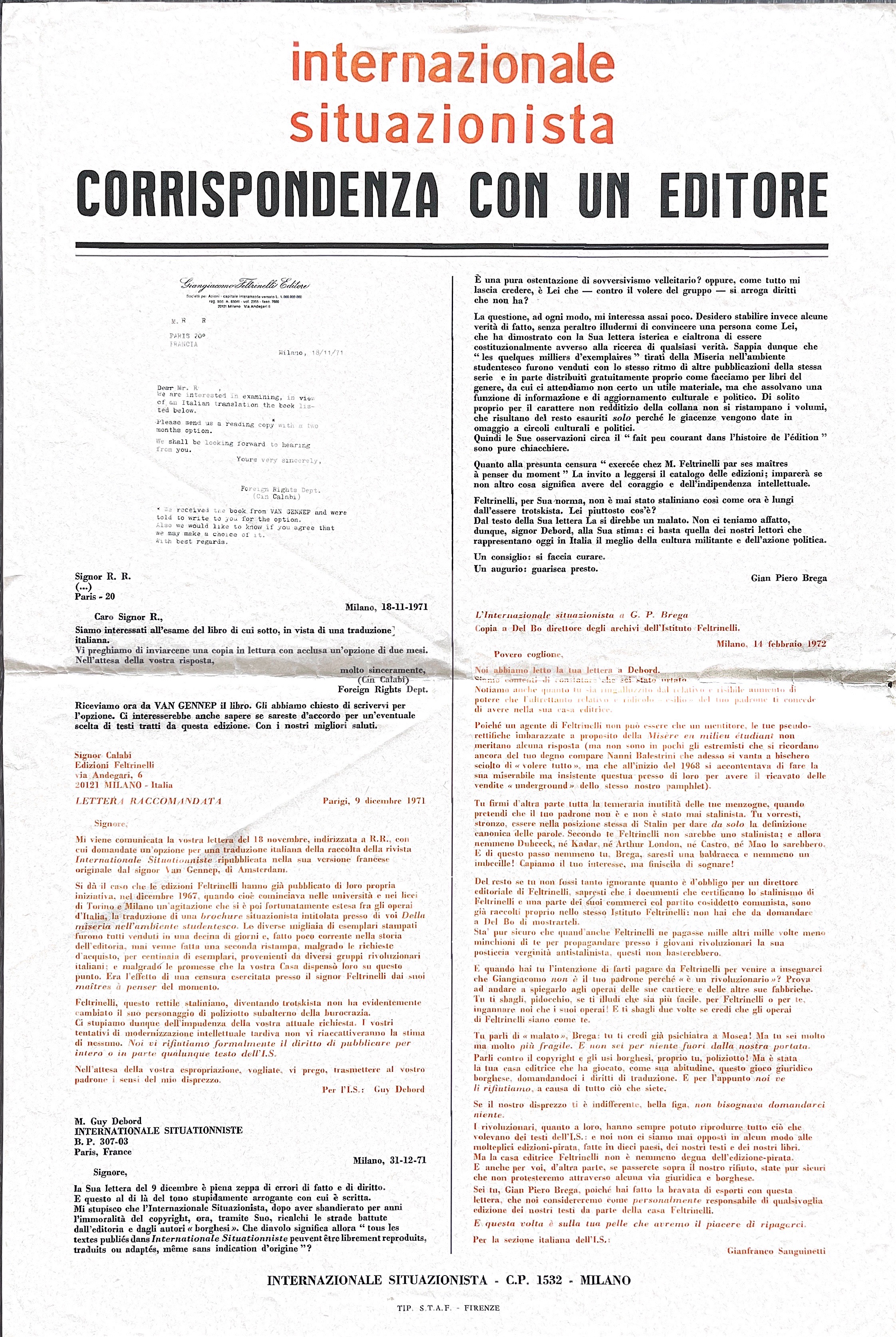
Internazionale Situazionista – Corrispondenza con un’editore [1972]

INTERNAZIONALE SITUAZIONISTA. Corrispondenza con un’editore. Milan: Internazionale Situazionista, n.d. [Feb. 1972]. Broadside; 49.5 x 33.2 cm.; black and red ink on white stock.

Printed and distributed in Italy, this broadside reproduces several letters between Guy Debord, Gianfranco Sanguinetti (from the Situationist International) and Gian Piero Brega (who worked for Italian publisher Giangiacomo Feltrinelli). Sanguinetti’s Foreign Rights department initiates contact with the SI, with the intent to publish an Italian translation of the 12 issues of Internationale Situationniste. Debord writes back, calling Feltrinelli a “Stalinist reptile” and “formally [denying him] the right to publish, in whole or in part, any SI text”. Brega further responds that Debord’s “letter of the 9th December is overflowing with errors of fact and of argument” then closes with “Good advice: get help. Good wishes: get well soon”. The last letter, penned by Sanguinetti, openly threatens Brega should he or Feltrinelli dare publish any texts from the SI.

The text from this broadside was reproduced alongside Avviso al proletariato italiano ; Gli operai d’Italia e la rivolta di Reggio Calabria by G.d.C in 1973 & 1976. It was translated into French by Luc Mercier and Joel Gayraud, then published in Ecrits complets. Section italienne de l’Internationale Situationniste [1969-1972] (Paris: Contre-Moule, 1988), pp. 133-137. It has also been translated into English by Phil Edwards in 1998 and posted on NotBored! (https://www.notbored.org/feltrinelli.html).

Gonzalvez 130.

We locate a single copy on OCLC at the Biblioteca del Museo di arte moderna e contemporanea (MART) in Italy.

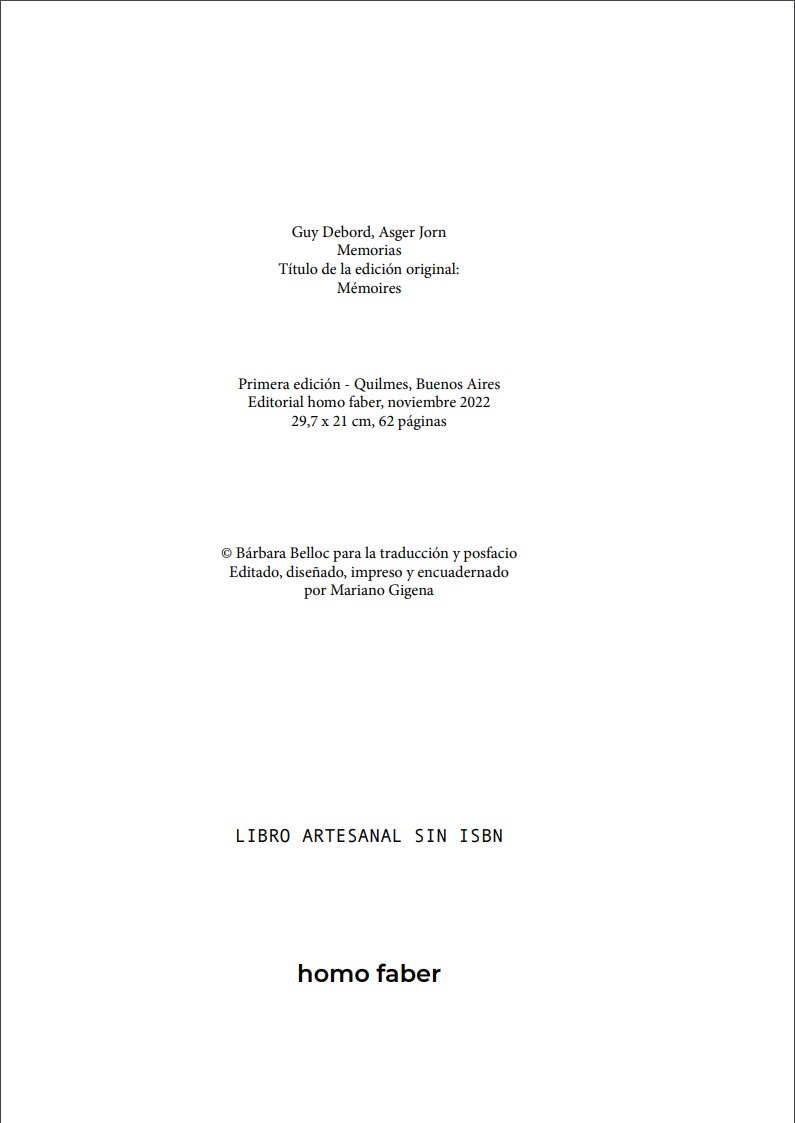
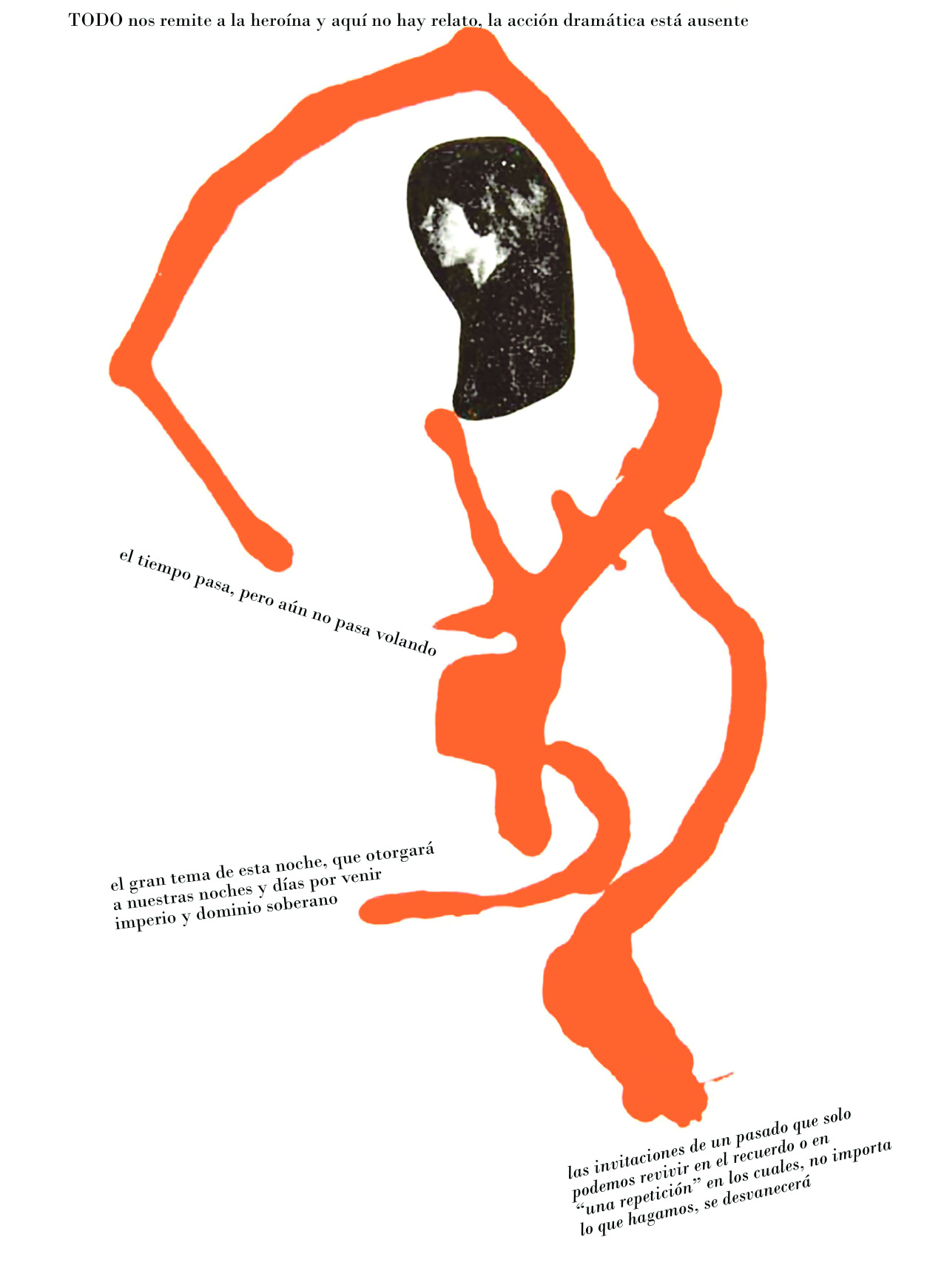
Memoires by Debord & Jorn – Spanish Edition [2022]

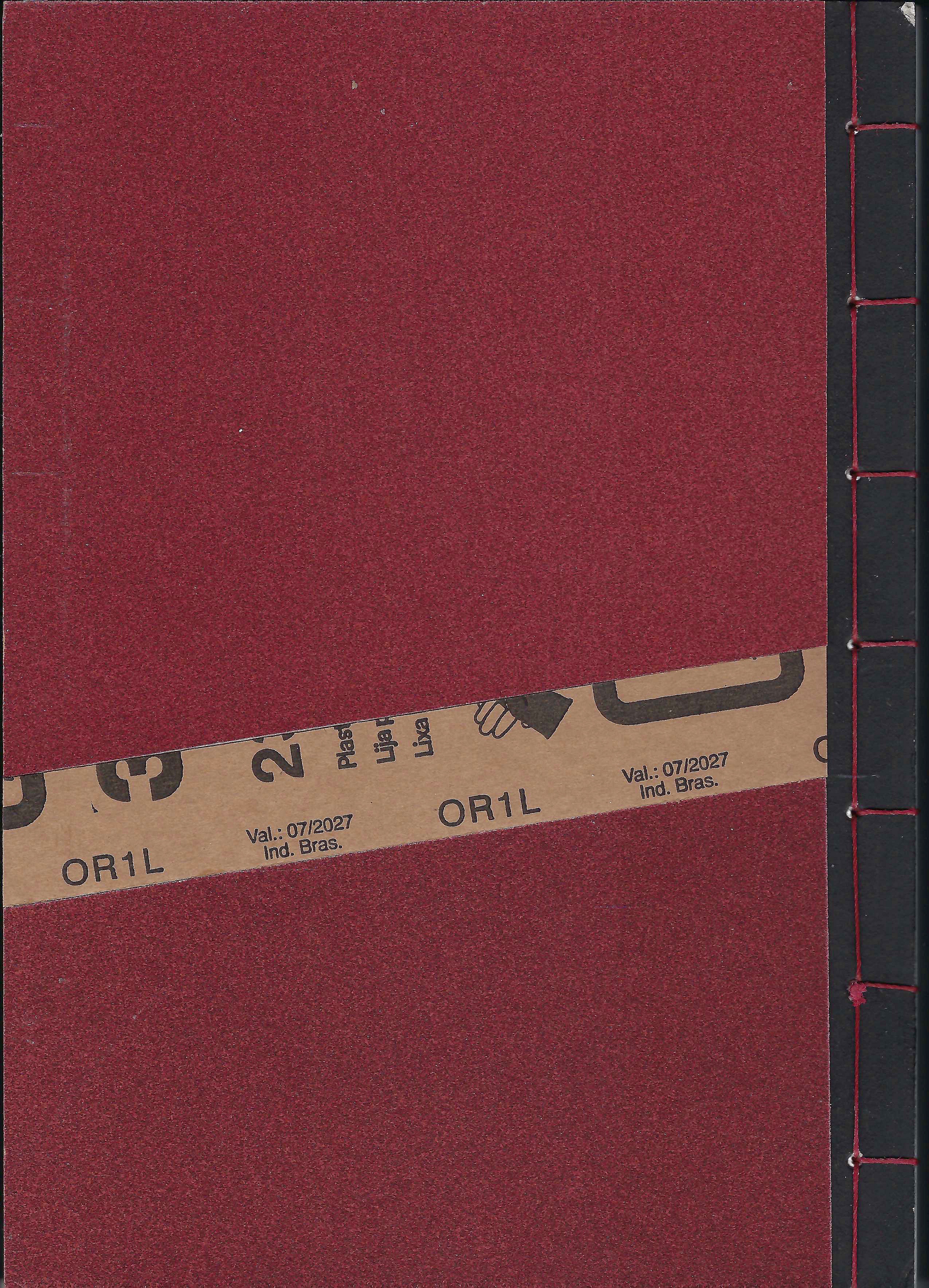
DEBORD, Guy and JORN, Asger. Memorias: Estructuras Portantes de Asger Jorn. Buenos Aires: Homo Faber, November 2022. n.p. [62 p.]; ill.; 21 x 29.7 cm. Japanese side-stitch binding with 3M sandpaper (ref. HB004070866) and 1mm thick grey cardboard.

Memoires is the product of a collaboration between Guy Debord and Asger Jorn in the early years of the Situationist International. Printed in vivid colors – the work of Danish master-printers Permild & Rosengreen – it is viewed by some as the most important art book of the twentieth century. 500 copies of Memoires were originally issued. For more details about the original edition, see here

Produced by Mariano Gigena and published by Homo Faber in Buenos Aires in November 2022, this work is believed to be the first Spanish language edition of Memoires. The translation and postface are the work of Argentinean poet Bárbara Belloc. The book is printed on 150 gr paper using a Brother DCP-T420 for the images and Brother HL-J2360dw for the text. Only 50 numbered copies were created, all handmade. For more information, see here

We do have two additional copies in our possession, which we are willing to trade.

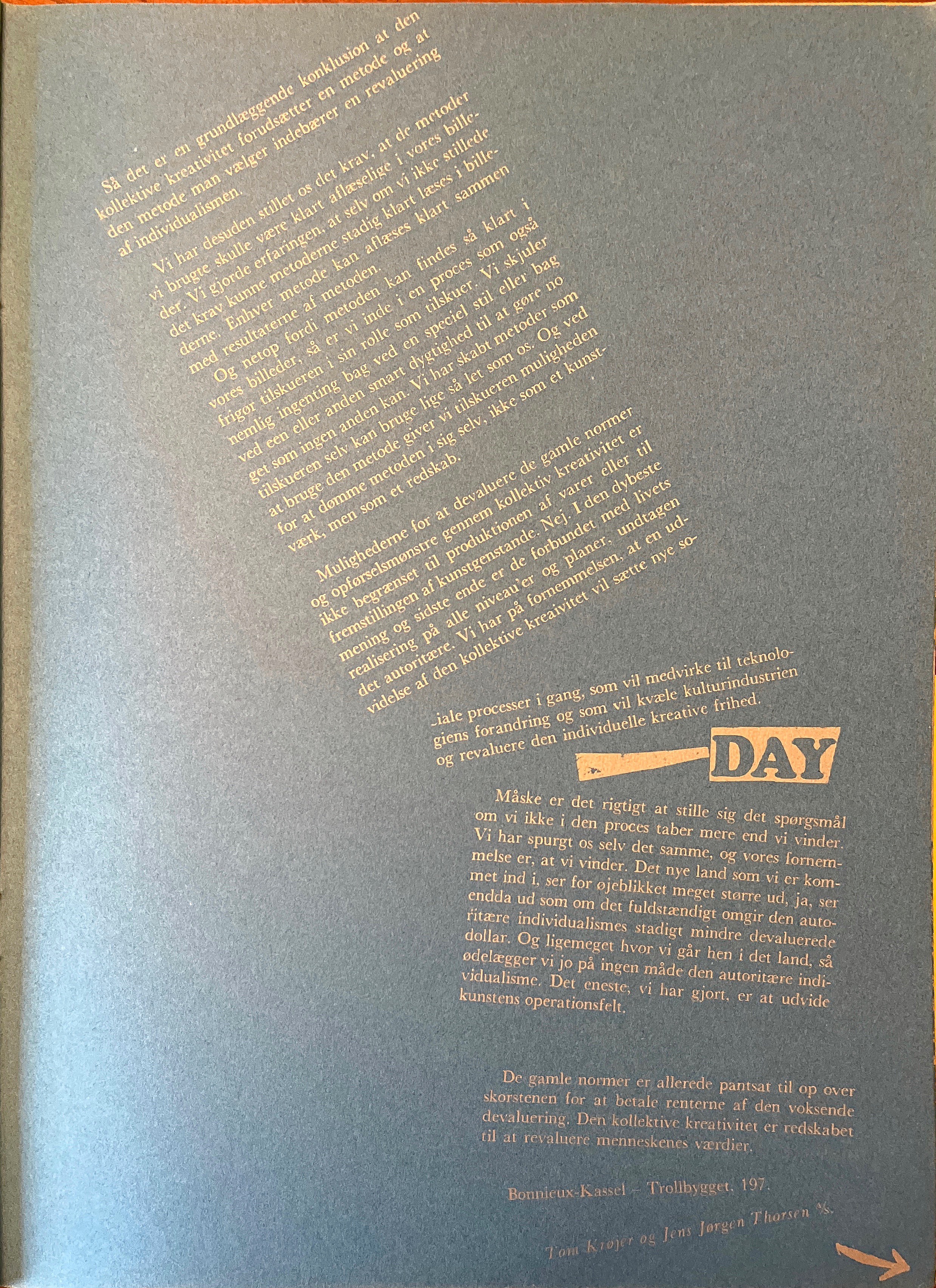
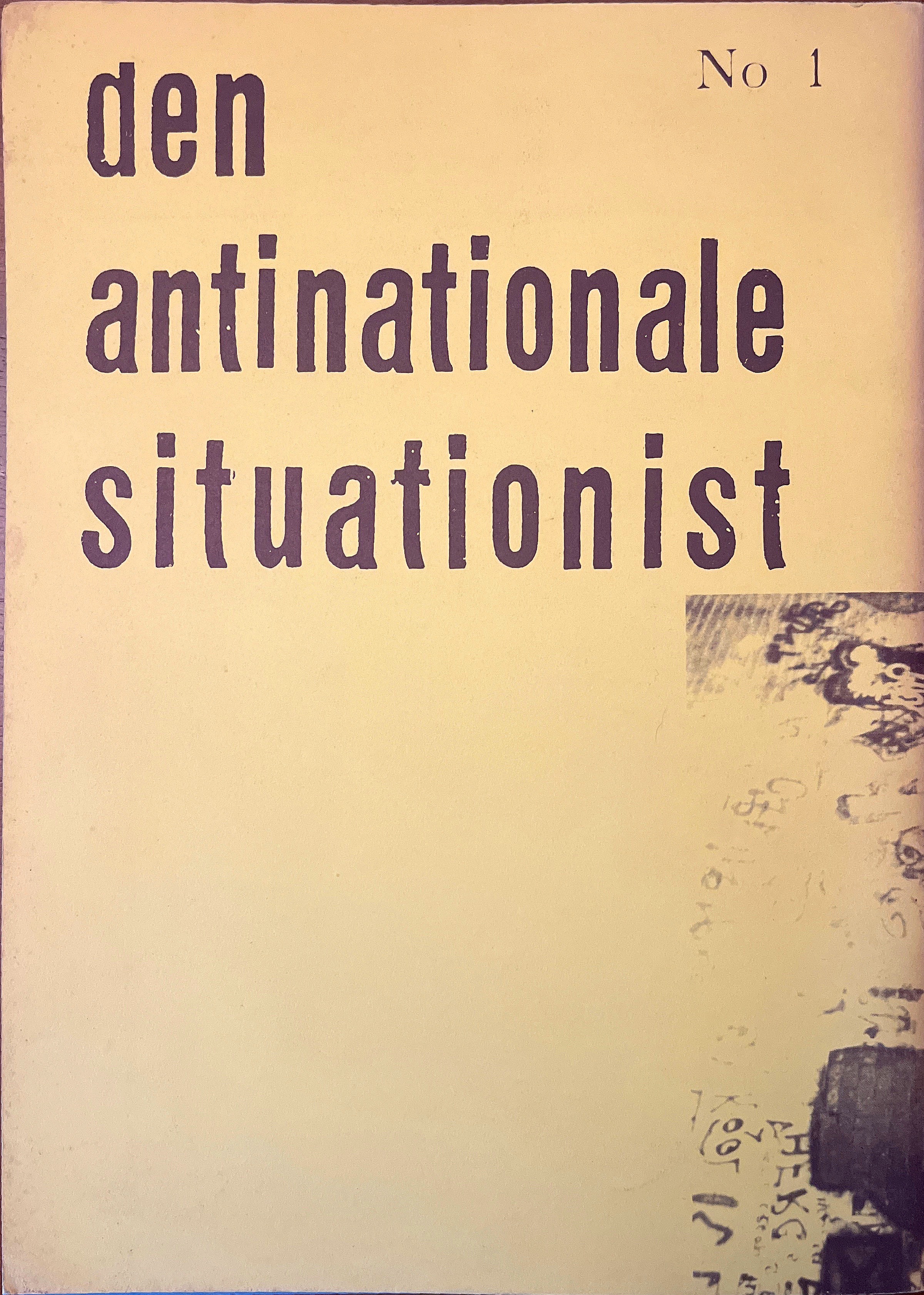
The Antinational Situationist No. 1 / Den Antinationale Situationist No.1 [1974]

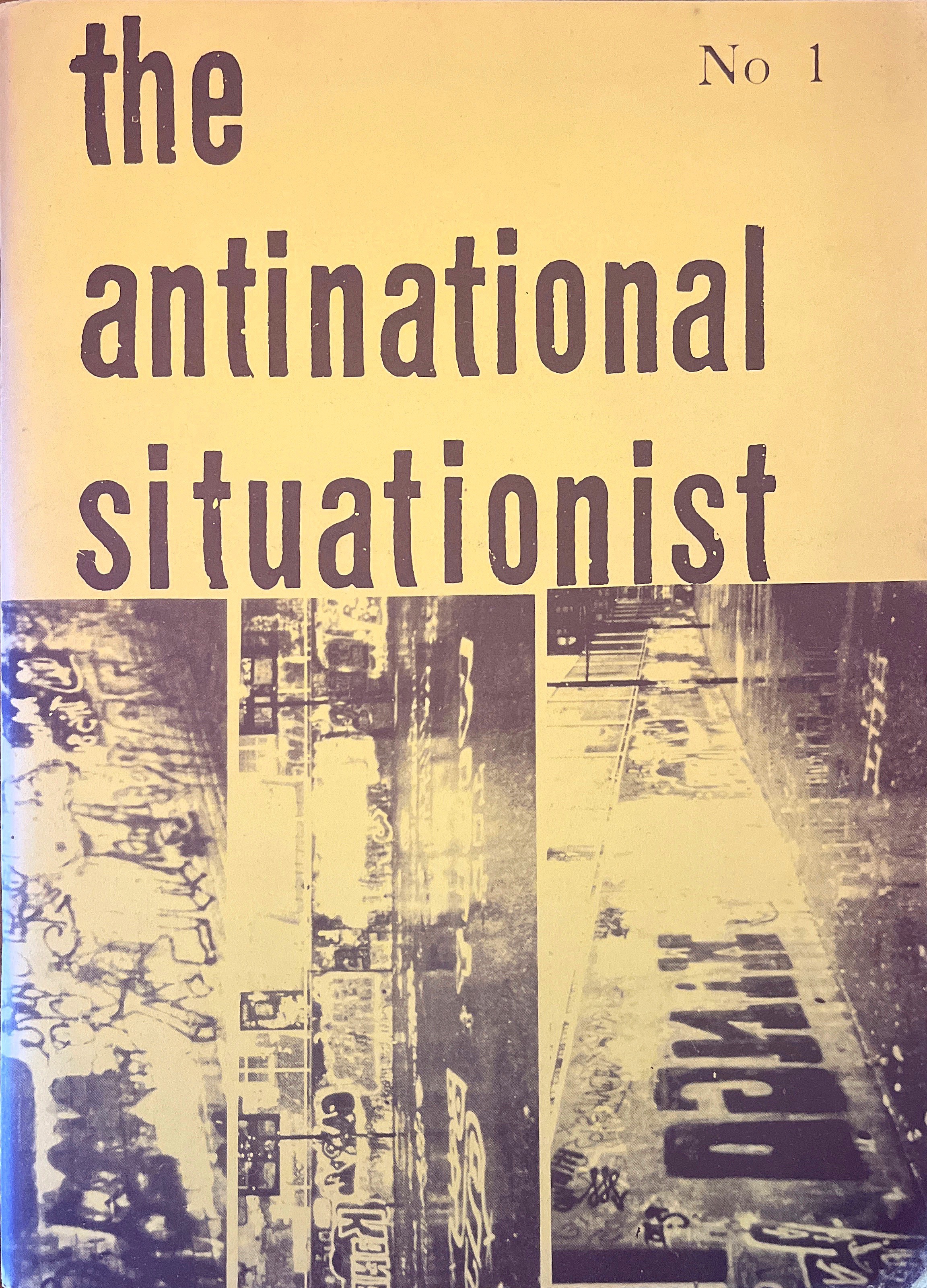
[Bauhaus Situationiste] KROJER, Tom; THORSEN, Jens Jorgen (Eds.). The Antinational Situationist No. 1 / Den Antinationale Situationist No.1. Våxtorp, Sweden / Copenhagen, Denmark: Bauhaus Situationiste, n.d. [1974]. n.p. [30 p.]; ill.; 21 x 29.5 cm.; yellow screen-printed wrappers with text in black

The Antinational Situationist – sub-titled “Tidsskrift for almen kreativitet mode stater, uniformer, autoriteter og generaler” (“periodical for common creativity against states, uniforms, authorities, popes and generals”) – was a bilingual (English/Danish) periodical published by the Bauhaus Situationiste. Its editors, Tom Krojer and Jens Jorgen Thersen, had big ambitions: “We are happy to present you the first issue of our periodical for common creativity, ‘The Antinational Situationist’. As you will see, this first issue is concentrated on the collective creativity, which according to our opinion is the threshold of a completely new phase in culture. The First Situationist International, based in Paris, is completely dead now….Therefore the Antinational Situationist movement is founded, and this is marked by bringing the outlines for the manifesto of the founding of this movement. In Issue 2 of this periodical we hope to be able to publish the signed and ratified manifesto.” (p.1). However, only a single issue of this beautiful screen-printed magazine would ever be released.

This inaugural issue includes a wide range of contributions (all in English and Danish)
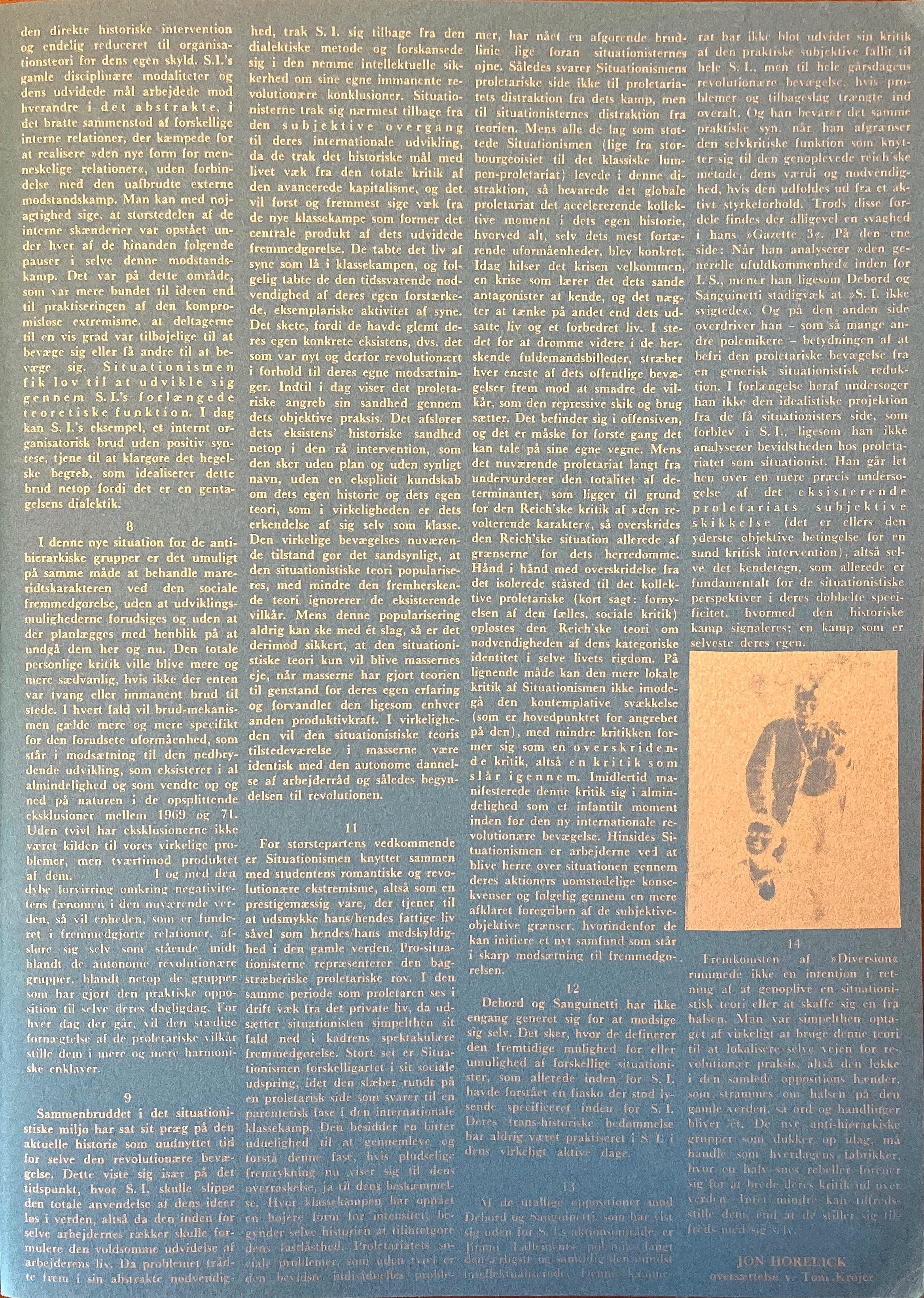
(1) “Beyond The Crisis Of Abstraction And The Abstract Break With That Crisis: The SI”, by former American SI member Jon Horelick. The article offers a harsh critique of Debord and Sanguinetti’s La véritable scission dans l’Internationale.
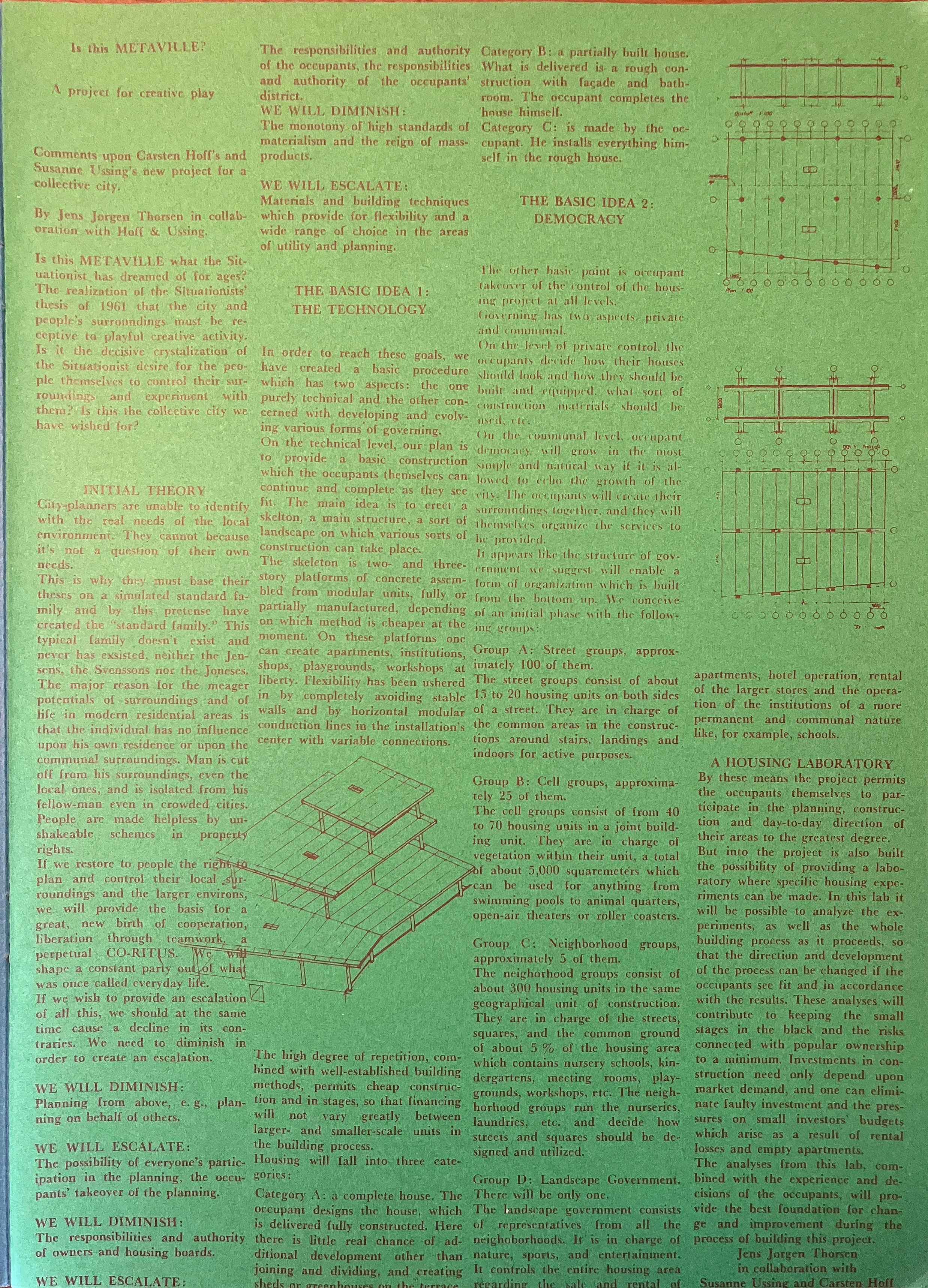
(2) “Is this Metaville? A project for creative play” by Jens Jorgen Thorsen, in collaboration with Susanne Ussing and Carsten Hoff. The article brings backs and builds on the notions of architecture and play, as expressed in the writings and Constant and the early SI.
(3) “The Antinational of the Fourth World: Divided we Stand” by Jens Jorgen Thorsen. This is the draft Manifesto of Antinational Situationist, which is co-signed by Jorgen Nash, J.V. Martin, Patrick O’Brien (i.e., Asger Jorn), Tom Krojen, Ambrosius Fjord (Jorn’s horse), Andres King, Yoshio Nakajima, Liza Menue, Heimad Prem, Mette Aarre, Heinz Freitag, Liz Zwick, Novi Maruni, and Helmut Strum.
(4) “My pocket history of collective painting” by Jens Jorgen Thorsen. This discusses the art of collective painting including Cobra’s practices
(5) “Collective painting statement” by Tom Krojer and J.J. Thorsen.
(6) “All culture is collective” by J.V. Martin, an apology of collective creation and criticism of individual art (“DOWN WITH ART WHICH IS SELF-CONTENTED AND EGOCENTRIC, WHICH CONTEMPLATES ITS OWN NAVEL!”)
Finally, the last two pages list publications by the Bauhaus Situationiste and its members

Texts (2), (3) and (6) are reproduced in Mikkel Bolt Rasmussen & Jakob Jakobsen’s Cosmonauts of the Future: Texts from the Situationist Movement in Scandinavia and Elsewhere (Copenhagen: Nebula and Brooklyn: Autonomedia, 2015.

We locate a single copy of this rare publication on OCLC (Princeton).

Erklæring vedrorende processen mod internationale situationister I Den Tyske Forbundsrepublik [1962]

[Internationale Situationniste] BERNSTEIN, Michele; MARTIN, J.V.; TROCCHI, Alexander; VANEIGEM, Raoul. [Déclaration sur les procès contre l’Internationale Situationniste en Allemagne Fédérale] Erklæring vedrorende processen mod internationale situationister I Den Tyske Forbundsrepublik. n.p. [Randers, Denmark]: n.p. [Internationale Situationniste], n.d. [1962]. 3 p.; 21 x 34 cm.; black ink on cream stock.

In November 1961, Gruppe SPUR published the sixth issue of their periodical, which was promptly seized by authorities. Soon thereafter, in the first trial of artists in Germany since the Third Reich, the group was prosecuted for “pornography” and “religious defamation”. Though the Situationist group excluded Gruppe SPUR in February 1962, it continued to showcase solidarity towards its members. In May 1962, the leaflet “Déclaration sur les procès contre l’Internationale Situationniste en Allemagne Fédérale” was published in Paris. Its last paragraph read “We ask that all the sections of the SI translate and publish this declaration; and that our comrades adhere to our perspectives and distribute information about this affair as widely as possible. We ask everyone to support Uwe Lausen as soon as possible, as much though public declarations that could be useful during his trial as through forms of practical aid that could help the continuation of the SI’s activities in Germany” (p.3).

The following leaflet therefore comes in direct response to this ask. In it, the Scandinavian section of the S.I. offers a translation of “Declaration” into Danish. It is unclear how widely this leaflet was distributed, though – this is the first copy we encounter. As far as we are aware, no bibliography mentions its existence. Readers are encouraged to reach out to us should they have more details to contribute.

We locate no copy of this rare leaflet on OCLC or in the trade. A facsimile of the (much more common) French original can be found here, while an English translation can be found here