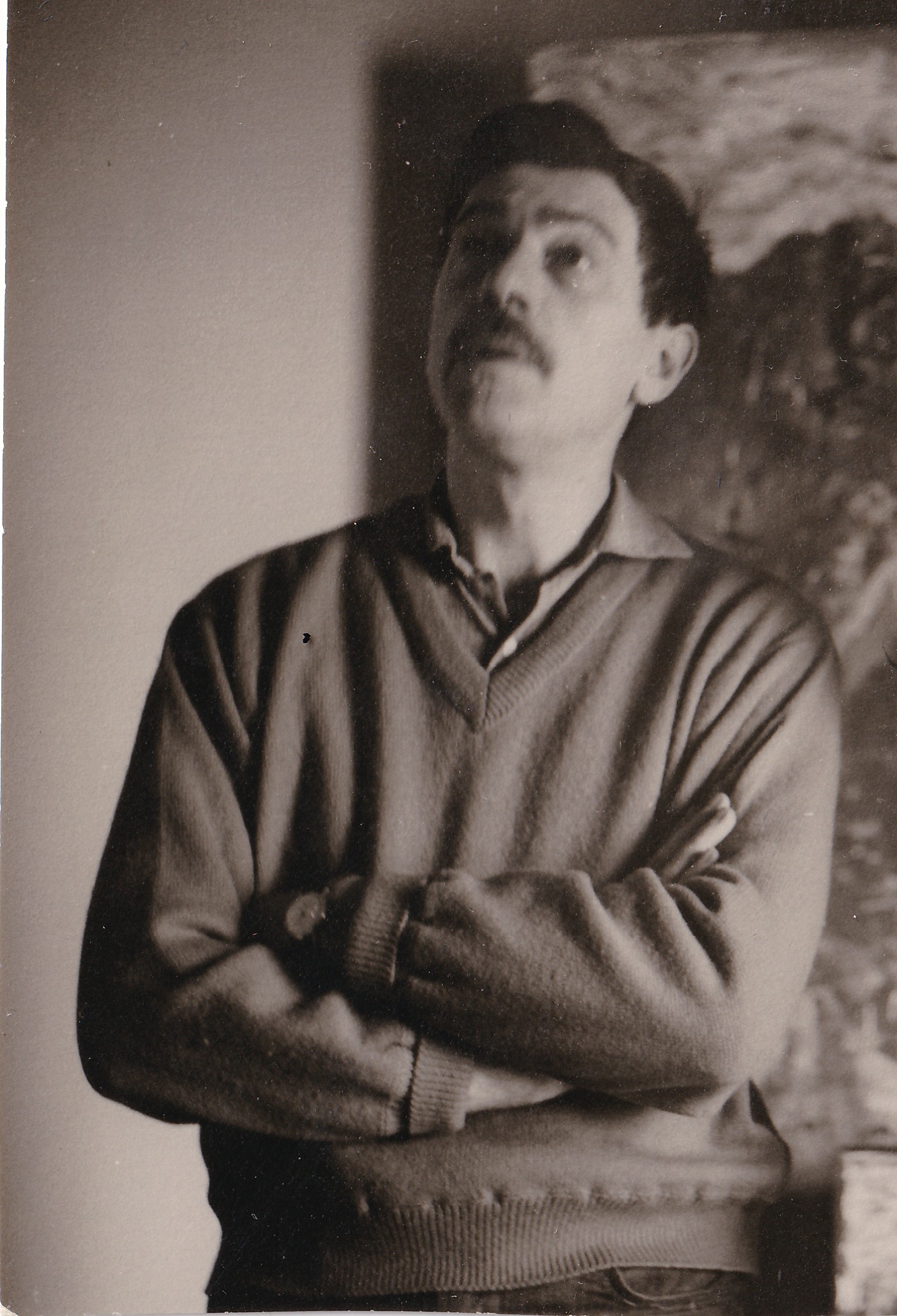
[WYCKAERT, Maurice]. [PHOTOGRAPH] Half-body headshot of Maurice Wyckaert. Late 1950s / early 1960s. 6.5 x 9.5 cm.; B&W photograph on photo stock.
[WYCKAERT, Maurice]. [PHOTOGRAPH] Half-body shot of Maurice Wyckaert, next to an unidentified young woman. Albissola, 1958. 6.5 x 9.5 cm.; B&W photograph on photo stock.
[WYCKAERT, Maurice]. [PHOTOGRAPH] Side portrait of Maurice Wyckaert Late 1950s / early 1960s. 10 x 15 cm.; B&W photograph on photo stock.
Series of 25 letters from Guy Debord to Maurice Wyckaert, between March 1, 1958 and December 6, 1960. This comprises all but 3 of the letters included in Guy Debord’s Correspondance.
Maurice WYCKAERT was a short-lived but pivotal figure in the Situationist International.
Wyckaert met Guy Debord through Asger Jorn and became a member of the Situationist International in 1957, a few months after the movement was founded in Cosio d’Arroscia.
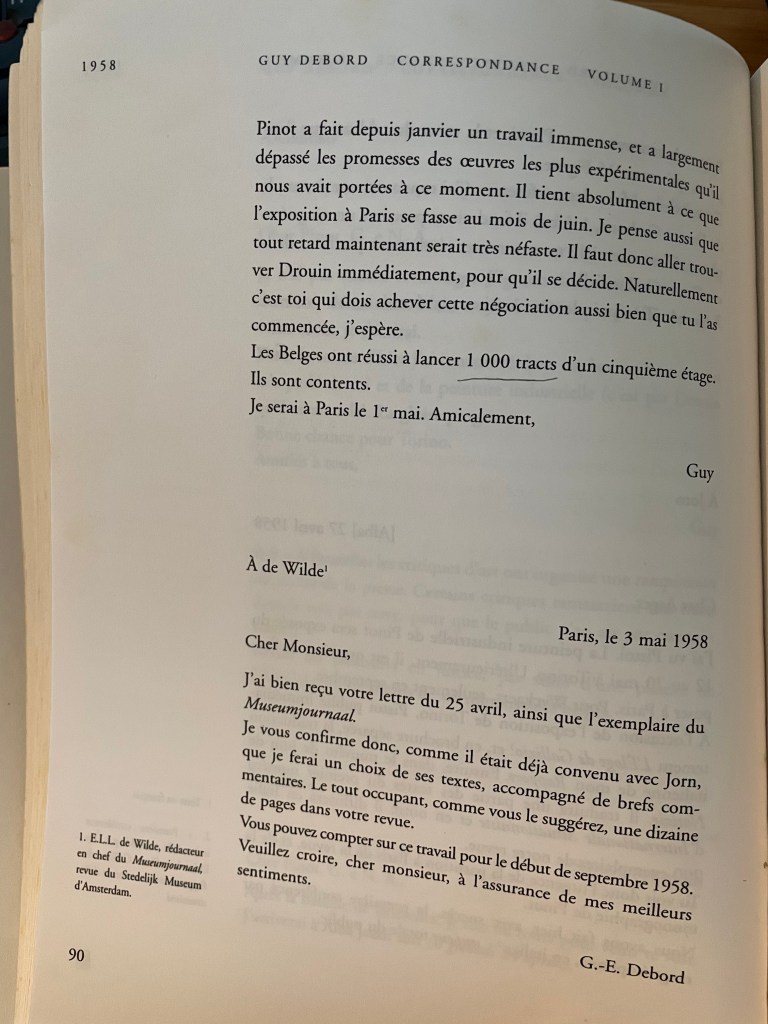
In the Spring of 1958, he became involved in the scandal against the International Assembly of Art Critics in Brussels. Wyckaert helped produce the leaflet Adresse de l’Internationale situationniste a l’assemblée générale de l’Association internationale des critiques d’art, a scathing attack against art critics on the occasion of their formal get-together, and threw 1,000 copies onto sidewalks from the roof of the Grand Bazaar. He also called numerous art critics (who resided in nearby hotels) on the phone, reading part of all of the text out loud. As a result of this action, SI members were threatened with prosecution.
Later that year, Wyckaert became a member of the editorial board of Internationale Situationniste, the organ of the Situationist movement.
In early 1960, Debord brought up the project of holding an exhibition at the Stedelijk museum in Amstrdam, which would consist in transforming two rooms into a labyrinth. Planned for May 1960, the exhibition would never take place due to a falling out with Willem Sandberg, the Museum’s director. However, Wyckaert created detourned palisades (to symbolize drifting) with planks rescued from the demolition site of the family house in Brussels” (see Maurice Wyckaert, l’Oeuvre Peint, p. 535).
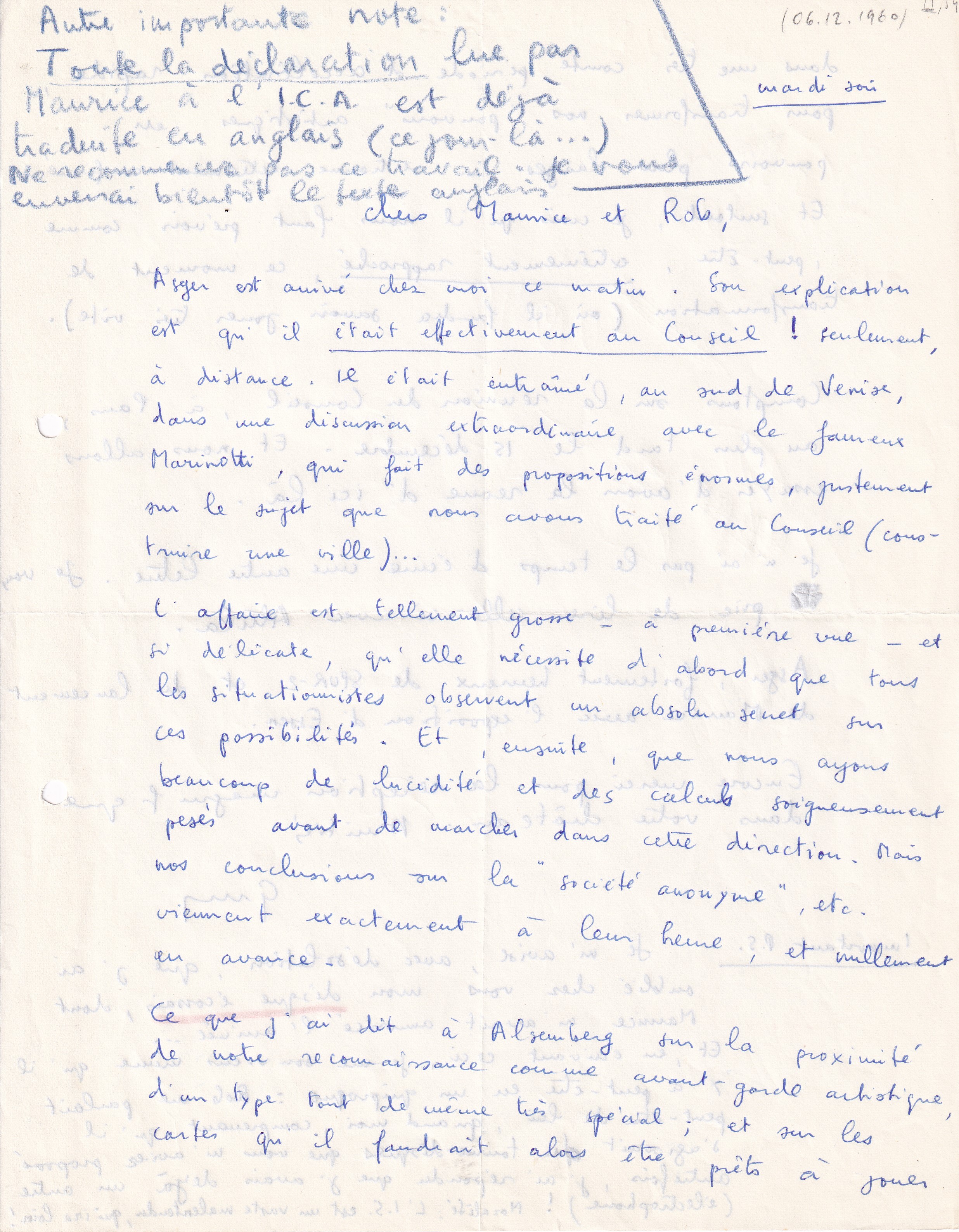
Wyckaert’s main contribution to the S.I. is his reading of the Declaration Made in the Name of the Fourth SI Conference to the Institute of Contemporary Arts in September 1960. Invited by the I.C.A. to give a lecture, the S.I. made Wyckaert its spokesperson — in part because he was one of the few English speakers at the time. Wyckaert read the text, but his strong Flemish accent made him particularly hard to understand. To make things worse, Wyckaert used a hearing aid, which he turned off during the Q&A after having been asked the one and only question of the evening: “What is Situationism, exactly?”. Debord stood up and said in French “we are not here to answer cuntish questions” and walked out with the other Situationists. A detailed first-hand account of that evening can be found here. The declaration would be published in issue #5 of Internationale Situationniste in December 1960.
Wyckaert was excluded from the S.I. in 1961, having sided with gallerist Otto Van de Loo in a conflict against Guy Debord. His departure coincided with that of many other artists from the S.I.
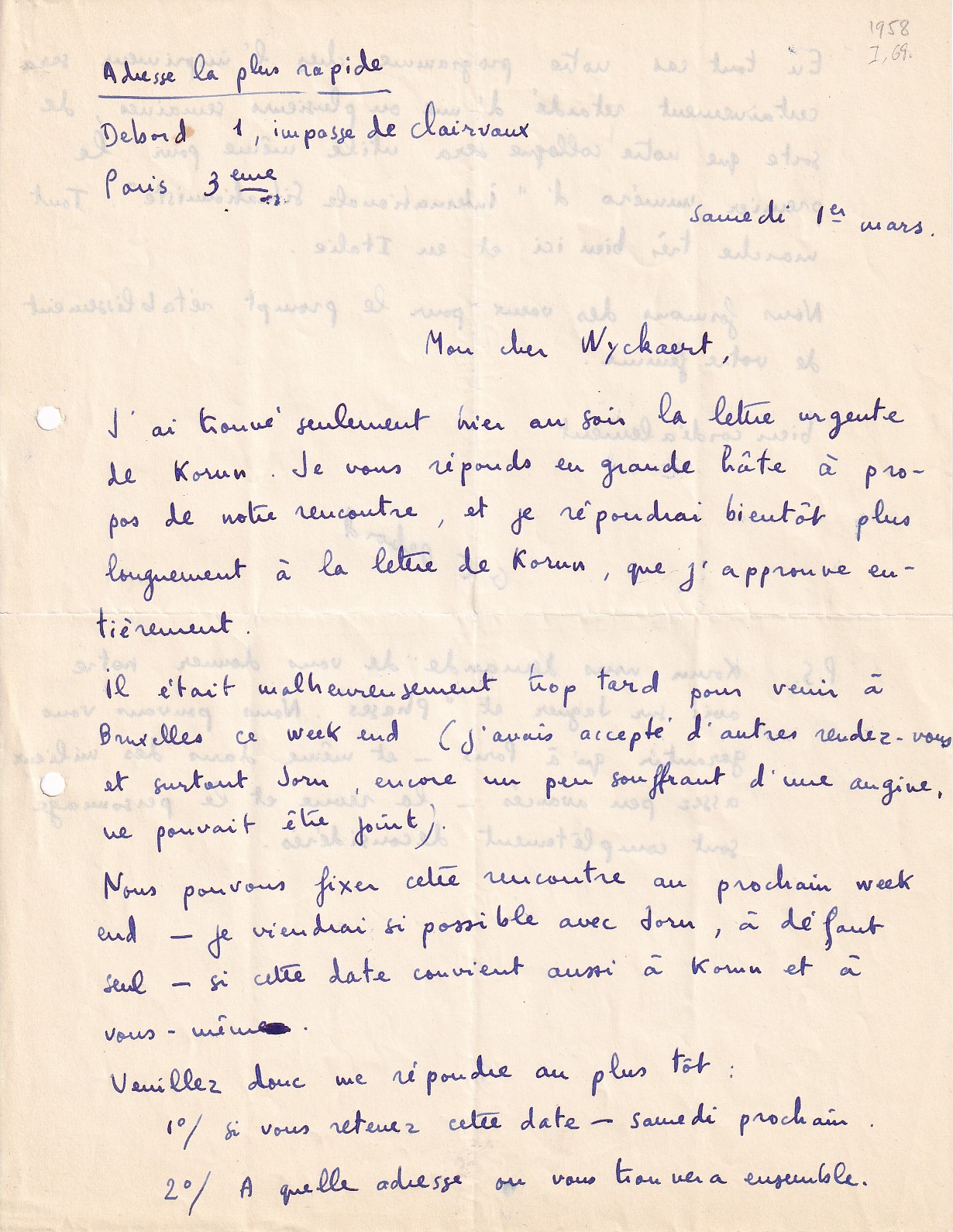
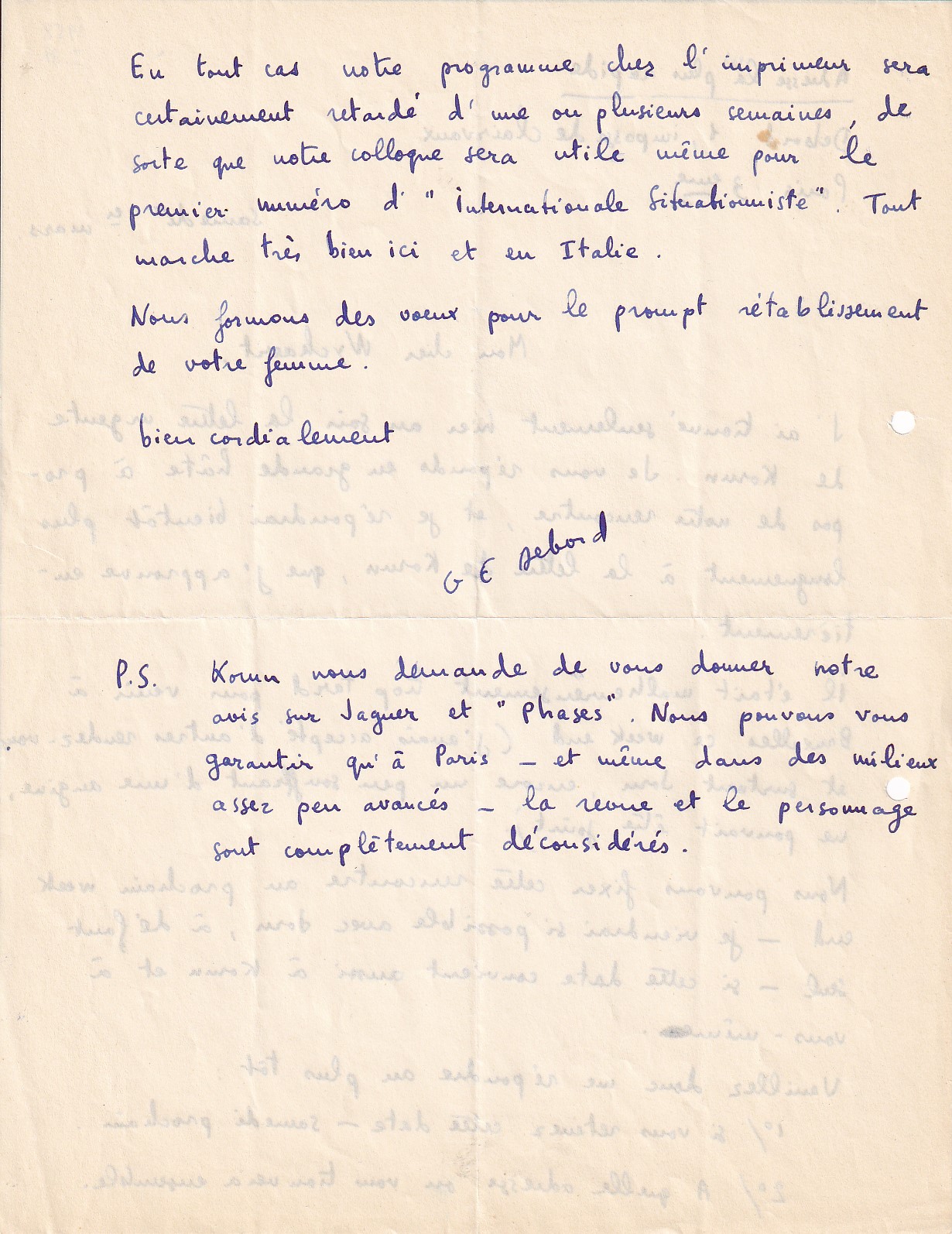
01. DEBORD, Guy. Signed handwritten letter dated Samedi 1er Mars [1958]. 2 p. (one sheet); 21 x 27 cm.; blue ink on white stock. Correspondance, Vol. I, p. 68-69.
Debord attempts to arrange a meeting with Walter Korun and Maurice Wyckaert for the following Saturday in Brussels. On Satuday, March 8, Debord mailed a postcard of the Manneken Pis to Pinot-Gallizio. The card is signed “Guy, Rob et Maurice Wyckaert, Wilma et Walter Korun”, proving that the meeting took place in Belgium as planned. One of the key topics discussed was the action against the International Assembly of Art Critics (more below).
02. DEBORD, Guy. Signed handwritten letter dated 13/3/[19]58. 2 p. (one sheet); 21 x 27 cm.; blue ink on white stock. Correspondance, Vol. I, p. 72-74.
In this letter addressed to the Belgian section (Wyckaert and Korun) Debord expresses his enthusiastic support for “Korun’s proposition concerning an action to be attempted on the occasion of the International Conference of Art Critics – on 15 April [1958] in Brussels”. He starts to sketch out some of the details of the intervention, including the decision to “print 2,000 copies of a tract to throw during this meeting – if possible at the time of the inaugural session” He concludes by asking members of the Belgian section for further information regarding the conference and its participants, while asking them to keep “the most rigorous secrecy” about this planned action. This letter has been translated into English: http://www.notbored.org/debord-13March1958.html
03. DEBORD, Guy. Signed handwritten letter dated 24/3/[19]58. 2 p. (one sheet); 21 x 27 cm.; blue ink on white stock. Correspondance, Vol. I, p. 77-79.
Debord confirms that the leaflet (Adresse de l’Internationale situationniste a l’assemblée générale de l’Association internationale des critiques d’art ) is ready; a first draft having been mailed to Wilma [Korun] on Friday [March 23]. He asks Wyckaert and Korun to mail copies to art critics on the day preceding the International Conference of Arts Critics (roughly 30 copies would end up being sent by post). Separately, Debord dismisses a proposed contribution by Korun and Wyckaert to the Surrealist-influenced periodical Edda.
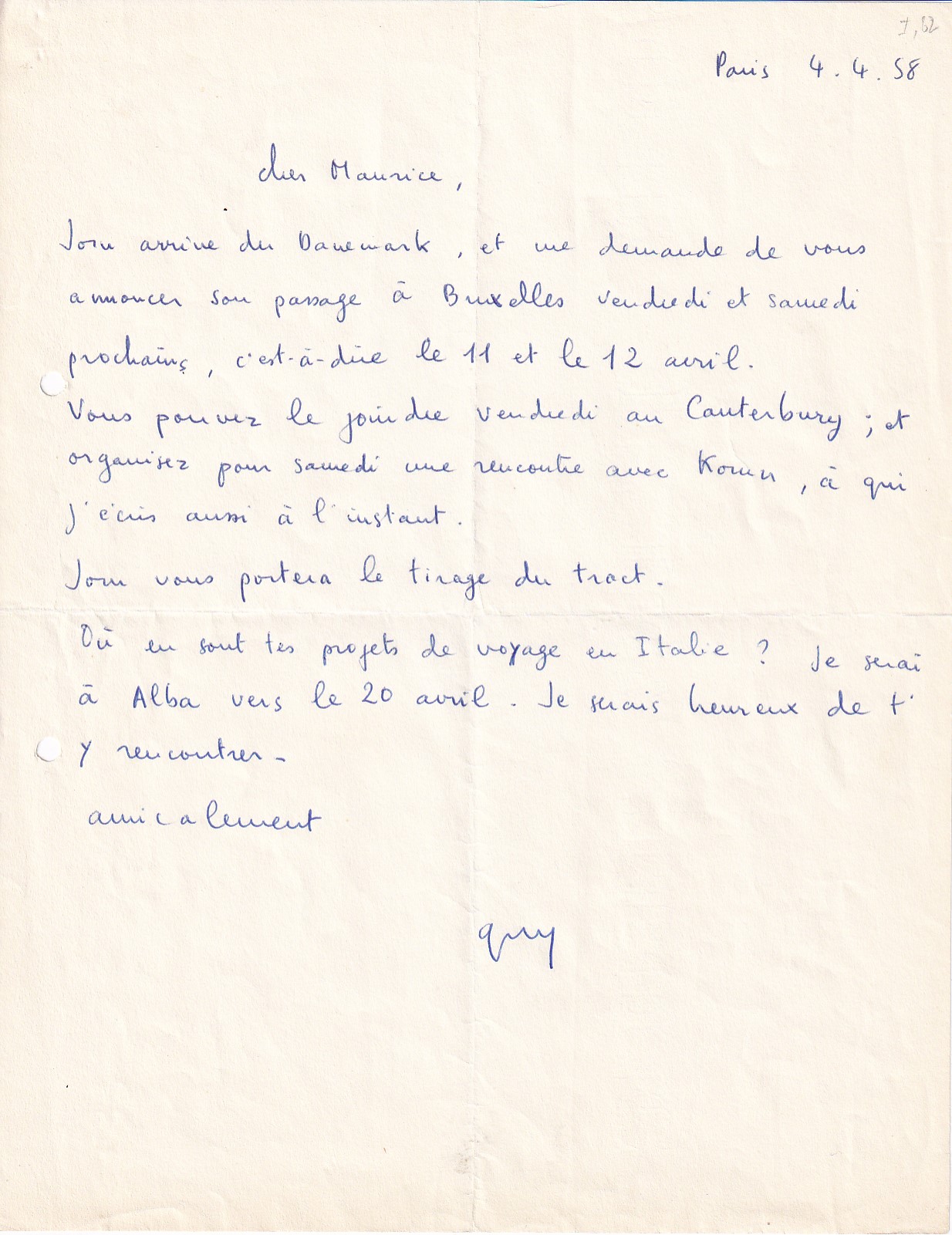
04. DEBORD, Guy. Signed handwritten letter dated 4/4/[19]58. 1 p.; 21 x 27 cm.; blue ink on white stock. Correspondance, Vol. I, p. 82.
Debord tells Wyckaert about Jorn’s planned trip to Brussels on April 11 & 12; the Danish painter will hand him and Korun copies of the tract. Ten days later, Adresse de l’Internationale situationniste a l’assemblée générale de l’Association internationale des critiques d’art would be handed in to art critics at the International Conference of Art Critics. Other critics were reached by telephone and read all or part of the text out loud. Perhaps most spectacularly, a group forced its way into the Press Club where the critics were being received and threw the leaflets among the audience. Wyckaert tossed another 1,000 copies of the leaflets onto sidewalks from the roof of the Grand Bazaar (now demolished). As a result of this action, SI members were threatened with prosecution. Korun, in particular, faced some legal issues as a result. In spite (or perhaps because) of this, Debord viewed what he referred to as “the battle of Brussels” (Letter to Pinot-Gallizio, 19 April 1958) as a great success
05. DEBORD, Guy. Signed handwritten letter dated 10 Fevrier [19]59. 2 p. (one sheet); 21 x 27 cm.; blue ink on white stock. Correspondance, Vol. I, p. 190-91.
In this letter, Debord informs Wyckaert that the third conference of the S.I. is planned in Munich (it would occur in April). Following an encounter with Helmut Sturm, Debord shows great excitement about Gruppe SPUR and talks about a “project for a German language journal” (7 issues of the Spur periodical would be published between 1960 and 1961).
06. DEBORD, Guy. Signed handwritten letter dated 5 Mai [1959]. 1 p.; 21 x 27 cm.; blue ink on white stock (Internationale Situationniste letterhead). Correspondance, Vol. I, p. 228.
Debord complains about issues with French customs. More importantly, he asks Wyckaert to meet him in Amsterdam to work together on a new series of the periodical Potlatch (the first and only issue of that new series — Potlatch #30 — would be issued in Amsterdam on 15 July 1959. It would include an important article by Constant, “Le grand jeu a venir”)
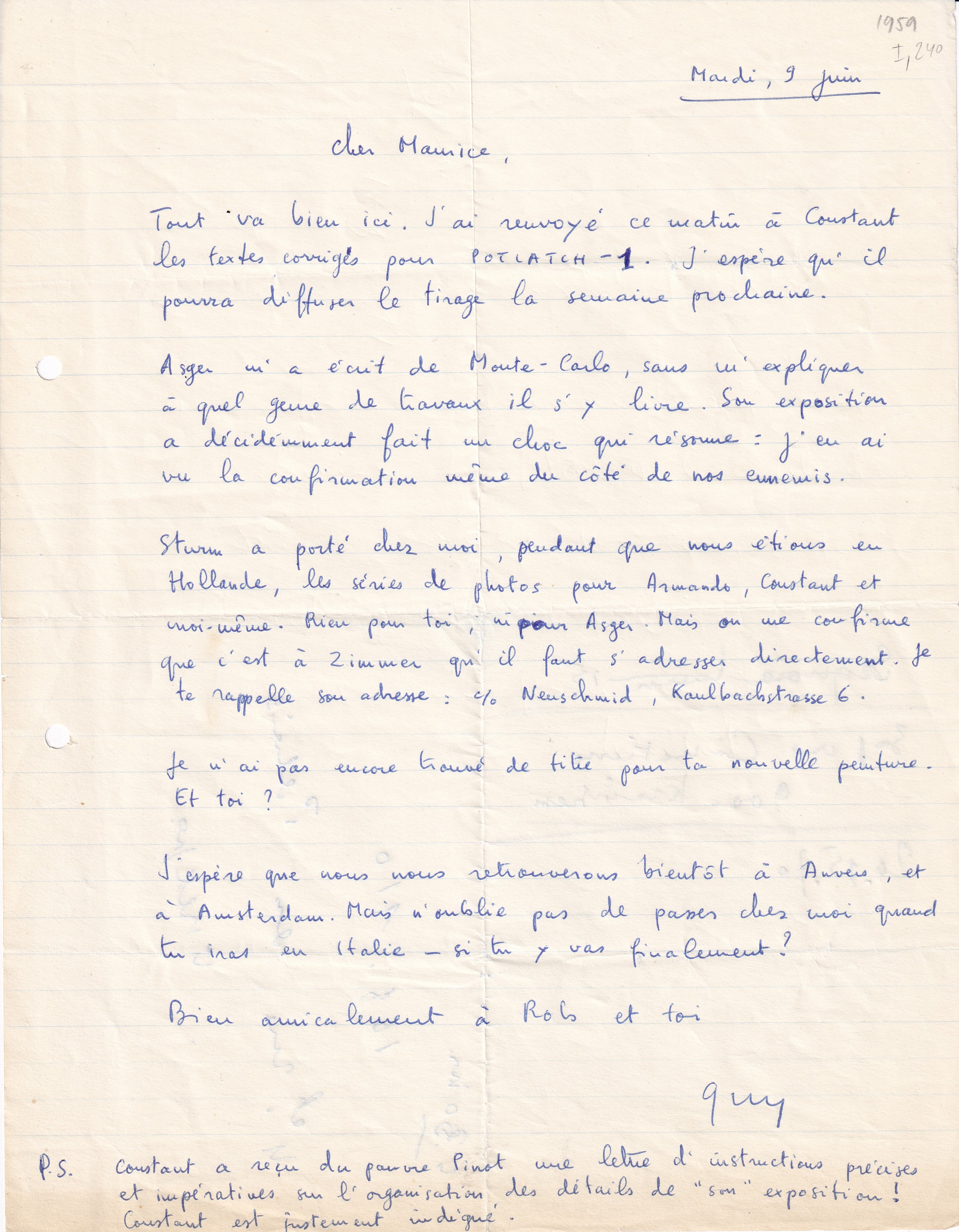
07. DEBORD, Guy. Signed handwritten letter dated Mardi 9 juin [1959]. 1 p.; 21 x 27 cm.; blue ink on white lined paper. Correspondance, Vol. I, p. 240.
Debord confirms to Wyckaert that the revised drafts for Potlatch 1 (new series) have been mailed to Constant. He tackles a few other topics, before asking Wyckaert whether they would be able to meet in Antwerp and Amsterdam, as planned, and perhaps in Italy.
08. DEBORD, Guy. Signed handwritten letter dated Mercredi 18 novembre [1959]. 1 p.; 21 x 27 cm.; blue ink on white stock. Correspondance, Vol. I, p. 279-80.
Debord tells Wyckaert that a monograph about him should be released “very soon”, but that he would need a few photographs for that purpose (this monograph does not seem to have ever been published).
09. DEBORD, Guy. Signed handwritten letter dated Lundi 14 decembre [1959]. 1 p.; 21 x 27 cm.; blue ink on white stock. Correspondance, Vol. I, p. 283-84.
In a short letter, Debord asks Wyckaert to visit him early in the week. He also tells him that “the periodical [Internationale Situationniste] should come out at the end of the week or early the following week” Indeed, issue #3 would be published in December 1959, with Maurice Wyckaert a member of the editorial board.
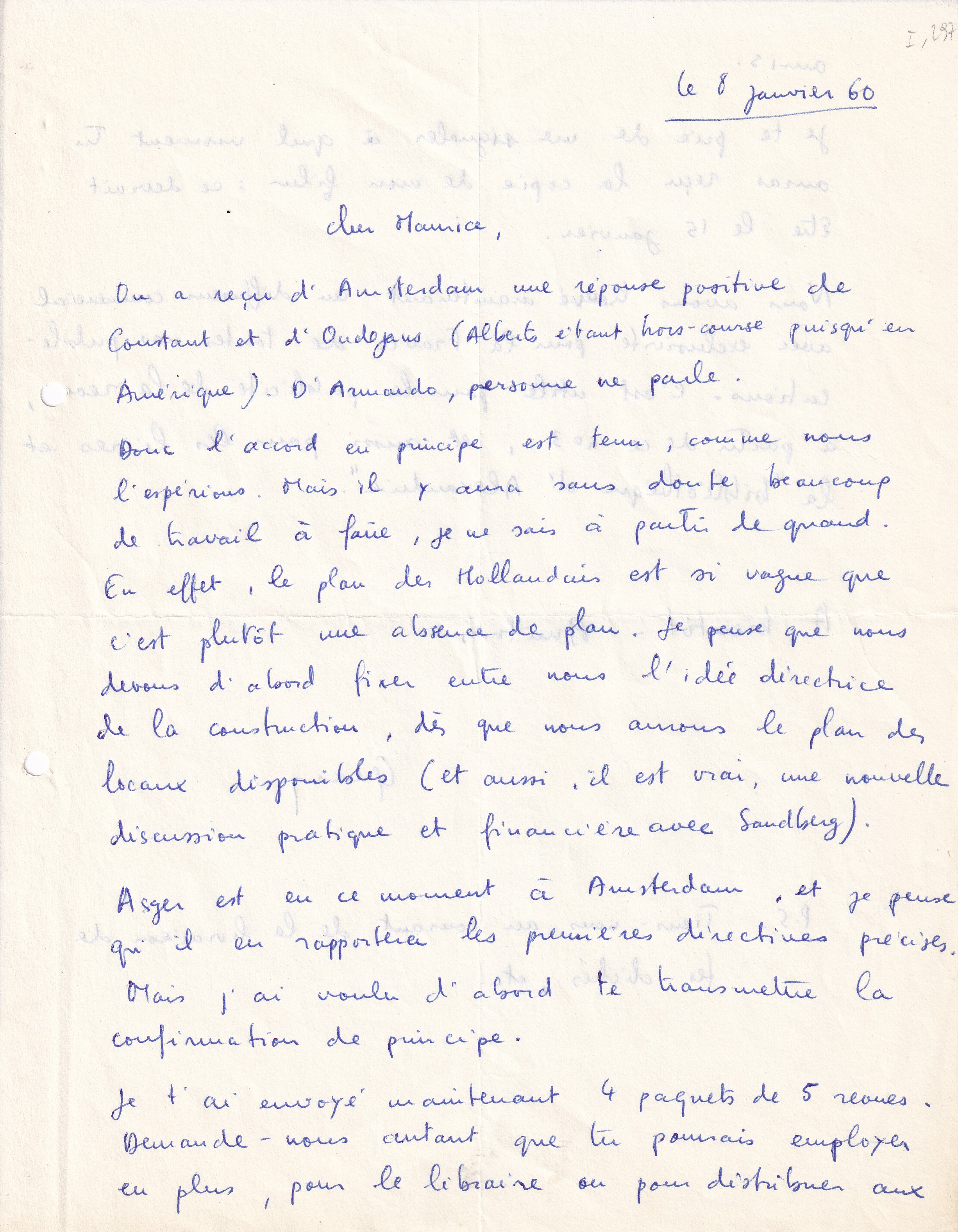
10. DEBORD, Guy. Signed handwritten letter dated 8 janvier [19] 60. 2 p. (one sheet); 21 x 27 cm.; blue ink on white stock. Correspondance, Vol. I, p. 297-98.
Debord brings up the project of holding an exhibition at the Stedelijk museum in Amstrdam, which would consist in transforming two rooms into a labyrinth. Planned for May 1960, the exhibition would never take place due to a falling out with Willem Sandberg, the Museum’s director. However, detourned palisades – to symbolize drifting – were created “with planks rescued from the demolition site of the family house in Brussels” (see Maurice Wyckaert, l’Oeuvre Peint, p. 535).
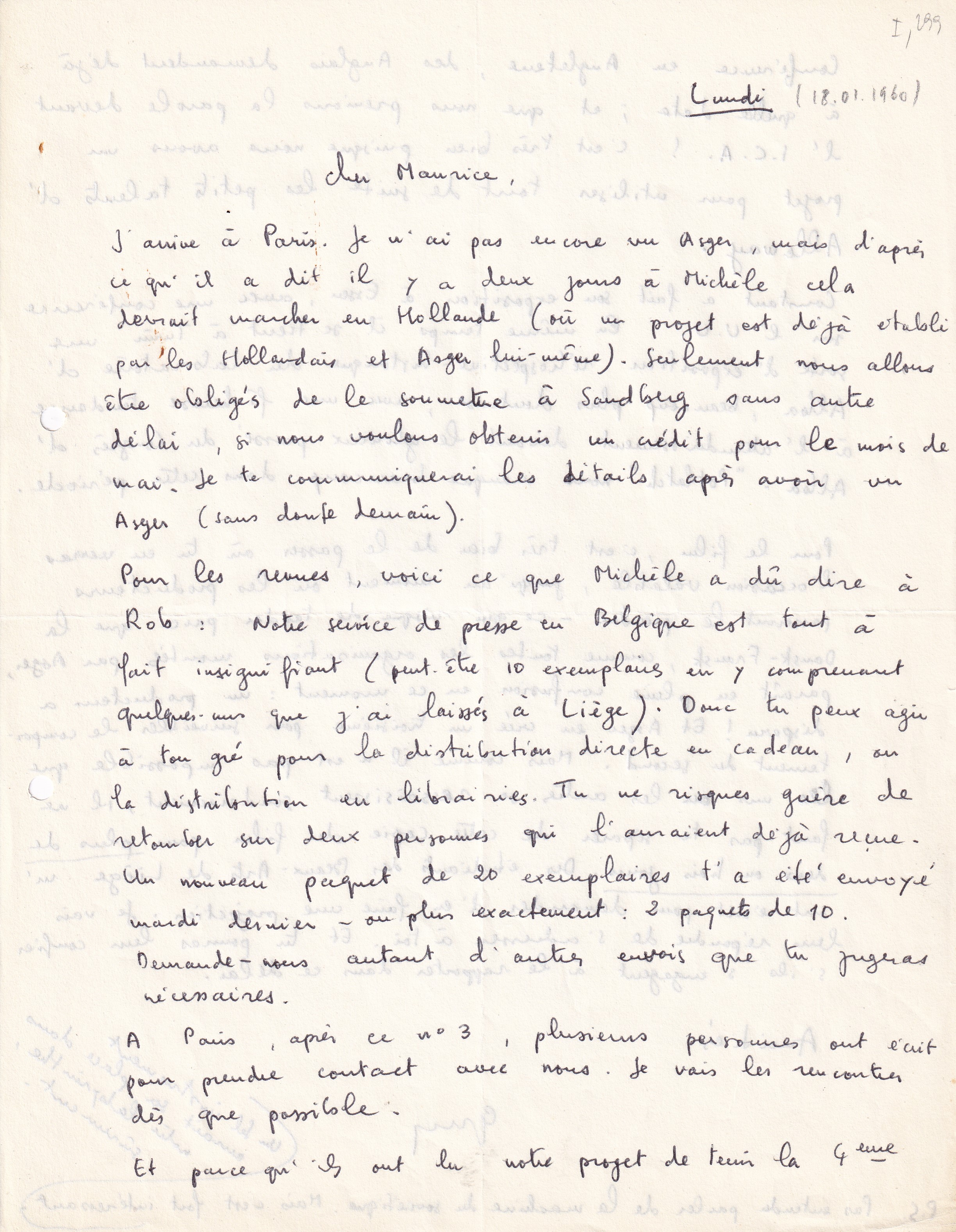
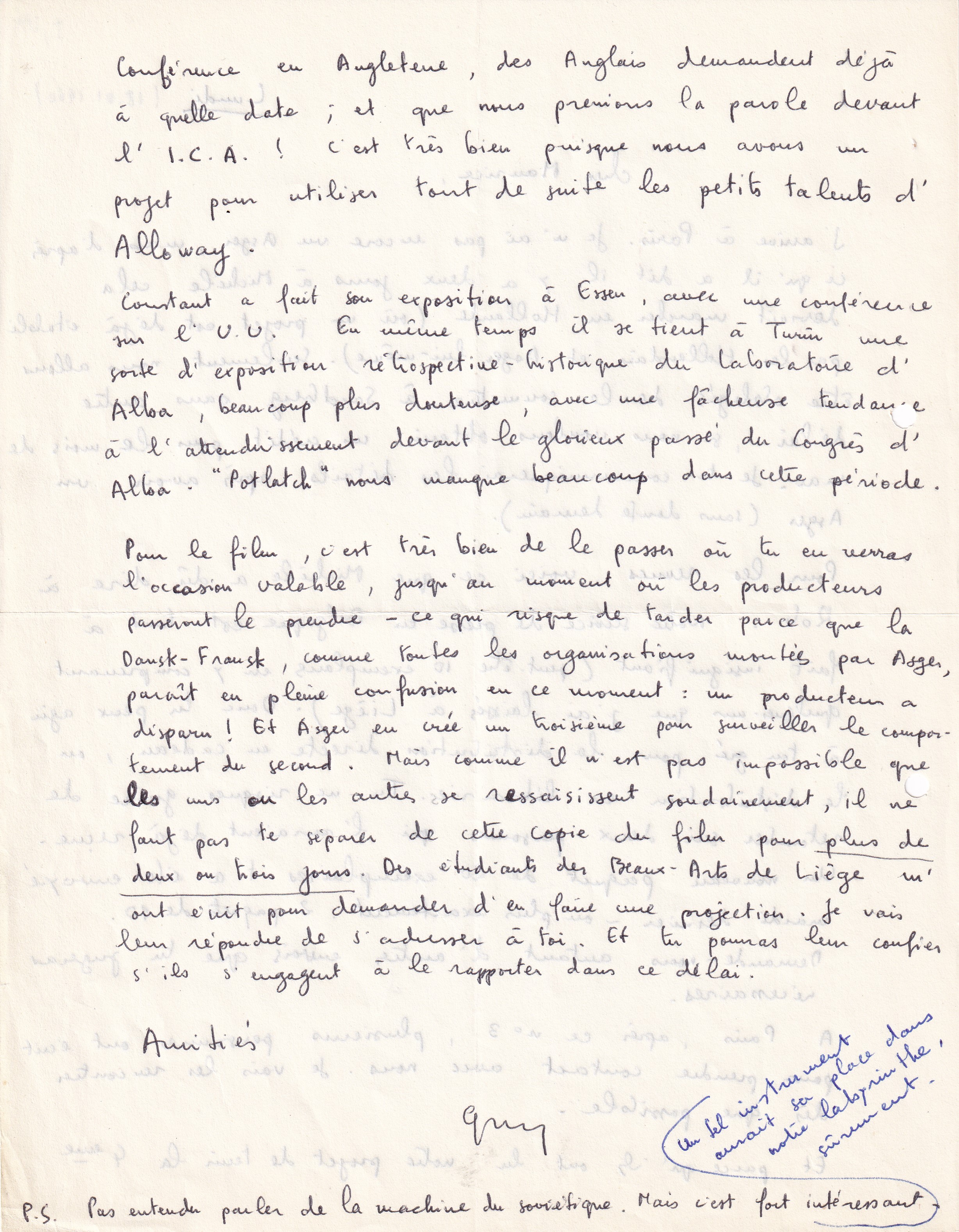
11. DEBORD, Guy. Signed handwritten letter dated Lundi [18/01/1960]. 2 p. (one sheet); 21 x 27 cm.; black and blue inks on white stock. Correspondance, Vol. I, p. 299-300.
Debord alludes to the Stedeljik exhibition project once more. He also brings up the possibility of a conference at the I.C.A., which would happen in September. Finally, Debord tells Wyckaert he would like to show him “the film” (i.e., On the Passage of a Few People Through a Rather Brief Unity of Time). This letter has been translated into English: http://www.notbored.org/debord-18January1960.html
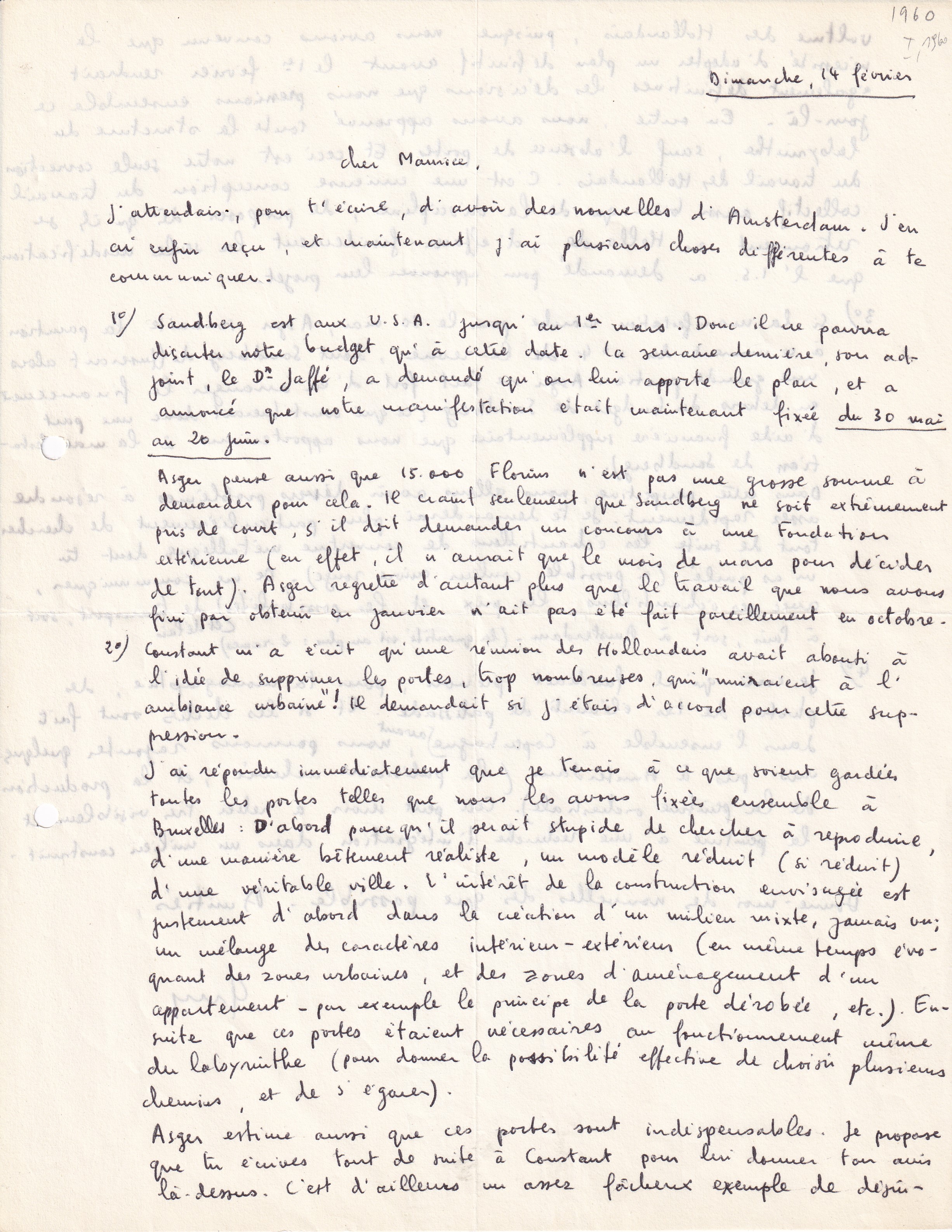
12. DEBORD, Guy. Signed handwritten letter dated Dimanche, 14 fevrier [1960]. 2 p. (one sheet); 21 x 27 cm.; black ink on white stock. Correspondance, Vol. I, p. 312-13.
In this long letter, Debord discusses some of the details and logistics relative to the planned Stedeljik exhibition. He explains his rationale behind some of the aesthetic choices, which put him at odds with the Dutch section. He then asks Wyckaert to reach out to Constant to express his point of view on the matter. The topic of Wyckaert’s monograph is brought up once more, with Debord asking that some elements from the planned Amsterdam exhibition (Wyckaert’s detourned palisades) be included so as to “clearly showcase ways in which painting can be incorporated into into a constructed environment.”
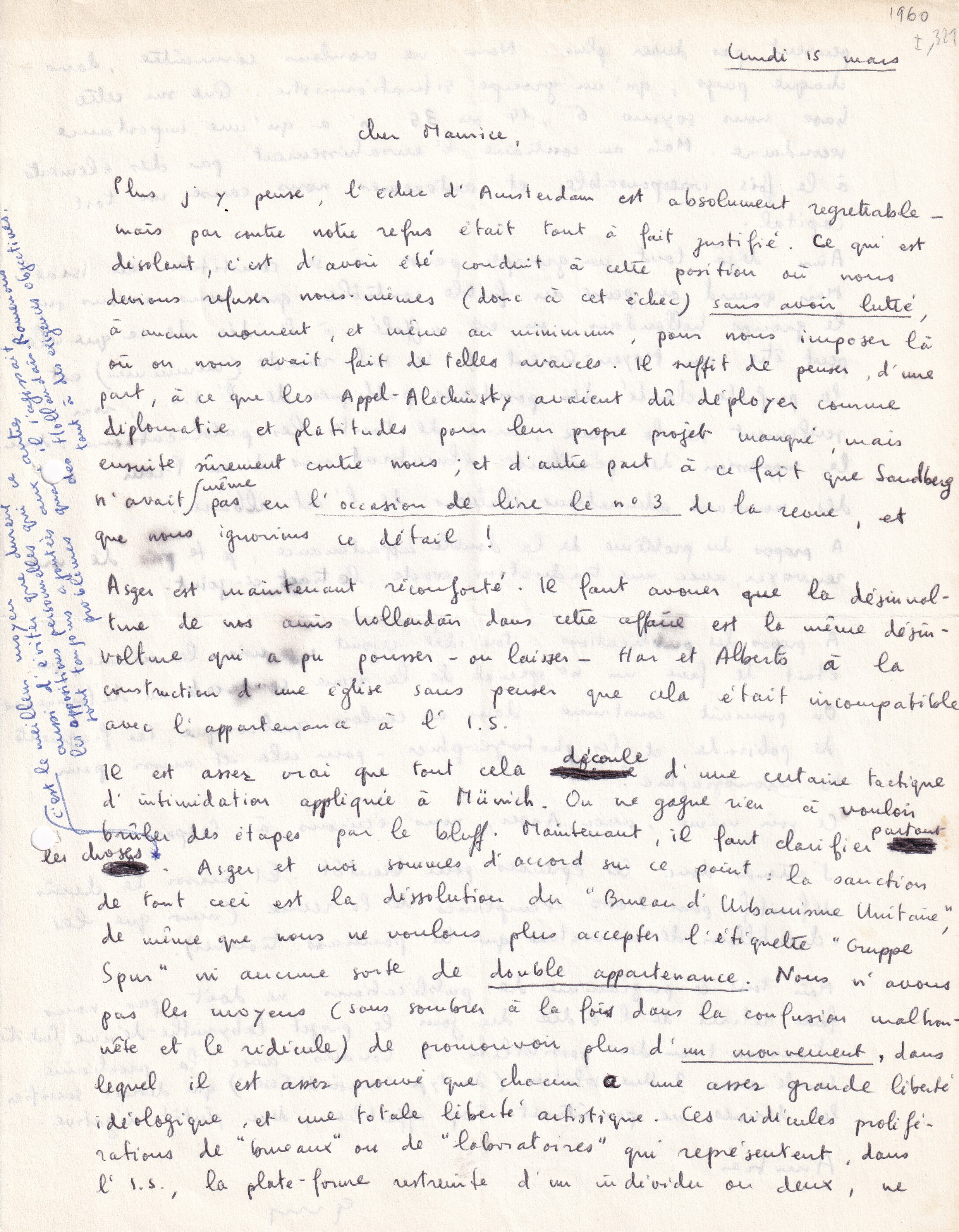
13. DEBORD, Guy. Signed handwritten letter dated Lundi 15 mars [1960]. 2 p. (one sheet); 21 x 27 cm.; black and blue inks on white stock. Correspondance, Vol. I, p. 321-23.
After plans for the Stedelijk exhibition fell apart, Debord reflects on this failure. In terms of next steps, he recommends “full transparency” (in reference to the disagreements with the Dutch section) and, more practically, the dissolution of the Bureau for Unitary Urbanism as well as the need to coalesce around a strongly-defined shared program. An authoritarian bent comes through: “There’s a group that wants to get formalized in Israel. But when you think about the limited oversight we have over the Dutch group, we are crazy to consider what could happen in the Middle East! The only (minimum) solution is a perfect clarity of the S.I.’s public positions”. Debord closes the letter by advocating for the need to find another venue for the “labyrinth-derive” project.
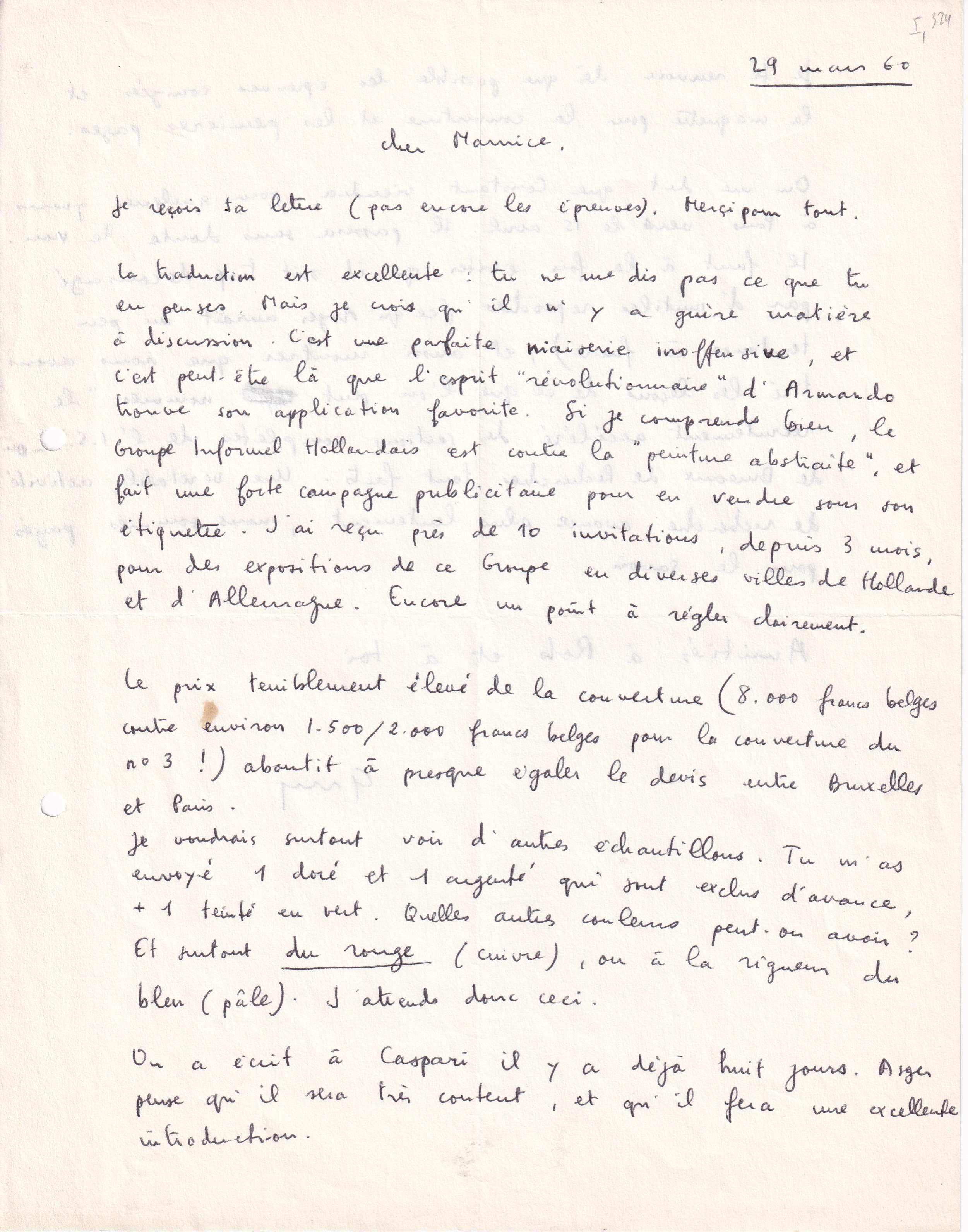
14. DEBORD, Guy. Signed handwritten letter dated 29 mars [19]60. 2 p. (one sheet); 21 x 27 cm.; black ink on white stock. Correspondance, Vol. I, p. 324-25.
This letter is primarily a discussion around the logistics for issue #4 of Internationale Situationniste (including the price and choice of the metallic wrappers).
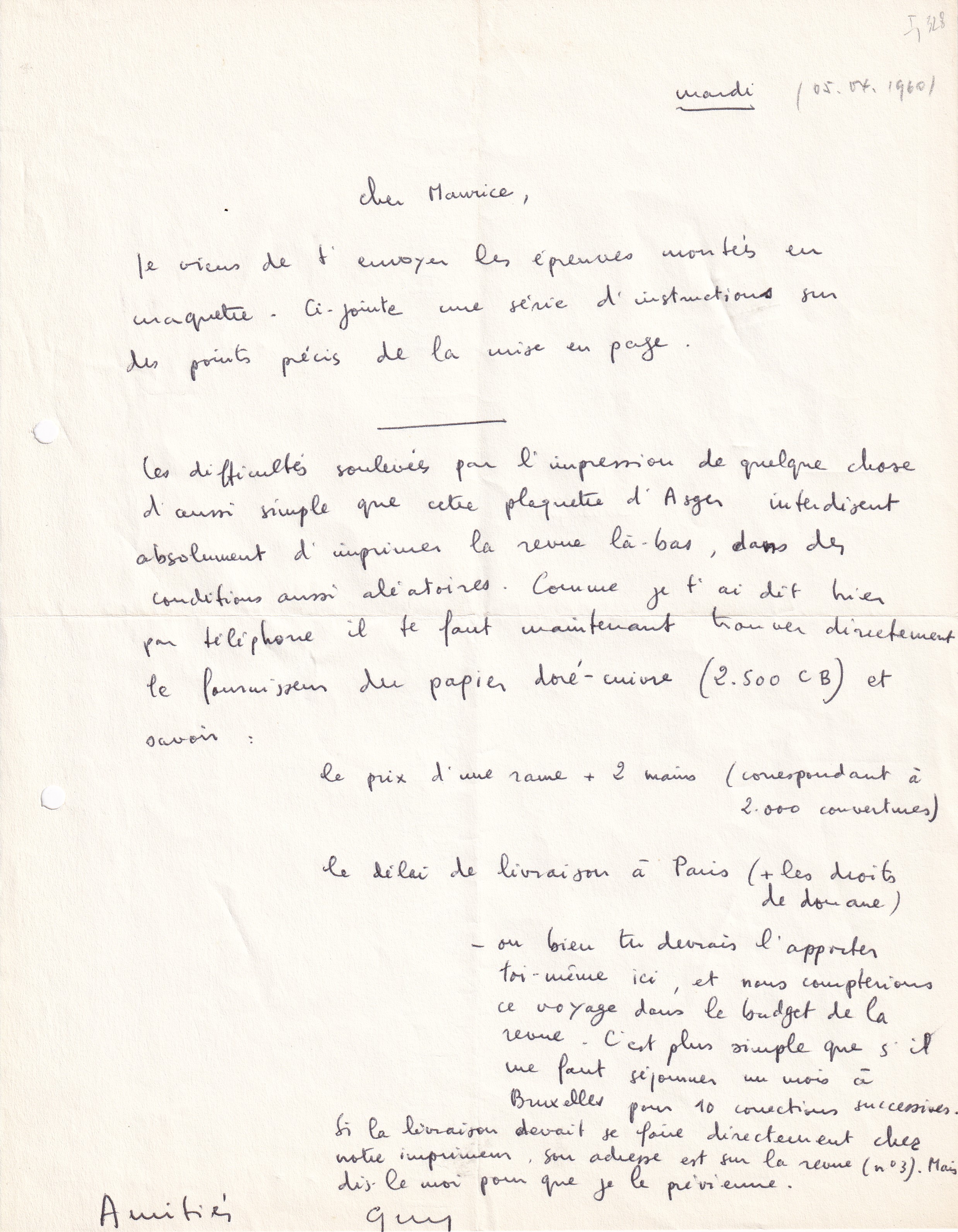
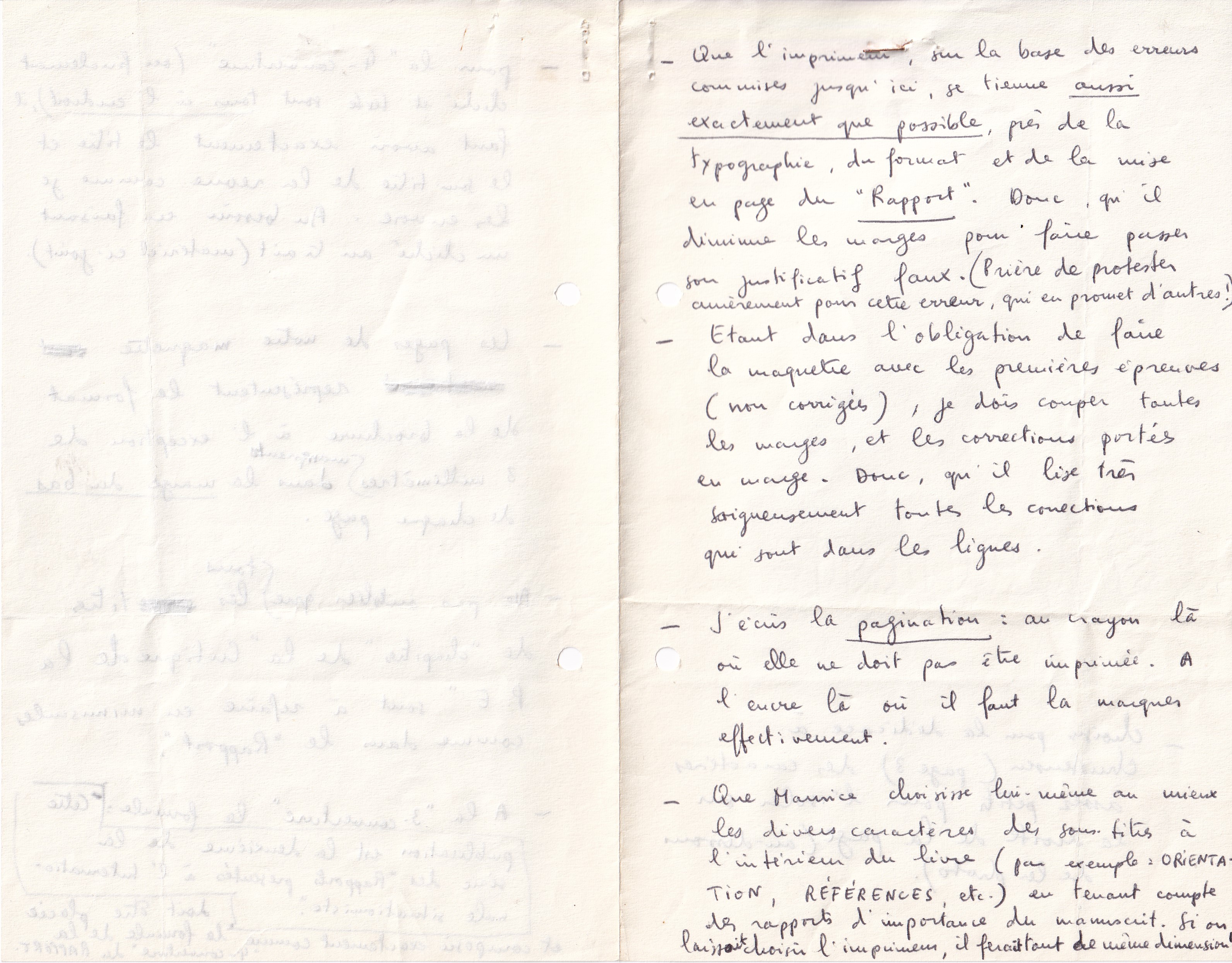
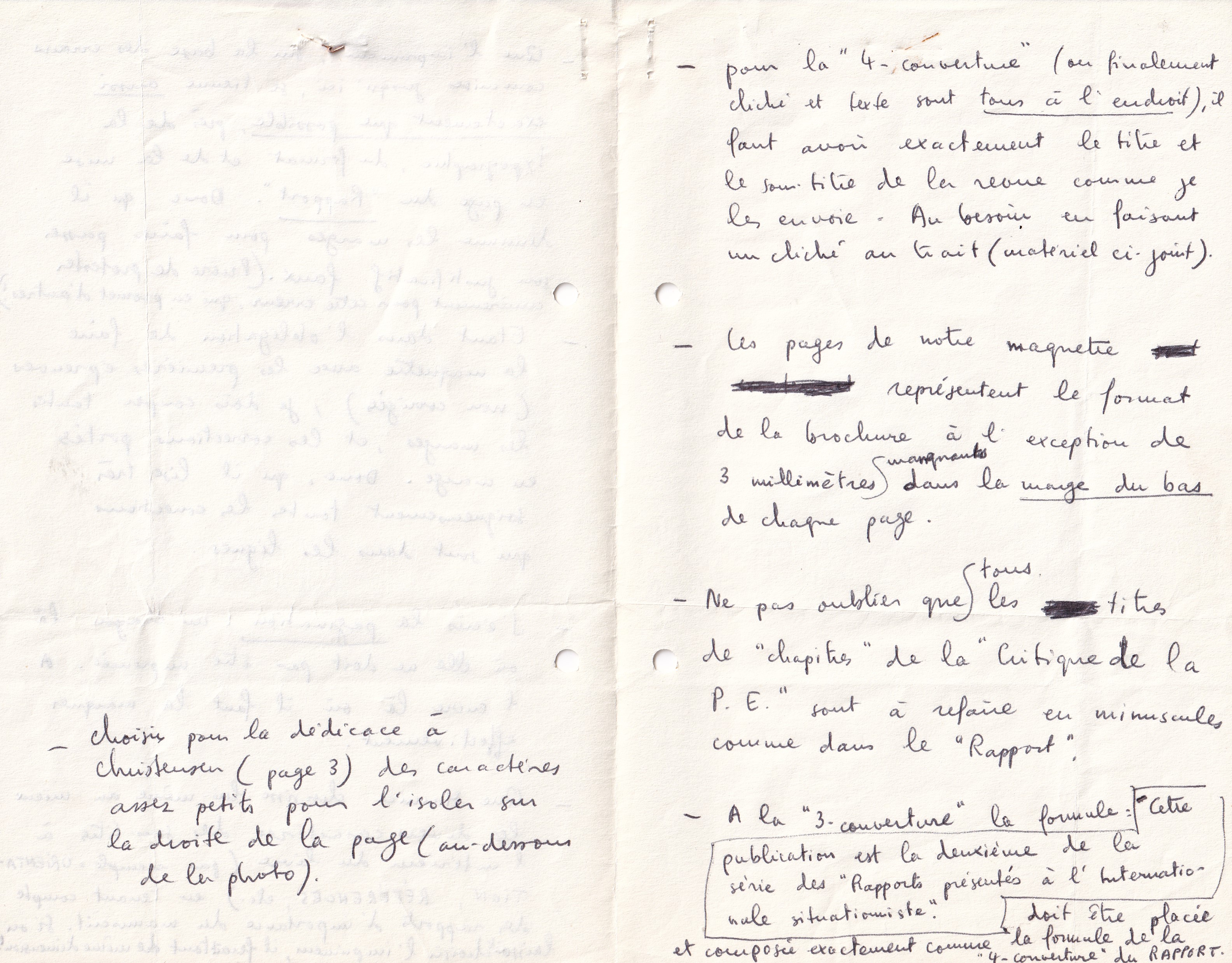
15. DEBORD, Guy. Signed handwritten letter mardi [05/04/1960].1 p.; 21 x 27 cm.; black ink on white stock. 3 p.; 21 x 13.5 cm.; black ink on white stock. Correspondance, Vol. I, p. 327-29.
Debord discusses in great detail the layout for the forthcoming brochure by Jorn (Critique de la politique economique, suivie de la lutte finale., which would be published shortly thereafter).
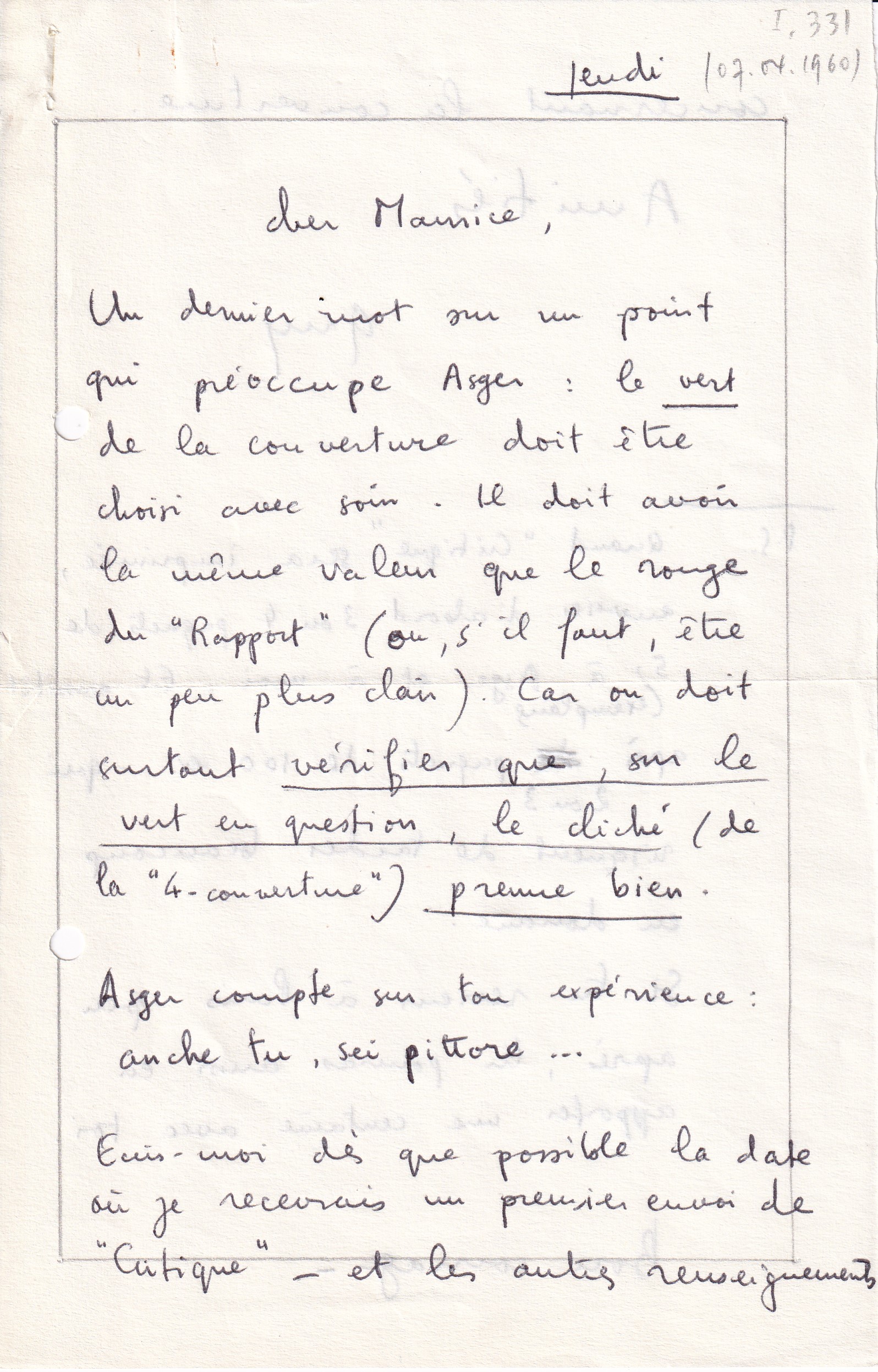
16. DEBORD, Guy. Signed handwritten letter dated jeudi [07/04/1960].2 p (one sheet).; 21 x 13.5 cm.; black ink on white stock. Correspondance, Vol. I, p. 329-30.
Debord follows up regarding the color of the cover for Critique de la politique economique, and asks Wyckaert to mail copies to Paris once the brochure is printed. The choice of illustration for the rear cover – a photograph of a group of paratroopers along with the text “Not everyone can read Internationale Situationniste” -. would cause the pamphlet to be seized by customs agents at the French-Belgian border. Most copies have not been recovered, and a new printing (with a different cover) was made in 1970.
17. DEBORD, Guy. Signed handwritten letter dated mercredi 22 juin [1960].2 p. (one sheet); 21 x 27 cm.; blue ink on white stock. Correspondance, Vol. I, p. 343-44.
Debord acknowledges receipt of copies of Critique de la politique economique, and asks Wyckaert whether he’s received Internationale Situationniste #4. He writes that his new film project (Critique de la separation) is keeping him incredibly busy. He forwards a copy of some letters exchanged with Constant. One more time, he asks Wyckaert “At what stage is your monograph?” This letter has been translated into English: http://www.notbored.org/debord-22June1960.html
18. DEBORD, Guy. Signed handwritten letter dated Samedi [13/08/1960].2 p. (one sheet); 21 x 27 cm.; black ink on white stock. Correspondance, Vol. I, p. 369-70.
Debord informs Wyckaert that he may be going through Brussels and could get together with him then. He comments on the exclusion of Pinot-Gallizio, and mentions the publication in Canada of Cahier pour un paysage a inventer, the work of Patrick Straram (“only 3/4th Situationist”). He closes with “CONGO TO THE CONGOLESE! U.N.E.S.C.O. TO THE SITUATIONISTS!”
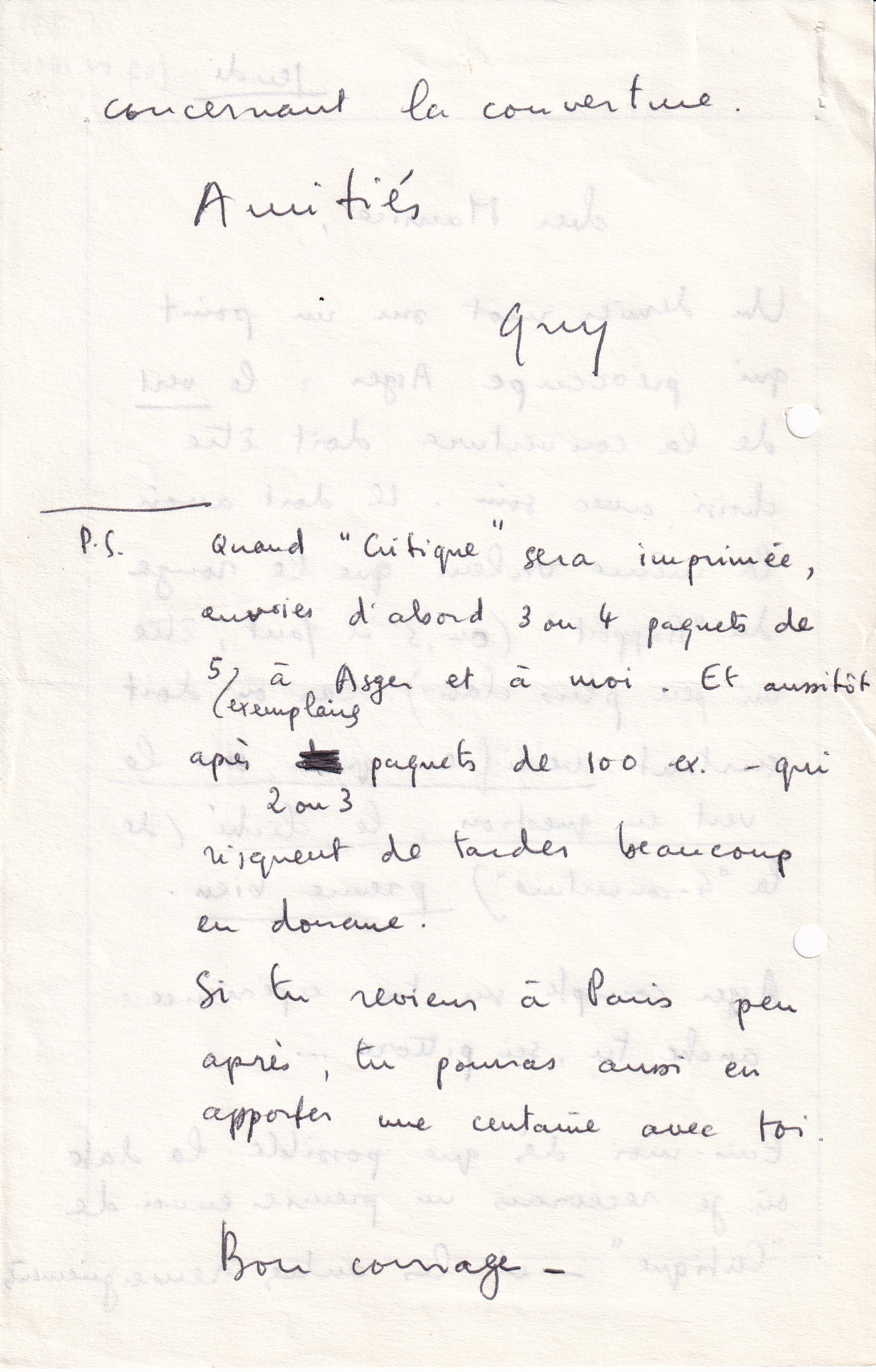
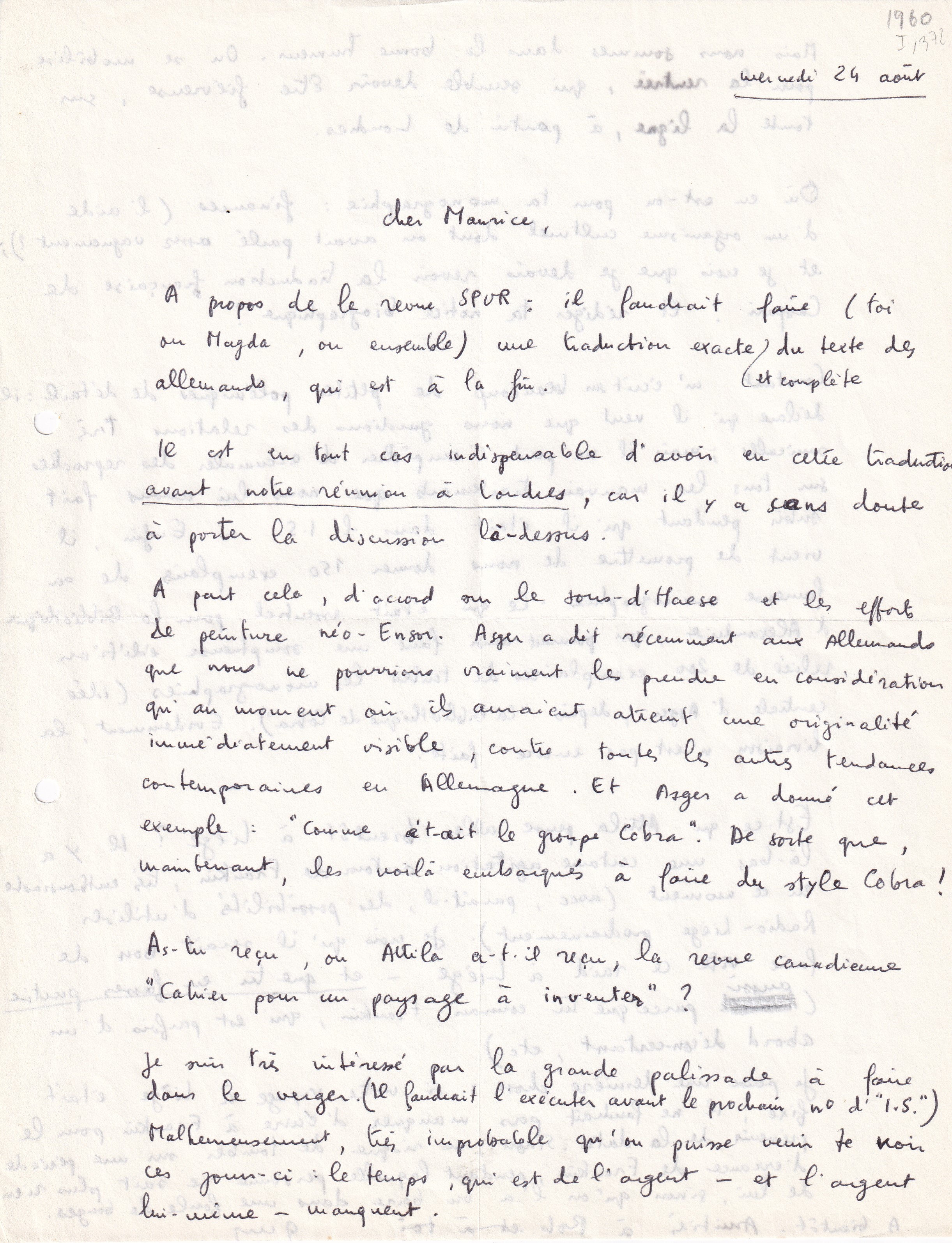
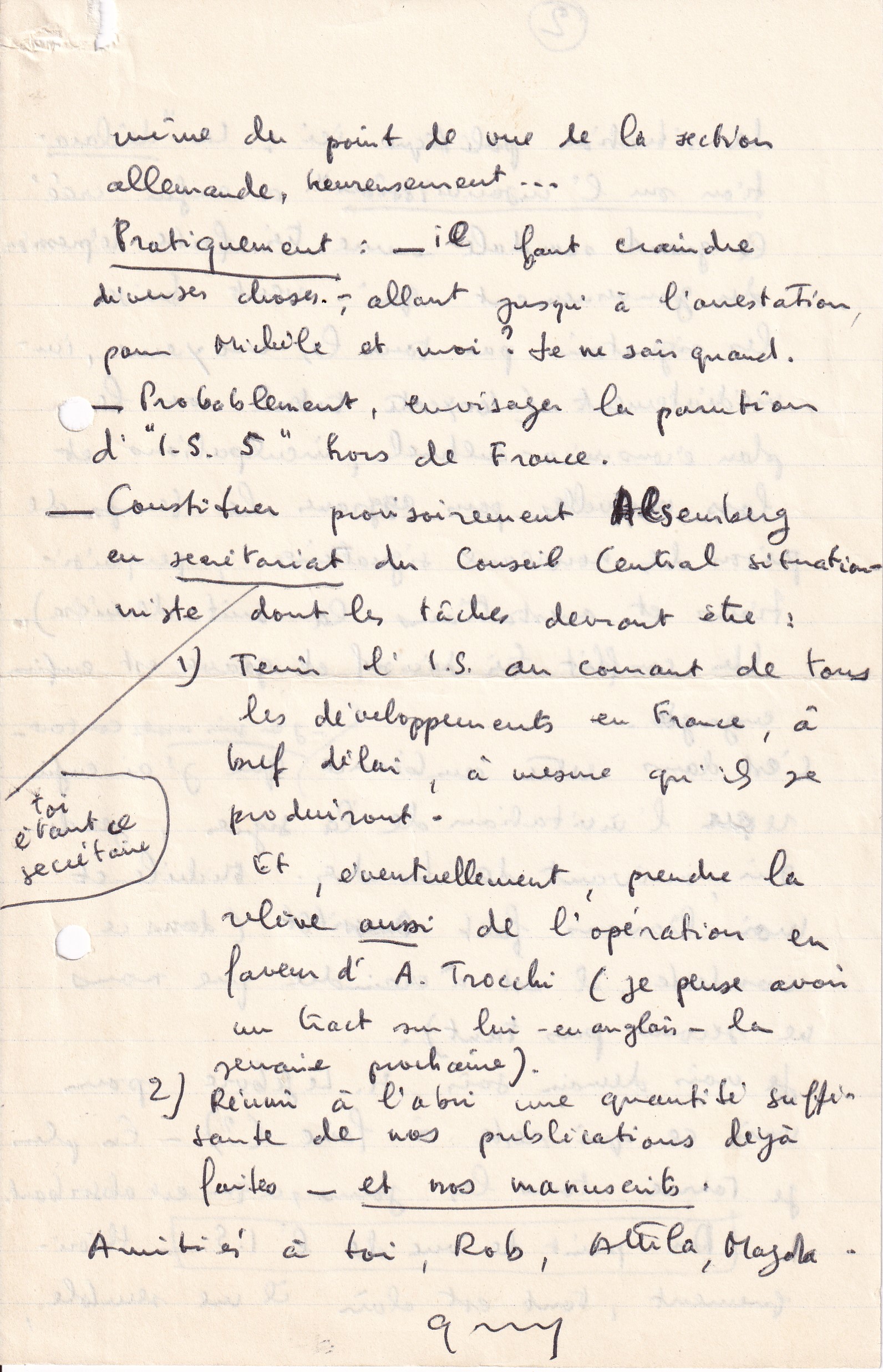
19. DEBORD, Guy. Signed handwritten letter dated mercredi 24 aout [1960].2 p. (one sheet); 21 x 27 cm.; black ink on white stock. Correspondance, Vol. I, p. 372-74.
Debord discusses a number of topics. He says that he’s “very interested in the project of a large palisade for the orchard (it must be completed ahead of the next issue of Internationale Situationniste)”. Unfortunately, we find no trace of this work of art, which was likely never created.
20. DEBORD, Guy. Signed handwritten letter dated samedi soir [01/10/1960].5 p. (three sheets); 21 x 13.5 cm.; black ink on white lined paper. Correspondance, Vol. II, p. 15-18.
Debord comments on Trocchi’s recent arrest in New York (due to drug possession) and the publication of a leaflet to protest it (Hands Off Alexander Trocchi! would be published on October 7), the boycott of Arguments, the famed Manifeste des 121 (against the war in Algeria, it was signed by numerous French intellectual, including Debord), an upcoming encounter with Henri Lefebvre This letter has been translated into English: http://www.notbored.org/debord-1October1960.html
21. DEBORD, Guy. Signed handwritten letter dated Lundi soir [03/10/1960].2 p. (one sheet); 21 x 27 cm.; black ink on white stock. Correspondance, Vol. II, p. 18-19.
Debord tells Wyckaert about a potential encounter with Henry Miller. He hopes Miller can help spread the news about Trocchi’s arrest and advocate for his liberation. This letter has been translated into English: http://www.notbored.org/debord-3October1960.html
22. DEBORD, Guy. Signed handwritten letter dated dimanche 13 nov. [13/11/1960].1 p.; 21 x 27 cm.; black ink on white stock. Correspondance, Vol. II, p. 47.
Debord writes to Wyckaert about everything he needs to finalize an English language situationist journal (beyond the Situationist Times). However, it would never see the day.
23. DEBORD, Guy. Signed handwritten letter dated lundi 21 [21/11/1960].2 p. (one sheet); 21 x 27 cm.; black ink on white stock. Correspondance, Vol. II, p. 48-49.
With a sense of urgency, Debord asks Wyckaert once more to complete a number of translations for the (never-to-be-published) English language Situationist journal. He also brings up the police interrogation he was subject to in relation to his involvement with the Manifeste des 121.
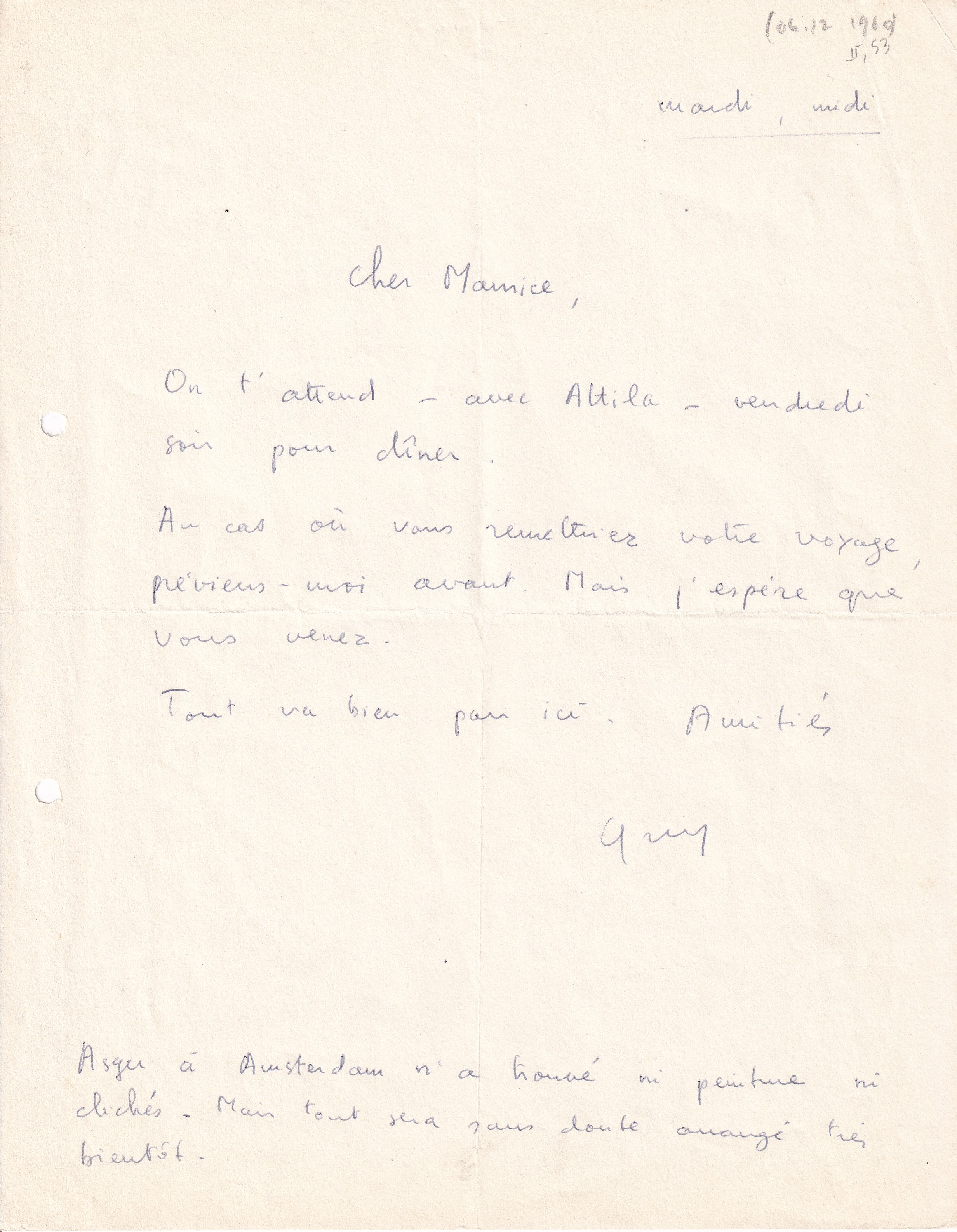
24. DEBORD, Guy. Signed handwritten letter dated mardi, midi [06/12/1960].1 p.; 21 x 27 cm.; blue ink on white stock. Correspondance, Vol. II, p. 53.
Debord informs Wyckaert that they can have dinner together (along with Attila Kotányi) on Friday [9 December].
25. DEBORD, Guy. Signed handwritten letter dated mardi soir [06/12/1960].2 p. (one sheet); 21 x 27 cm.; blue ink on white stock. Correspondance, Vol. II, p. 54-55.
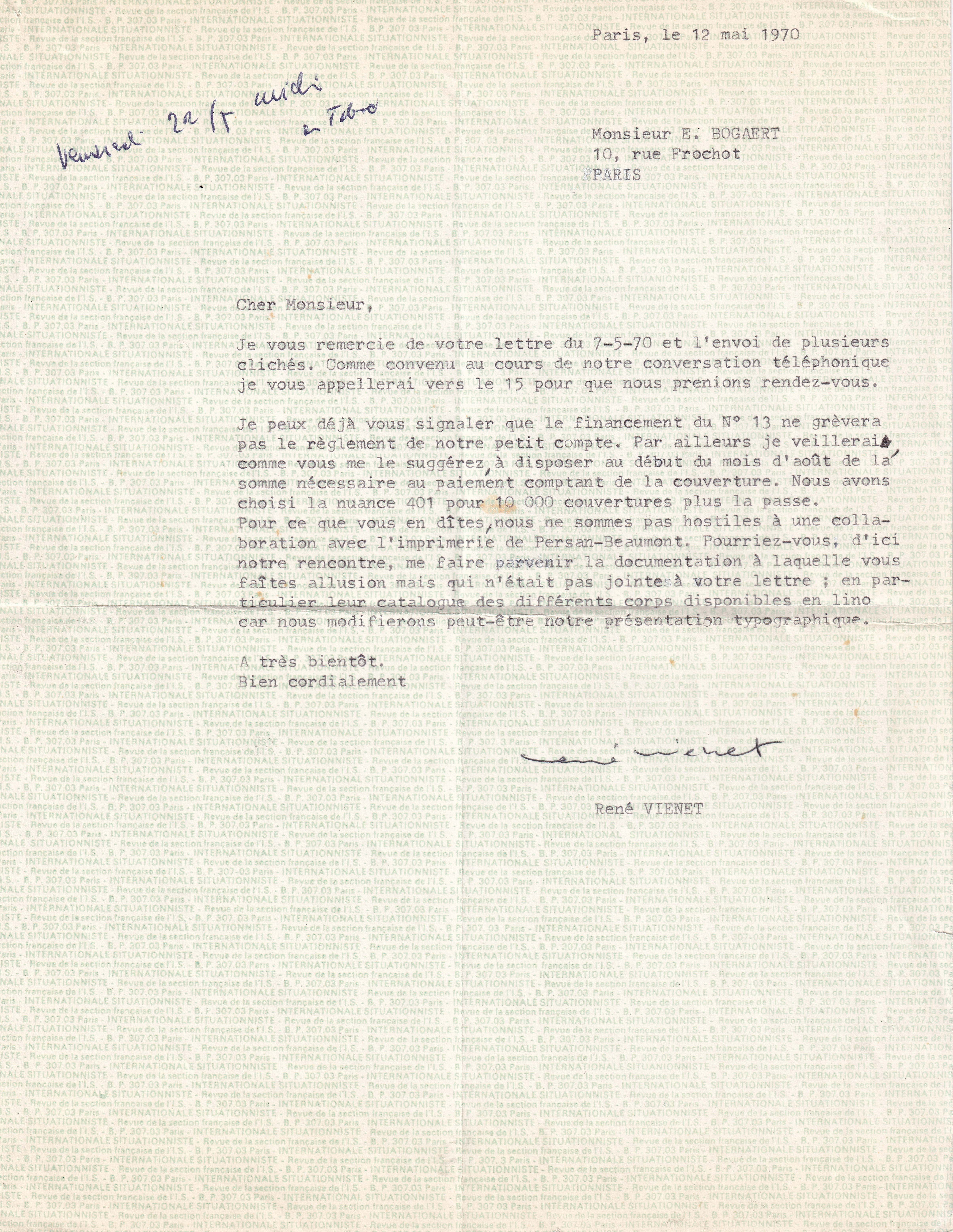
VIENET, René. [Typed letter to Monsieur E. BOGAERT dated 12 May 1970]. 1 p.; 21 x 27 cm.; black ink on white and green Internationale Situationniste stock.
Debord first met Eugene Bogaert in late 1959, entrusting him with the printing of the third issue of Internationale Situationniste (Paris: Internationale Situationniste, December 1959). In a letter dated 14 December 1959, Debord tells Constant “Nous sommes maintenant chez un imprimeur excellent” (“We are now with an excellent printer”). The previous printer had botched the printing of the second issue of Internationale Situationniste: the aluminum foil used for the wrappers was of such poor quality that the majority of copies did not survive the printing process. A second printing was realized by Bogaert in the Spring of 1962 using a more durable material (see here for pictures: https://situationnisteblog.wordpress.com/2016/02/03/internationale-situationniste-2-first-and-second-printing-1958-1962/).
Despite a few issues (e.g., with the printing of Internationale Situationniste 6, see letters in Correspondance Volume 2 , pp. 104-115), Debord and Bogaert would get along well and Ch. Bernard would remain the printer of Internationale Situationniste through the very last issue in 1969. This is in part due to the fact that Bogaert showed tremendous patience and understanding regarding the SI’s chronically delayed payments (see, for instance, the letter from Debord dated 1 October 1962 in Correspondance Volume 2, pp. 168-170). Bogaert would also print many of the SI’s leaflets and brochures over the years.
In this letter dated 12 May 1970, Viénet discusses the printing of the thirteenth issue of the periodical Internationale Situationniste. He states (translation is mine): “I can already assure you that the financing of no. 13 will not impact the settling of our debts. Besides, I will ensure, as you suggest, that the required amount for the cover is made available to you by early August. We have chosen the color 401 for 10.000 covers”. As our readers are likely aware, Internationale Situationniste13 would never be published. Preliminary notes and manuscripts related to that issue can be found at Yale University’s Beinecke Library, in the Gianfranco Sanguinetti papers (see https://archives.yale.edu/repositories/11/archival_objects/193237)
Letter from Vienet to BogaertCourtesy of Yale University’s Beinecke Library
VIENET,René. [Typed letter to Monsieur BOGAERT dated 9 August 1969]. 1 p.; 21 x 27 cm.; black ink on white and green Internationale Situationniste stock
Debord first met Eugene Bogaert in late 1959, entrusting him with the printing of the third issue of Internationale Situationniste (Paris: Internationale Situationniste, December 1959). In a letter dated 14 December 1959, Debord tells Constant “Nous sommes maintenant chez un imprimeur excellent” (“We are now with an excellent printer”). The previous printer had botched the printing of the second issue of Internationale Situationniste: the aluminum foil used for the wrappers was of such poor quality that the majority of copies did not survive the printing process. A second printing was realized by Bogaert in the Spring of 1962 using a more durable material (see here for pictures: https://situationnisteblog.wordpress.com/2016/02/03/internationale-situationniste-2-first-and-second-printing-1958-1962/).
Despite a few issues (e.g., with the printing of Internationale Situationniste 6, see letters in Correspondance Volume 2 , pp. 104-115), Debord and Bogaert would get along well and Ch. Bernard would remain the printer of Internationale Situationniste through the very last issue in 1969. This is in part due to the fact that Bogaert showed tremendous patience and understanding regarding the SI’s chronically delayed payments (see, for instance, the letter from Debord dated 1 October 1962 in Correspondance Volume 2, pp. 168-170). Bogaert would also print many of the SI’s leaflets and brochures over the years.
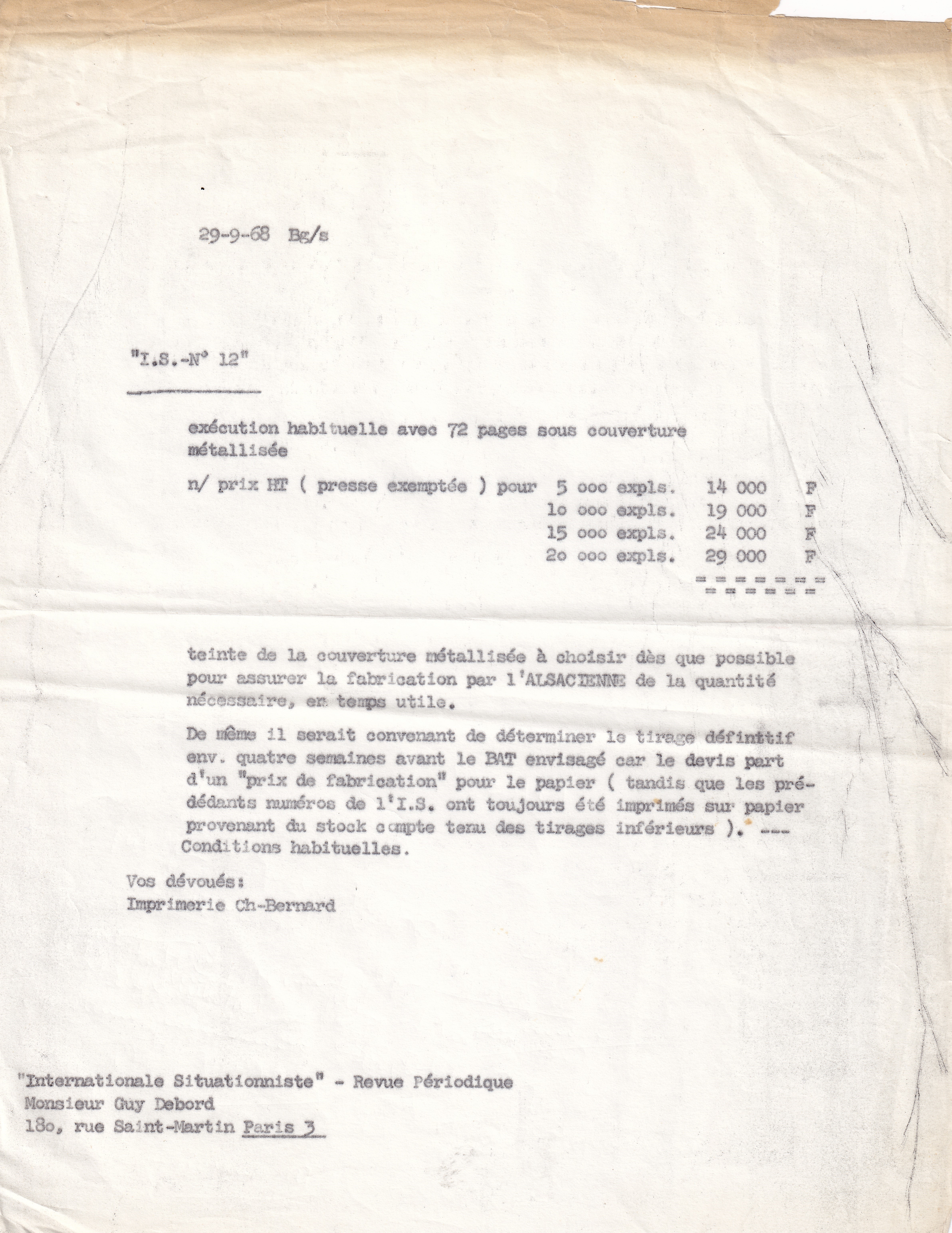
In a first letter dated 29-9-68, Bogaert had provided the tentative price for Internationale Situationniste 12 for different print runs, assuming a 72-page count. Internationale Situationniste 12 would would ultimately be nearly twice as long, standing at a 120 pages,
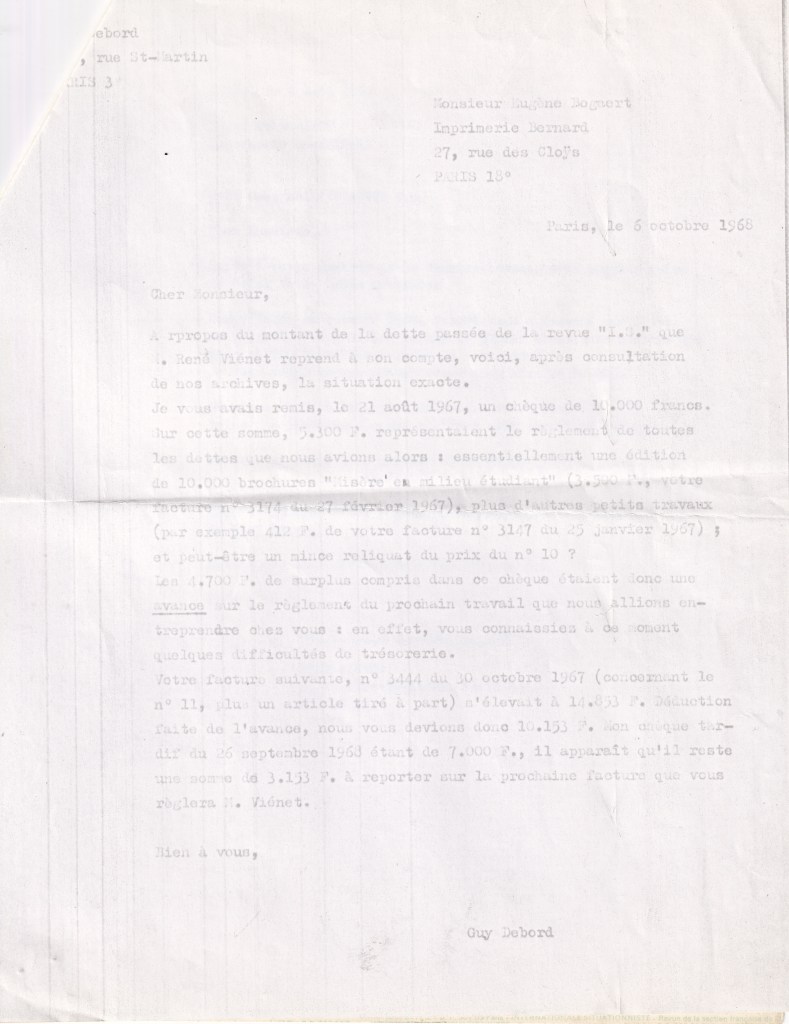
This letter from Rene Viénet to Bogaert, dated 9 August 1969, also concerns the twelfth (and last) issue of the Internationale Situationniste periodical. It confirms the wrapper design and color (Alsacienne 441) and print run (10.000 copies), as per a letter from Guy Debord dated 6 October 1968 (a xerox copy is included; also reproduced in Correspondance Volume 3, pp. 289-290). Viénet also recaps the latest accounting, asking Bogaert to confirm that the amount (3.847 Francs) is aligned with his own financial ledger.
Internationale Situationniste 12 would be ultimately published in September 1969.
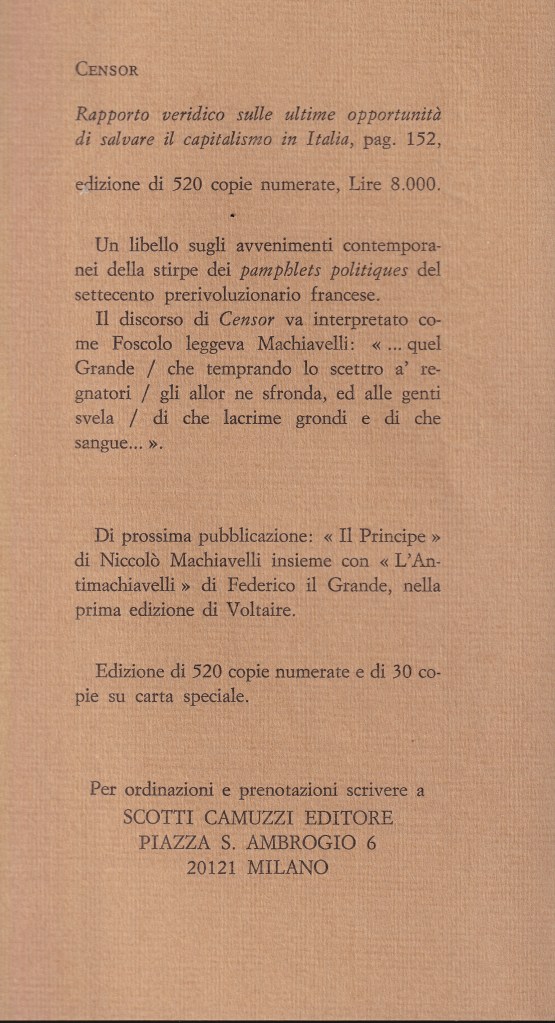
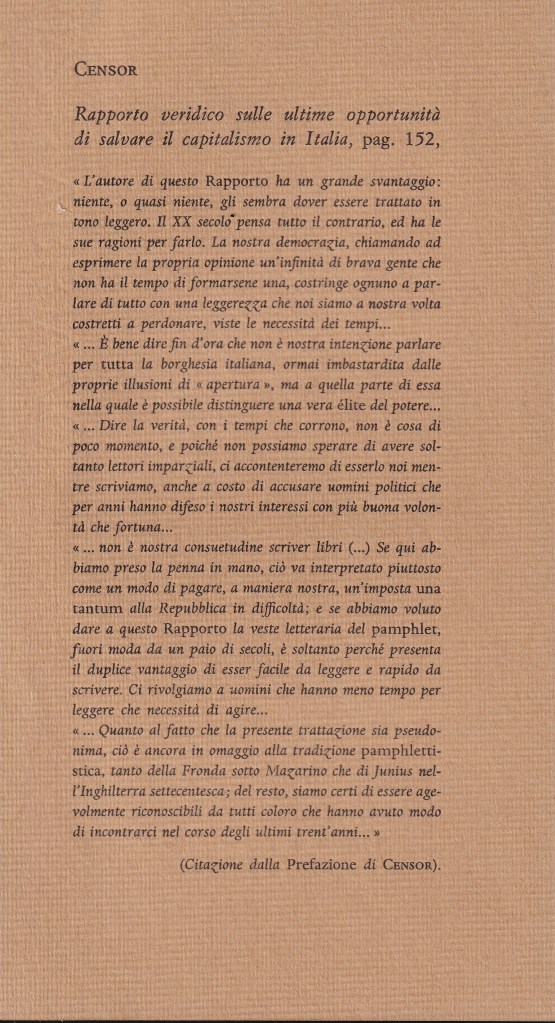
[SANGUINETTI, Gianfranco]CENSOR. Rapporto Veridico Sulle Ultime Opportunia di Salvare il Capitalismo en Italia. Milan: Scotti Camuzi, 1975. 150 p.; 23.5 x 14.8 cm.; tan cover with text in red and black. Copy no. 137 of 520. Complete of its errata card. We locate a single OCLC copy at Yale University’s Beinecke Library, part of the Gianfranco Sanguinetti papers.
True first edition of what is perhaps Gianfranco Sanguinetti’s most critical work.
Gianfranco Sanguinetti joined the Situationist International after May 68, and soon turned into a key contributor to the organization (and of its last two members). He was one of the founding members of the Italian section of the S.I. in January 1969, alongside Claudio Pavan and Paolo Salvadori. Sanguinetti became very close to Debord (the two of them exchanged over 600 letters, many of which remain unpublished to this day), with whom he co-authored La veritable scission dans l’Internationale Situationniste in 1972. He also helped Debord with his film, La Société du Spectacle, also in 1972.
In July 1975, writing under the pseudonym of Censor, Sanguinetti authors the Rapporto Veridico Sulle Ultime Opportunia di Salvare il Capitalismo en Italia (in English: Truthful Report on the Last Chance to Save Capitalism in Italy). Posing as an anonymous, high-ranking member of the Italian intelligentsia, Sanguinetti makes the argument that the Christian democrats should welcome Communists in a coalition government in order to maintain the capitalist order. Written in the style of a political treatise, the book openly draws from the likes of Machiavelli and Clausewitz.
The book was printed in 520 numbered copies, then mailed to a small set of influential politicians, company executives, union leaders, and journalists. The book was then printed by Mursia in October 1975, garnering many positive reviews in the press and selling thousands of copies. The Rapporto would eventually be translated into French (Paris: Champ Libre, 1976) and English (Pougkeepsie, N.Y. : Anti-torpor league, 1979 — partial translation; Flatland: Fort Bragg, 1997; and online here)
For more details on the context behind the book, see here.
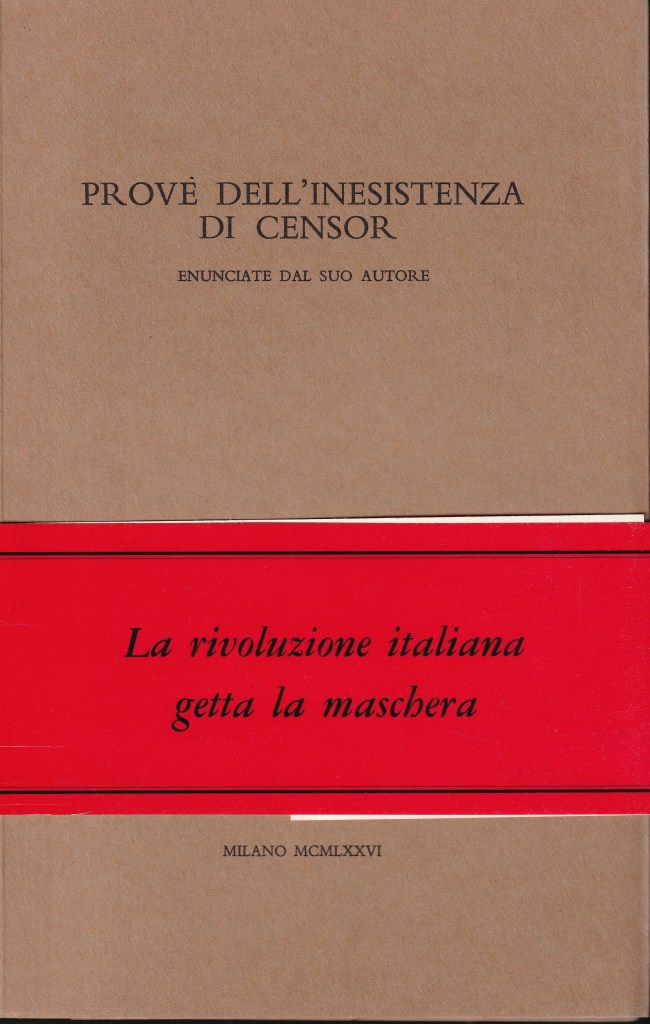
SANGUINETTI, Gianfranco. Prove Dell’Inesistenza di Censor. Milan: n.p., 1976. 32 p.; 23.5 x 15.3 cm.; tan cover with text in black. Copy no. 400 of 520. Compete with its red wrapper band. We locate two OCLC copies, at Bologna and Roma.
It was not until December 1975 that Sanguinetti revealed that the book was a fake, a hoax. In Prove Dell’Inesistenza di Censor: Censor did not exist; Rapporto was Sanguinetti’s attempt to point out the cynicism of the Italian bourgeoisie. This caused a large scandal, contrasting with the many positive reviews of the Rapporto in the Italian press.
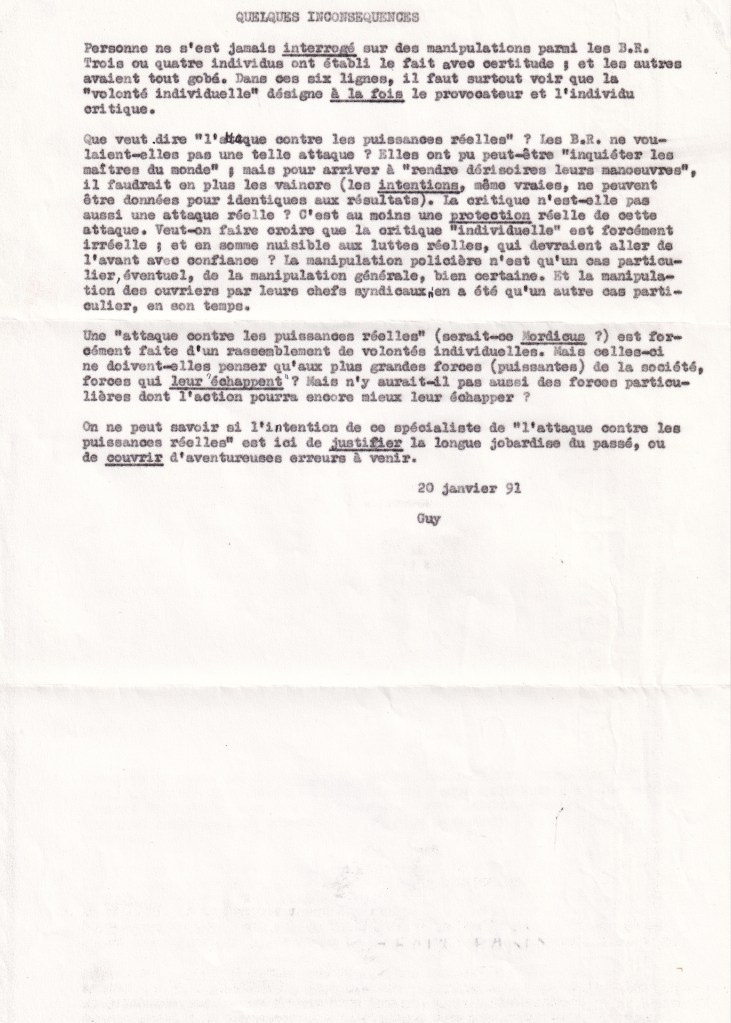
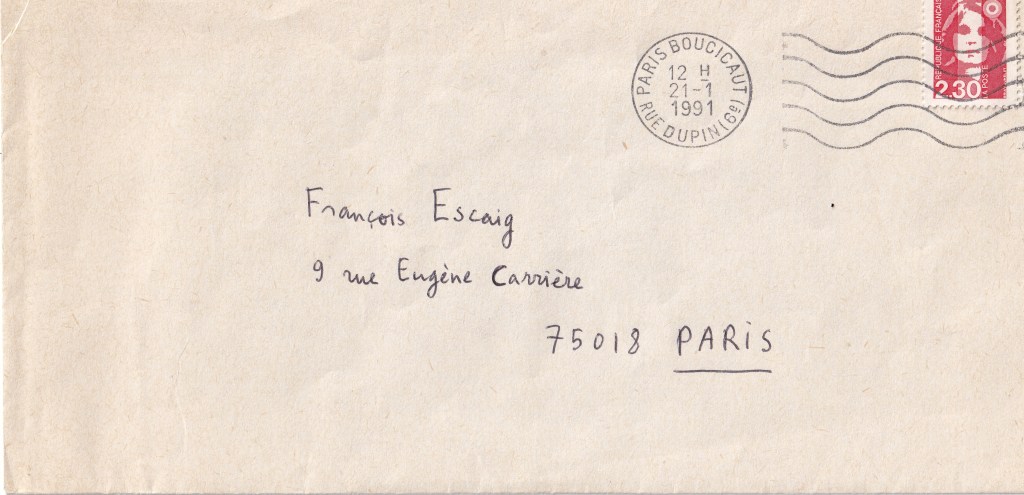
DEBORD, Guy. Typed letter [to Renaud Burel] (signed “Guy”) dated 20/01/1991. n.p. [Paris], 20 January 1991. 1 p.; 21 x 30 cm.; black ink on white stock.
Typed letter [to Renaud Burel] dated 20 January 1991. This letter, however, was mailed to Francois Escaig.
This letter is a “correction” of an exercise proposed by Guy Debord to Renaud Burel in his letter dated 2 January 1991. He had then written the following: “In the periodical that you gave me the other evening [Mordicus], I identified a paragraph in which several contradictions can be discovered. Since I have said that your logic (with respect to a completely unworthy inheritor) appears a little weak to me, I now propose to you an exercise, which you can do together with your friend: what are the manifestly false points in these six short lines and to which intentions could they correspond?”
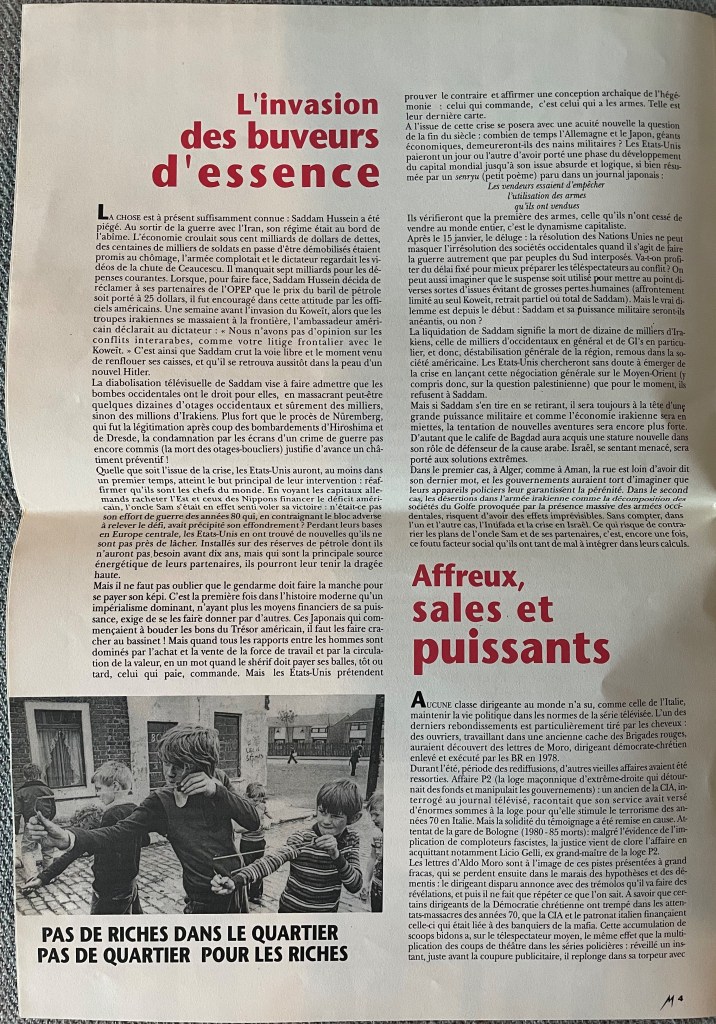
While we could not locate Burel’s (and perhaps Escaig’s?) response, we have identified the six lines that Debord was referring to. They are part of an article on the Red Brigades published in the first issue of Mordicus (“Affreux, sales et puissants”, pp. 4-5) in December 1990. It translates as follows: “Many have wondered about the possibility that groups like the R[ed] B[rigades] could have been manipulated. However, inifinitely more powerful than all conspiracies and conspirators, the “manipulation” by society, the economy, and the media trumps the will of the individual. Only an attack against these real powers can threaten those rule the world and render their actions meaningless” (p.5)
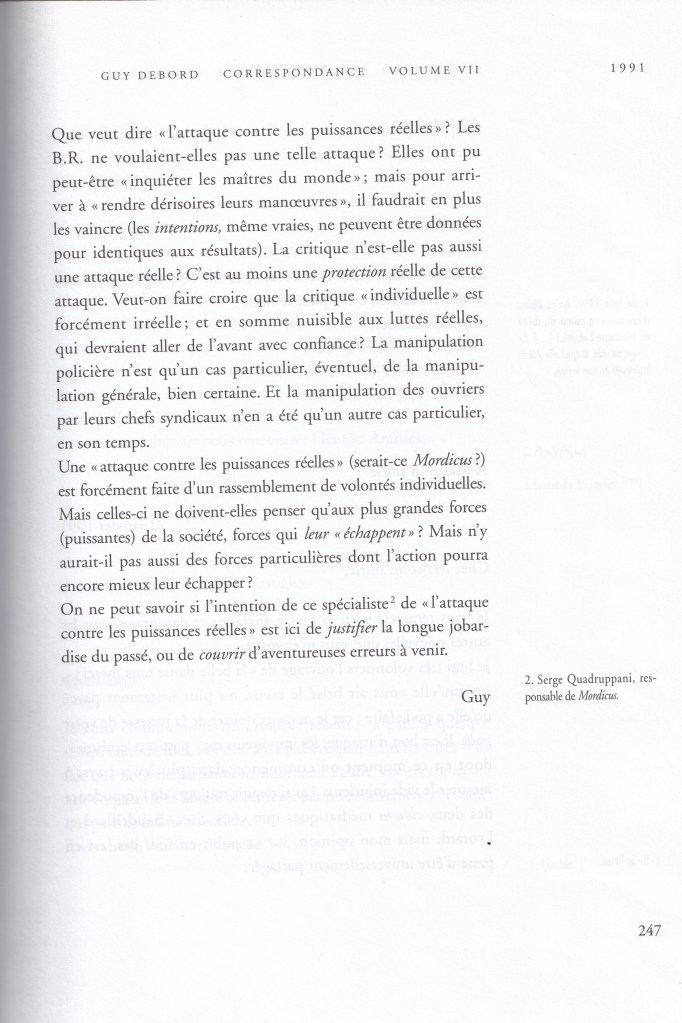
The letter by Debord is a line-by-line rebuttal of these six lines. An English translation of that letter can be found here: http://www.notbored.org/debord-20January1991.html. It is reproduced below for the reader’s benefit:
Several inconsistencies
No one was ever interrogated about the manipulations of the R[ed] B[rigades]. Three or four individuals established the fact with certainty and the others swallowed it all. In those six lines,one must especially see that “individual will” designates both the provocateur and individual critique.
What does “the attack against the real powers” mean? Did not the RB want [to make] such an attack? Perhaps they did “disquiet the masters of the world,” but to arrive at “rendering their maneuvers derisory” it would be necessary to also vanquish them (the intentions, even the true ones, cannot be taken as identical with the results). Is not critique a real attack, too? It is at least a real protection from attack. Does one want to pretend that “individual” critique is necessarily unreal and in sum harmful to real struggles, which must go to the fore with confidence? Police manipulation is only a particular possible case of general manipulation, quite certainly. And the manipulation of the workers by their union leaders was only another particular case in its time.
An “attack against the real powers” (meaning Mordicus?) is necessarily made from an assemblage of individual wills. But must they only think about the great (powerful) forces of society, forces that “escape” them? But would there not also be particular forces whose action could escape them even better?
One cannot know if the intention of this specialist of “the attack against the real forces” is here to justify the gullibility of the past or to cover adventurous errors to come.
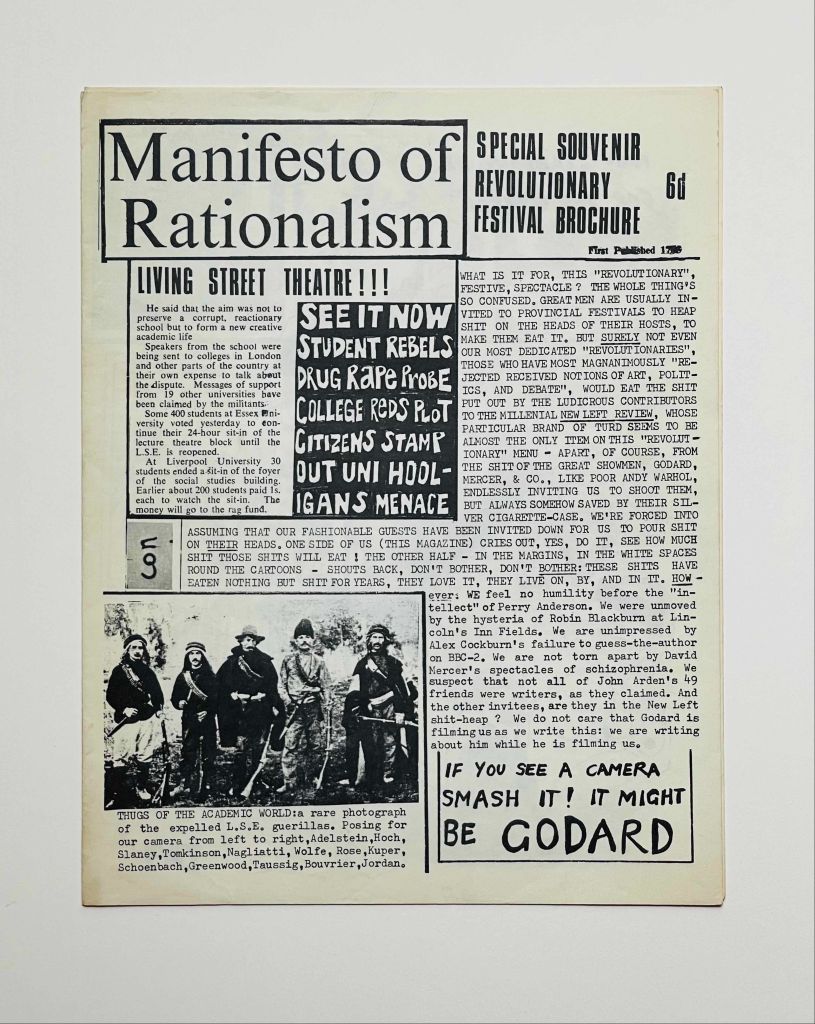
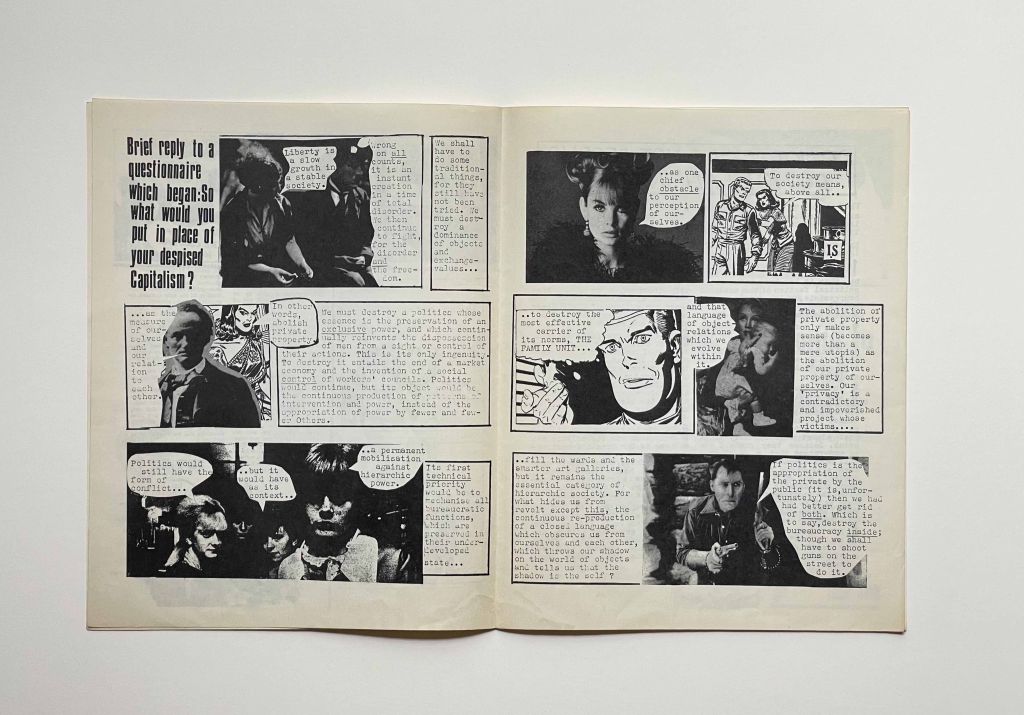
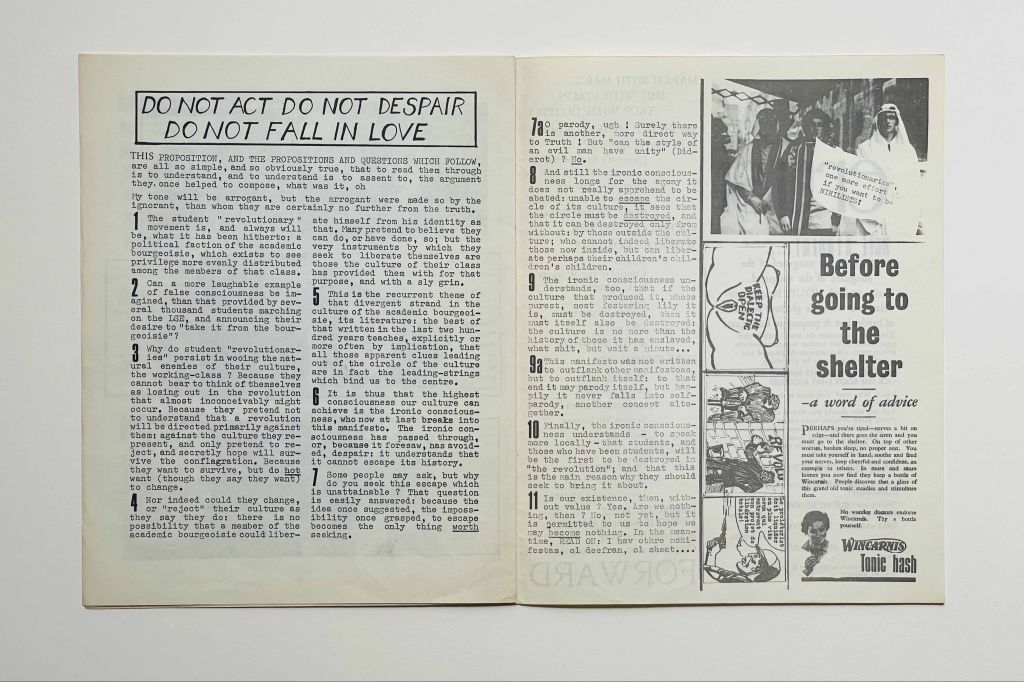
[KING MOB / Clark, T.J. et al.]. Manifesto of Rationalism: Special Souvenir Revolutionary Festival Brochure. n.p. [London]: n.p., n.d. [1968]. n.p. [8 p.]; ill.; 21 x 27.5 cm.; black ink on white stock.
Several “articles” refer to student protests in 1968 at the Essex University, Liverpool University, and the London School of Economics. A mixture of text, cut-ups, and détourned comic strips (OCLC)
“According to an interview with T.J. Clark (Power to the People, 2013) “In 1968 Essex University hosted a dreadful “revolutionary festival” with Godard and co. in attendance. A group of naysayers produced something called the Manifesto of Rationalism in hopes of spoiling the party, and I remember that my contribution was a strip cartoon beginning with a quote from Lewis Namier: ‘Liberty is the fruit of slow growth in a stable society.'” Clark goes on to express sincere hope that the item won’t be recovered for future scholars to examine.” (Arthur Fournier Rare Books)
We locate a single copy on OCLC at Yale University’s Beinecke Library.
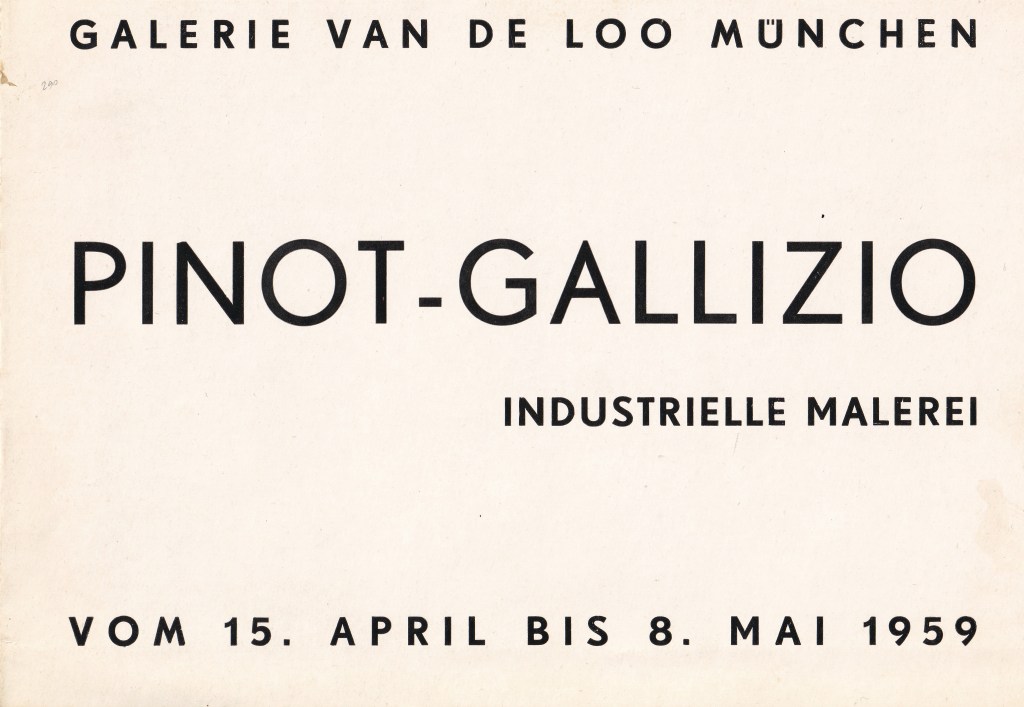
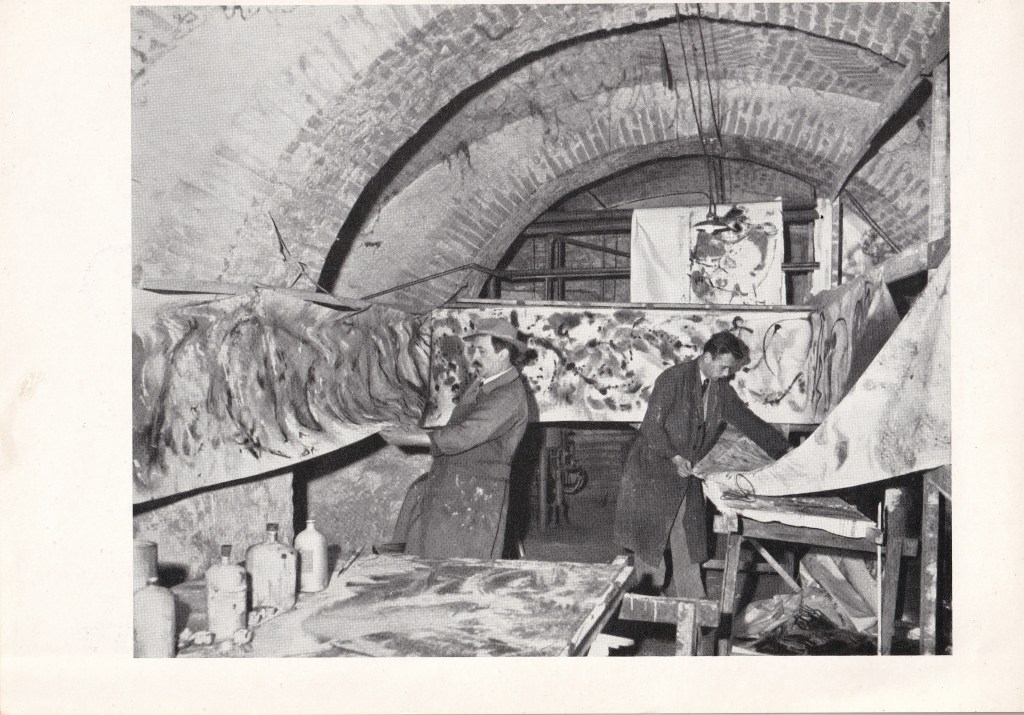
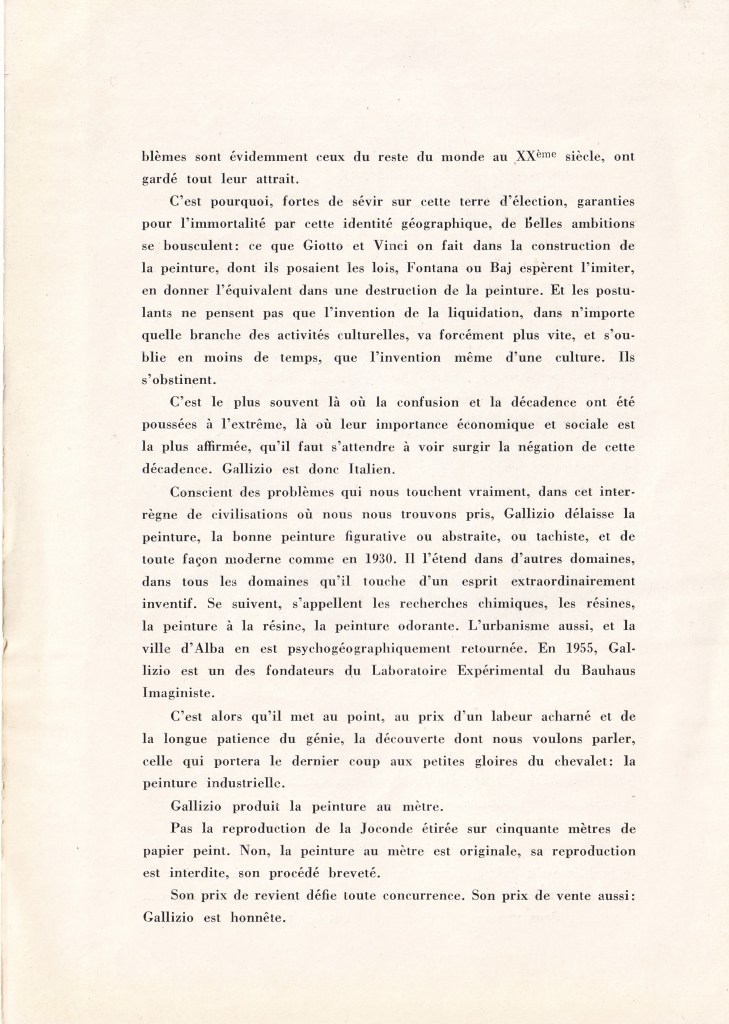
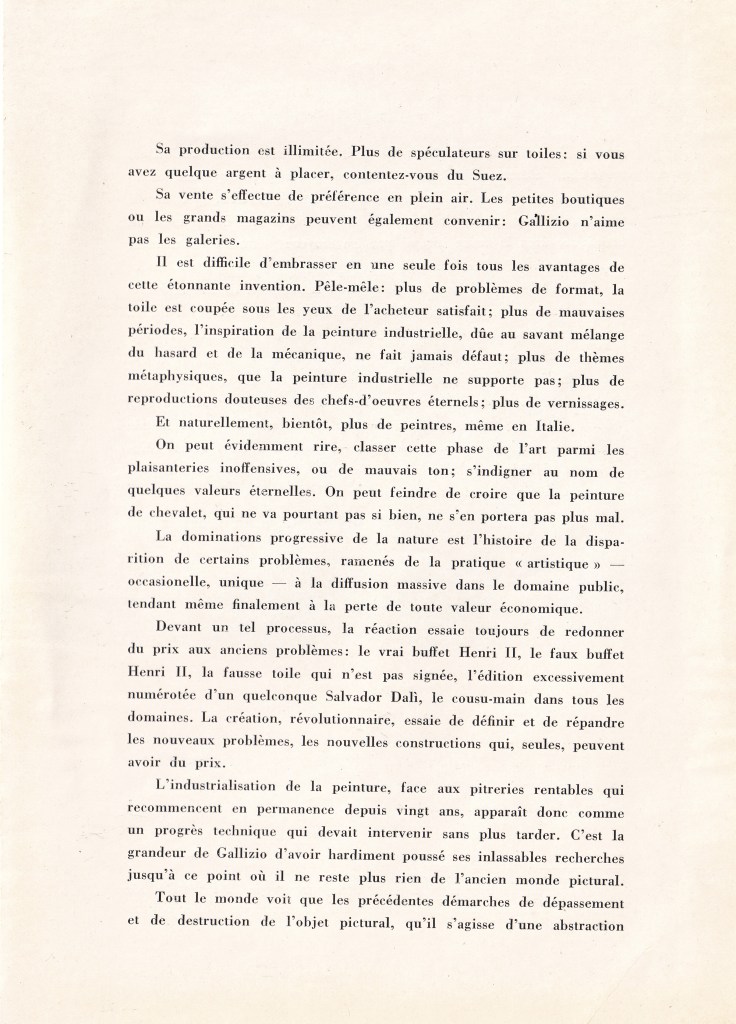
[PINOT-GALLIZIO, Giuseppe]Pinot-Gallizio: Industrielle Malerei. Munich: Van de Loo, 1959. n.p. [4 p.]; ill.; 15 x 21 cm.; black ink on white stock.
Catalog published on the occasion of Pinot-Gallizio’s exhibition, held at the Galerie Van de Loo in Munich between 14 April and 8 May 1959. This was Gallizio’s third exhibition of industrial painting, and the first one outside Italy (the Drouin exhibition in Paris would follow shortly thereafter). Contents include: a photograph of Pinot-Gallizio in his workshop in Alba (different from the one in the catalog of the exhibition held in Torino in 1958), a translation into German of excerpts of Michele Bernstein’s Elogio di Pinot Gallizio, and a translation into German of Pinot-Gallizio’s biography as found in the Torino catalog. For more details, see Debord’s letter to Pinot-Gallizio dated February 1958 (Correspondance Vol.1, pp. 193-194)
BERNSTEIN, Michele. Elogio di Pinot-Gallizio. Prima Mostra di Pittura Industriale. Torino: Notizie – Associazione Arti Figurative, [May] 1958. 4 p.; ill.; 21.5 x 15.5 cm.; cream wrappers with text in black.
Elogio di Pinot-Gallizio (In Praise of Pinot-Gallizio) is Michele Bernstein’s homage to the Italian painter on the occasion of his first exhibition of industrial painting, which opened on May 31, 1958 in Torino. This exhibition predates the ones held at Galerie Montenapoleone in July 1958, at the Galerie Van de Loo in Munich, in April-May 1959, and at the Galerie Drouin in May 1959. Bernstein’s text is followed by a short biography of Pinot-Gallizio, where we learn that the current exhibition showcases: “12 meters of oil painting on canvas, 14 meters of thermostatic resins on canvas, 70 meters on canvas produced in the lExperimental Laboratory of Alba, with the collaboration of Giorgio Melanotte” (translation is mine). A photograph of Pinot-Gallizio in his workshop is also included. The rear wrapper features an advert for the aperitif “Carpano”.
Debord writes to Asger Jorn about Pinot-Gallizio’s first exhibition in a letter dated 27 April 1958 (Correspondance Vol.1, p.89-90). A few months later, in another letter dated 16 June 1958, Debord sends Gallizio his “heartfelt congratulations for a well-deserved and expected success” (Correspondance Vol. 1, pp.99)
Excerpts from Bernstein’s text appeared in Internationale Situationniste 2 (Paris: Internationale Situationniste, December 1958: pp.27-28) while the full text was reproduced in Pinot-Gallizio (Paris: Institut scandinave de Vandalisme Comparé, 1960). An English language translation can be found here: https://www.cddc.vt.edu/sionline/si/inpraise.html
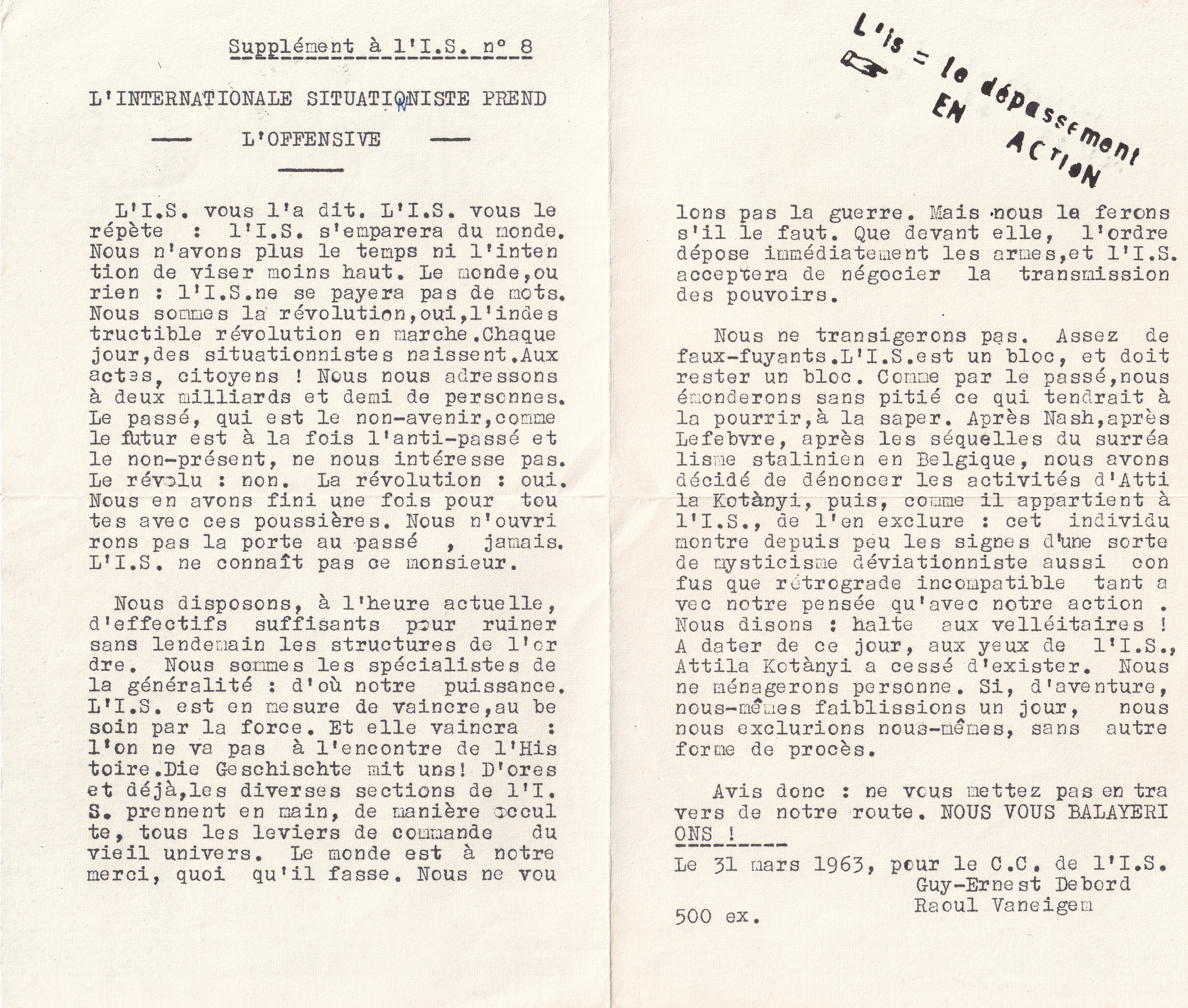
[INTERNATIONALE SITUATIONNISTE] [GUTT, Tom et al.]. l’Internationale Situationniste prend l’offensive. n.p. [Brussels]: n.p., 31 March 1963. Leaflet: 1 p. (two-sided); 21.5 x 25 cm.; black ink on white stock. Envelope: 15.5 x 12.5 cm.; blue ink and black stamps on light blue stock.
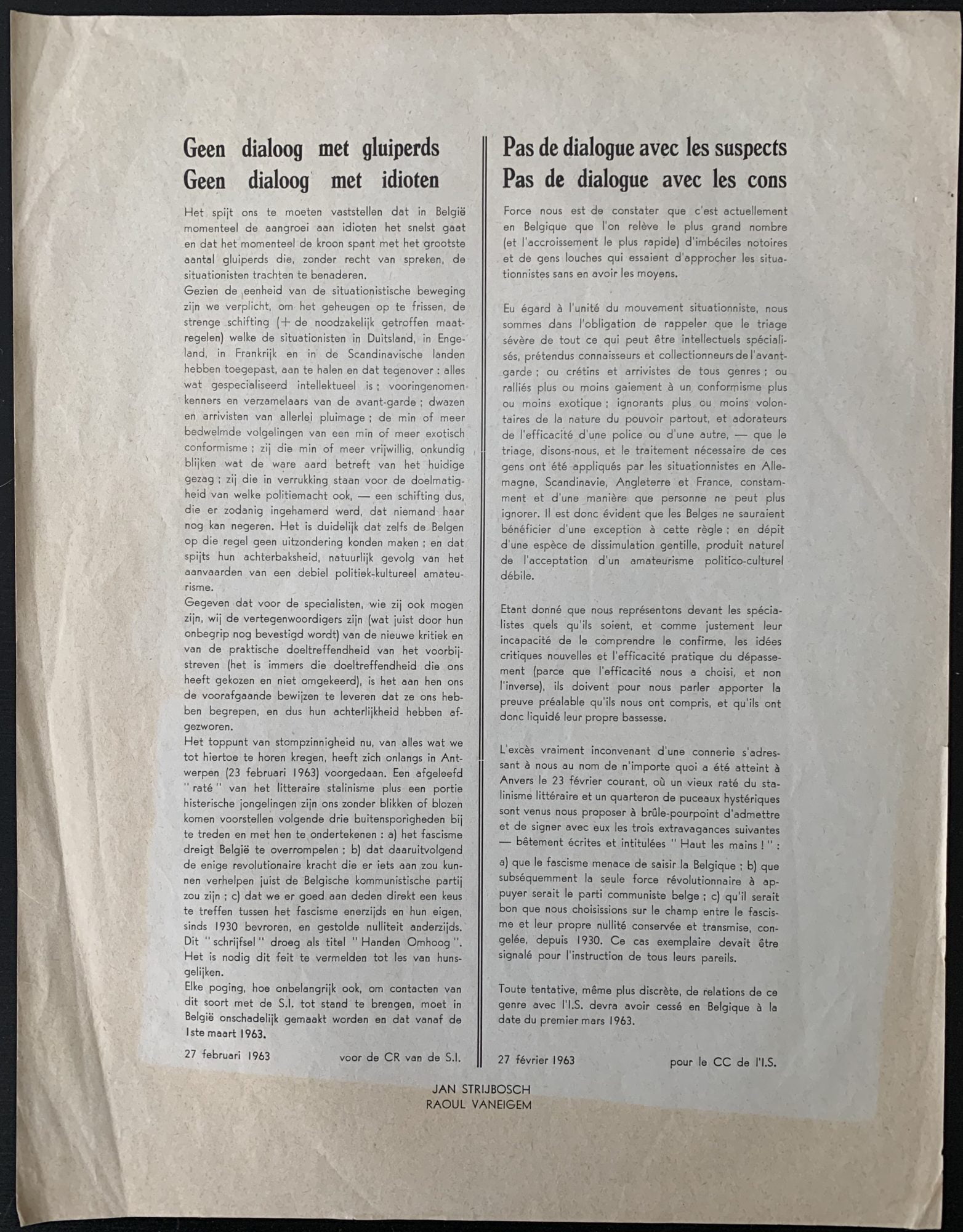
Written by Belgian Surrealist Tom Gutt (1941-2002), this leaflet was issued as a fake supplement to Internationale Situationniste 8 and is signed by Guy Debord and Raoul Vaneigem on the behalf of the Situationist International’s Central Committee. 500 copies were printed. L’Internationale Situationniste prend l’offensive is Gutt’s response to the Situationist leaflet Pas de dialogue avec les suspects! Pas de dialogue avec les cons! , a violent attack against the Belgian Surrealists that was published on 27 February 1963. The conflict would also be discussed in Internationale Situationniste 9 in August 1964 (“Under the pretext of a completely imaginary anti-fascism, a few fragments of surrealism’s Stalinist tendency attempted to join the situationists in Anvers. Their inevitable ejection was reported by a tract issued in Dutch and French on 27 February 1963: No Dialogue with Suspects! No Dialogue with Morons!“)
Gutt’s leaflet parodies Situationist rhetoric and announces the (fake) exclusion of Attila Kotanyi. Concidentally, Kotanyi would be excluded from the S.I. later that year — in December 1963 specifically
To make the story believable, Gutt mailed the leaflet from Paris (instead of Brussels) – specifically from the rue Cujas post office, not far from the Sorbonne and from the Situationist International’s PO BOX location. He also managed to duplicate the Internationale Situationniste stamp, which appears on the front of the mailing envelope. This particular copy was mailed to Belgian writer Louis Scutenaire.
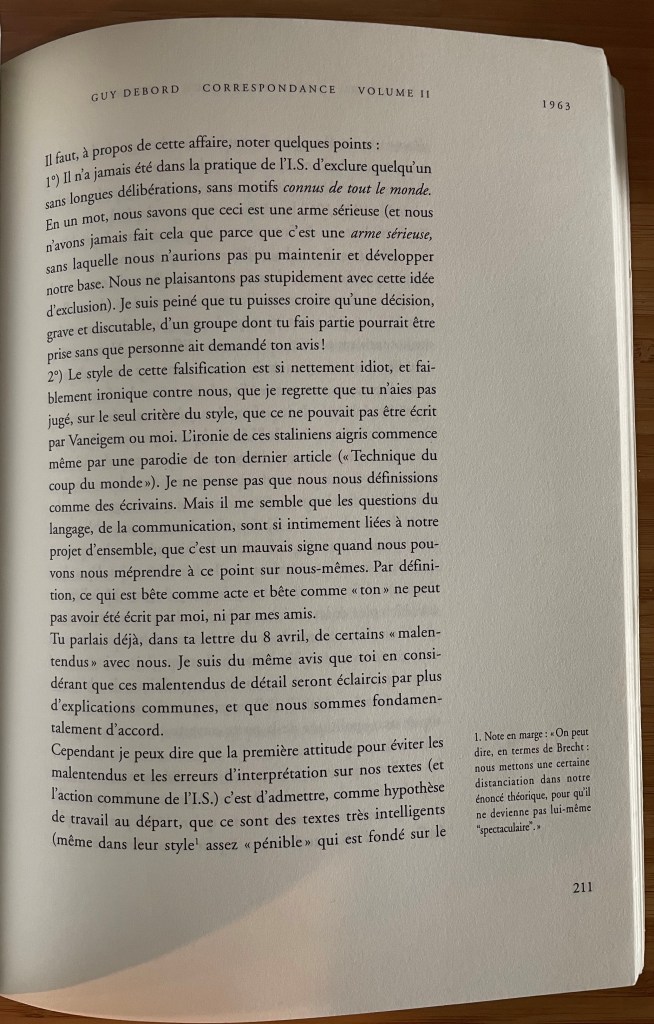
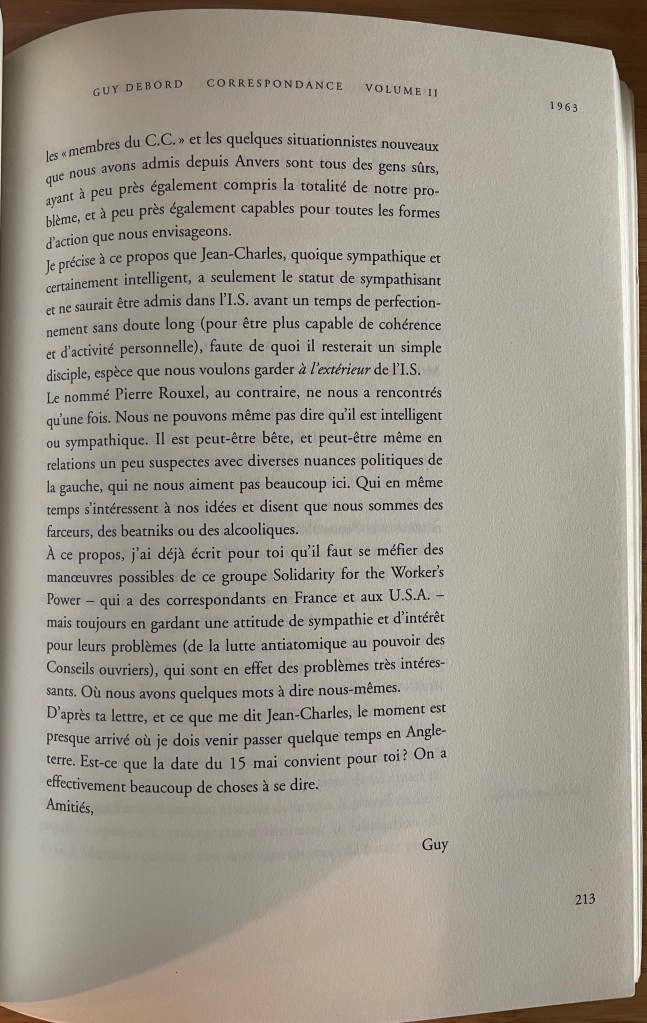
Debord soon learnt about the ploy, and wrote to Alexander Trocchi about it on 20 April and 22 April 1963 (see Correspondance Vol. 2, p. 209-213).
We locate OCLC copies at Yale and the Getty Museum.









































 Situationniste Blog