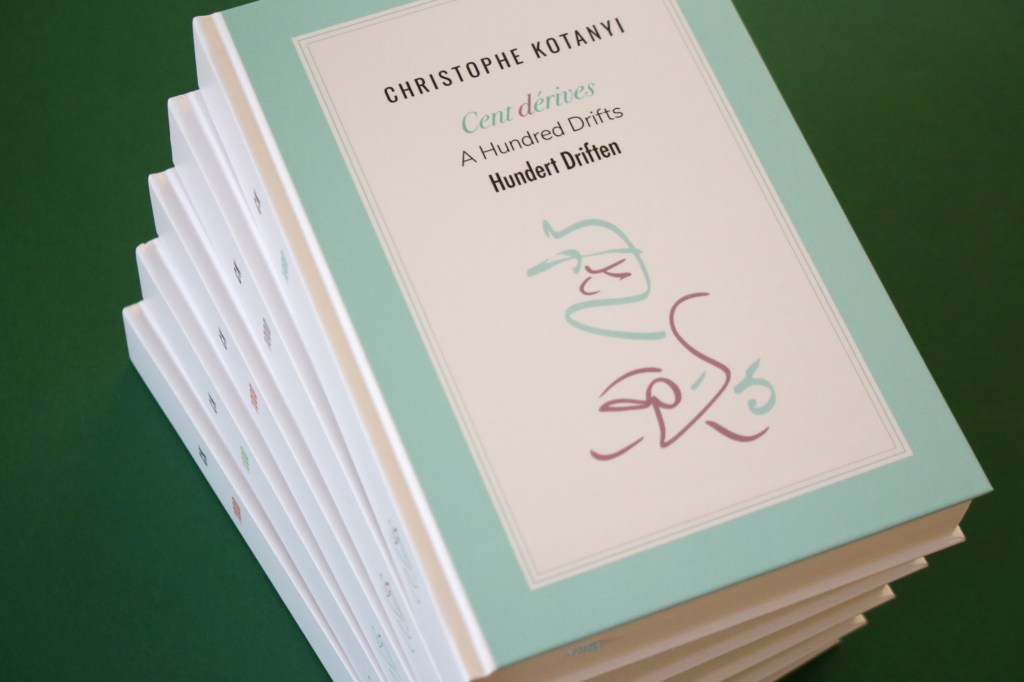
Cent dérives · A Hundred Drifts · Hundert Driften [2020]

KOTANYI, Christophe. Cent dérives · A Hundred Drifts · Hundert Driften”. Axel Roch, Magda van Suntum (Eds.) 544pages, ill. Berlin: Gegenstalt, 2020

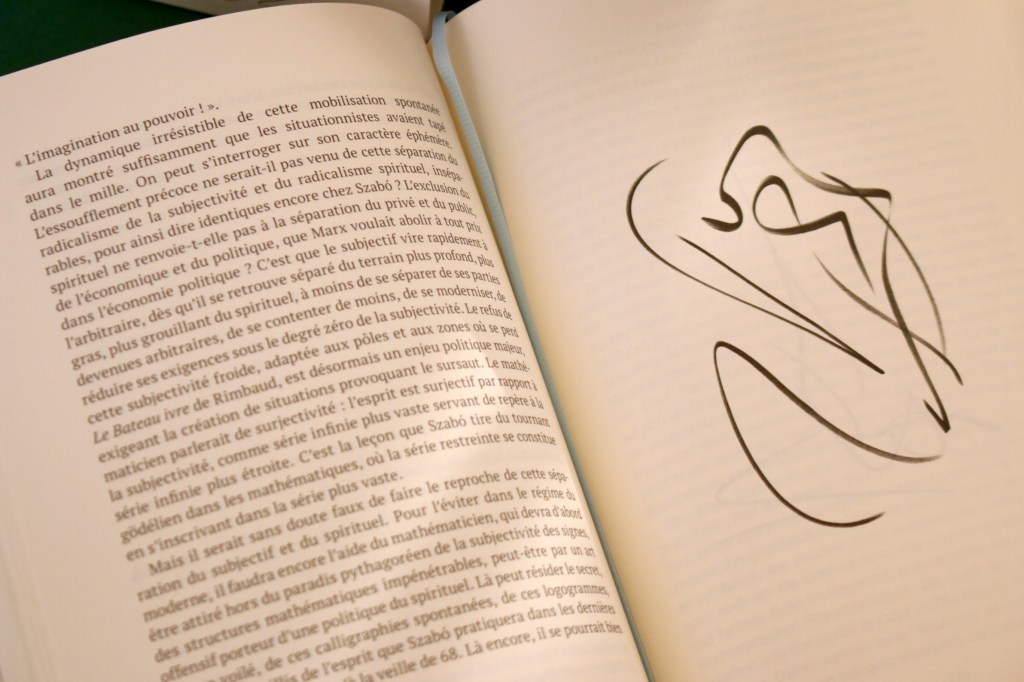
Cent dérives · A Hundred Drifts · Hundert Driften is a tri-lingual book in French, English and German by Christophe Kotanyi, the son of Attila Kotányi, who was a member of the S.I. between 1959 and 1963. The book drifts in the philosophies of subjectivity, as they were debated and talked over between 1945 and 1956 in Hungary, just before Attila Kotányi fled Hungary, and traces the tremendous influence on the SI through Attila Kotányi by the so-called Budapest Dialogical School, which consisted of Lajos Szabó, Béla Hamvas, and Béla Tabor. The author Christophe Kotanyi states for instance that “Attila Kotányi most certainly discussed [Lajos] Szabó’s theory of subjectivity with the Situationists in Paris, at a time when they were working on a political theory in terms of subjectivity as the active force, seeking to think beyond the romantic concept of subjectivity inherited from Marxism,” (see p. 332)

Indeed, Guy Debord puts in his Society of the Spectacle dialogue as true from of communication against falseness and deceitfulness of the spectacle. Debord claims in §18 the spectacle “is the opposite of dialogue.” And Debord ends his 1967-manifesto claiming that the “‘historical mission of installing truth in the world’ cannot be accomplished either by the isolated individual, or by the atomized crowd subjected to manipulation,” but “only where dialogue arms itself to make its own conditions victorious” (§221). This is the “dialogical principle” as just one example of what the situationist took apparently from the Budapest Dialogical School. Dialogical philosophies not only preceded situationism, but were also, as it seems, introduced to the situationists in person by Attila Kotányi. Kotányi’s influences on Debord are, probably similar to those of Ivan Chtcheglov, of tremendous historical interest.

In a similar way as Attila Kotányi introduced dialogical thinking and the political philosophy of subjectivity to the Situationists between 1959-1963, the author of Cent dérives introduces to the reader key topics of the philosophy of Lajos Szabó, Béla Hamvas, and Béla Tabor, a philosophy forgotten in the West, but central not only to Europe, but to situationism as well. The author of Cent dérives states for instance clearly that “Attila Kotányi transmitted this principle and method [the dialogical principle and the political theory of subjectivity of the Budapest Dialogical School] to the Situationists in Paris in the early sixties,” see also pp.75, 117, 124, 172, 332, etc. The book Cent dérives, thus, ends with an incredible theatre play about the situationists. Actors like “Guy Bordstein”, obviously a mix between “Guy Debord” and “Michèle Bernstein”, enter the stage as pirates that seem to steal and smuggle concepts and ideas in a play called “Le perroquet gris”…

The book equally drifts on a ship in various philosophical currents, and offers the reader ideas and concepts, not only in three languages, but also on 544 pages. The book has been published in Berlin by gegenstalt as hardcover with five different covers.

Copies can be obtained at the publisher or on Amazon. Excerpts here: http://gegenstalt.com/pdf/100D_reading.pdf

Proclamation from l’Internationale Situationniste [1962]

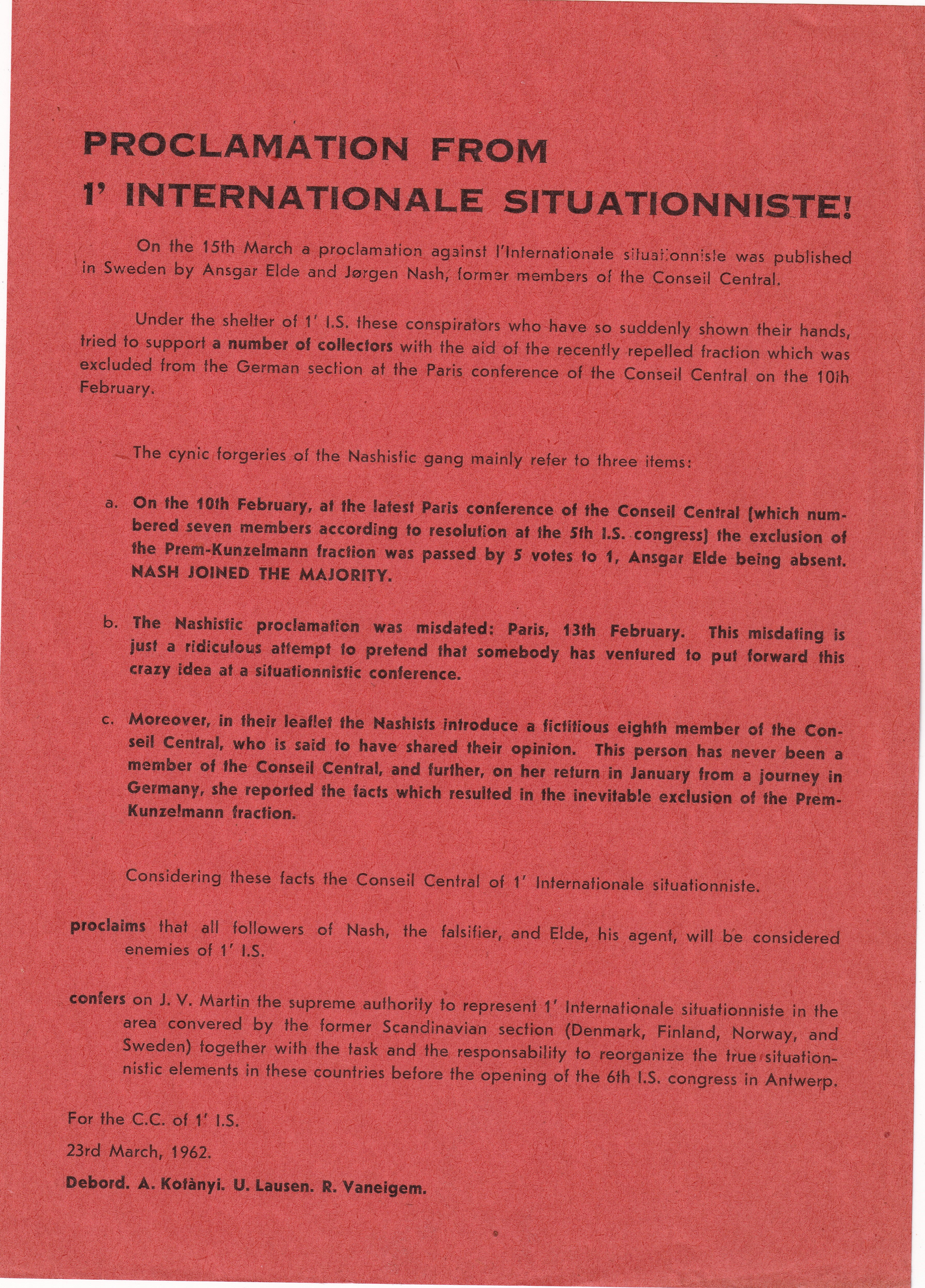
DEBORD, [Guy]; KOTANYI, A[ttila]; LAUSEN, U[we]; VANEIGEM, R[aoul]. Proclamation from l’Internationale Situationniste. n.p. [Goteborg, Sweden]: Internationale Situationniste, 23 March 1962. 1 p.; 21 x 15 cm.; black ink on thin red stock.

English language leaflet written by Debord in response to the future “Nashists'”(Jacqueline de Jong, Jörgen Nash and Ansgar Elde) own denunciation of their expulsion from the SI (see Nicht Hinauslehnen = Ne pas se pencher au dèhors = E pericoloso sporgesi! = Danger! Do not lean out! = Det är livsfarligt att luta sig ut! = Niet naar buiten hangen!). The formatting and typography of the two leaflets are indeed very similar.

Nash and Elde are blamed for their “support [of] a number of collectors with the aid of the recently repelled fraction which was excluded from the German section at the Paris conference of the Conseil Central on the 10th of February”. JV Martin becomes the “supreme authority to represent l’Internationale Situationniste in the area covered by the former Scandinavian section…”

Full text available here: http://scansitu.antipool.org/6206.html

BnF (Jeu de la Guerre) 219. Gonzalvez 117. Scheppe & Ohrt 201

We locate copies at Yale’s Beinecke Library (Jacqueline de Jong papers) and at the BNF (Guy Debord archive)

Nicht Hinauslehnen = Ne pas se pencher au dèhors = E pericoloso sporgesi! = Danger! Do not lean out! = Det är livsfarligt att luta sig ut! = Niet naar buiten hangen! [1962]

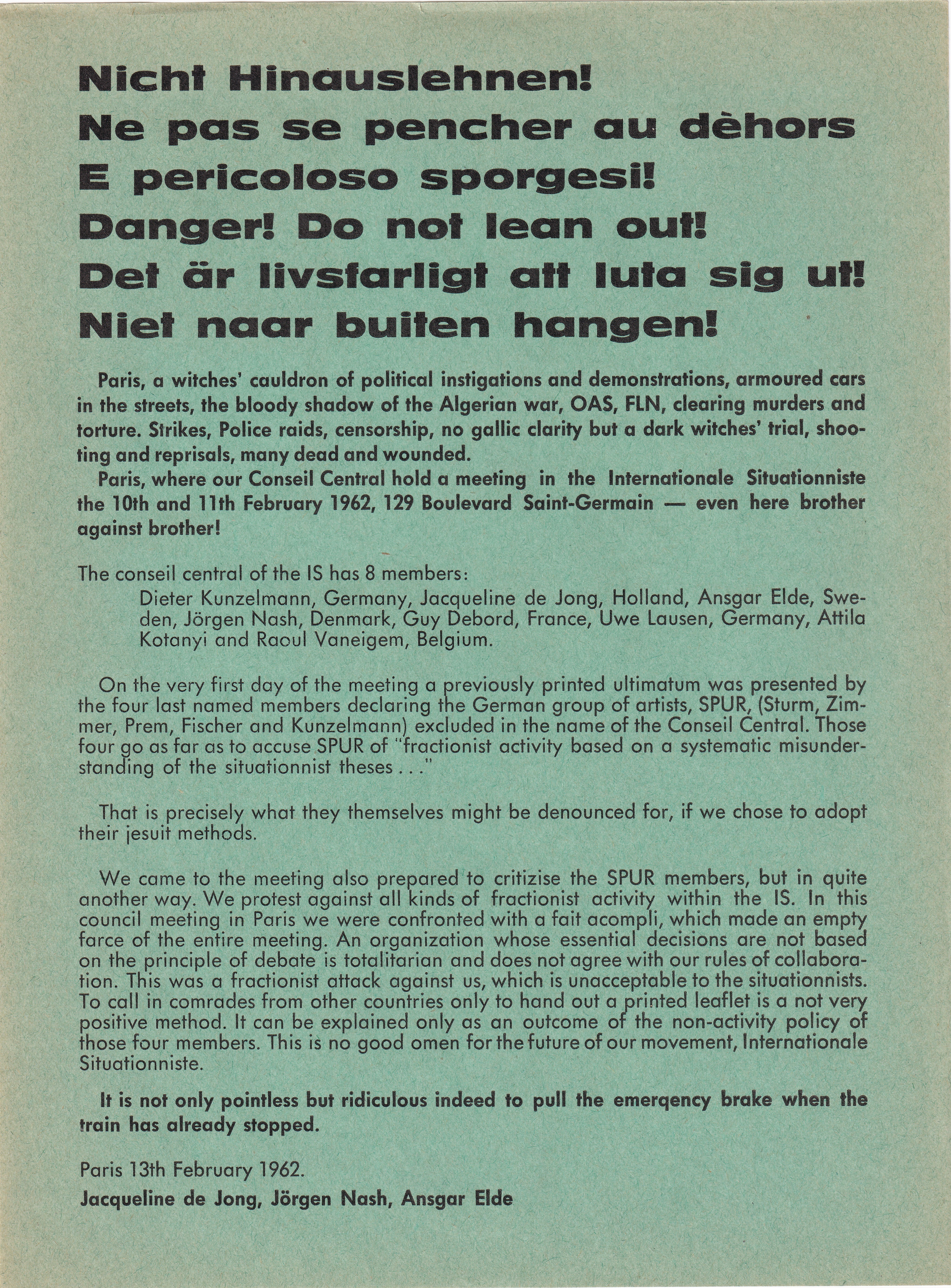
DE JONG, Jacqueline; NASH, Jorgen; ELDE, Ansgar. Nicht Hinauslehnen = Ne pas se pencher au dèhors = E pericoloso sporgesi! = Danger! Do not lean out! = Det är livsfarligt att luta sig ut! = Niet naar buiten hangen!. Paris: n.p., 13 February 1962. 11 p.; 23.5 x 17.5 cm.; black ink on green stock.

English language leaflet written by the future “Nashists” (Jacqueline de Jong, Jorgen Nash and Ansgar Elde) to denounce the expulsion of SPUR members from the SI. While Jorn did not sign the leaflet, he is believed to have financed its publication. Nash would go on to form the 2nd Situationist International after his own expulsion less than two months later.

“Paris, a witches’ cauldron of political instigations and demonstrations, armoured cars in the streets, the bloody shadow of the Algerian war, OAS, FLN, clearing murders and torture. Strikes, Police raids, censorship, no gallic clarity but a dark witches’ trial, shootings and reprisals, many dead and wounded. Paris, where our Conseil Central hold a meeting in the Internationale Situationniste the 10th and 11th February 1962, 129 Boulevard Saint-German – even here brother against brother!”

Scheppe & Ohrt 200.

We locate copies at Yale’s Beinecke Library (Jacqueline de Jong papers), at the Stedelijk Museum (Amsterdam), at the MACBA (Barcelona)

Traité de savoir-vivre à l’usage des jeunes générations [1967]

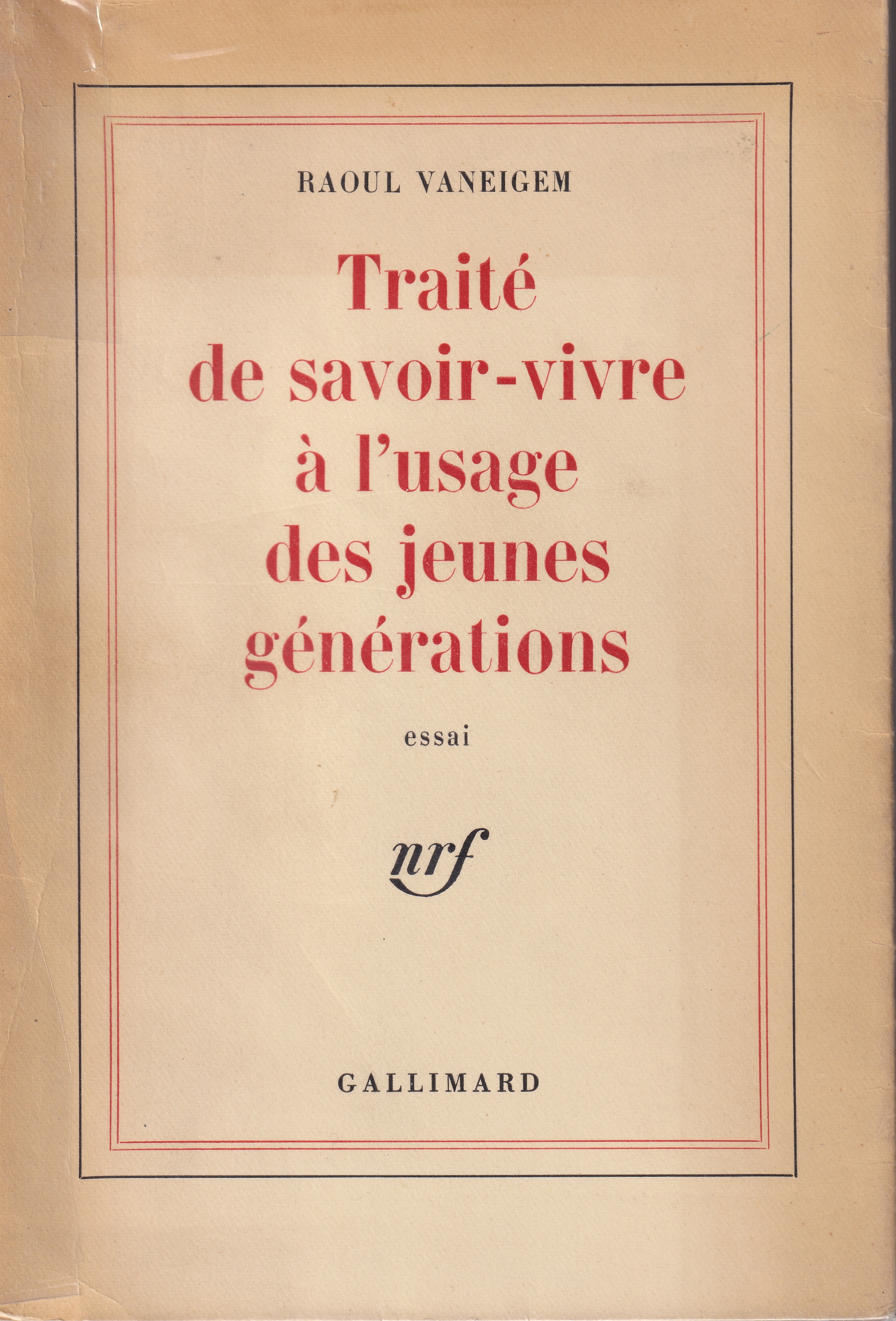
VANEIGEM, Raoul. Traité de savoir-vivre à l’usage des jeunes générations. Paris: Gallimard, November 1967. 167 p.; 20.5 x 14 cm. Beige cover with text in black and red

First edition of Raoul Vaneigem’s masterpiece. Traité de savoir-vivre à l’usage des jeunes générations is one of the two cornerstones of Situationist theory (along with Guy Debord’s La Société du spectacle, published around the same time by Buchet-Chastel). Excerpts would quickly be translated into English (“Two sections from “Treatise on Living by Raoul Vaneigem”, Re-invention of Everyday Life, 1970), with the full text translated (in two parts) by John Fullerton and Paul Sieveking as “Treatise on Living for the Use of Young Generation” around 1972. Future translations will change the title to “The Revolution of Everyday Life”.

Exceptionally signed by author on title page: “Avec tous mes remerciements pour cette passion et cet interet pour mon travail – Raoul”

Council for Liberation of Imagination [1969]

COUNCIL FOR LIBERATION OF IMAGINATION. [I have been a PL member for a month now…]. n.p. [Cambridge, MA?]: Council for Liberation of Imagination, n.d. [1969?]. 1 p.; ill.; 21 x 29.5 cm.; black ink on white stock

Leaflet published by a mysterious “Council for the Liberation of Imagination”, likely an offshoot of the Council for Conscious Existence (itself an offshoot of Radical Action Cooperative when its members moved to Harvard — more details here) that Hannah Ziegellaub (who was one of the translators of the first English language edition of Guy Debord’s Society of the Spetacle — more details here) was a member of. There were many such, often ephemeral “Council” groups in the late 1960s: the Council for the Liberation of Daily Life, the Council for the Eruption of the Marvelous, the Council for Conscious Existence, etc.

Very Situ inspired: “Due to your insufficient critique of your daily life and its poverty, you continue to participate in the spectacular commodity system. Capitalist society creates the illusion of participation. And it learned from Eastern bureaucracies how to organize the illusion of participation…”

We do not locate any information or holdings about the Council for the Liberation of Imagination in the trade or on OCLC.

Nous rions mais jamais en meme temps que vous [2020]

[DEBORD, GUY]. Nous rions mais jamais en meme temps que vous. Paris: Edition privée hors commerce, 2020. 15 x10.5 cm.; ill. color postcard.

A postcard released as an homage to Guy Debord. The slogan was originally released as a header for the text “Position du continent Contrescarpe” in Lèvres nues, no 9, p. 38, novembre 1956 (see below). Also accounted for in Guy Debord, Correspondance volume 0, p. 126 and Lettres à Marcel Mariën, p. 72.

Copies of the detourned postcard can be obtained free of charge from Edition privée hors commerce (see PDF linked)

Ne Teletravaillez Jamais! [2020]

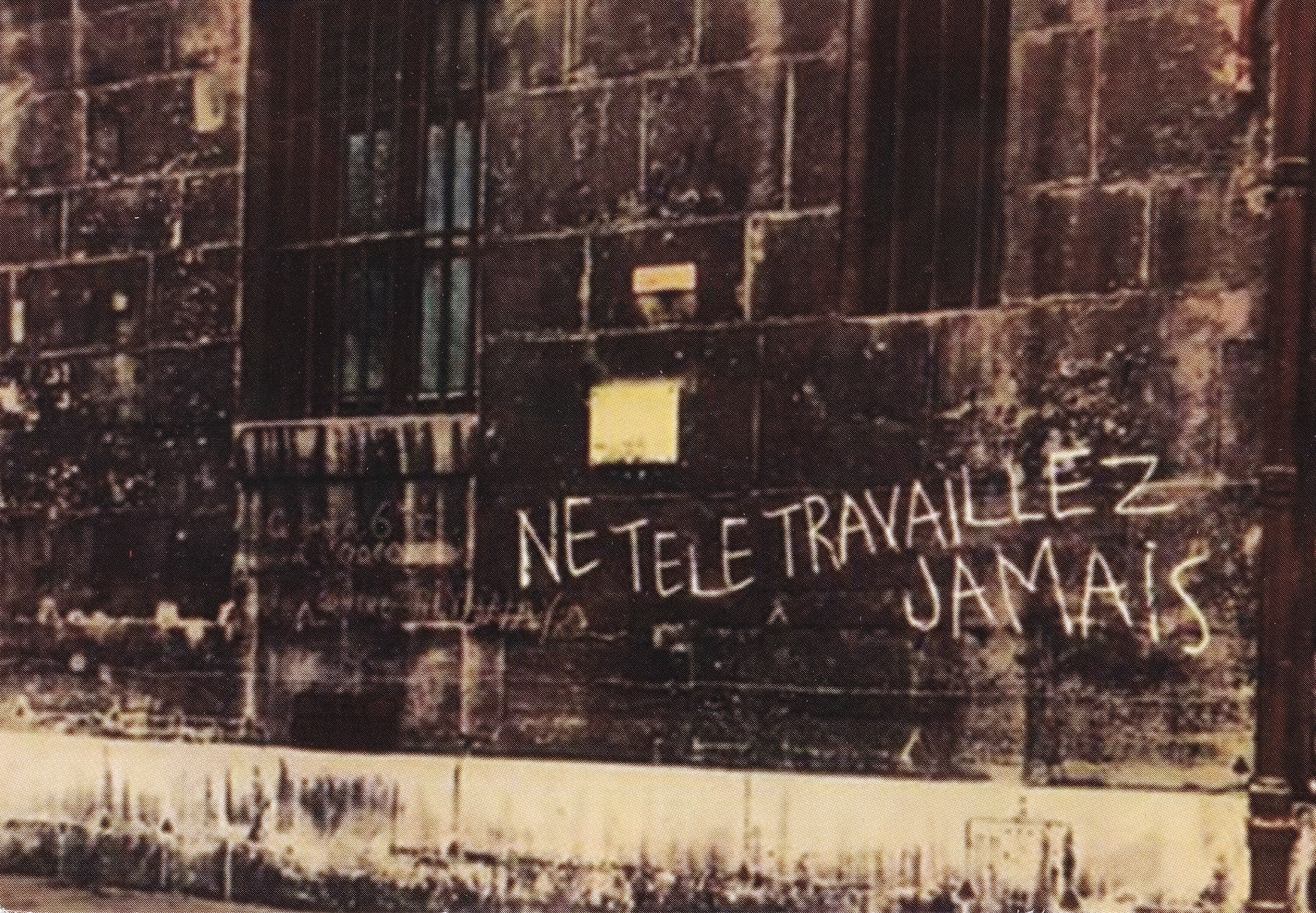
[DEBORD, GUY]. Ne télétravaillez jamais. Paris: Edition privée hors commerce, 2020. 15 x10.5 cm.; ill. color postcard.

A detournement of the original French postcard (designed by Louis Buffier) featuring a colorized photograph of the famous “Ne travaillez jamais” (Never Work) graffito, for which Debord claims ownership. This was released on the occasion of COVID-19 and the shift to remote work during the pandemic.

More details on the original postcard can be found on the blog here

Copies of the detourned postcard can be obtained free of charge from Edition privée hors commerce

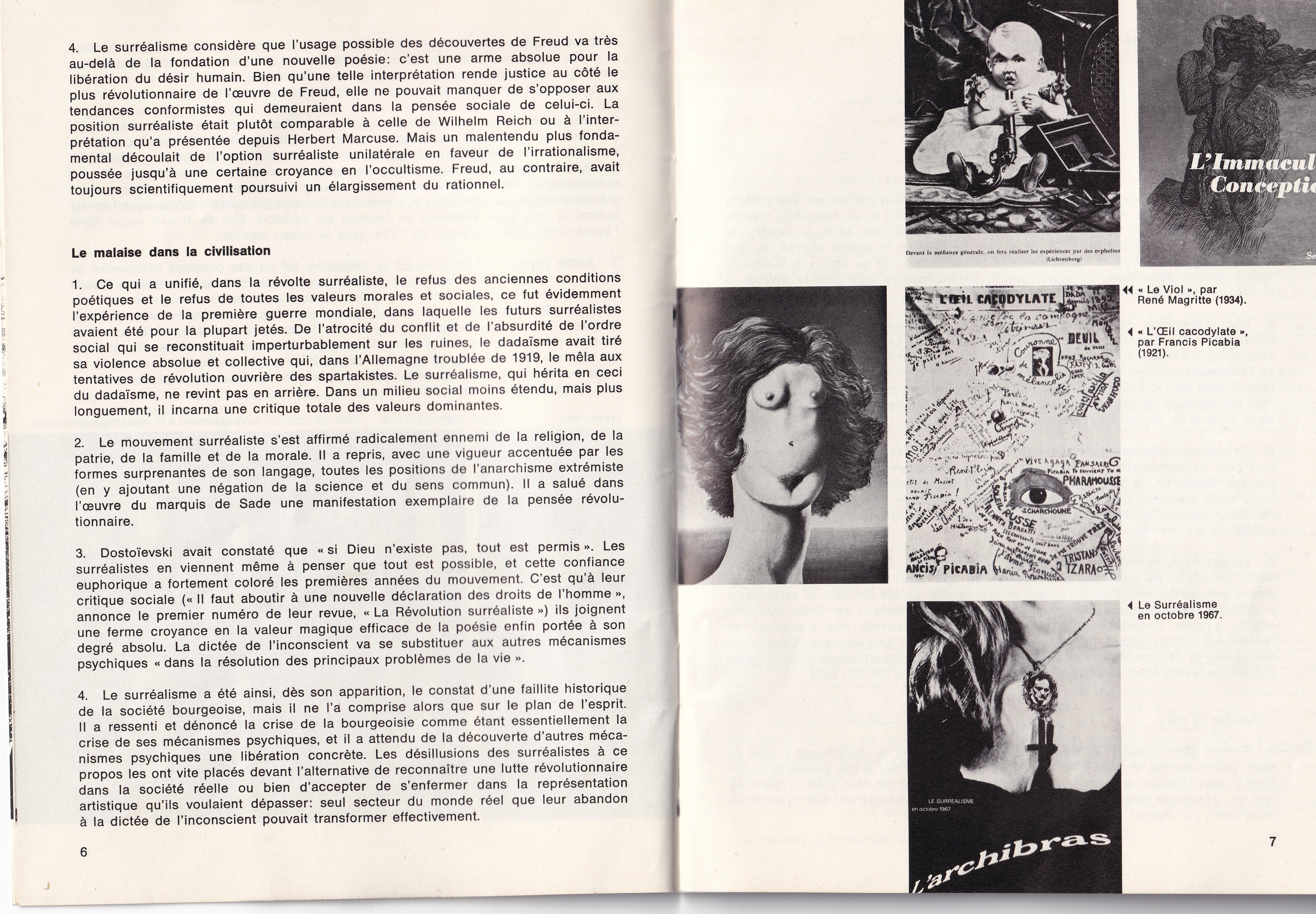
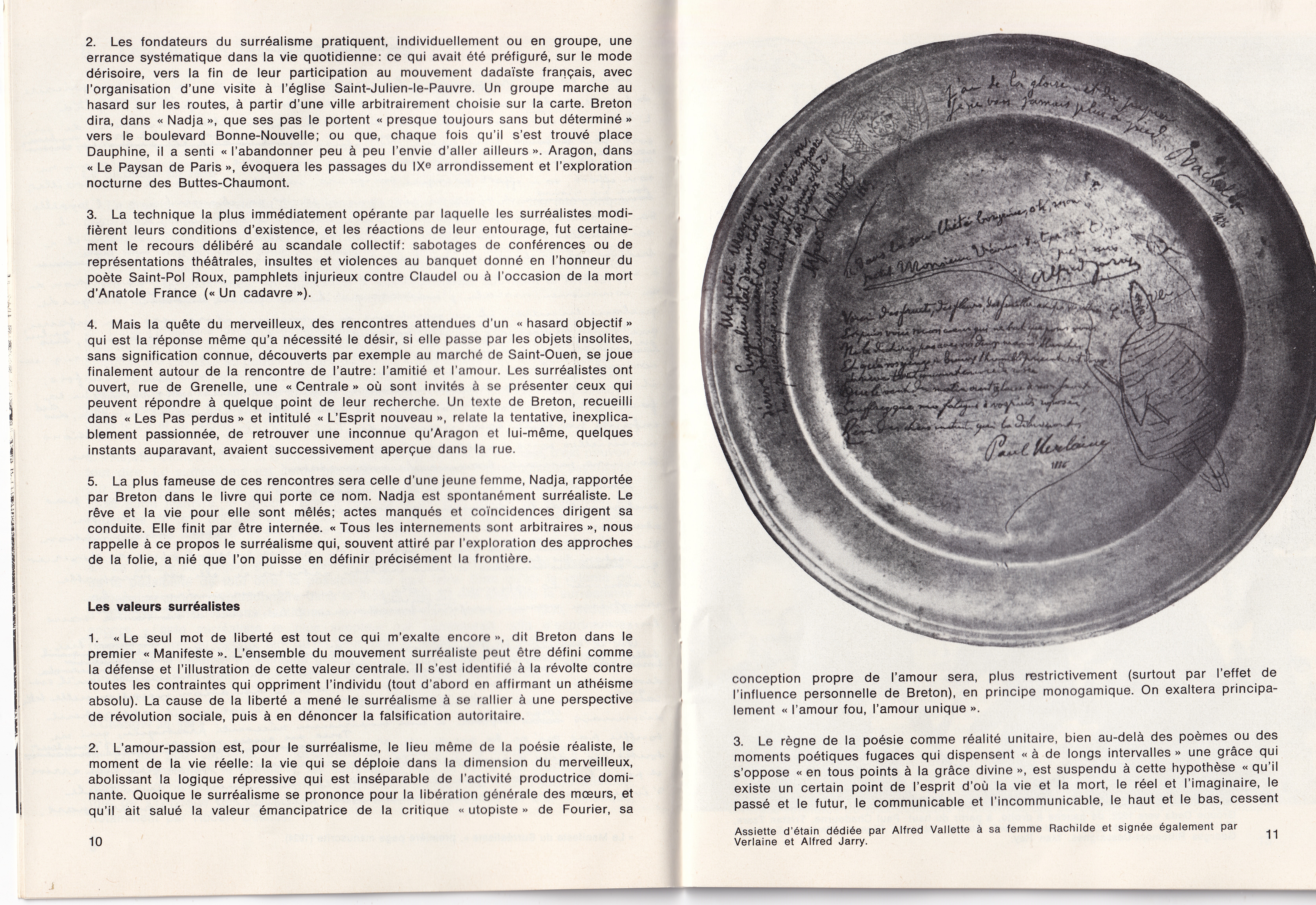
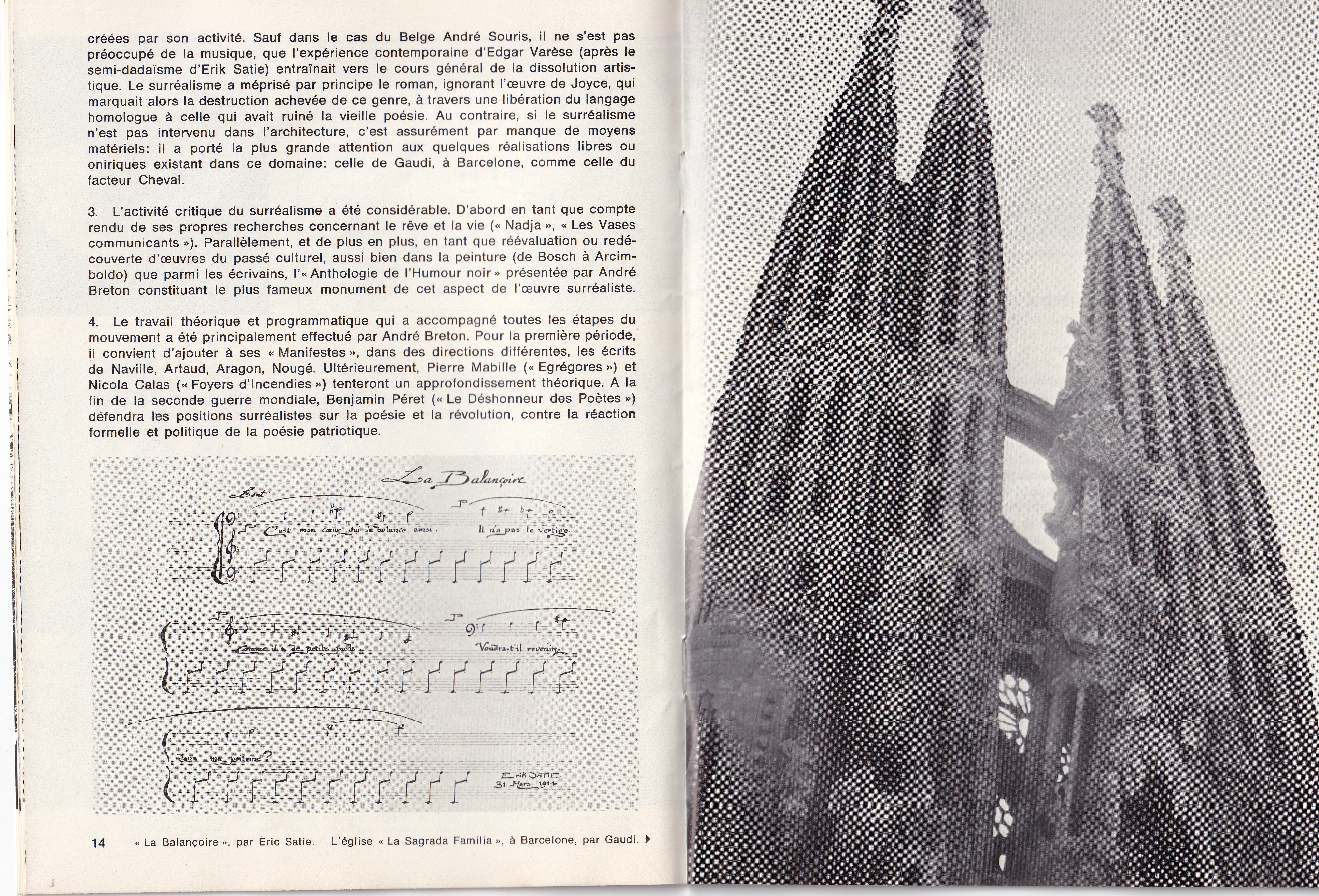
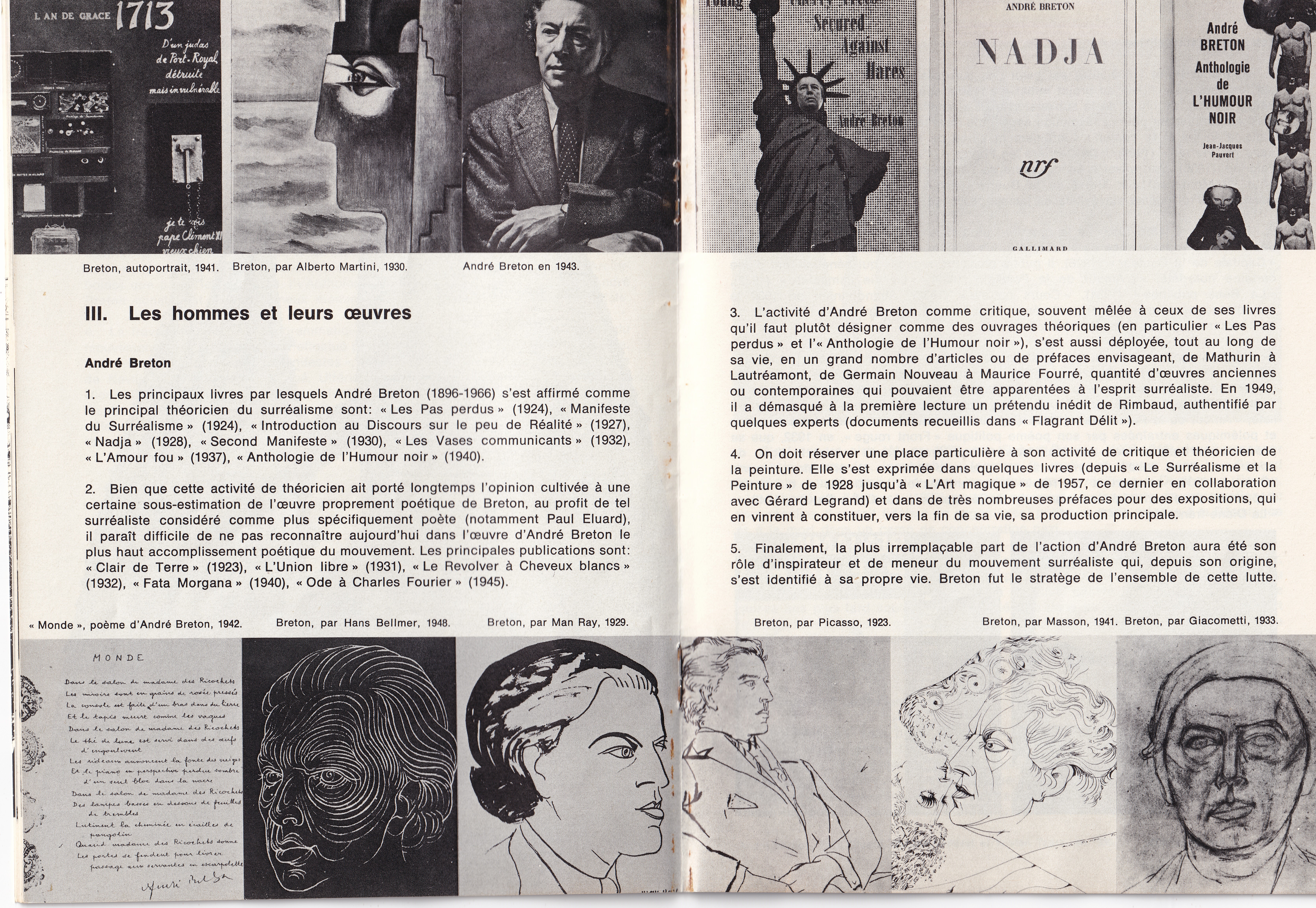
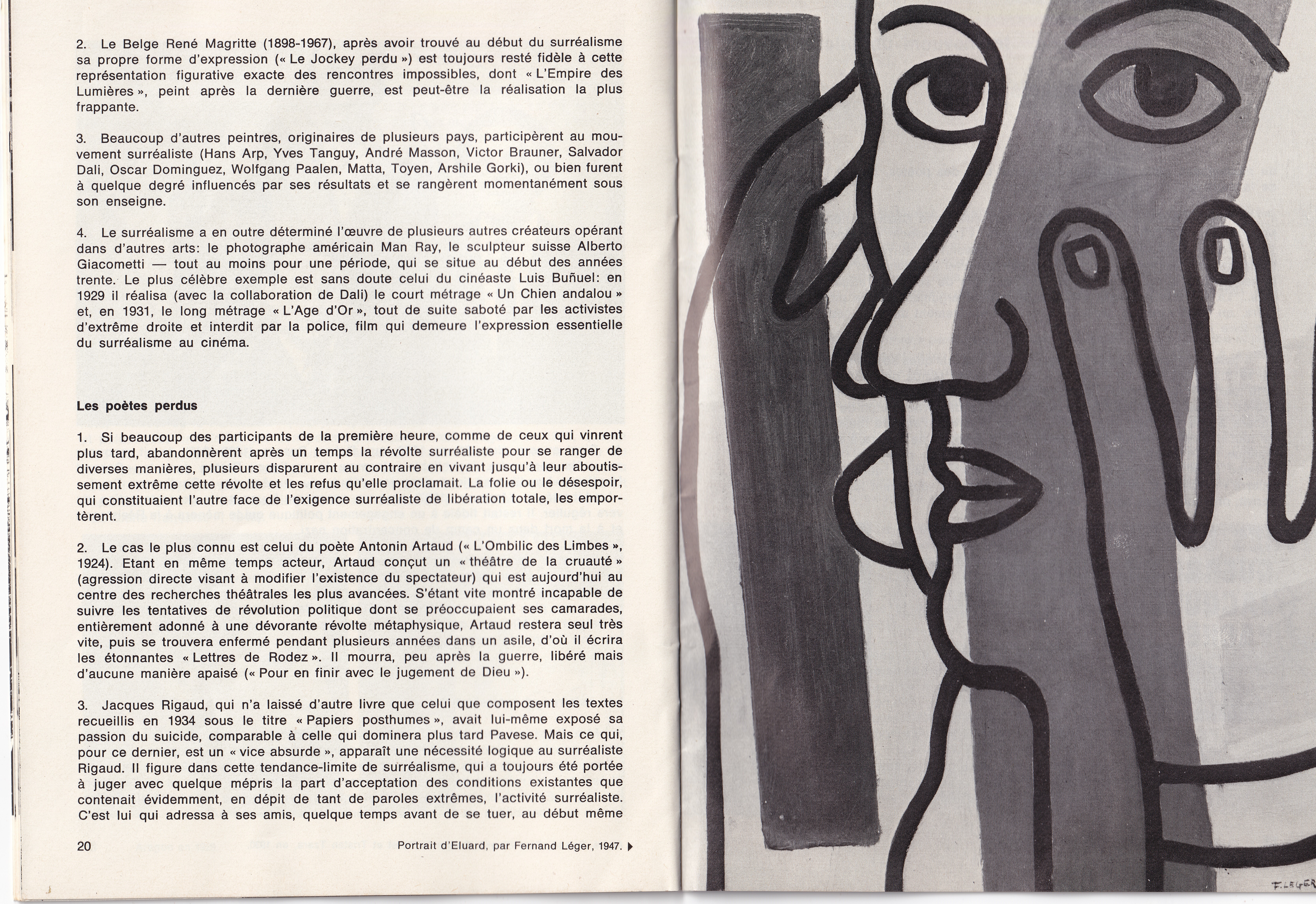
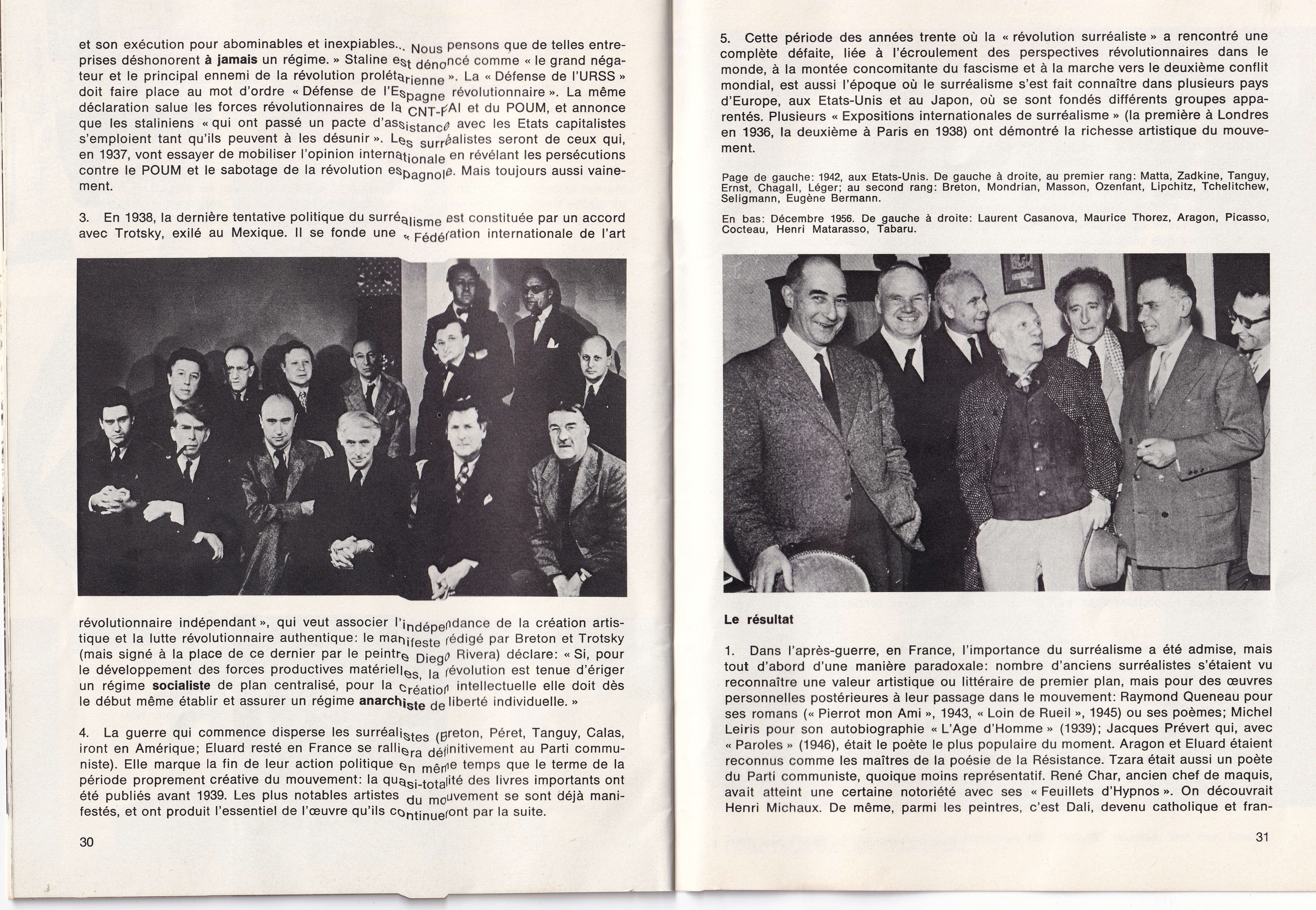
[Guy Debord] Le Surréalisme, une révolution de l’irrationnel [1968]

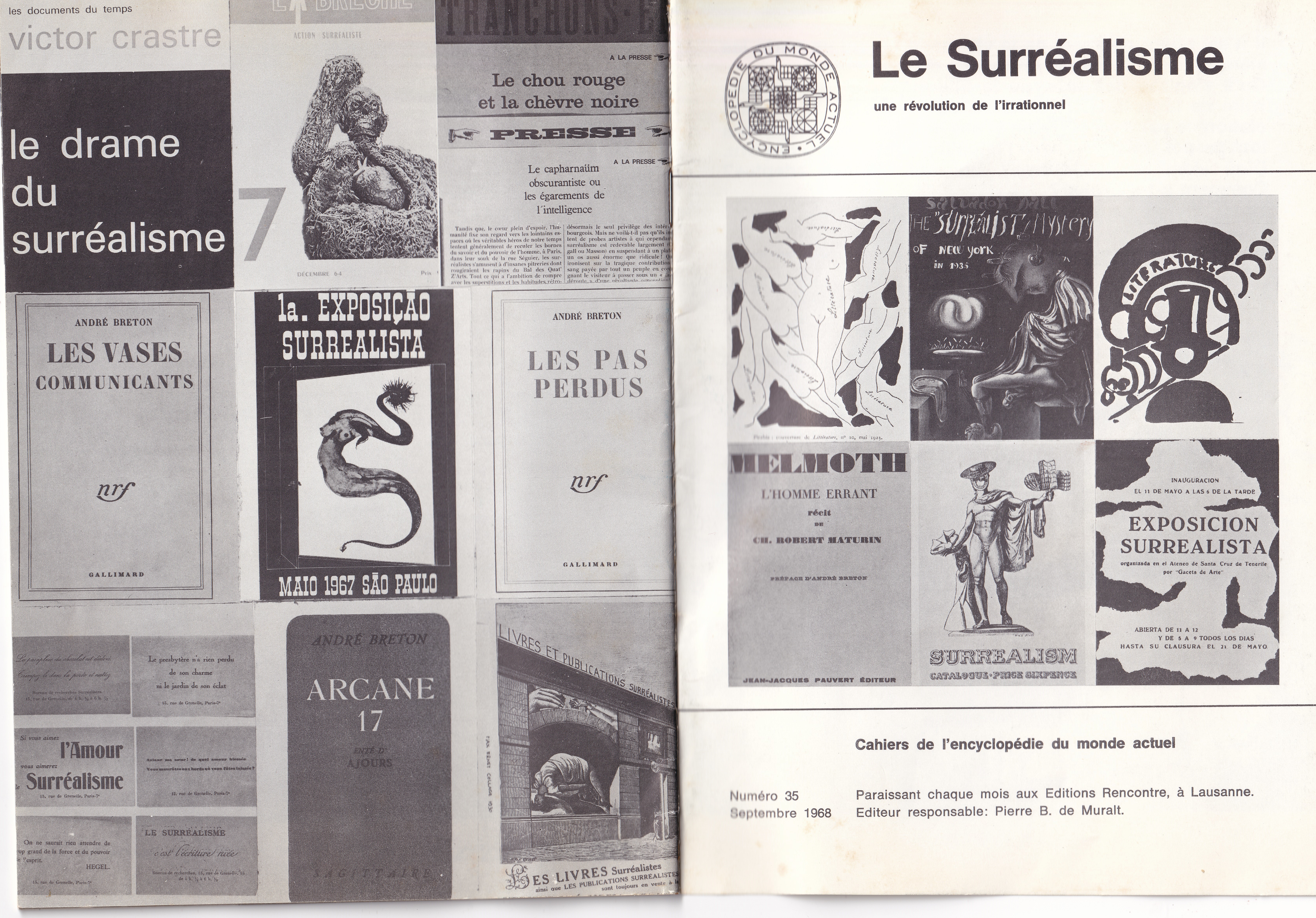
Anonymous [Debord, Guy]. Les Cahiers de l’Encyclopedie du Monde Actuel no. 35.  Le Surréalisme, une révolution de l’irrationnel. Lausanne: Rencontres, September 1968. 32 p.; ill.; 14 x 20 cm.; ill. B&W wrappers with pictures of surrealist books and leaflets.

Text attributed to Guy Debord, which features a brief history of the Surrealist movement.

Gerard Berreby, who spoke to Donald Nicholson-Smith, Mustapha Khayati, and a few others explains the genesis of the Situationists’ participation to the Encyclopedie du Monde Actuel: “The participation of the “situationist group” in the Encyclopédie du monde actuel [EDMA] wasn’t official. There were a few small-paying jobs to which some members of the SI devoted themselves. The work consisted in drafting “EDMA cards” and, eventually, monthly booklets. (Each perforated card included a 500-word-long text; each booklet contained around 30 illustrated pages.) At the start, in 1966, it was my wife, Cathy Pozzo di Borgo, and I who began to produce, on a freelance basis, this type of card under the direction of André Fougerousse – Cathy’s stepfather – for publication by Editions Rencontre in Lausanne. Along with Charles-Henri Favrod, Fougerousse had been (in 1962) one of the founders of this editorial project. Later on, we passed the cards “to be done” to friends, including Mustapha and Raoul [Vaneigem]…The members of the SI, no doubt with Raoul at the head, had, for the most part, continued to contribute to EDMA more or less until 1974. In this way, many of the booklets were written by situationists or ex-situs – even after the dissolution of the movement in 1972. Guy Debord drafted Le Surréalisme in September 1968. ” (translation by NotBored!; emphasis is mine).

Uncommon, with a single copy on OCLC and none in the trade.

We reproduce the text in full below as we do not believe it is available anywhere online

July 4, 2021 update: A complete English translation now available:
https://thesinisterscience.com/2021/07/02/surrealism-an-irrational-revolution/
and here:
https://www.academia.edu/49504538/_Surrealism_an_irrational_revolution_by_Guy_Debord

Le Jeu de la guerre de Guy Debord: l’émancipation comme projet [2020]

GUY, Emmanuel. Le Jeu de la guerre de Guy Debord: l’émancipation comme projet [2020]. Paris: Editions B42, October 2020. 192 p.; ill.; 16.5 x 23.5 cm. Ill. black cover with text in white and purple.

Situationist scholar Emmanuel Guy graces us with the first book-length analysis of the Jeu de la Guerre and, more broadly, of Guy Debord as a strategist. Guy had already written on the topic (see, for instance, here). He also wrote the preface to Strategie , a compendium of Guy Debord’s extensive reading notes on the topic (these notes, which were organized by Debord himself prior to his passing, are all preserved in the manuscript department of the French National Library).

Below is the editor’s presentation of the book.

“On connaît Guy Debord pour avoir été poète, cinéaste, artiste, théoricien révolutionnaire, directeur de revue et fondateur de mouvements
d’avant-garde. Mais il a surtout été stratège. Qu’entend-on par là ? Qu’il a utilisé la poésie, le cinéma, la théorie et l’avant-garde dans le cadre d’un conflit avec la société de son temps. Un objet en particulier dans la production de Guy Debord répond de cet objectif : le Jeu de la guerre, qui avait pour vocation d’aiguiser le sens stratégique et la conscience d’une lutte à mener. Au milieu des années 1950, Debord conçoit un jeu constitué d’un plateau quadrillé et de pions représentant les diverses unités d’une armée. En tant que modélisation de la guerre, ce jeu participe des recherches situationnistes sur l’environnement construit, la vie aliénée et les moyens de s’en émanciper. À l’heure où le design tend à envahir les discours et à englober de plus en plus de champs de l’activité créative, technique, sociale et économique, et alors que l’art ne cesse de repenser les conditions de sa validité critique, Emmanuel Guy propose ici une réflexion sur le rôle de la stratégie dans tout projet d’émancipation.”

Translation: “Guy Debord is known for having been a poet, filmmaker, artist, revolutionary theorist, magazine editor, and founder of avant-garde movements. But above all, he was a strategist. What do we mean by that? That he used poetry, film, theory and the avant-garde as part of his fight against the society of his time. One thing in Guy Debord’s production best speaks to this : the Game of War, which was intended to sharpen the strategic sense and the awareness of a struggle to be waged. In the mid-1950s, Debord designed a game consisting of a board and game pieces representing different army units. As a representation of war, this game is a contribution to situationist research on the constructed environment, alienated life and the means to emancipate oneself from it. At a time when design tends to invade discourse and encompass more and more fields of creative, technical, social and economic activity, and while art continues to rethink the conditions of its critical validity, Emmanuel Guy offers here a reflection on the role of strategy in emancipation projects. “

Copies can be obtained from the editor here or online.

ANNOUNCEMENT: Same Players Shoot again : Jacqueline de Jong and the Situationist Times (Oct 31 – Nov 29, Paris)

SAME PLAYERS SHOOT AGAIN : JACQUELINE DE JONG & THE SITUATIONIST TIMES

Oct 31 – Nov 29 2020
Opening day, Oct 31, 2-8pm

Treize
24 rue Moret
75011 Paris


On September 18th 2016, while visiting the Massachusetts Institute of Technology (MIT) in Boston, Dutch painter Jacqueline de Jong (b. 1939) came across the Digi-Comp II, an educational toy presenting the basics of computational logic using beads, a ramp and a series of separators. This chance encounter brought back the memory of another – far more ludic – machine which De Jong had enjoyed in her youth: the pinball machine. In the early 1970s, she had even planned to dedicate the seventh issue of her magazine The Situationist Times to the game.


Co-produced with designer and gallerist Hans Brinkmann, this Pinball issue eventually went unpublished. The preparatory documents that remained – photographs, letters, press clippings and various printed matter – were stored in a box in the artist’s house in Amsterdam and eventually forgotten .


These archives have since been reactivated through the publishing and curatorial project “These Are Situationist Times”, which Norwegian researcher Ellef Prestæter and the publisher and Torpedo Press (Oslo) have developed in close collaboration with De Jong. These documents will soon join the Jacqueline de Jong Papers of the Beinecke Library, Yale University. “Same Players Shoot Again” is the Parisian instalment of an exhibition which has been presented on several occasions since 2018 and which features a book and a digital interface produced by Torpedo Press and theInstitute for Computational Vandalism.


A topological manifesto, political bulletin and visual encyclopedia, The Situationist Times (1962-1967) – which De Jong launched right after being excluded from the Situationist International – has its roots in vernacular culture, the history of games, and non-euclidean mathematics. The exhibition presents the archives of the unpublished final issue of this landmark of post-war artists’ magazines alongside art and graphic works by De Jong from the same period. Like a pinball, the exhibition traces a dérive, a knot, an underground web of relations, a hazardous curve, or a dissident trajectory across the artistic and political avant-garde movements of its time.


An exhibition developed by Jacqueline de Jong and Ellef Prestæter, in collaboration with Juliette Pollet, Gallien Déjean, Emmanuel Guy & Fanny Schulmann.


Programming:
November 28th, afternoon, Kandinsky Library, Centre Pompidou: presentation of Ellef Prestæter’s book These Are Situationist Times ! An Inventory of Reproductions, Deformations, Modifications, Derivations, and Transformations (Torpedo Press, 2019), and Gallien Déjean’s book of interviews with Jacqueline de Jong (Manuella Editions/AWARE, 2020). With Jacqueline de Jong (TBC), Gallien Déjean, Juliette Pollet, Emmanuel Guy and Fanny Schulmann.In partnership with AWARE (Archives of Women Artists Research and Exhibition).


The exhibition and programming benefited from the support of the Embassy of the Netherlands, the Embassy of Norway and AWARE (Archives of Women Artists Research and Exhibition).