UP AGAINST THE WALL MOTHERFUCKER. We Propose a Culture Exchange (garbage for garbage). n.p. [New York]: Up Against the Wall Motherfucker, n.d. [1968]. 1 p. (two sided); ill.; 21 x 29.5 cm.; black ink on white stock. Text on rector, photomontage on verso.
Leaflet by UAW-MF promoting what is perhaps its most famous and successful intervention. On February 12, 1968, a group of radicals leby by Ben Morea collected garbage on the lower east side, trucked it, then dumped it in front of the Lincoln Center on a gala night. The event coincided with a NYC garbage strike and was meant to express both the group’s contempt for the bourgeois establishment and its support of the strikers.
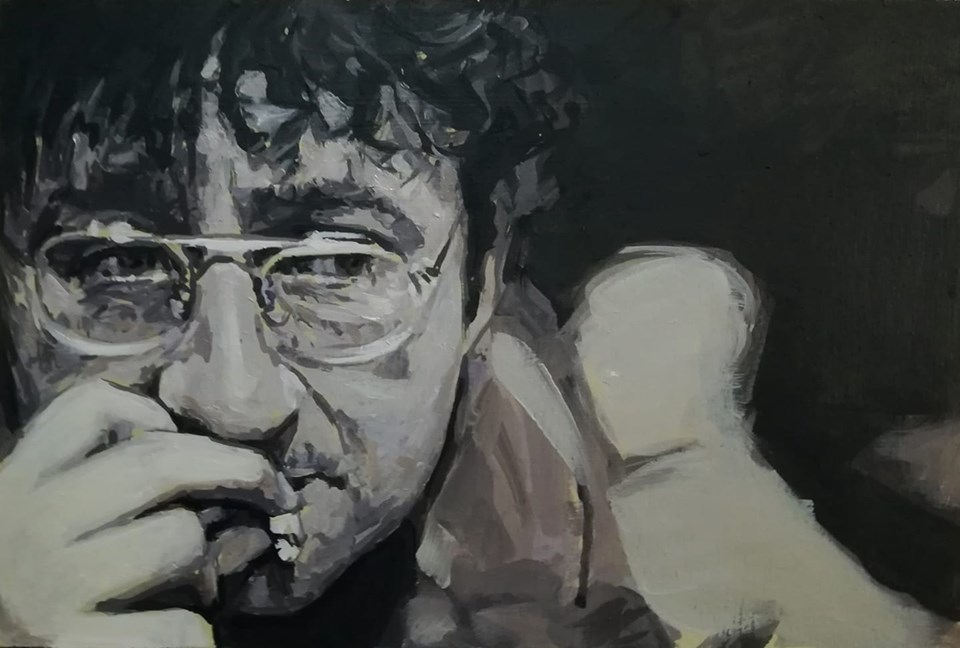
DEL BALDO, Luca (b. 1969). Guy Debord. 2020. Oil and acrylic on wood. 30 x 20 cm
Original portrait of Guy Debord by Italian painter Luca Del Baldo.
Born in 1969, Del Baldo resides in Cantu (Como), Italy. Operating outside the institutional art world, Del Baldo spent the last ten years working on the “The Visionary Academy of Ocular Mentality (De Gruyter, 2020). As part of this project, the artist “asked famous art critics, art historians, and philosophers for headshot photographs of themselves, which he used to make paintings. He then shared the paintings with his subjects and told them to comment on the results. His goal was thus not simply to make a portrait, but to establish a relationship with his subject; how that person responds is revealing” (source). Featured art historians and scholars includes WJT Mitchell, Jacques Ranciere, Jean-Luc Nancy, Michel Onfray, Slavoj Zizek, Zigmunt Bauman, George Steiner, Stephen Greenblatt, and many others. Del Baldo is also known for his painting of a dead Gaddafi (see below)
[STRARAM, Patrick]. [ORIGINAL PHOTOGRAPH] Take it All (A Tout Prendre). n.p.: n.p. [Canada], n.d. [1963]. 1 p.; 20.5 x 25.40 cm.; black ink on white photography stock.
Stunning portrait of a young (29-year old) Patrick Straram, from the film À tout prendre (released as All Things Considered in English Canada and as Take It All in the United States).
Born in Paris in 1934, Patrick Straram was a member of the Internationale Lettriste and a close (and early) friend of Guy Debord. He left the I.L. in 1954 when he fled to Canada to avoid military conscription He remained close to Debord for several, as attested by their warm letters. Straram released the Cahier pour un Paysage a Inventer in 1960, including both articles from the Situationist International and poems and critical texts by Quebec writers (Gaston Miron, Marie-France O’Leary, Paul-Marie Lapointe, Gilles Hénault, Serge Garant, Marcel Dubé…). He ultimately became an iconic figure of Quebec’s counterculture scene.
À tout prendre was a “semi-autobiographical portrait of Claude Jutra’s own life focusing on his romantic relationship with actress and model Johanne Harrelle, and his struggle to accept his own homosexuality”. More broadly speaking, the film offers a portrait of the young intellectual and artistic scene of early 1960s Montreal. Staram played the role of Nicholas, Harelle’s former husband. A tout prendre was well-received by critics and is considered a classic of Quebecois cinema. The film ends with an image of wall graffiti: “Quebec Libre”
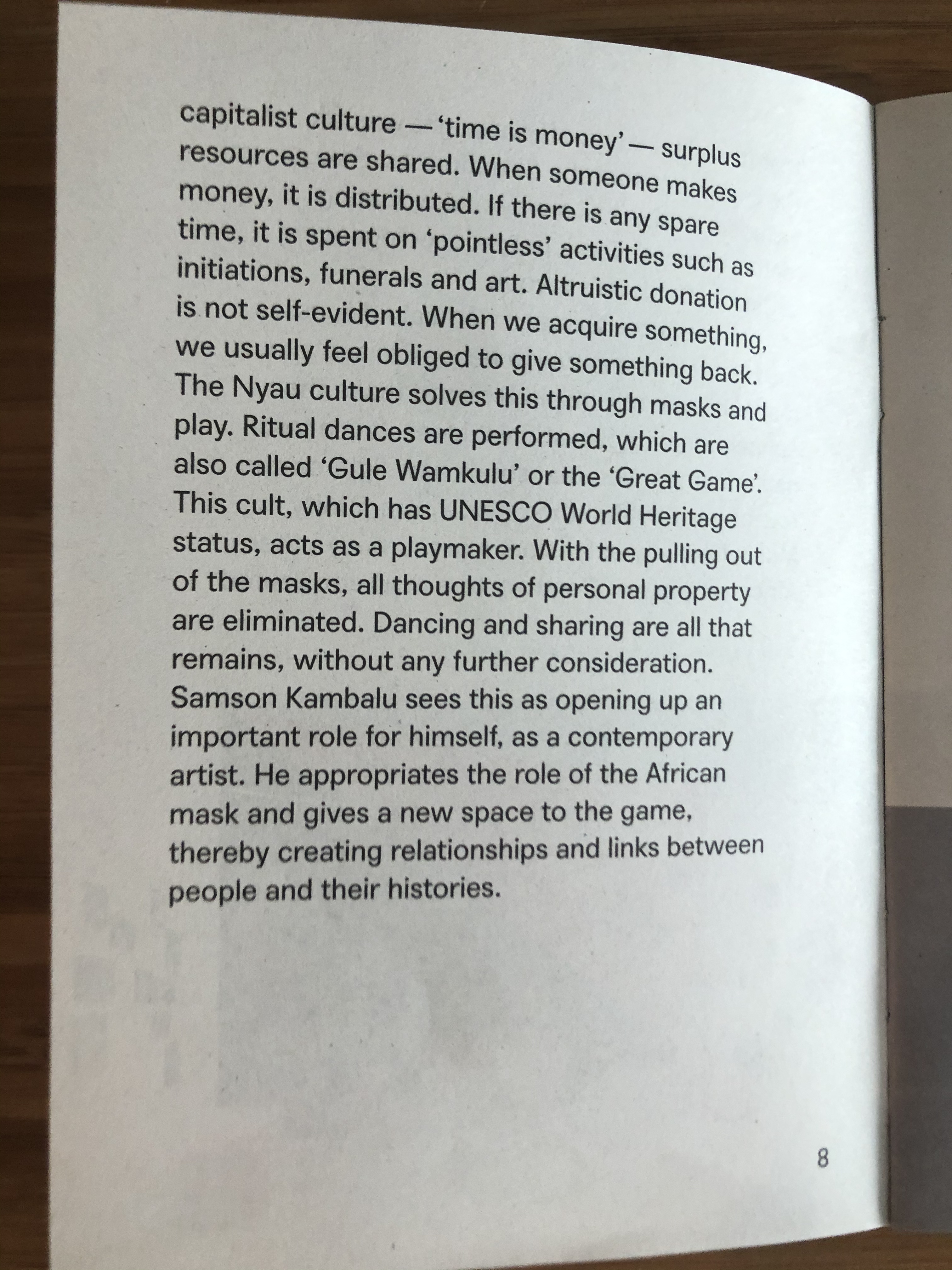
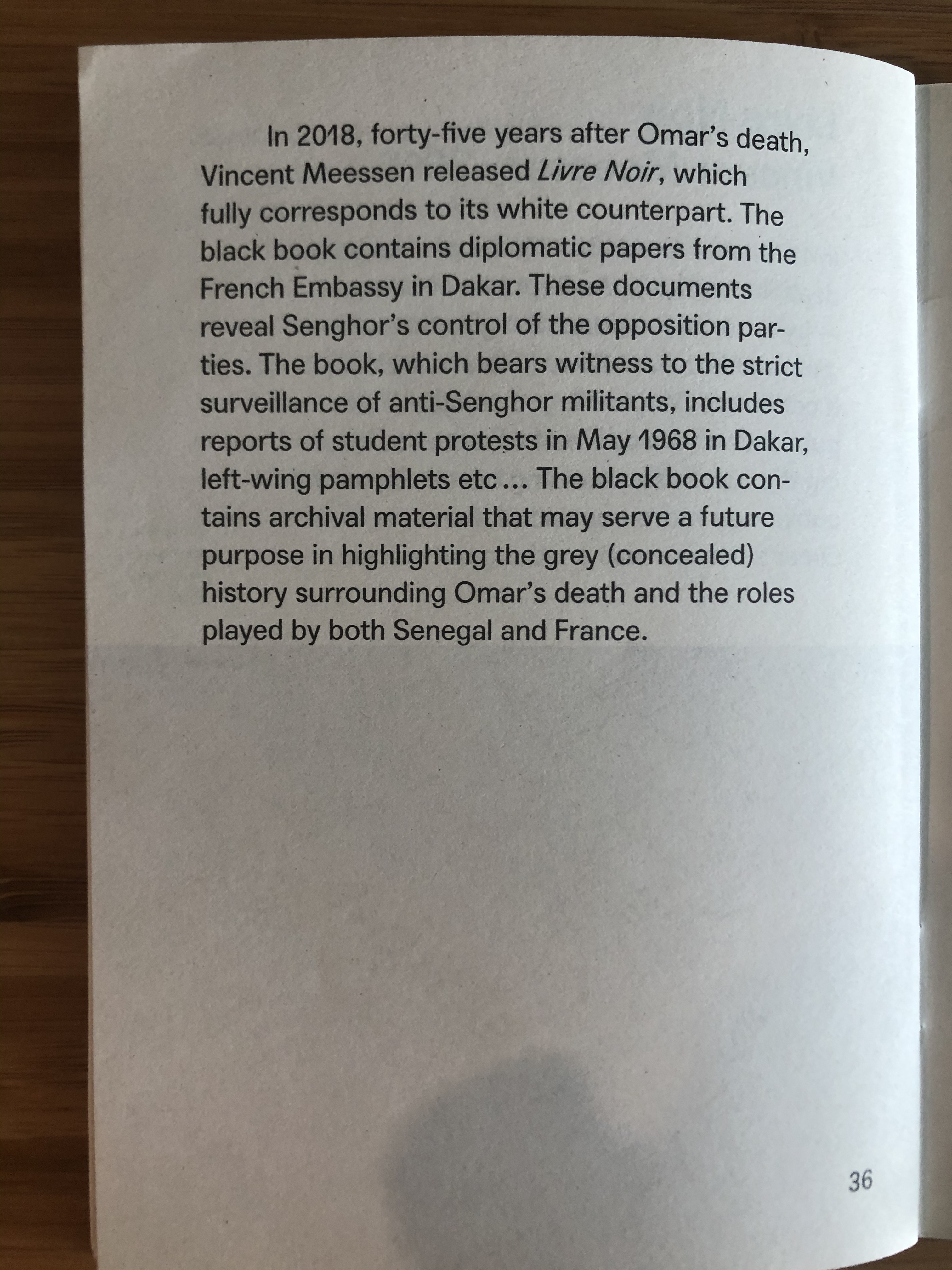
MEESSEN, Vincent and KAMBALU, Samsom. History Without a Past. Ostend (Belgium): Mu.Zee Ostend, 2020. 36 p.; ill.; 10 x 15 cm.; ill. Green wrappers with text in black.
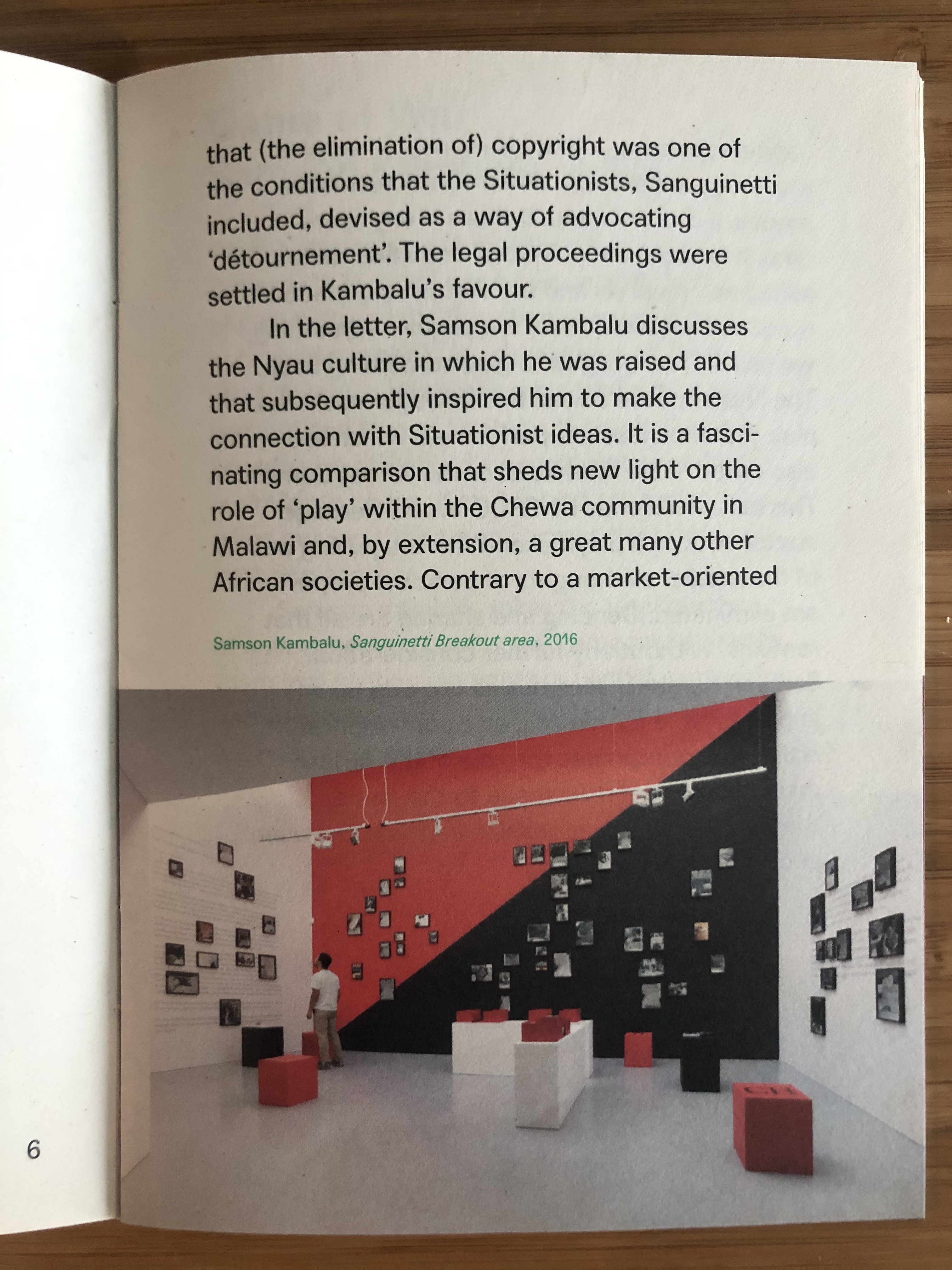
Booklet published on the occasion of Vincent Meessen and Samson Kambalu’s exhibition at the Mu.Zee in Ostend from 01/02/2020 to 17/05/2020. Features short biosketches of the artists, and short presentation of the art pieces, including
Sanguinetti Breakout Area : a sheet-by-sheet reproduction of Sanguinetti’s archive, which was first exhibited in Venice in 2015. This led Sanguinetti to sue Kambalu for copyright infringement, with Kambalu ultimately prevailing in court.
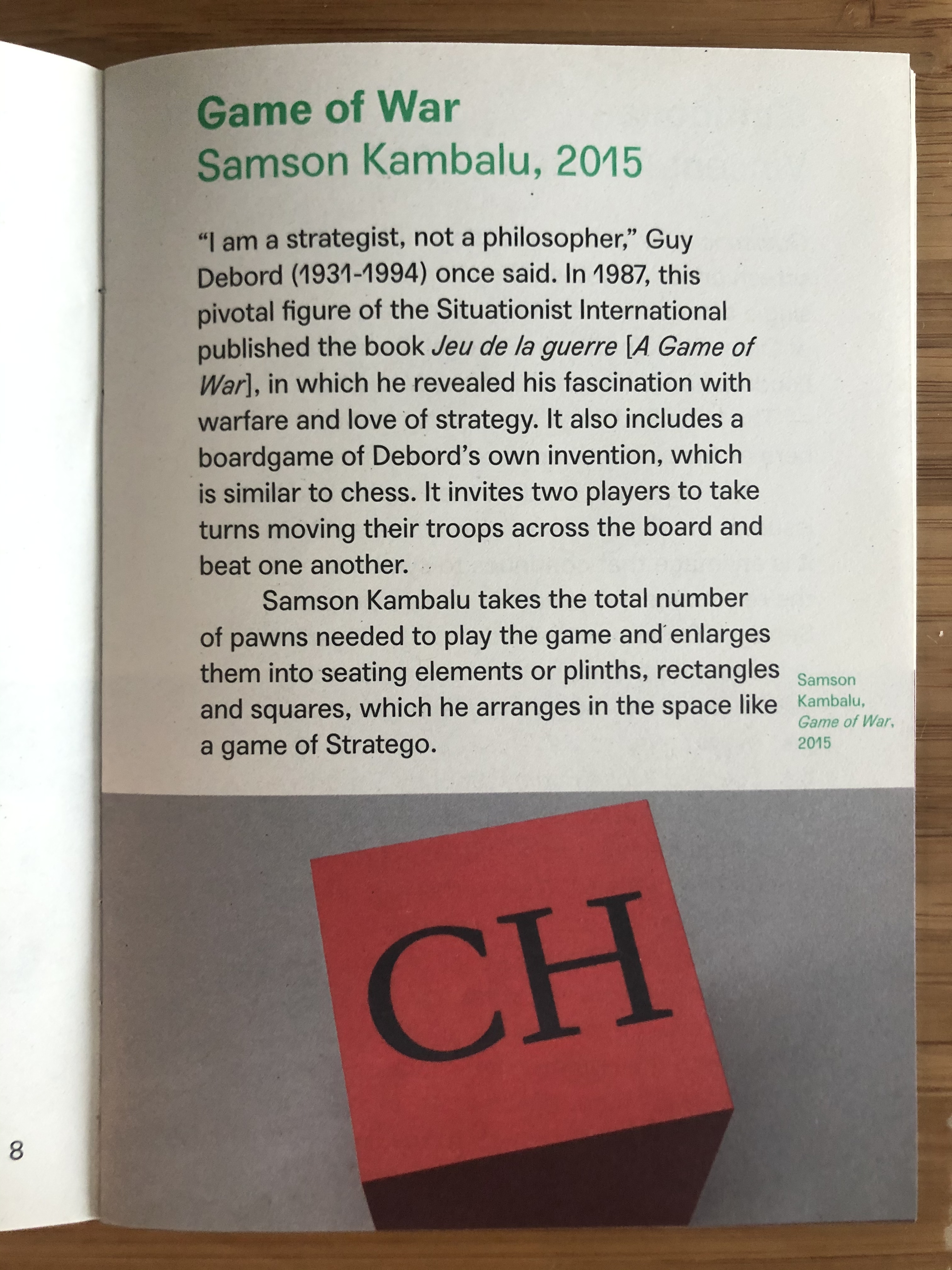
Game of War : Kambalu’s reinterpretation / detournement/ homage to Guy Debord’s “Jeu de la Guerre”
Quinconce : a collection of five silk prints by Meessen that contextualize the story of Senegalese revolutionary Omar Blondin Diop
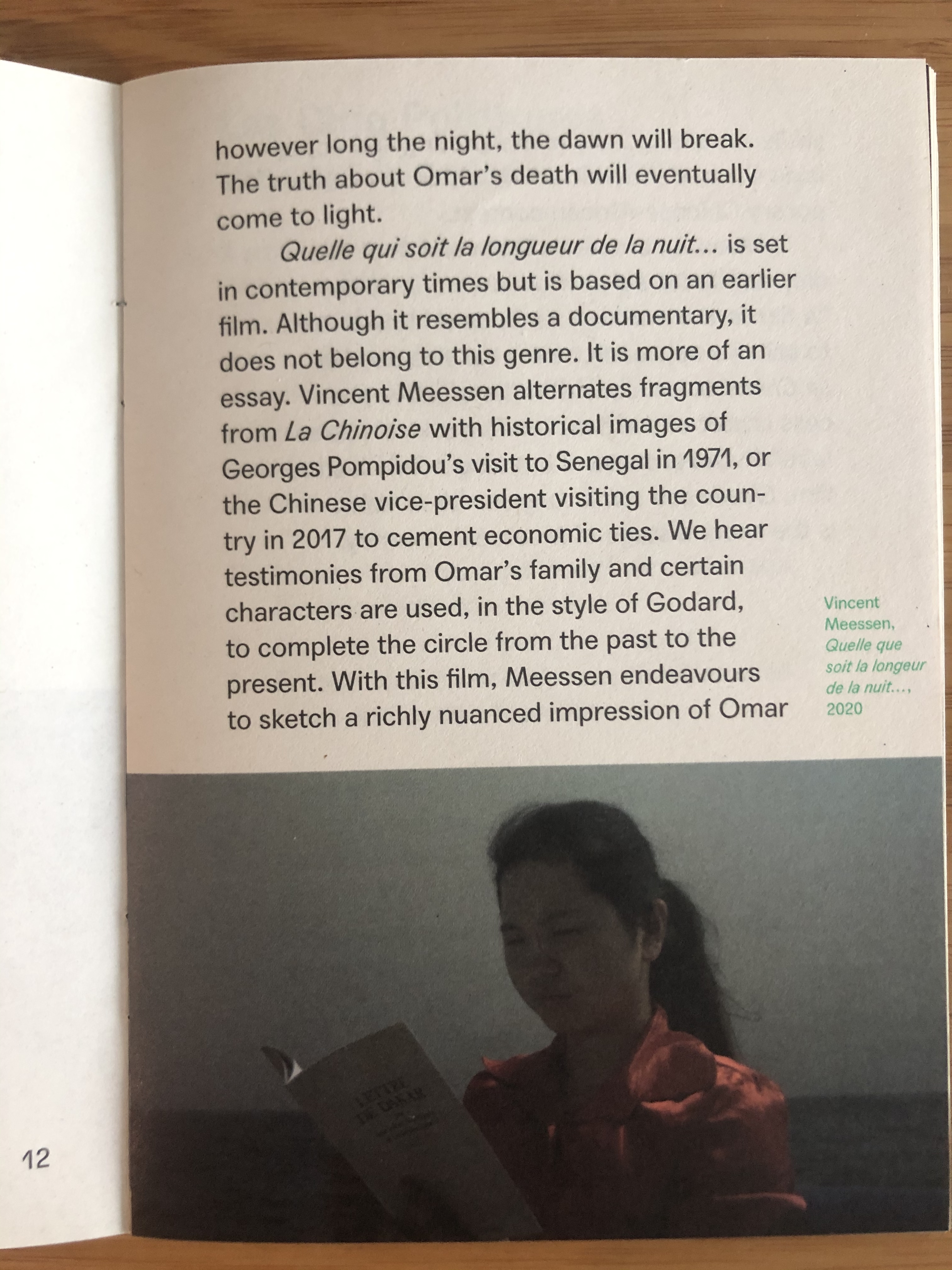
Quelle que soit la longueur de la nuit…le soleil finit toujours par se lever : a film by Meessen that serves as an homage to Diop, who was captured and believe to have been murdered by the Senegalese government
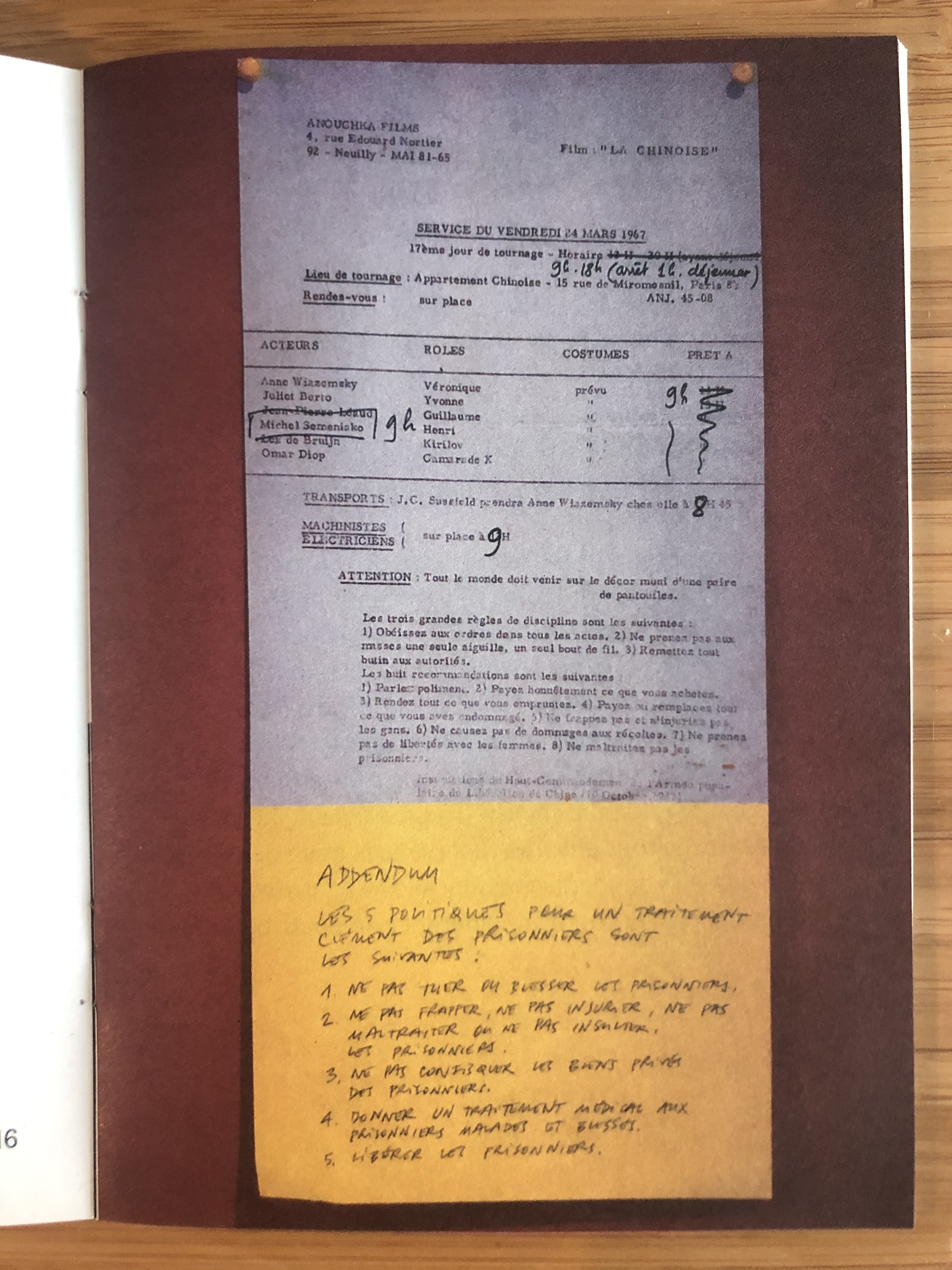
Les Cinq Politiques : Meessen’s detournement of Jean Luc Goard’s instructions for the smoothing running of a location shoot for La Chinoise)
Chaosmos : a neon installation inspired by OK Jazz, the house orchestra at Kinshasa’s legendary colonial era club, Un Deux Trois!
One.Two.Three : a video installation about an unpublished protest song by Congolese student Joseph Mbelolo ya Mpiku in May 1968. Meessen found the lyrics in the archive of Raoul Vaneigem
and many others.
Contemporary artist Vincent Meessen and Samsom Kambalu engage in a thoughtful re-writing of Situationist history. Meessen has focused on surfacing the oft-neglected African and Carribbean dimension of the movement. See for instance Blues Klair (Toronto, The Power Plant, 2019). More about Meessen here and about Kambalu here and here
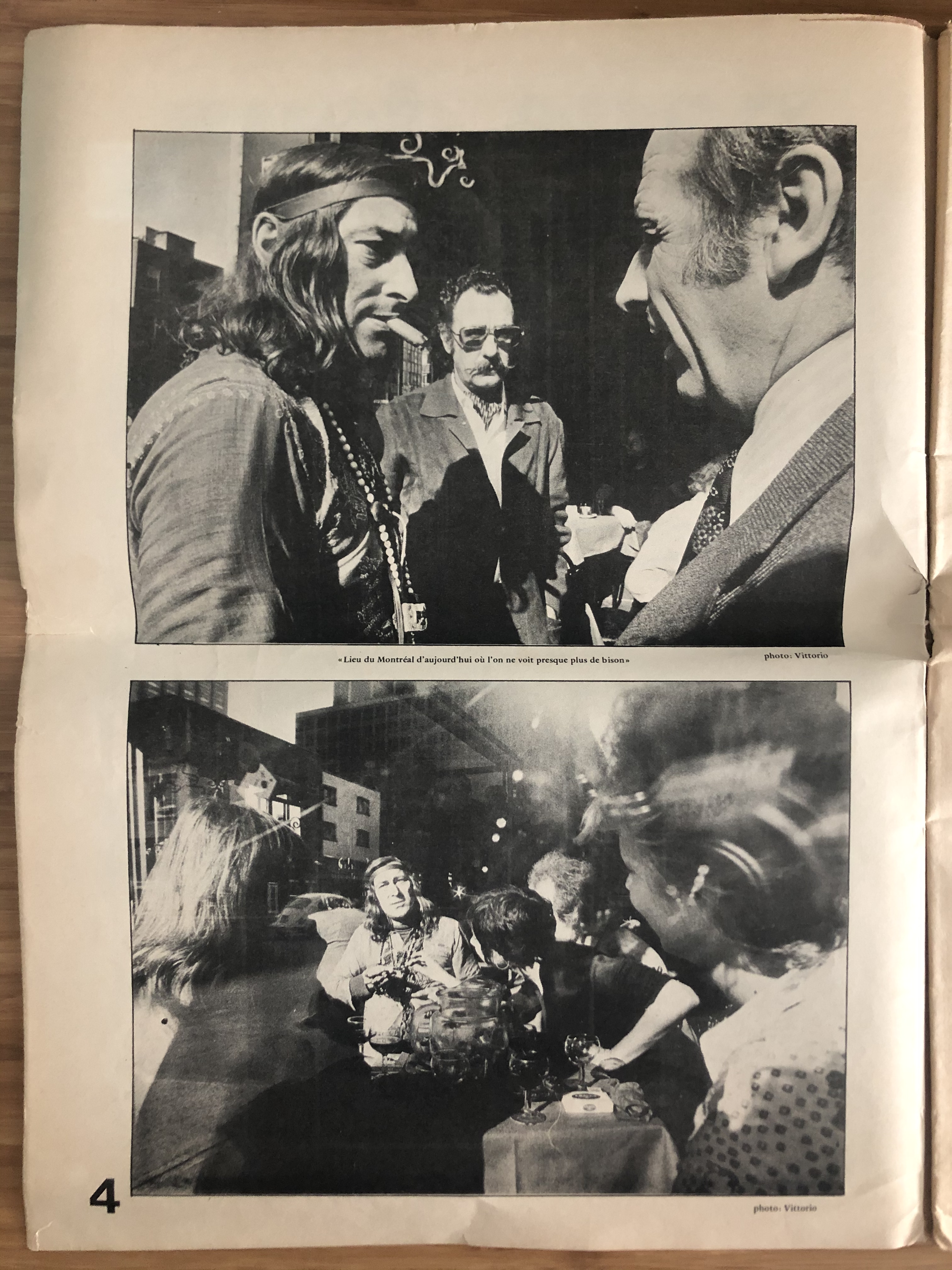
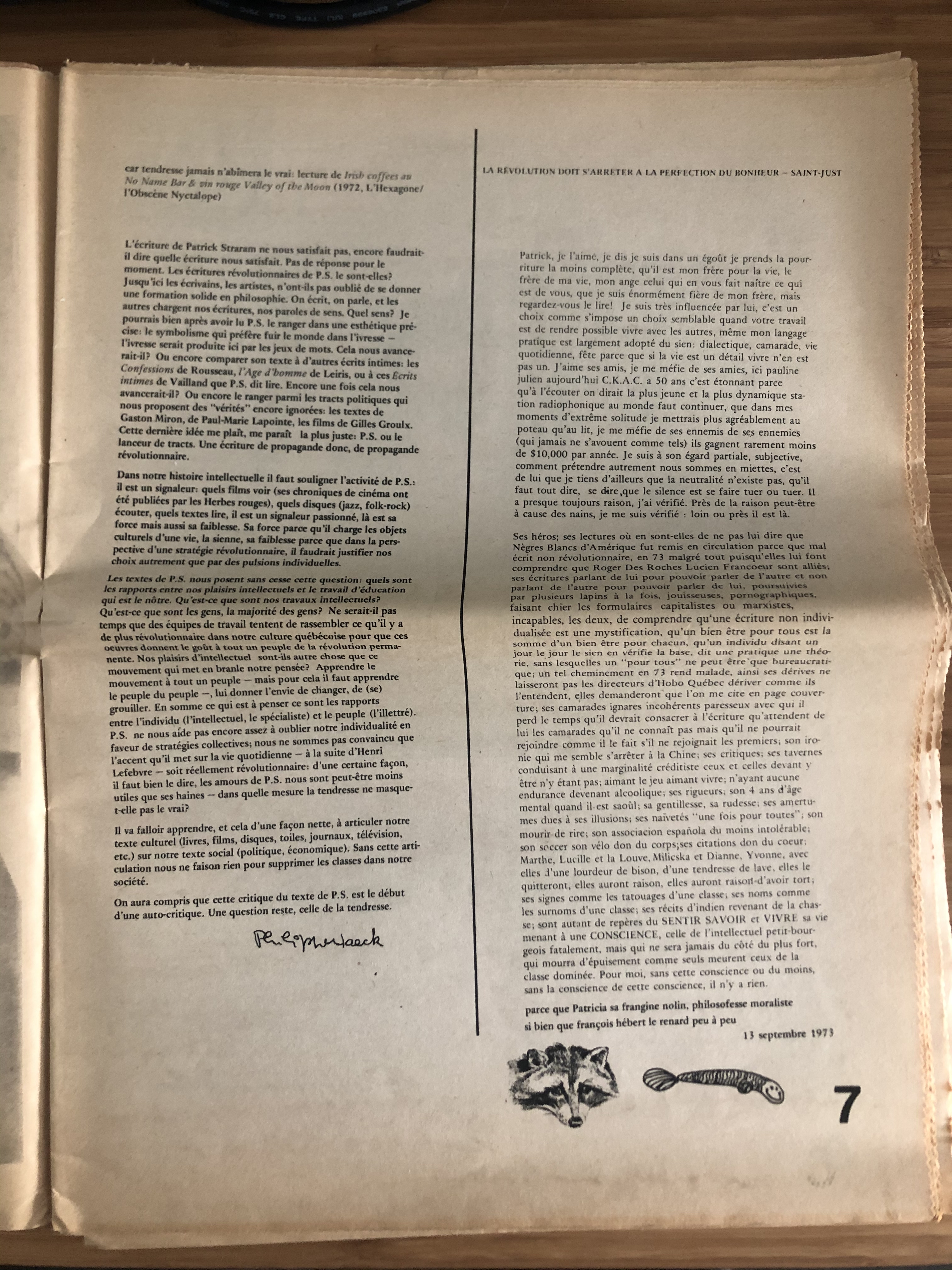
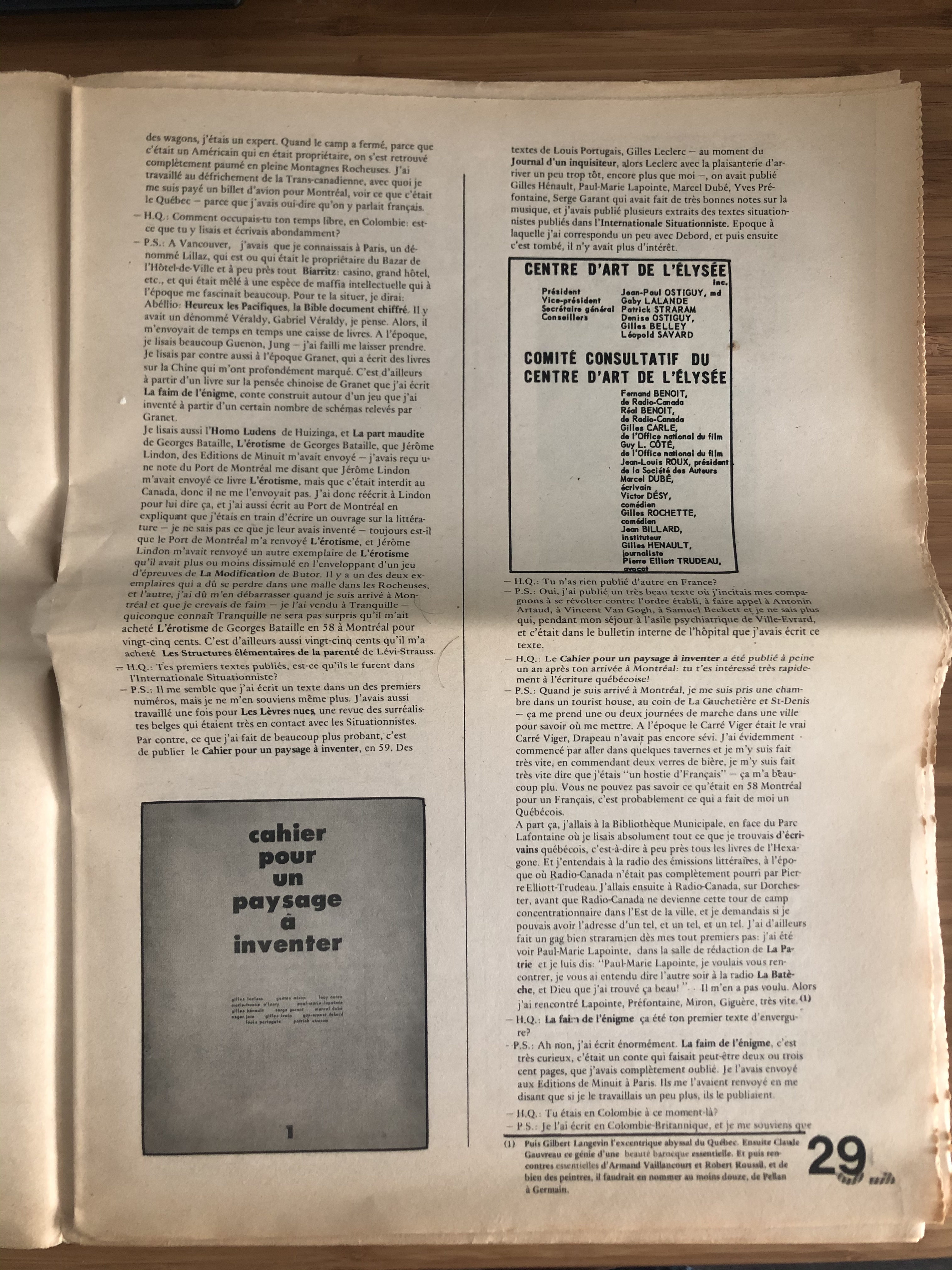
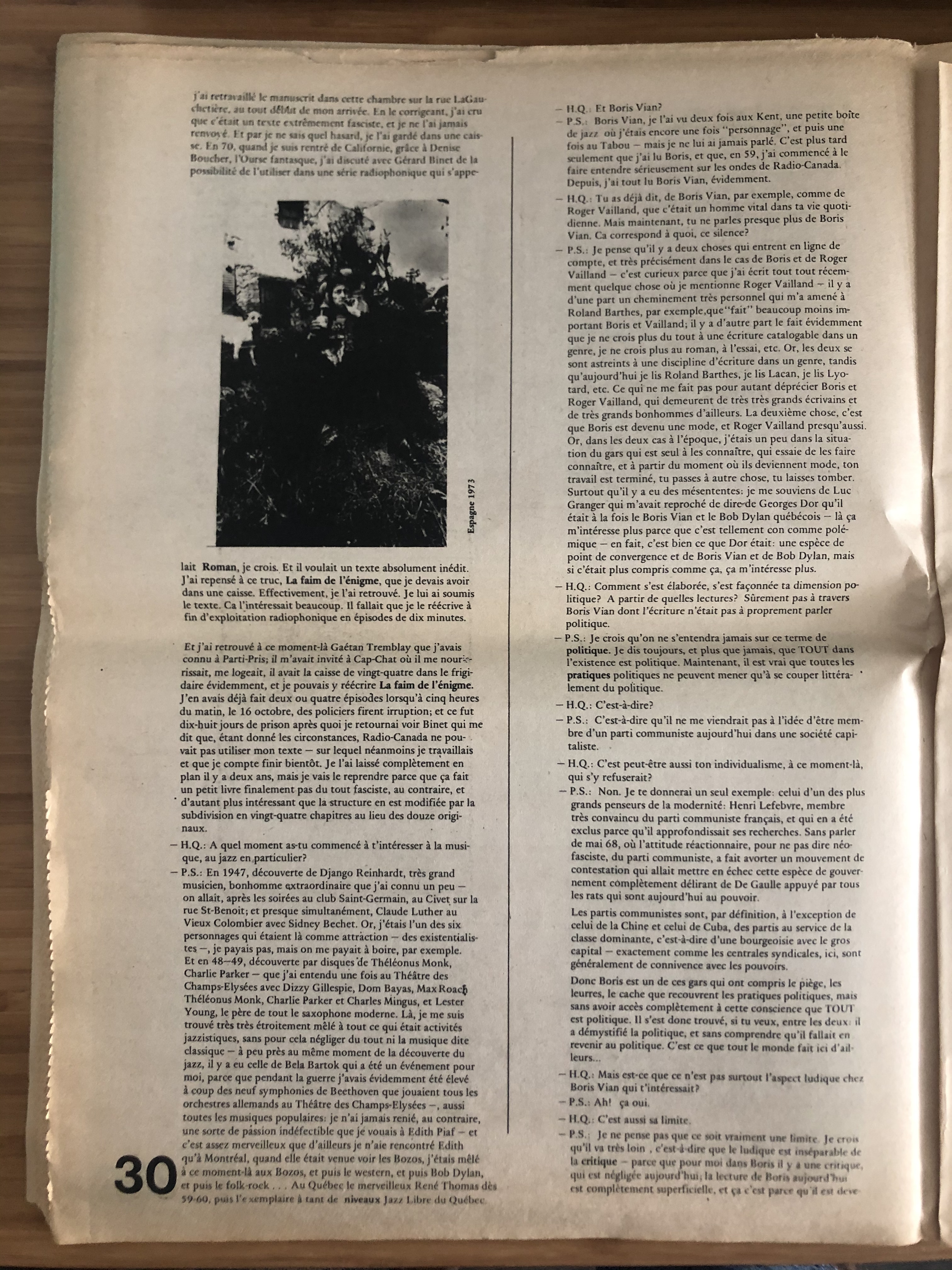
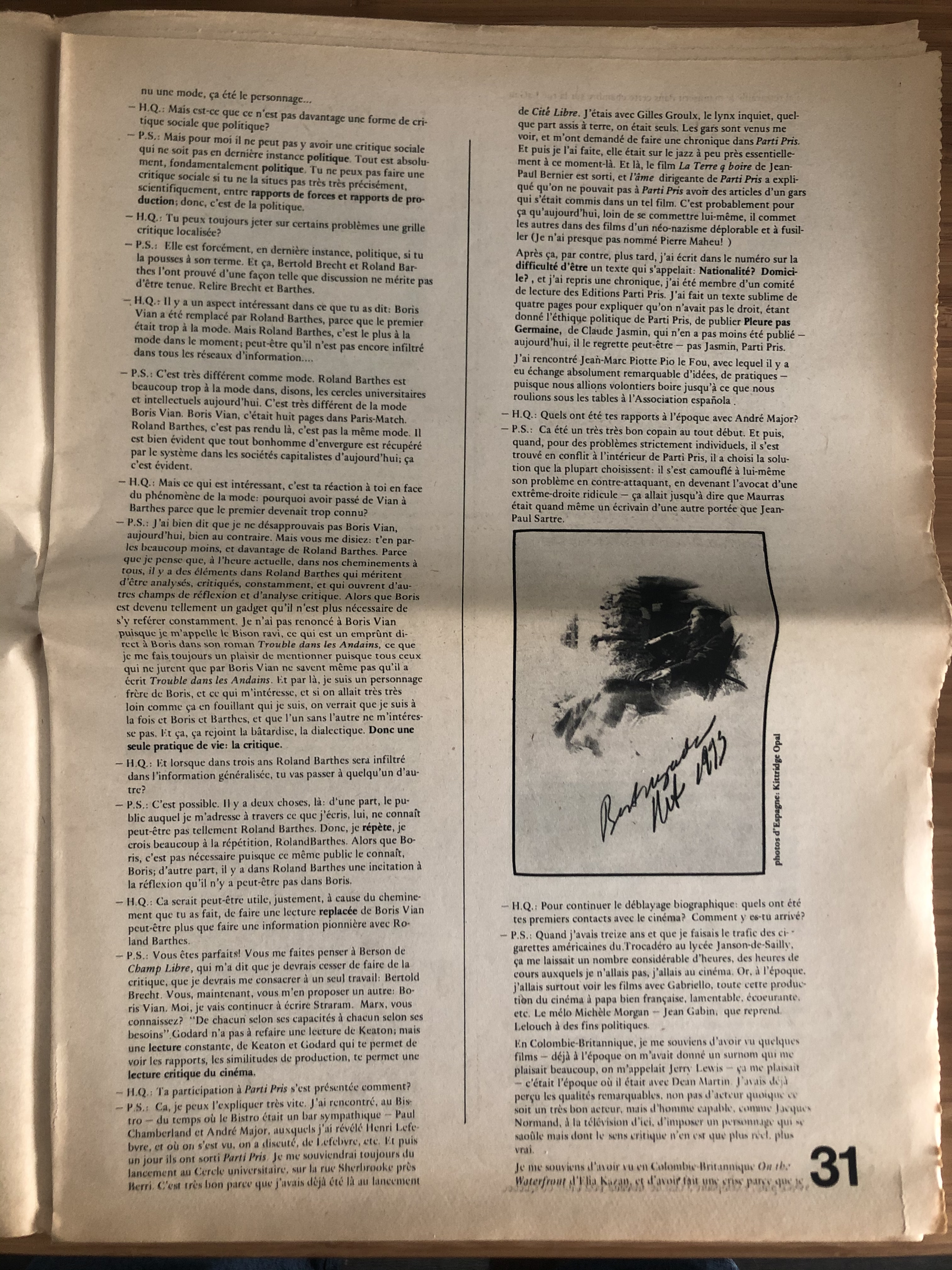
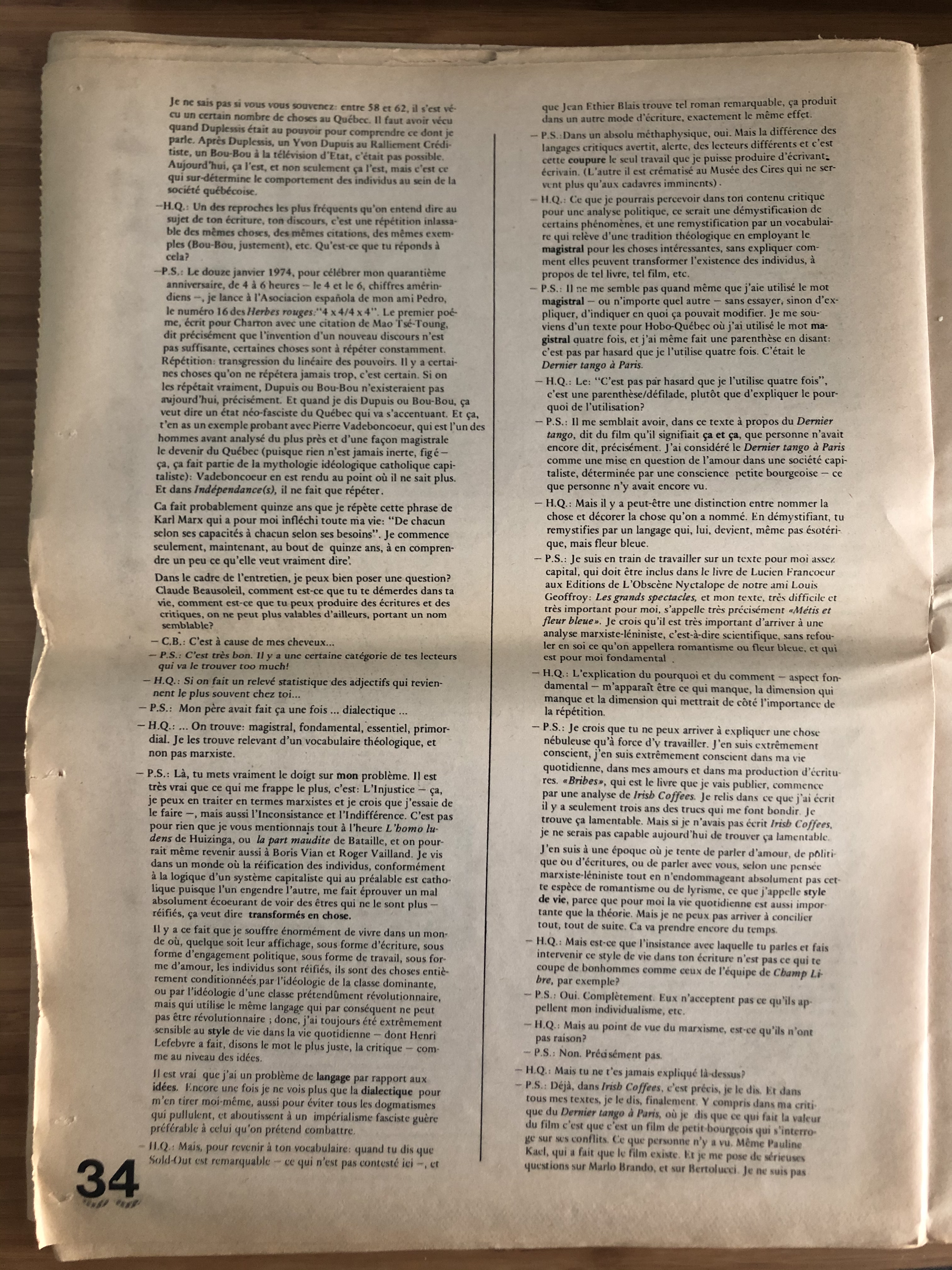
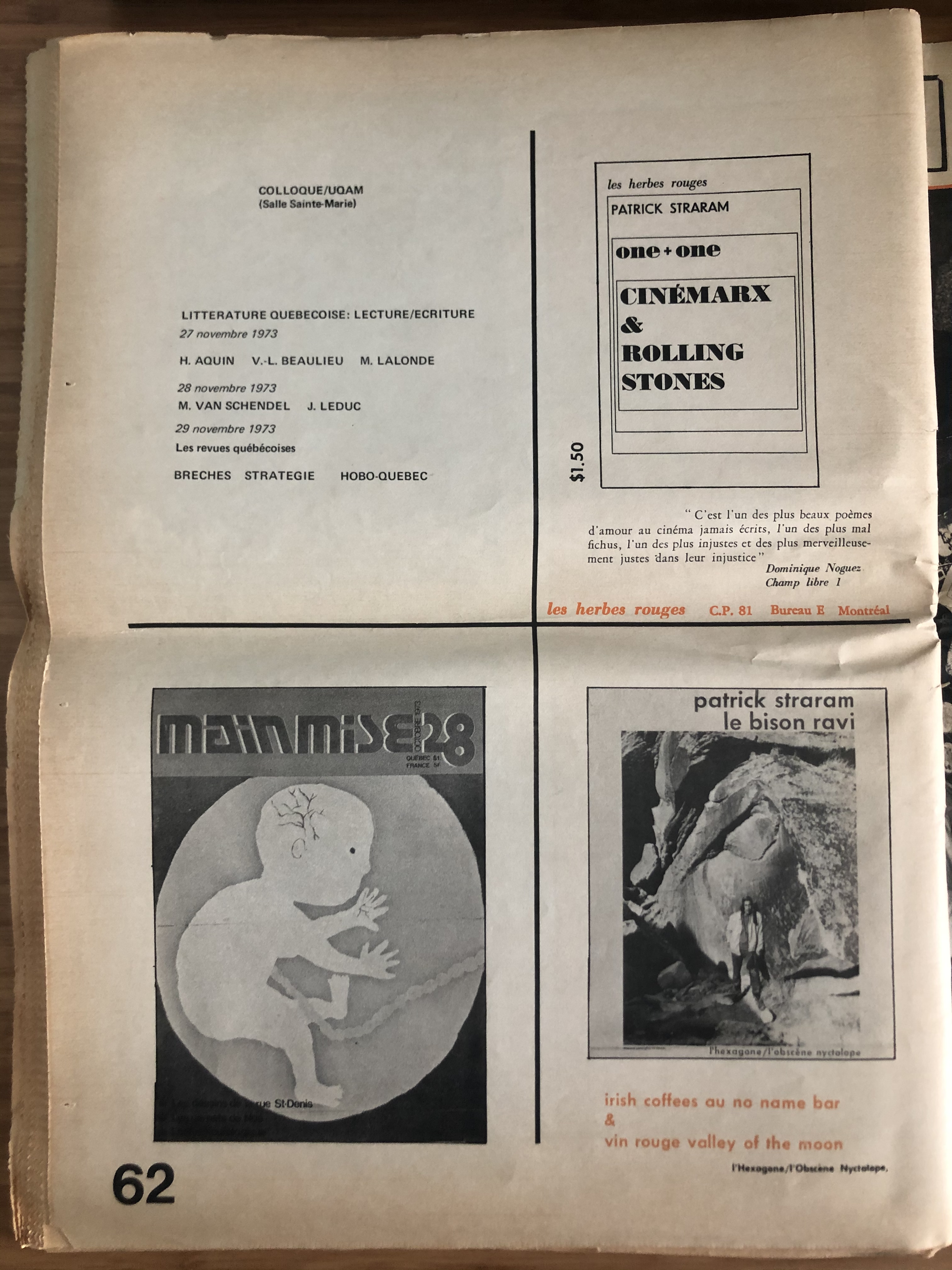
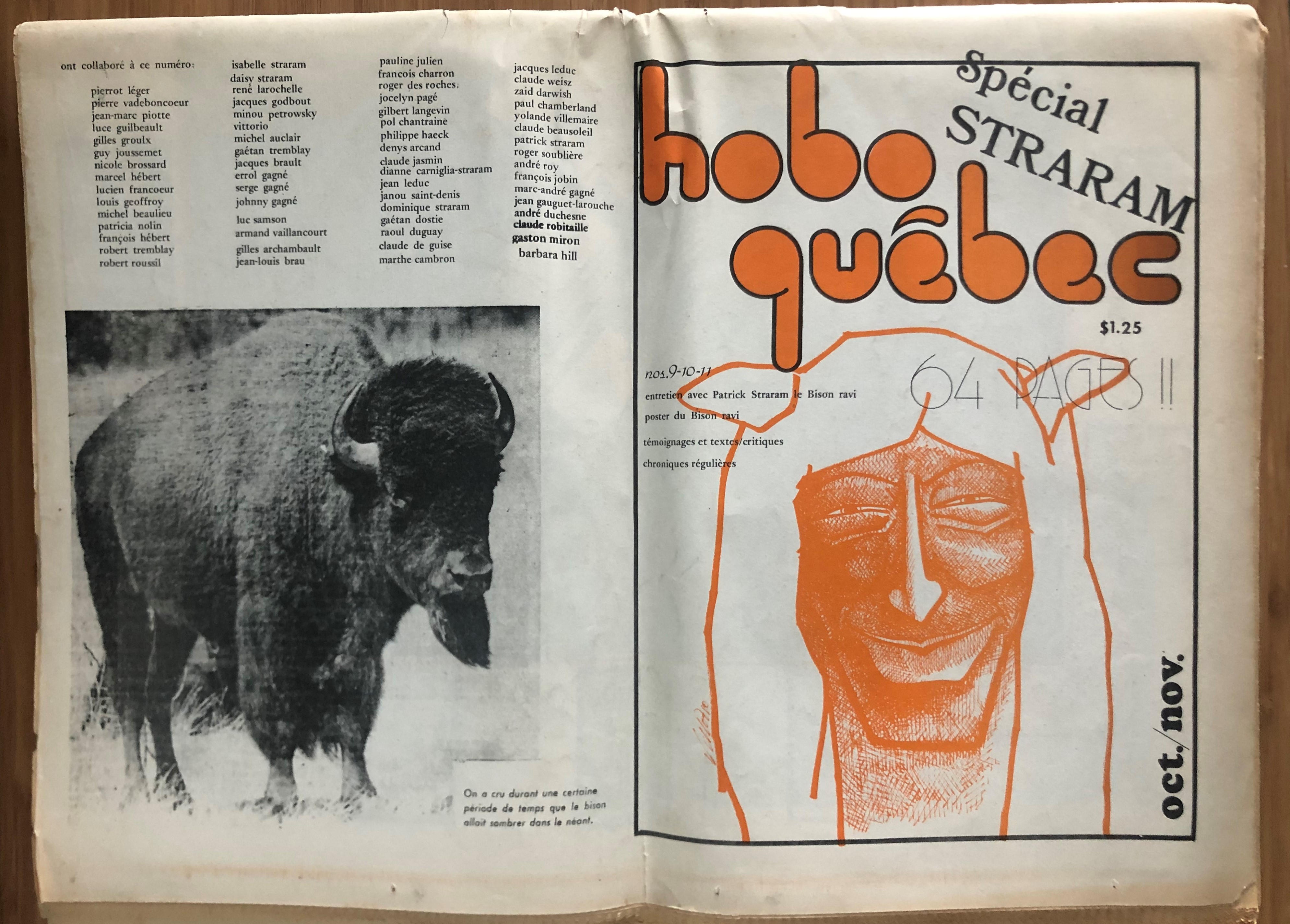
Hobo Quebec 9-10-11: Special Straram. Montreal, Oct-Nov 1973. 64 p.; ill.; 39.5 x 29 cm.; ill. Wrappers with photograph of Straram.
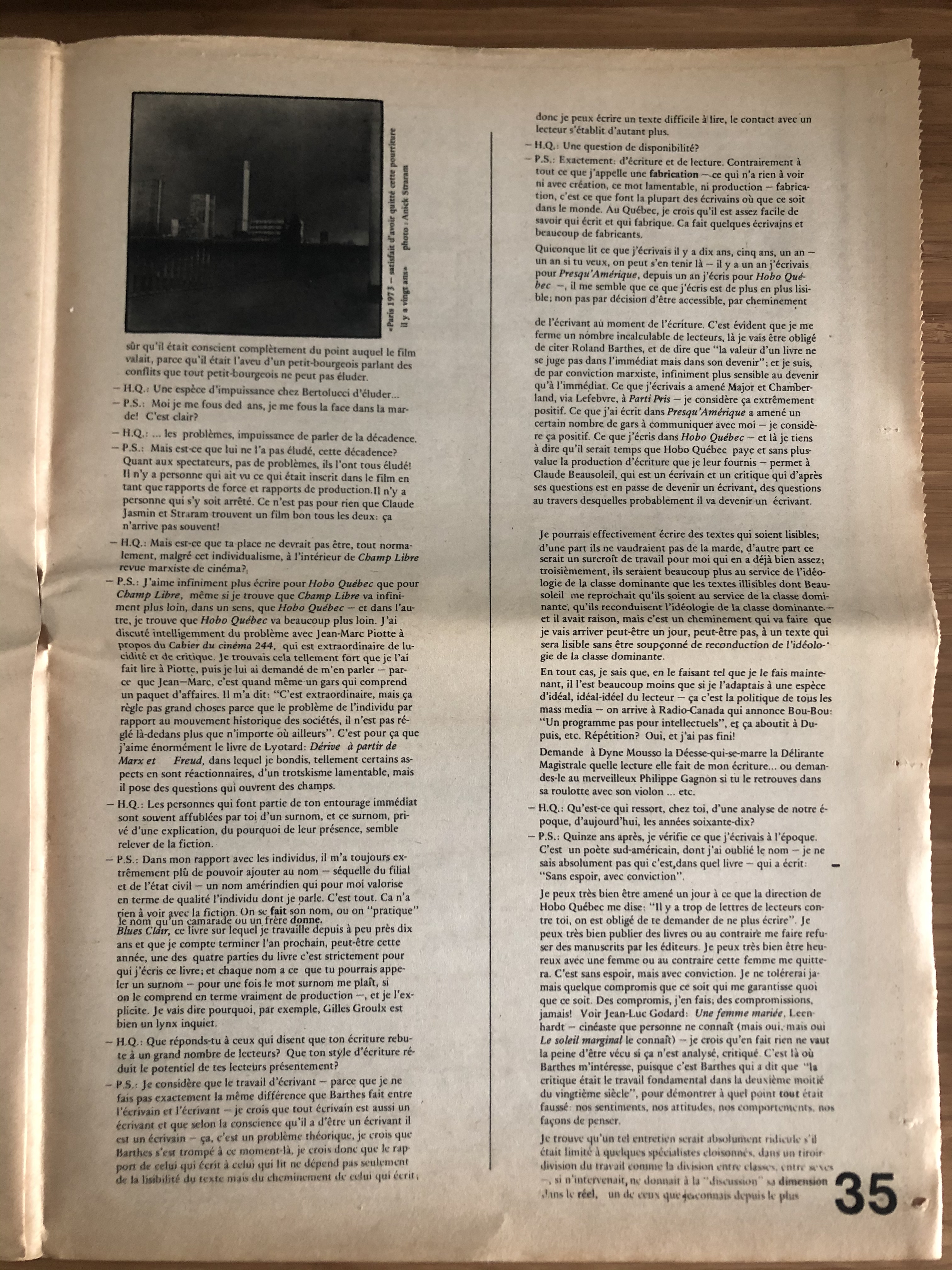
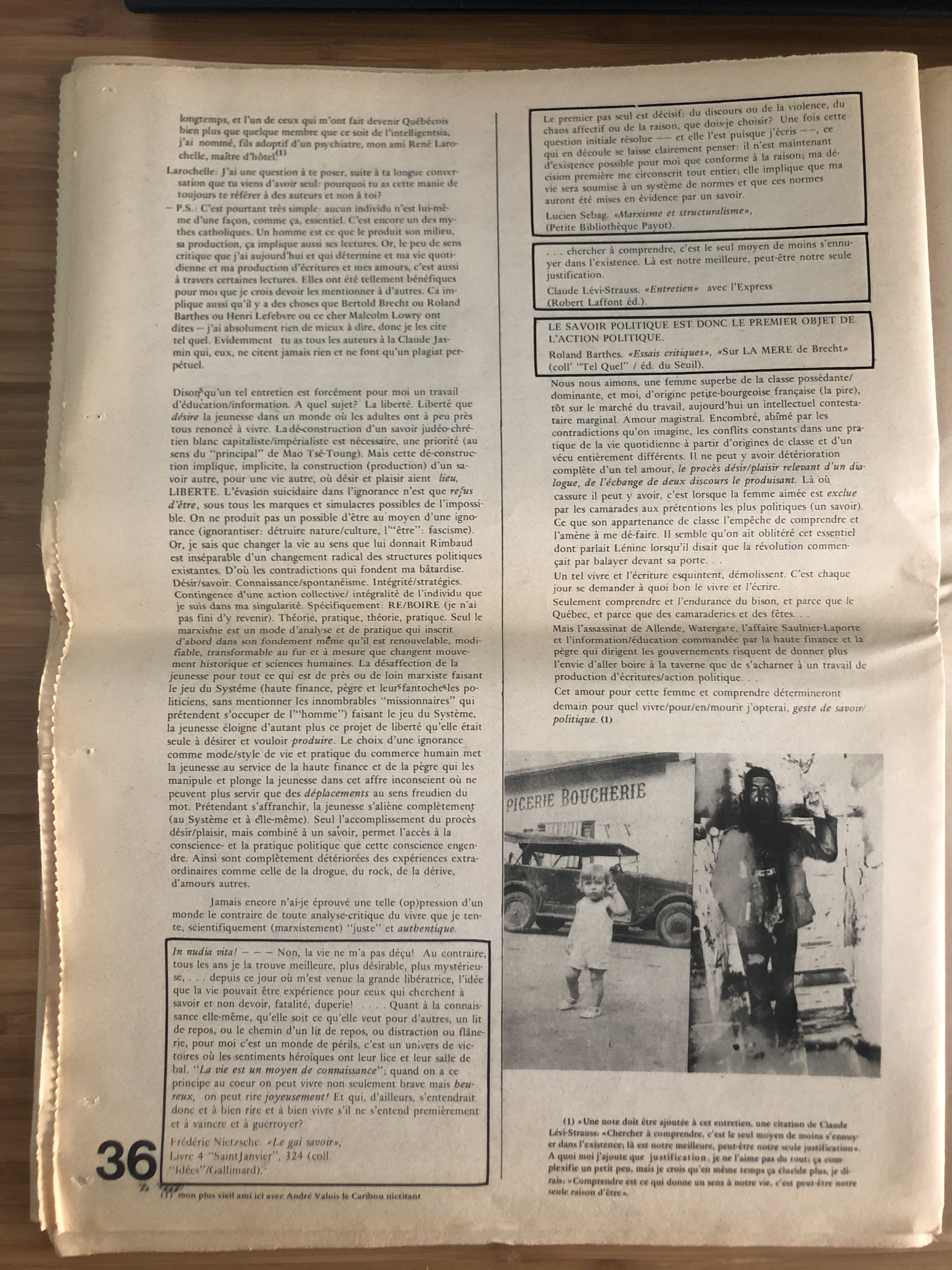
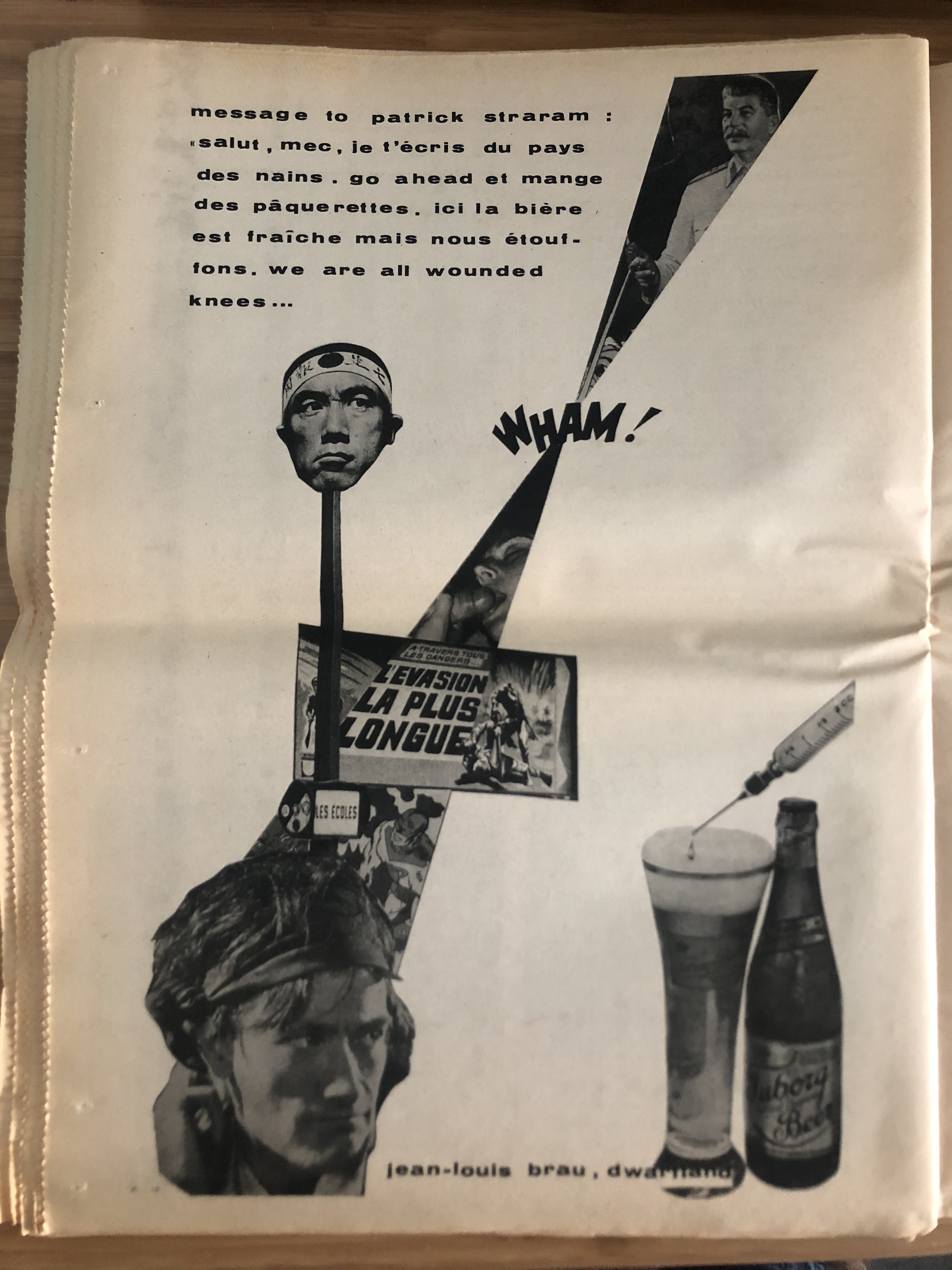
Special issue of the Quebec counterculture magazine dedicated to Patrick Staram, “Le Bison Ravi”. Features a 10-page long interview of Straram, where he shares details about his youth (including his friendship with the Lettristes in Saint-Germain), discusses the literary (Boris Vian, Roland Barthes, Henri Lefebvre, etc.), musical, and cinema figures that influenced him, and more (pp 26-36). Jean-Louis Brau is given 2 pages to share memories of his friendship with Straram (pp. 46-47). Also includes contributions by a plethora of Quebecois avant-garde figures such as Luce Guilbeault, Denys Arcand, Gilbert Langevin, Gilles Archambault, Louis Geoffroy, Lucien Francoeur, Nicole Brossard, Jean-Marc Piotte, Pierre Vadeboncoeur, Pierrot Léger, Gilles Groulx, Robert Roussil, Pauline Julien, etc.
Born in Paris in 1934, Patrick Straram was a member of the Internationale Lettriste and a close (and early) friend of Guy Debord and Ivan Chtcheglov. He left the I.L. in 1954 when he fled to Canada, in part to avoid conscription. He remained close to Debord for several, as attested by their warm letters (see Correspondance vol. 0-2) and the publication of the Cahier pour un Paysage a Inventer. After a few years in Vancouver as a barman and a lumberjack, he settles in Montreal in 1958 where he quickly becomes a fixture in Quebec’s avant-garde cinema and music scene.
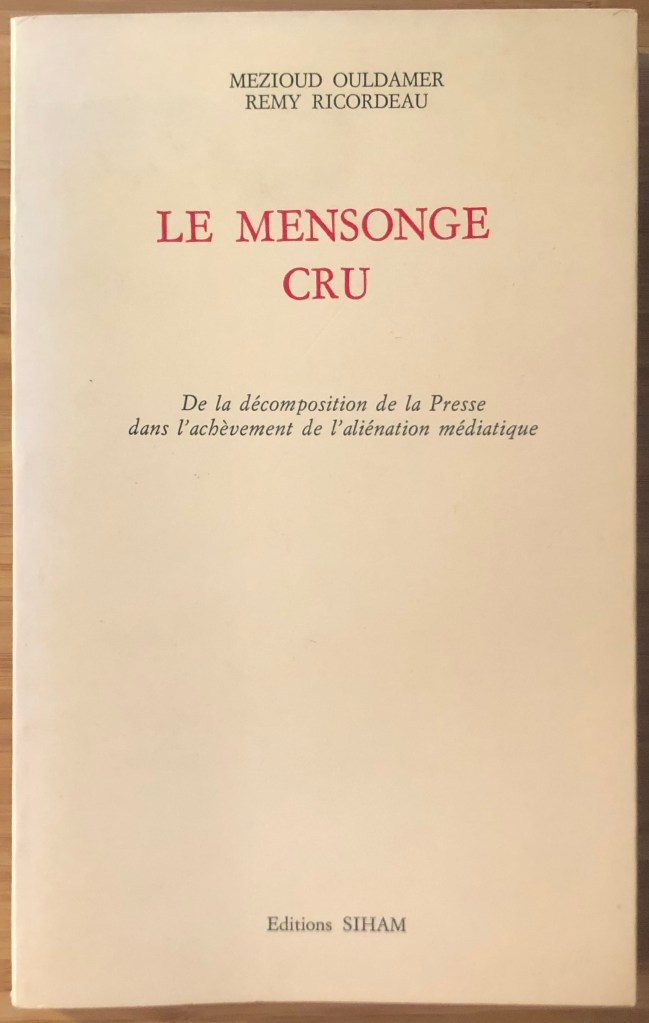
OULDAMER, Mezioud and RICORDEAU, Remy. Le Mensonge cru. De la Décomposition de la Presse dans l’Achèvement de l’Aliénation médiatique. Paris: SIHAM, November 1988. 123 p.; 22 x 14 cm. Cream cover
OULDAMER, Mezioud. Le cauchemar immigré dans la décomposition de la France. Paris: Gerard Lebovici, November 1986. 128 p.; 22 x 14 cm. orange cover
Mezioud Ouldamer is an unjustly neglected figure of the so-called “post-situationist” movement. Little is known about Ouldamer — like Debord, he shied away from the spotlight, and there is no known photograph of him. Political science scholar Nedjib Sidi Moussa made a valiant attempt at piecing together pieces of the incomplete puzzle that is Ouldamer’s life in an eulogy Some of what follows is an abbreviated and translated version of Sidi Moussa’s scholarly work, and some is the result of our own research
Ouldamer was born in Ait Saada, Algeria in 1957. In 1980, he writes l’Algerie Brule! (Algeria is Burning!) under a pseudonym. This short pamphlet offers a radical reading of the Algerian uprising and points at the advanced decomposition of the Algerian state. Ouldamer, who was a construction worker at the time, is arrested in December 1980 and receives a two-year prison sentence as a result.
Four years later, in Offense à President (Offense to President), Ouldamer doubles-down, providing a sobering account of Algeria’s authoritarian regime and its political prisons. In a letter to Floriana Lebovici dated 30 August 1984, Debord had recommended she publish this work (see Correspondance Vol 6, p. 274). The two men would first meet in September or October 1984, and then strike an immediate friendship (see Correspondance Vol 6., p. 278). It appears that Debord, through Floriana Lebovici, had tried to alleviate some of Ouldamer’s immigration troubles so that the Algerian dissident may remain in France (see Correspondance Vol 6., p. 288 and p. 355-356). Debord would heartily recommend Ouldamer’s Offense à President to his friends, including Jaime Semprun (see Correspondance Vol 6, p. 309)
In 1986, amidst a vibrant debate on immigration, Ouldamer writes Le Cauchemar immigré dans la Décomposition de la France (The Immigrant Nightmare in the Decomposition of France). In this work, the Algerian-born author attacks the myths behind both racist and anti-racist arguments. Guy Debord had provided ample input on the subject to Ouldamer in a long letter dated 22 November 1985 (see Correspondance Vol 6, p. 362-369). A few months later, in a letter dated 30 August 1986, Debord congratulates Ouldamer in an unusually eulogistic missive : “Cher Mezioud, j’ai lu le manuscrit du Cauchemar immigré avec grande admiration. Tout est juste ; et c’est bien dit. Sur ce sujet, tellement central dans la décomposition de la France, c’est exactement la scandaleuse vérité qu’il fallait écrire. On n’y peut faire, de bonne foi, aucune réserve. Reçois toutes mes amicales félicitations” (“Dear Mezioud, I read the manuscript of the Immigrant Nightmare with great admiration. Everything is right; and it is well said. On this subject, so central in the decomposition of France, it is exactly the scandalous truth that it was necessary to write. One cannot, in good faith, make any reservations. My heartfelt congratulations”) (see Correspondance Vol 6, p. 436)
Le Mensonge cru. De la Décomposition de la Presse dans l’Achèvement de l’Aliénation médiatique (A Lie believed: On the Decomposition of the Press in the Achievement Media Alienation) is Ouldamer’s fourth opus and a violent attack against journalists and journalism, both of which are seen as sheer lackeys of the prevailing socio-economic order. Published in 1988, the book received very limited press coverage. In the interim, Debord and Mezioud had had a following out (see Correspondance Vol 6, p. 488), though it remains unclear why. As a result, the opus wasn’t published by Champ Libre / G. Lebovici, as Ouldamer’s first 3 books had been.
La Naissance de la guerre sociale en Algérie (The birth of social strugglesin Algeria) from 1991 is an updated criticism of the Algerian political situation and is particularly prescient, announcing that “a civil war could erupt anytime”. History would prove Mezioud right.
Mezioud published two more works of social criticism, in 1995 and 2007 respectively. He took his own life on July 12, 2017 in Saint-Jean-de-Luz. Unsurprisingly, his death was not reported by any newspaper.
Bibliography
L’Algérie brûle ! (Paris: Champ Libre, 1981)
Offense à President (Paris: Gerard Lebovici, 1985)
Le Cauchemar immigré dans la décomposition de la France (Paris: Gerard Lebovici, 1986)
Le Mensonge cru : de la décomposition de la presse dans l’achèvement de l’aliénation médiatique (Paris: Siham, 1988)
La Naissance de la guerre sociale en Algérie (Paris: Hors Commerce, 1991)
[BLACK MASK / U.A.W.M.F.]. MOTHERFUCKERS. Armed Love in Rat: Subterranean News, vol. 1, no.27, January 31-February 6, 1969, p.9. New York: Rat Subterranean News, 1969. 20 p.; ill.; 28.5 x 42 cm.; ill. Wrappers with B&W photographs
“”A more expansive version of the Zig-Zag man [from the eponymous rolling paper] wotj added imagery of male genitalia and a brief statement on consciousness and revolution” (Opposition: Black Mask, Ben Morea, & U.A.W.M.F., p.21). Reproduced in Kugelberg 79
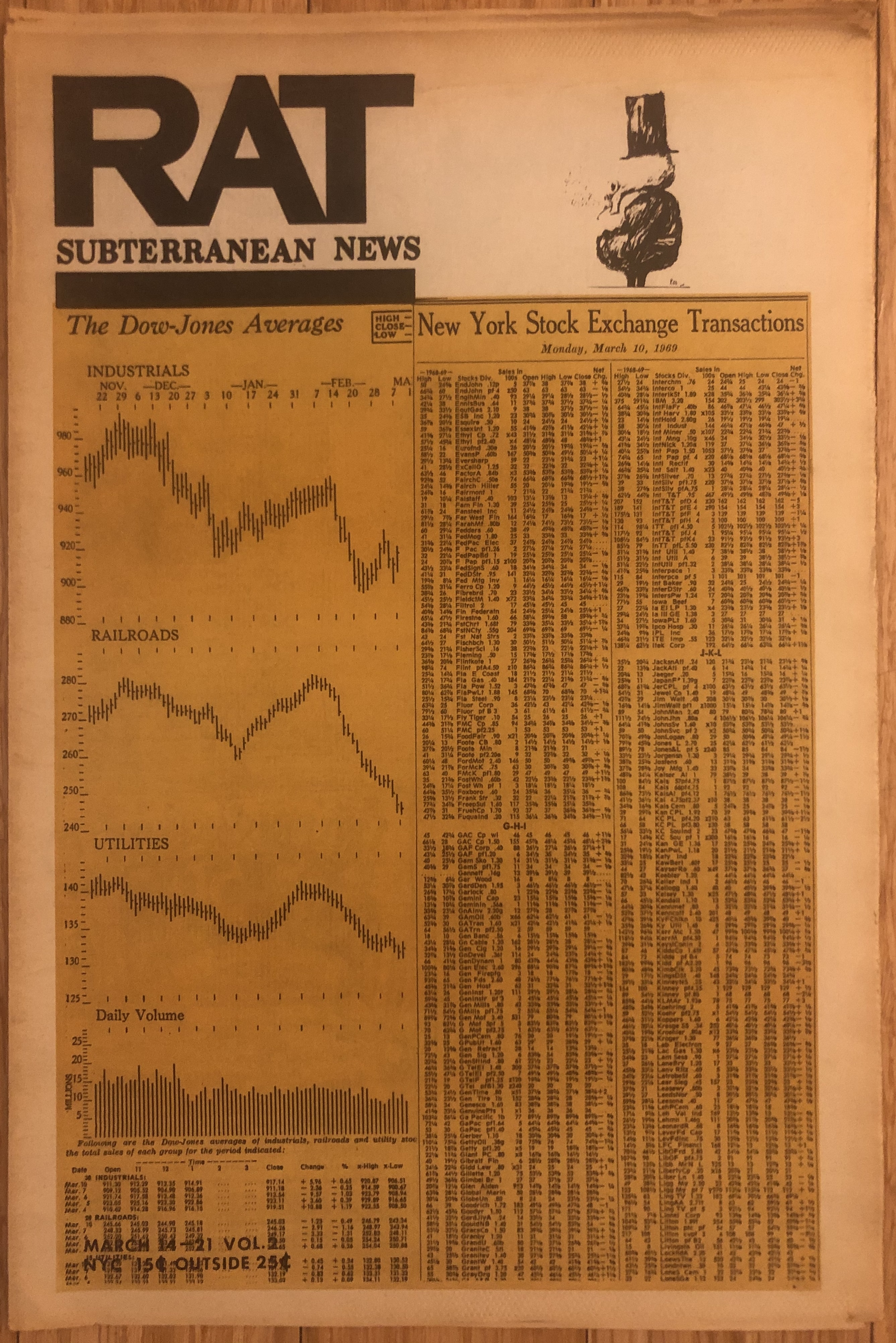
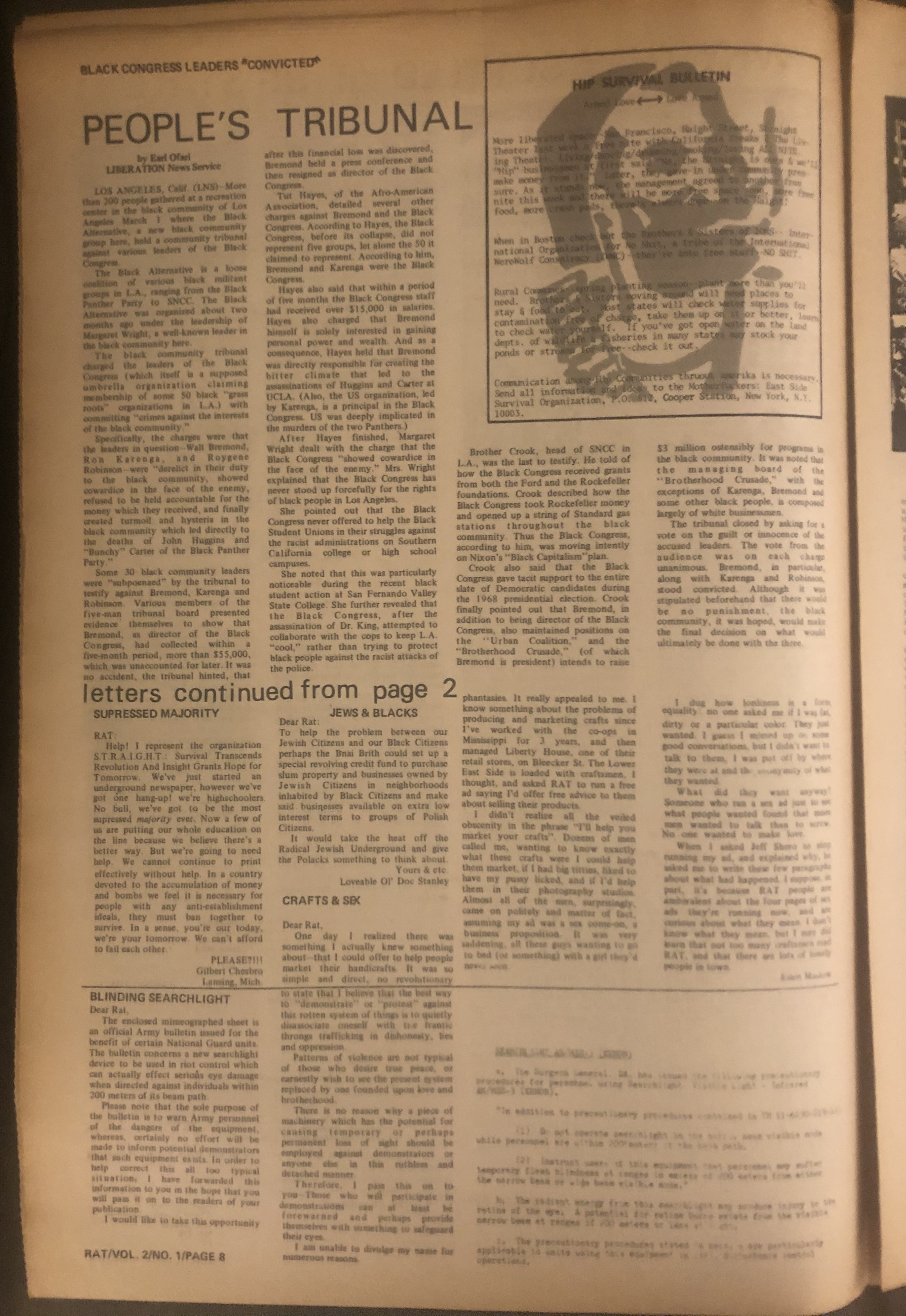
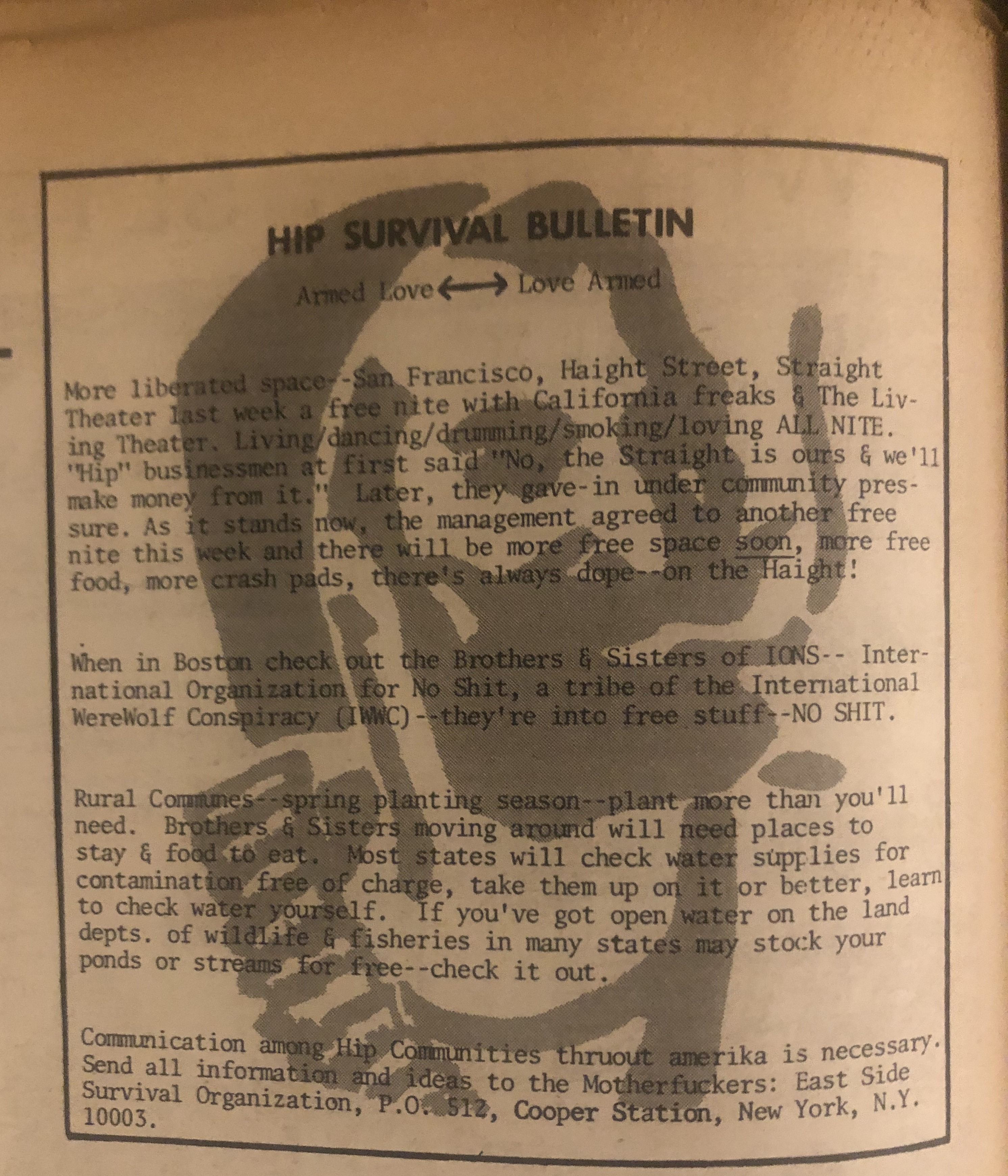
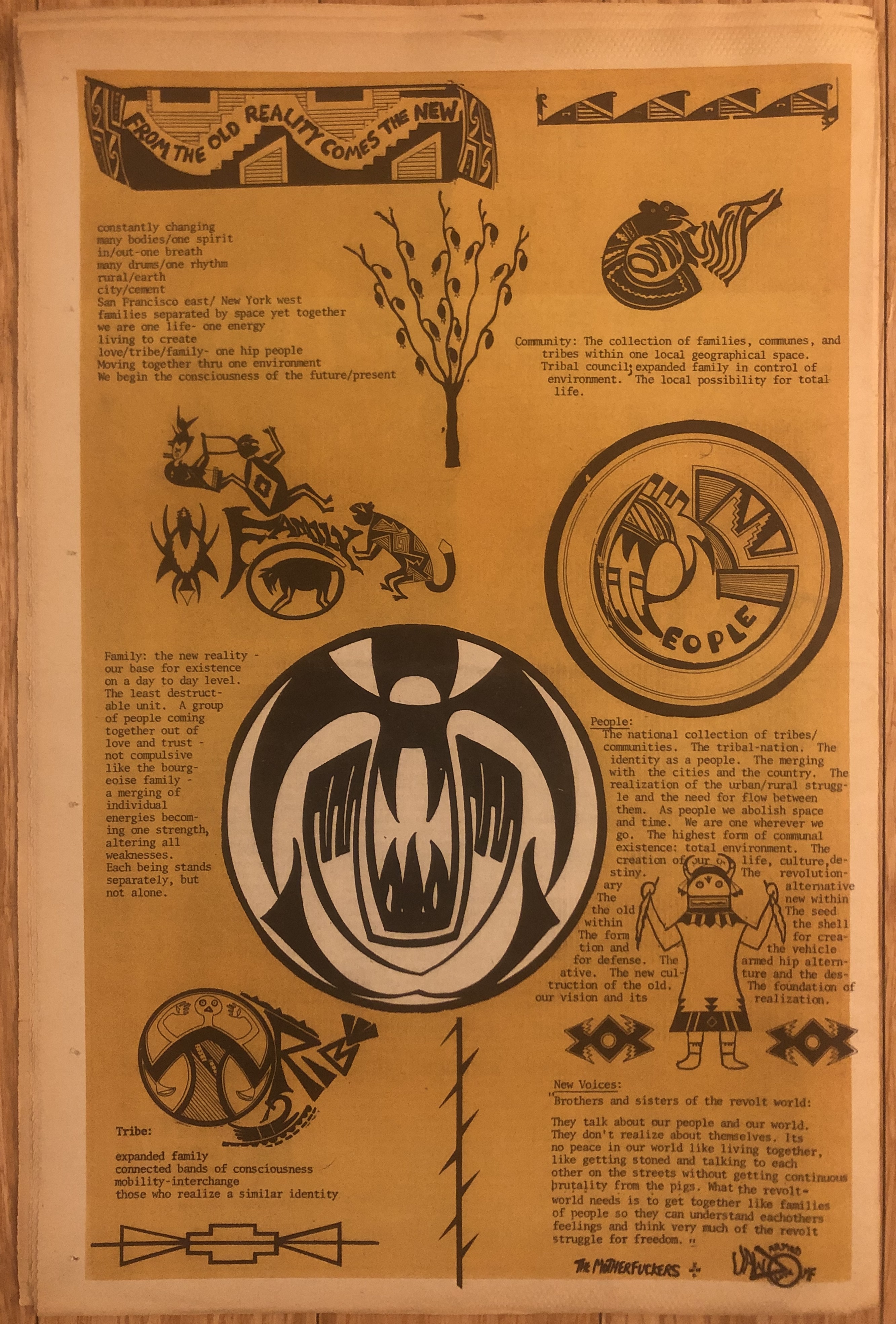
[BLACK MASK / U.A.W.M.F.]. MOTHERFUCKERS. Hip Survival Bulletin and From the Old Reality Comes the Newin Rat Subterranean News, vol. 2, no.1, March 14-21, [1969], p.8 and p. 20. New York: Rat Subterranean News, 1969. 20 p.; ill.; 28.5 x 42 cm.; ill. Wrappers with stock market chart.
Includes two Motherfucker pieces:
– “Hip Survival Bulletin”: “This one page report in the Rat giving late information on the takeover of the Straight Theater in San Francisco a la the U.A.W.M.F. action against the Fillmore in New York, notes on an affiliated Boston group, and a call for regular communication among ‘Hip Communities'”(Opposition: Black Mask, Ben Morea, & U.A.W.M.F., p.21). Reproduced in Kugelberg 84
– “From the Old Reality Comes the New”: “This illustrated statement by the two groups [Motherfuckers and International Werewolf Conspiracy] appeared in the Rat, describing and celebrating the new, activist-focused, communal reality” (Opposition: Black Mask, Ben Morea, & U.A.W.M.F., p.21). Reproduced in Kugelberg 85
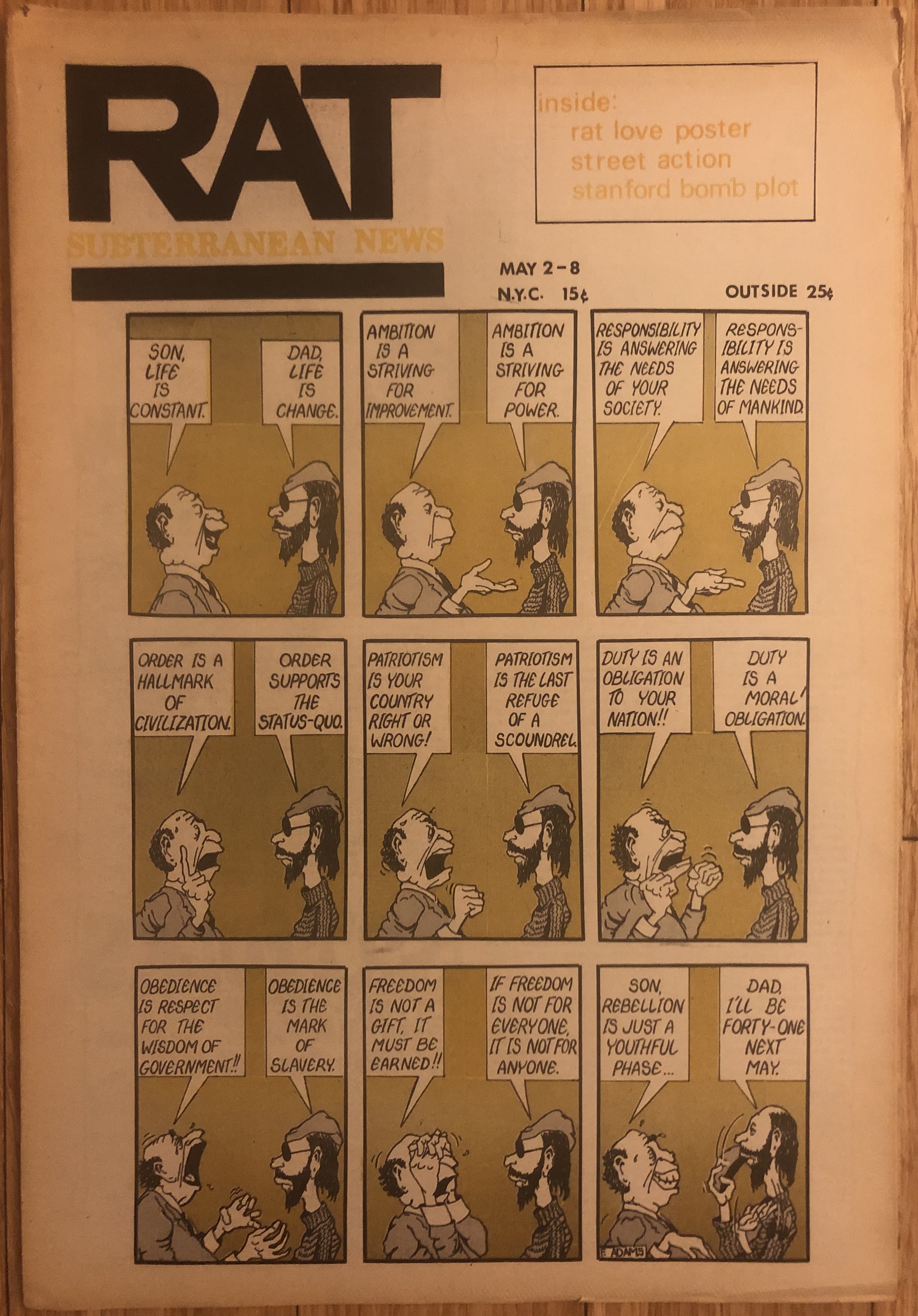
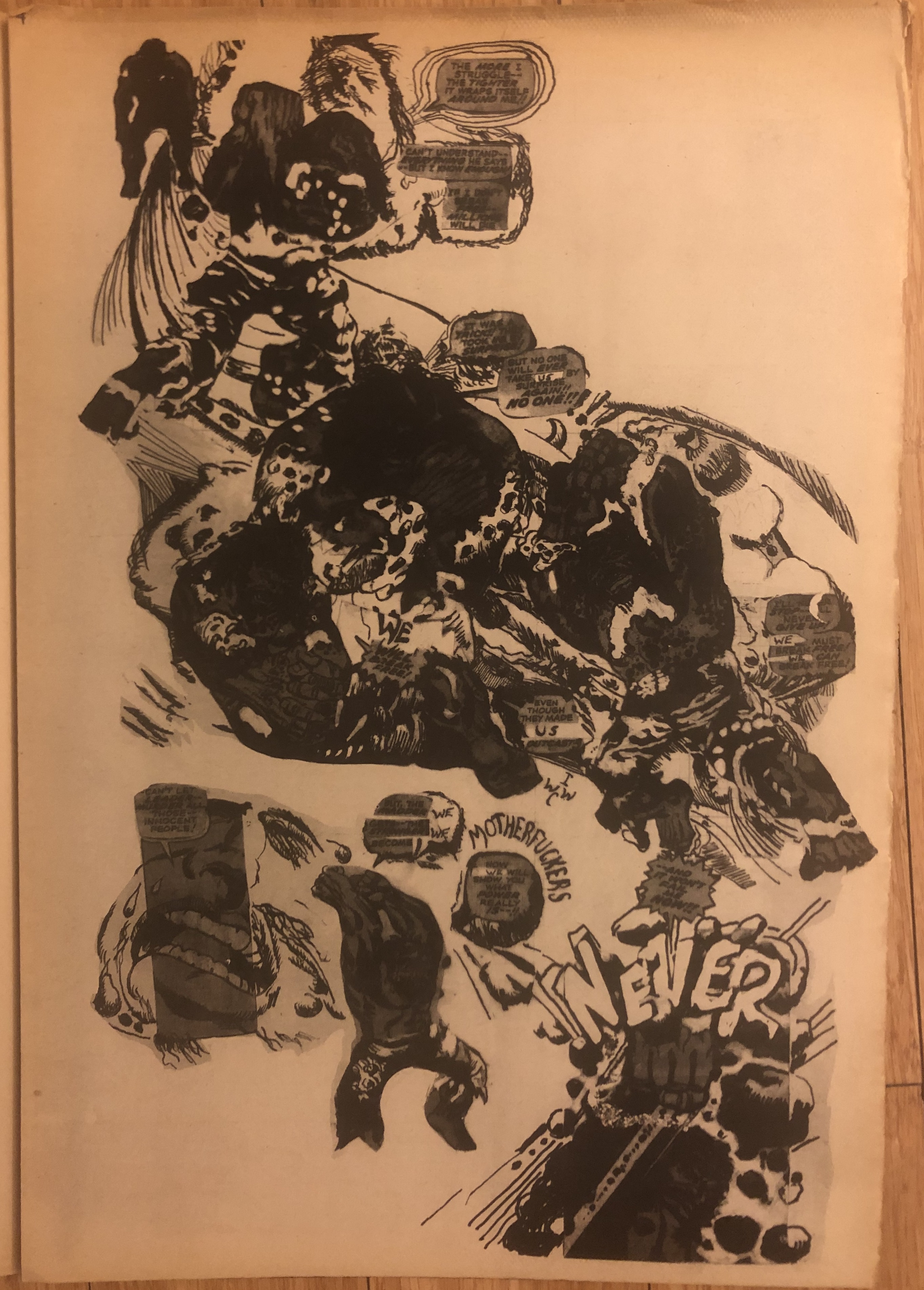
[BLACK MASK / U.A.W.M.F.]. MOTHERFUCKERS. Neverin Rat: Subterranean News, May 2-8 1969, p.9. New York: Rat Subterranean News, 1969. 20 p.; ill.; 28.5 x 42 cm.; ill. Wrappers with a comic strip.
“This brief statement by the Motherfuckers employs’found art’ , in this instance, re-adapted panels from Marvel’s Hulk comics” (Opposition: Black Mask, Ben Morea, & U.A.W.M.F., p.22). Reproduced in Kugelberg 87.
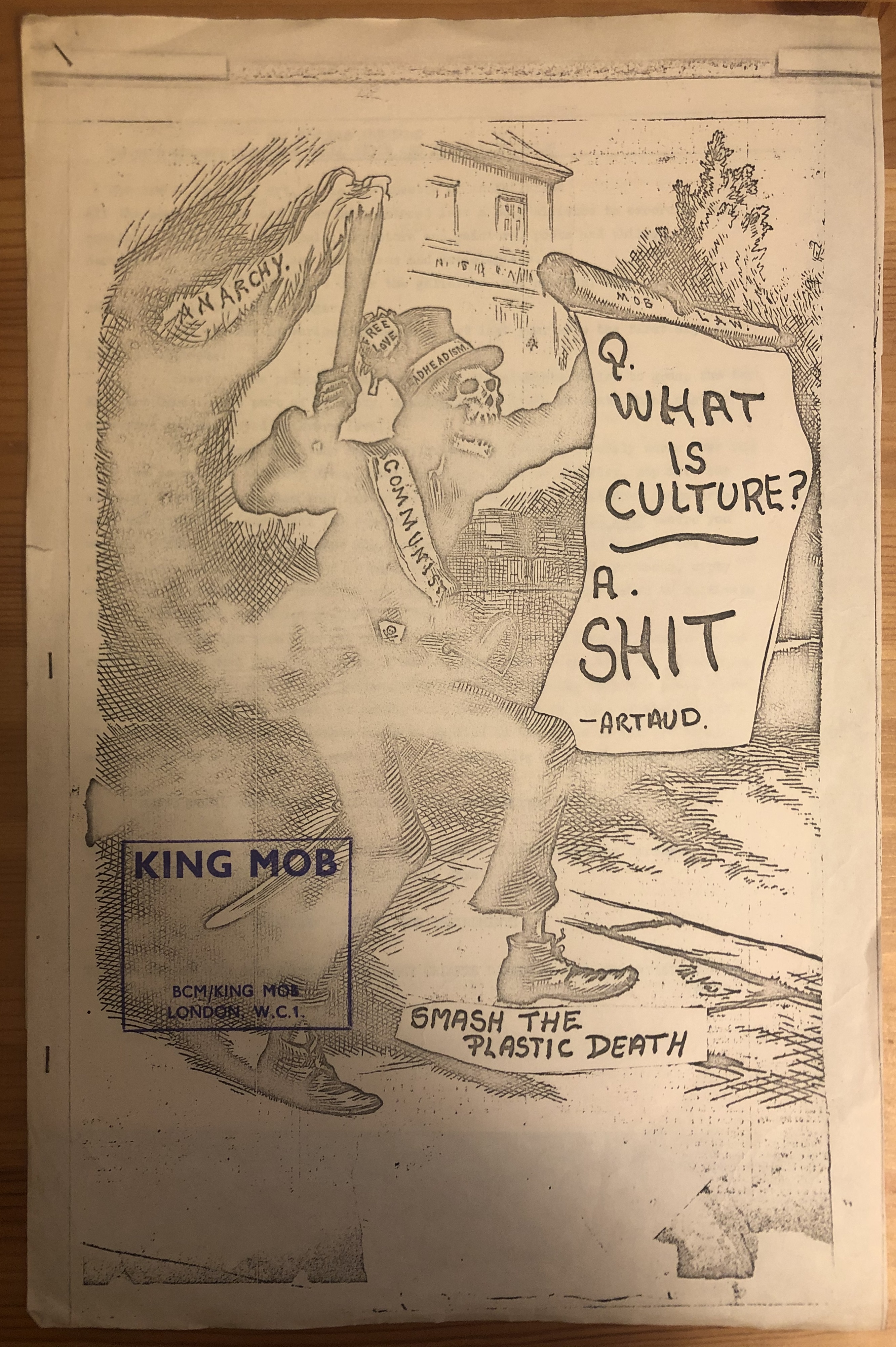
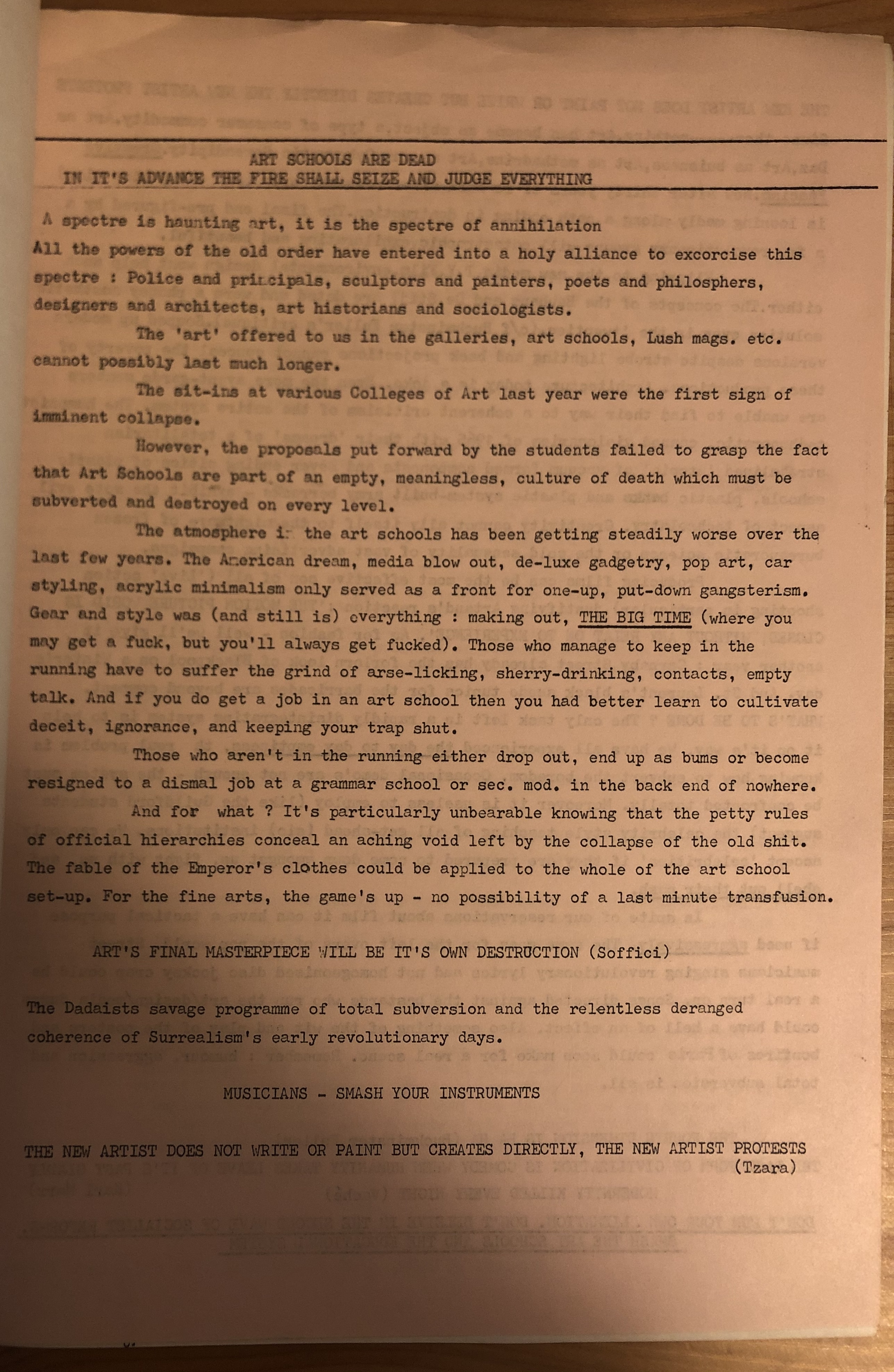
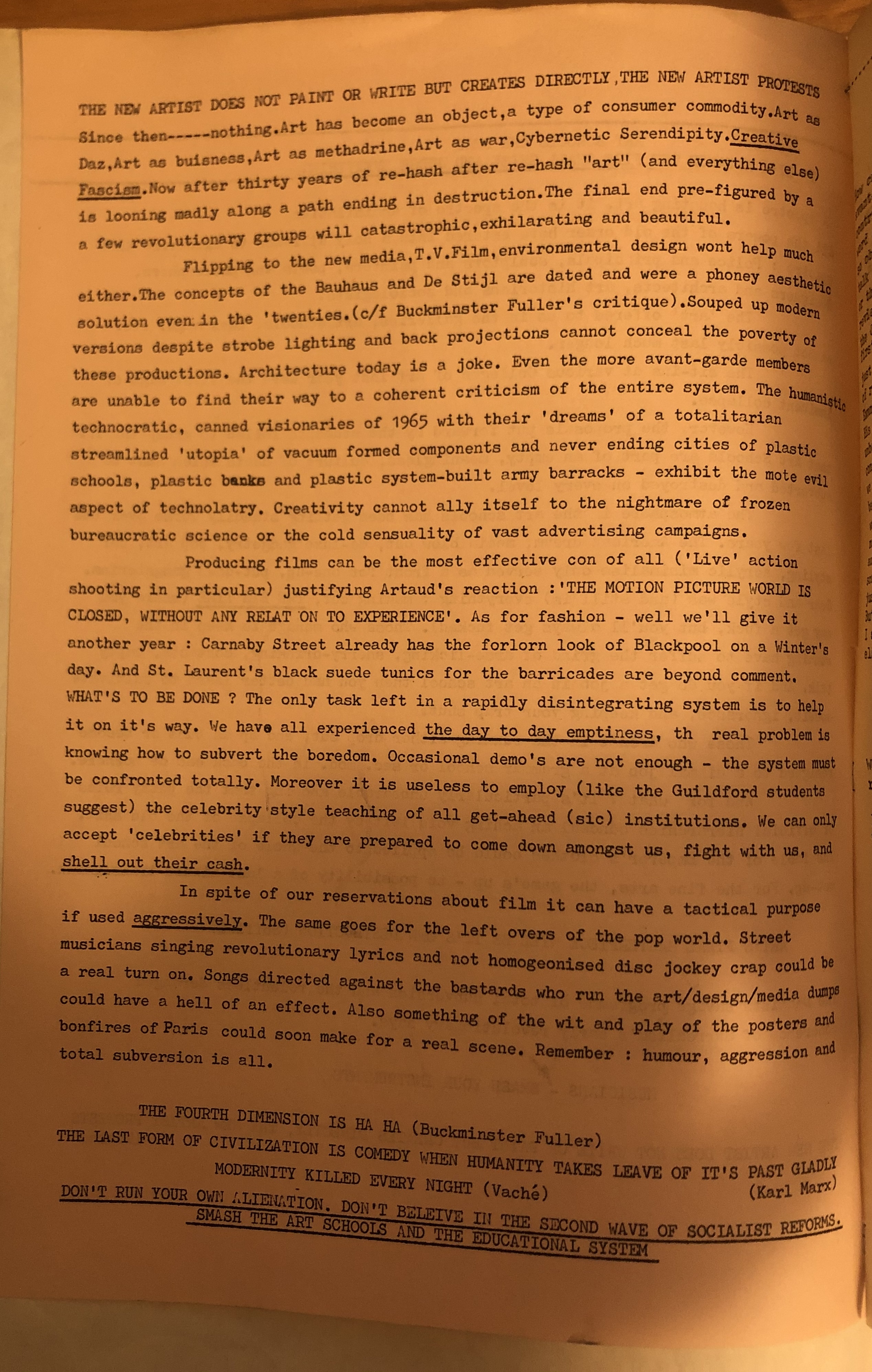
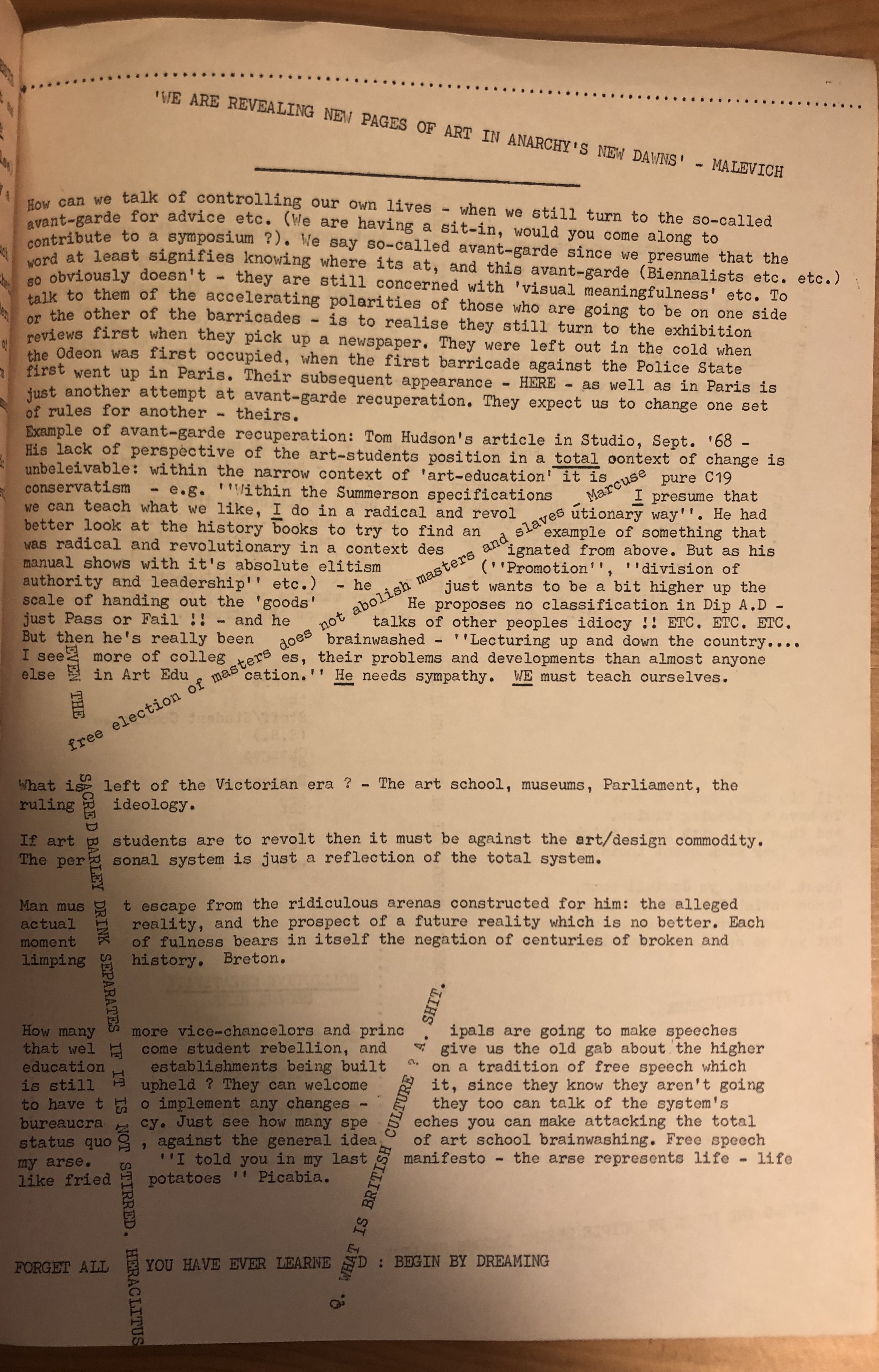
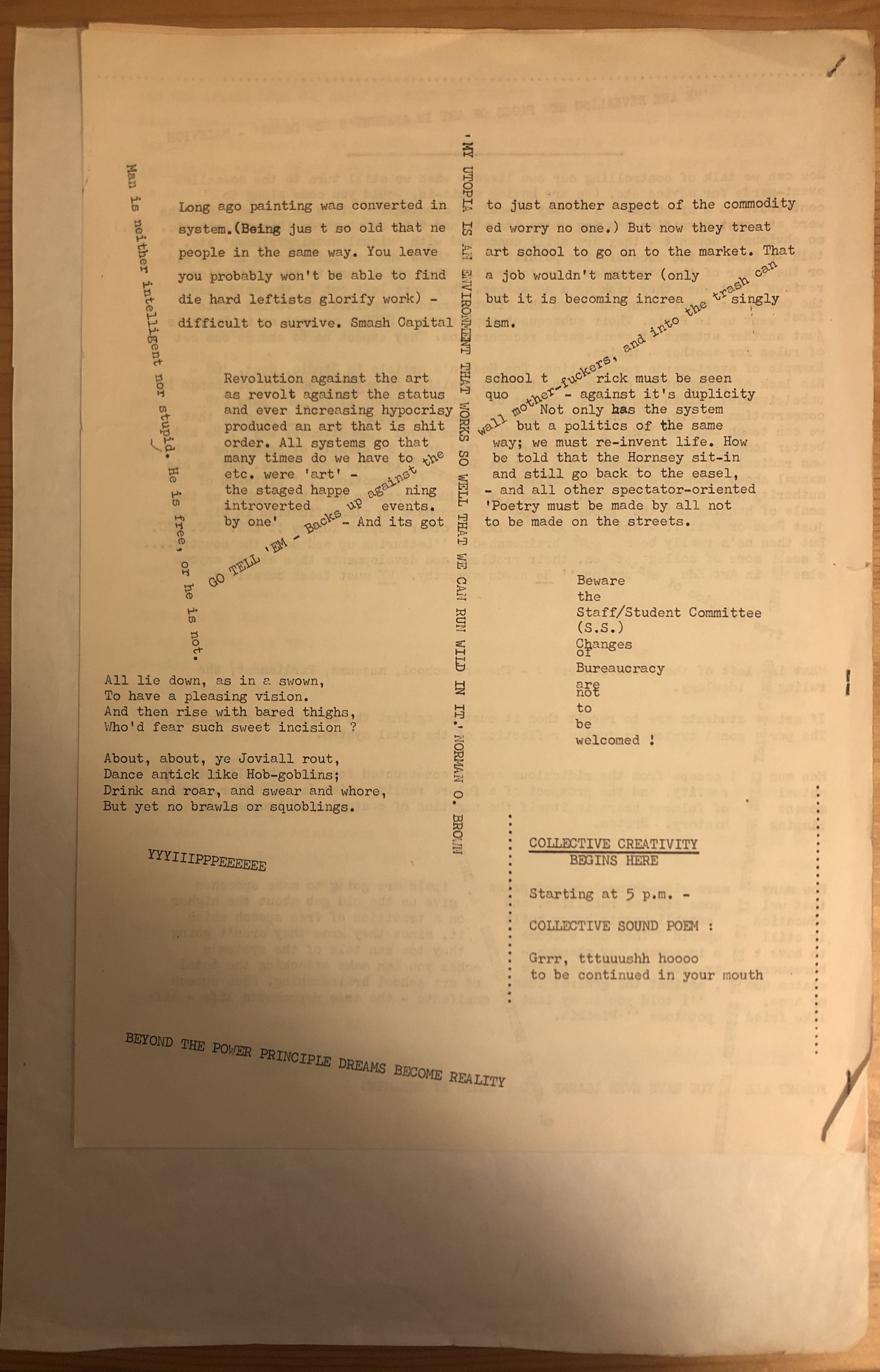
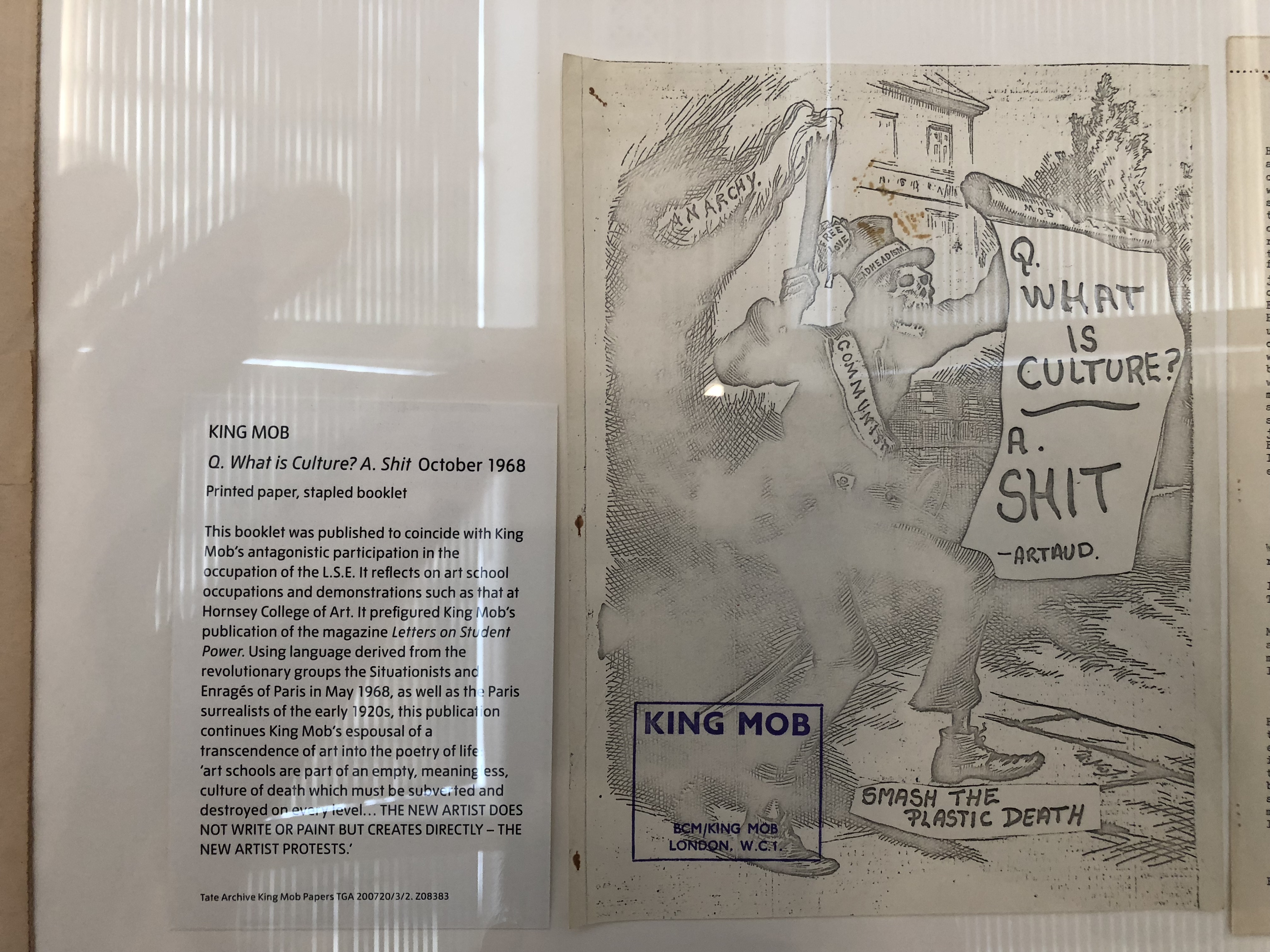
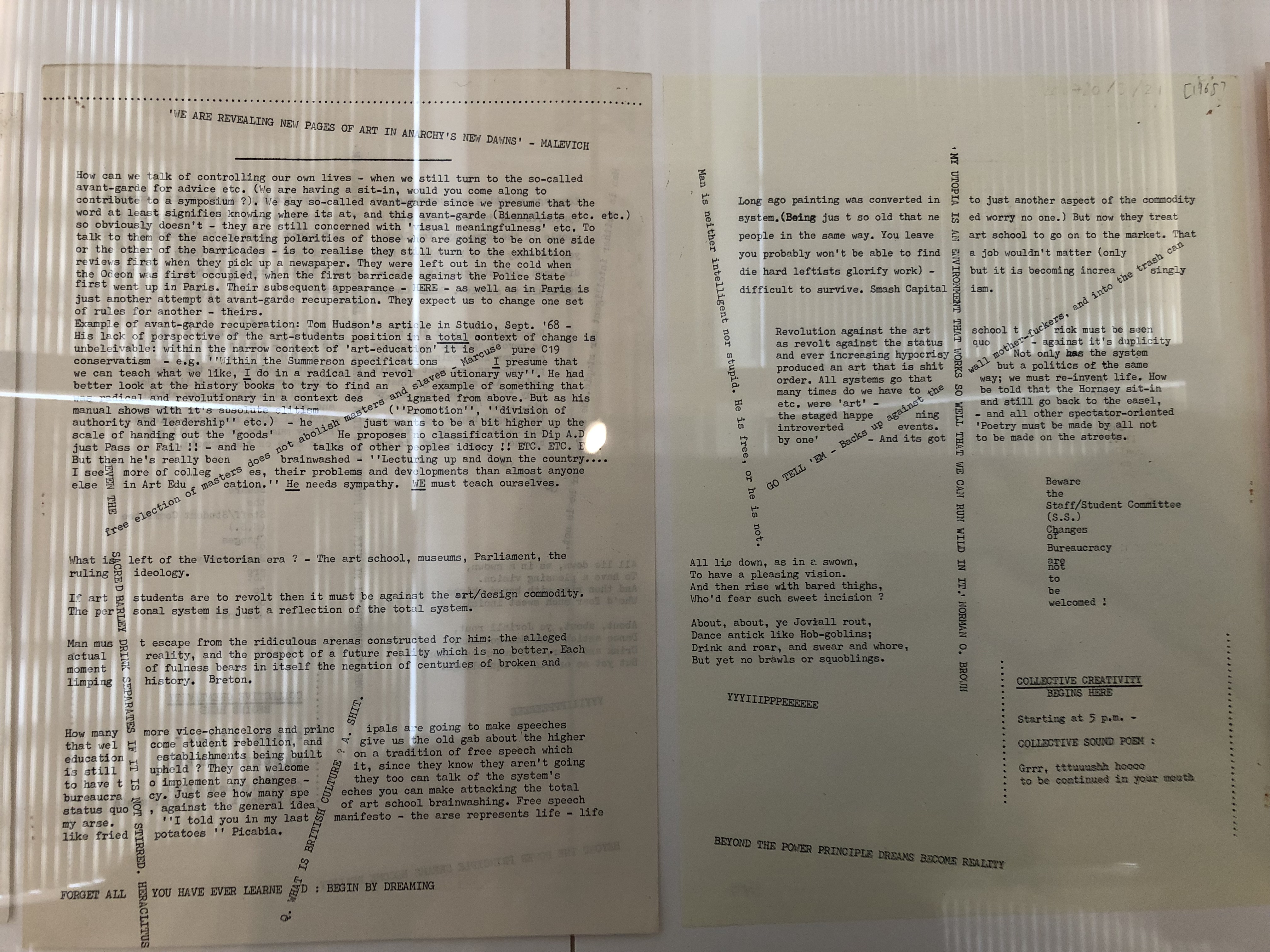
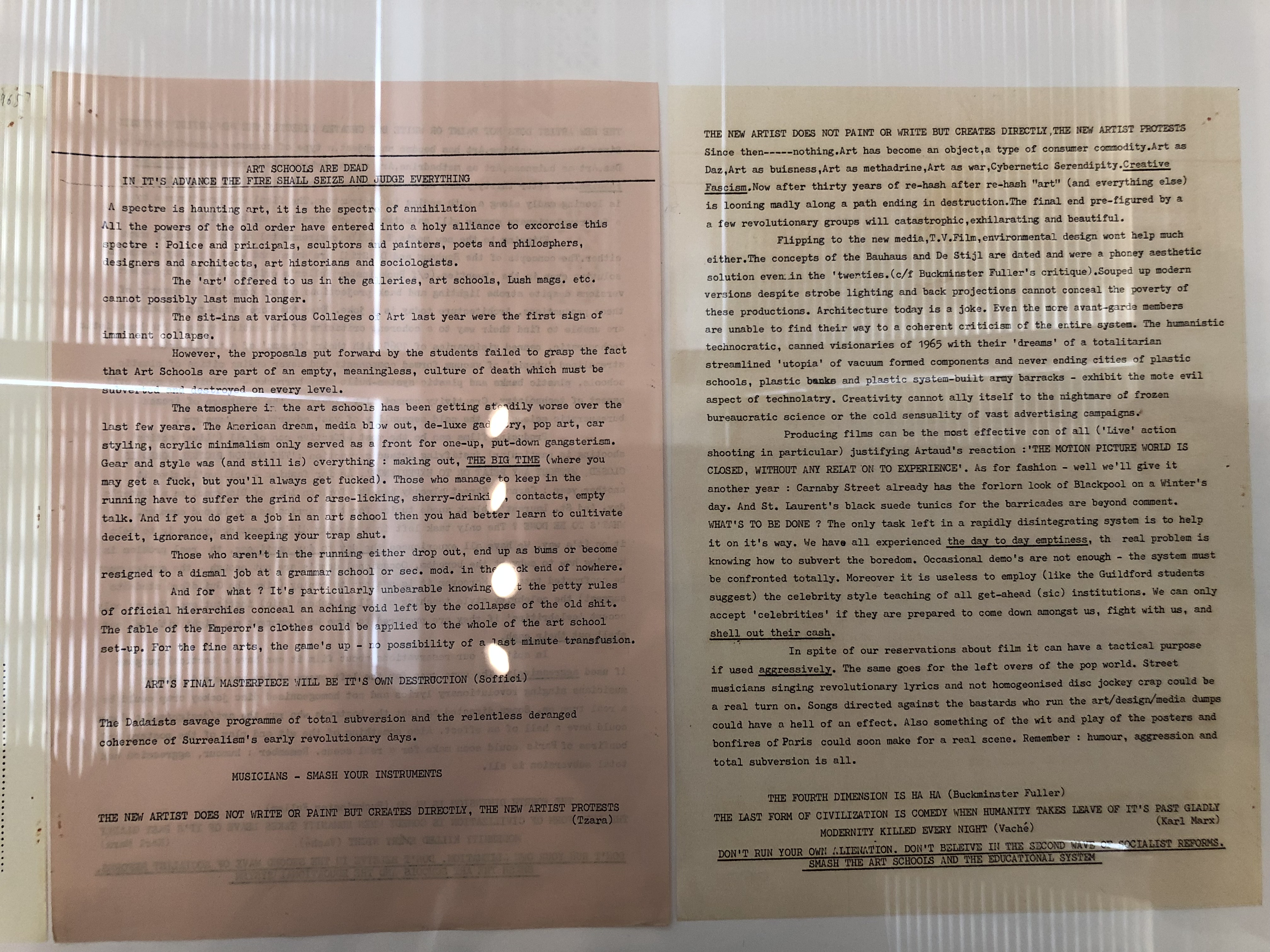
KING MOB. Q. What is Culture? A. Shit. London: King Mob, n.d. [October 1968]. 3 sheets; 21 x 34 cm.; black ink on white and pink stock
“This booklet was published to coincide with King Mob’s antagonistic participation in the occupation at the L.S.E. It reflect on art school occupations and demonstrations such as that at Hornsey College of Art. It prefigured King Mob’s publication of the magazine Letter on Student Power. Using language derived from the revolutionary groups the Situationists and the Enrages of Paris in May 1968, as well as the Paris surrealists of the early 1920s, this publication continues King Mob’s espousal of a transcendence of art into the poetry of life: ‘art schools are part of an empty, meaningless culture of death which must be subverted and destroyed on every level…THE NEW ARTIST DOES NOT WRITE OR PAINT BUT CREATES DIRECTLY – THE NEW ARTIST PROTESTS'” (Tate Modern)
See below for pictures from both my copy and the Tate’s exhibit.
We locate a copy at the Tate, part of the King Mob collection.



























 Situationniste Blog