Asger Jorn’s “Modifications” [1959]

[JORN, Asger]. Modifications: R.A. Augustinci présente vingt peintures modifiées par ASGER JORN. n.p. [Paris]: n.p. [Galerie Rive Gauche], n.d. [May 1959]. n.p. [16 p. + 4 p.]; ill.; 21 x 18.5 cm.; ill. cover reproducing one of Jorn’s detourned paintings.

Catalog of Asger Jorn’s famed “Modifications” show, which was held under the auspices of R.A. Augustinci at the galerie Rive Gauche in Paris between 6 and 28 May 1959. Twenty paintings were exhibited, nine of which are reproduced here (one in color, serving as the catalog’s cover, and eight in B&W).

Stapled inside is a four-page, French-language text printed on thick yellow stock: “Peinture détournée” (detourned painting). In this short essay, Jorn celebrates the death of painting and advocates for detournement in the visual arts. The text is reproduced in full, both in French and in an English translation, here: http://viemoderne2.blogspot.com/2006/08/peinture-dtourne-jorn-mai-1959.html

The catalog has been scanned and reproduced in full by Allia – see http://www.editions-allia.com/files/pdf_72_file.pdf. The document is preceded by a one-page introduction that sheds further light on this exhibition and its importance in the history of the Internationale Situationniste. Indeed, the galerie Rive Gauche show is mentioned in Debord’s correspondence (in a letter dated 7 June 1959, he congratulates Jorn on the ‘serious shock’ the exhibition caused) and discussed in Potlatch #30 (July 1959).

Our copy is unique in that someone (perhaps the gallery owner?) wrote down in black pen the names of the collectors who acquired Jorn’s paintings. Augustinci appeared to have bought a single painting, while Italian modern art collector Paolo Marinotti snagged five. Paride Accetti, a lawyer who also collected Baj, got another three.

Scarce in the trade, with about a dozen copies on OCLC

UntitledUntitled2Untitled3Untitled4

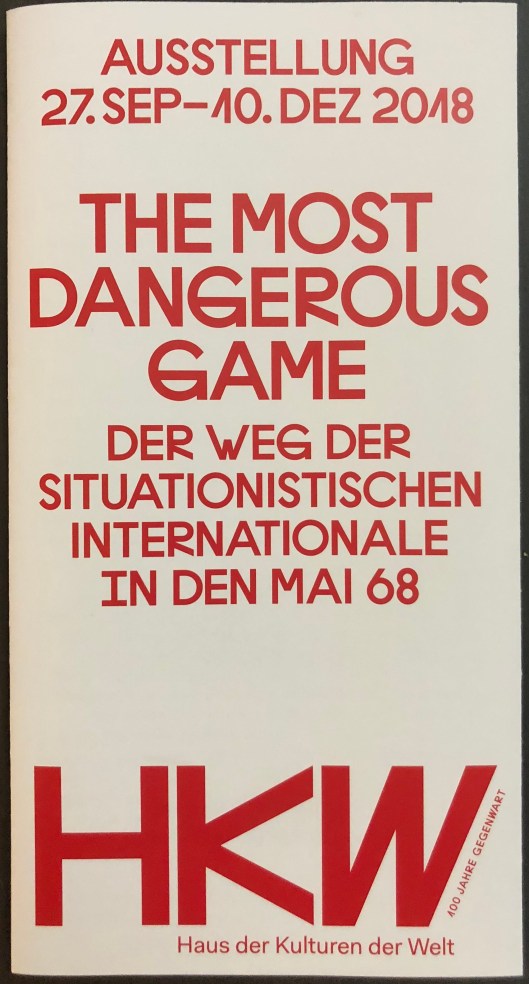
[Interlude] PSA: The Most Dangerous Game – exhibition at Haus der Kulturen der Welt in Berlin (27 Sept – 10 Dec. 2018)

If you are in Berlin, I highly encourage you check out The Most Dangerous Game: Der Weg der Situationistischen Internationale in den Mai 68, to be held at the Haus der Kulturen der Welt between 27 September and 10 December 2018. The exhibition is a project of Wolfgang Scheppe,in collaboration with Roberto Ohrt and Eleonora Sovrani.

Press Release

Between 1957 and 1972, the Situationist International (S.I.) first projected a “revolutionary front in culture” and then shifted its propaganda to the political field. Employing ludic methods, the movement offered a fundamental critique of the spectacle of a consumerist society. In an age in which the principles of the market economy are increasingly permeating all areas of life, The Most Dangerous Game instigates a new envisioning of the years in which the S.I. articulated its critique.

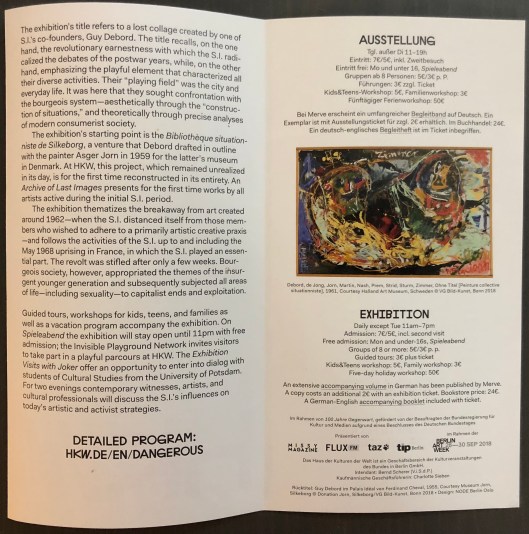
The exhibition’s title refers to a lost collage created by one of S.I.’s co-founders, Guy Debord. The title recalls, on the one hand, the revolutionary earnestness with which the S.I. radicalized the debates of the postwar years, while, on the other hand, emphasizing the playful element that characterized all their diverse activities. Their ‘playing field’ was the city and everyday life. It was here that they sought confrontation with the bourgeois system – aesthetically through the “construction of situations”, and theoretically through precise analyses of modern consumerist society.

The exhibition’s starting-point is the Bibliothèque situationniste de Silkeborg, a venture that Debord drafted in outline with the painter Asger Jorn in 1959 for the latter’s museum in Denmark. At HKW, this project, which remained unrealized in its day, is for the first time constructed in its entirety. An Archive of Last Images presents for the first time works by all artists active during the initial S.I. period.

The exhibition thematizes the break away from art created around 1962 – when the S.I. distanced itself from those members who wished to adhere to a primarily artistic creative praxis – and follows the activities of the S.I. up to and including the May 1968 uprising in France, in which the S.I. played an essential part. The revolt was stifled after only a few weeks. Bourgeois society, however, appropriated the themes of the insurgent younger generation and subsequently subjected all areas of life – including sexuality – to capitalist ends and exploitation.

The Most Dangerous Game at Haus der Kulturen der Welt ties into the discussion of Surrealism in the exhibition Neolithic Childhood. Art in a False Present, c. 1930, the remapping of post-war modernism in Parapolitics. Cultural Freedom and Cold War, and revolutionary Russia’s progressively aspirational melding of art and science in Art Without Death: Russian Cosmism. The exhibition The Most Dangerous Game draws lines that the project bauhaus imaginista takes up in 2019, exploring the influence of and roles played by the Bauhaus in an international context.

With works by Pierre Alechinsky, Karel Appel, Armando, Enrico Baj, CoBrA, Constant, Corneille, Guy Debord, Erwin Eisch, Ansgar Elde, Farfa, Lothar Fischer, Internationale Lettriste, Internationale Situationniste, Isidore Isou, Jacqueline de Jong, Asger Jorn, Laboratorio Sperimentale, Uwe Lausen, Jeppesen Victor Martin, Giors Melanotte, Eva Renée Nele, Erik Nyholm, Panamarenko, Giuseppe Pinot-Gallizio, Hans Platschek, Heimrad Prem, Ralph Rumney, Piero Simondo, Gruppe SPUR, Gretel Stadler, Hardy Strid, Helmut Sturm, Maurice Wyckaert and Hans-Peter Zimmer.

For more information see https://www.hkw.de/en/presse/pressemitteilungen/pressemitteilung_142772.php

IMG_1746IMG_1747IMG_1748IMG_1749IMG_1750

Sigma 2 – Invisible Insurrection of a Million Minds [1964]

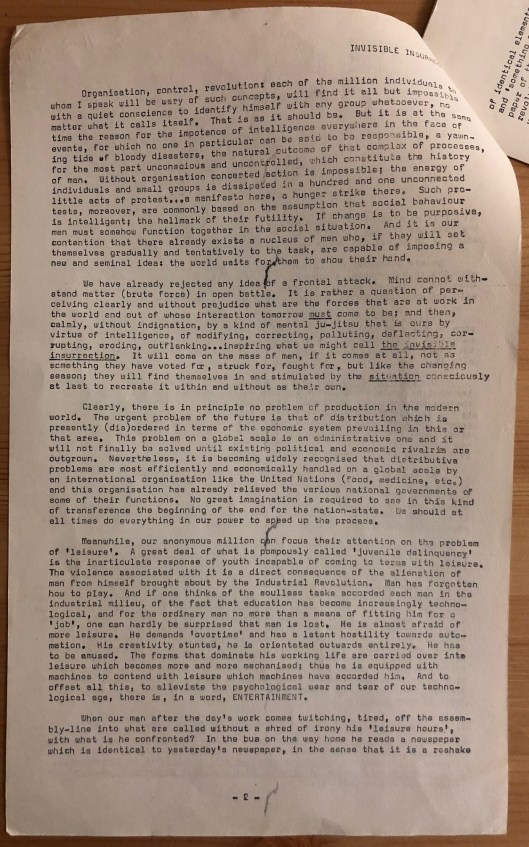
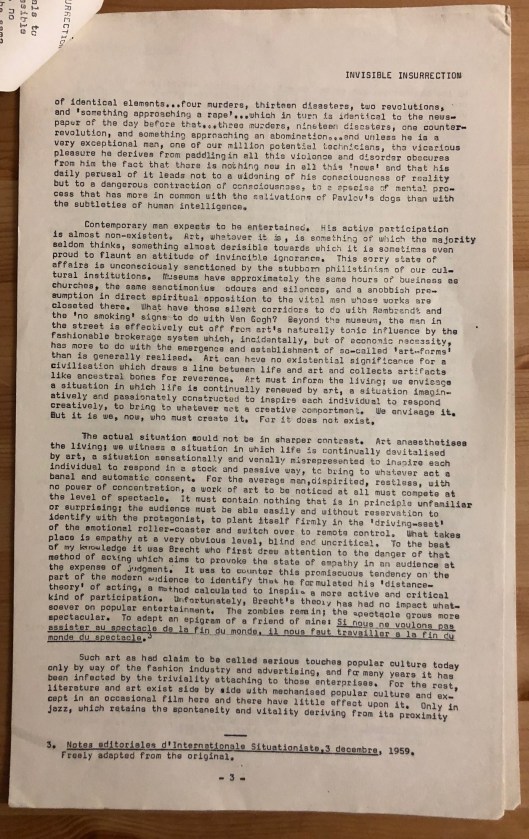
TROCCHI, ALEXANDER. Sigma 2 – Invisible Insurrection of a million mindsLondon: Sigma, 1964. 8 mimeographed p.; 20.5 x 33 cm.; black ink on white stock.

Trocchi meets Guy Debord in Paris in 1955,  and joins the Internationale Situationniste in 1958. In 1960, he publishes Cain’s book, which offers an apology of drugs and particularly heroin. For this, he was arrested in the United States, which led the Situationists to publish the leaflet Hands off Alexander Trocchi! in October 1960. Trocchi then returns to Europe and becomes part of the editing committee of Internationale Situationniste in 1963. The next year, he launches Project Sigma (more below), which leads to a break with Debord and the SI.

With Project Sigma, Trocchi tried to establish an international network of countercultural activism largely focused on socially-based institutions perceived as limiting free expression such as the media, universities, and workplaces. For more about Sigma, see http://realitysandwich.com/128311/alexander_trocchi_project_sigma/ and http://omeka.wustl.edu/omeka/items/show/9588

The most important of the Sigma folios, Insurrection of a million minds calls for a cultural revolution which “must seize the grids of expression and the power-houses of the mind” and proposes the creation of an international ‘spontaneous university’ “as the possible detonator of the invisible insurrection.

“Invisible Insurrection” was originally published in New Saltire Review in 1962, then subsequently as ‘Technique du Coup du Monde’ in Internationale Situationniste no. 8 (Jan. 1963). Full text available at http://www.notbored.org/invisible.html [English]

IMG_1734IMG_1735IMG_1736IMG_1737IMG_1738IMG_1739IMG_1740IMG_1741

Heatwave [1966]

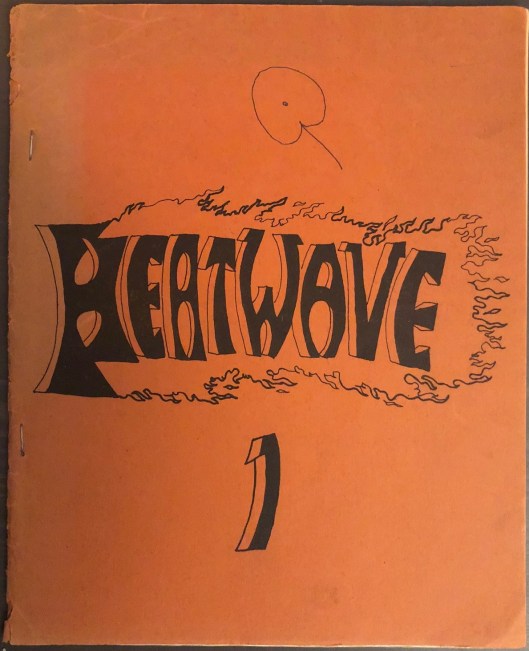
RADCLIFFE, Charles (Ed.). Heatwave 1London: Heatwave, July 1966. 40 p.; ill.; 21 x 28 cm.; orange wrappers with text in black.

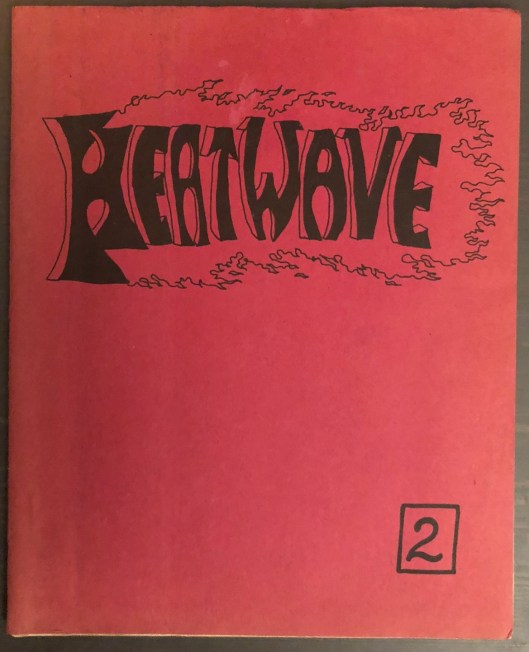
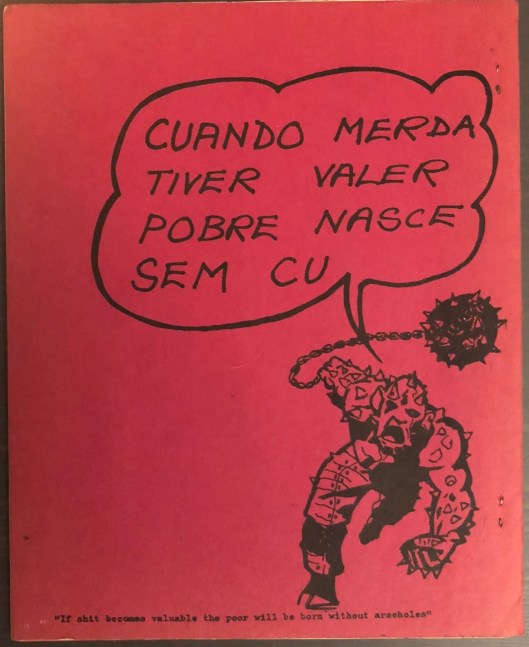
GRAY, Chris and RADCLIFFE, Charles (Eds.). Heatwave 2. London: Heatwave, October 1966. 36 p.; ill.; 21 x 28 cm.; red wrappers with text in black.

Short-lived, yet influential magazine edited by Charles Radcliffe alone (issue #1, July) then in collaboration with Chris Gray (issue #2, October). A third issue appears to have been largely drafted, but never published. To date, only issue #1 has been reprinted (in 1993). Thankfully, full scans of the first two issues can be found on Charles Radcliffe’s website at  http://charlieradcliffe.com/heatwave/

For Radcliffe, “Heatwave 1 & 2 were direct descendants of The Chicago Rebel Worker and came from the revolutionary ferment that surrounded us.” Indeed, Heatwave‘s launch is advertized in issue #6 of The Rebel Worker, which was edited by the Rosmonts in the United States. Heatwave is lauded in the pamphlet De la Misère en Milieu Etudiant (On the Poverty of Student Life) in Fall 1966: “One thinks here of the excellent journal Heatwave, which seems to be evolving toward an increasingly rigorous radicality”.

Charles Radcliffe was a member of the English section of the Situationist International from December 1966 to November 1967. Guy Debord did not view Radcliffe’s contributions to the SI in a favorable light. In a letter to Robert Chasse dated 23 December 1967, he writes that “Radcliffe n’avait rigoureusement rien fait en dix-huit mois, et finalement avait amicalement formule sa démission a Chris…” (English: Radcliffe had done literally nothing in eighteen months, and had eventually handed his resignation to Chris [Gray] (Corrrespondance vol. 0, p. 338).

IMG_1699IMG_1701IMG_1702

Original drawing by Attila Kotanyi [1960]

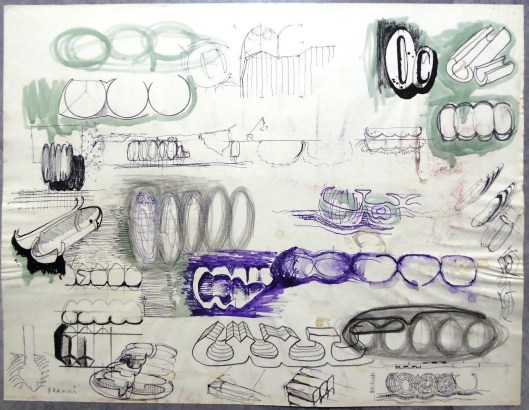
KOTANYI, Attila. [Original, untitled drawing]. 1960. 50 x 65 cm; colored inks on thick white stock. Provenance: Guy De Sauvage (Belgian painter and friend of Kotanyi).

Original drawing by Attila Kotanyi, one of the lesser-known figures of the Situationist International, during his exile in Belgium in the aftermath of the failed Hungarian revolution (1956).

Kotanyi’s joined the SI in the Spring of 1960, In a letter to Pinot-Gallizio dated 16 May 1960, Debord writes: “Parmi les “nouvelles recrues de l’I.S.”, je viens de rencontrer Attila Kotányi. Il est sensationnel : et Asger est très content.” (“Among the ‘new recruits to the SI’, I just met Attila Kotanyi. He is amazing: and Asger is very happy”). Kotanyi was excluded in 1963 for his alleged “Christian mysticism”. (see https://thesinisterquarter.wordpress.com/2012/08/19/on-the-exclusion-of-attila-kotanyi-2/).

In those short years, Kotanyi made numerous contributions to the SI

  • “Gangland et Philosophie” (Issue 4, p.33) (English)
  • “Rapport a la IVe conférence” (Issue 5, p.24)
  • “Programme élémentaire du bureau d’urbanisme unitaire” (issue 6, p. 16) (English)
  • “L’étage suivant” (issue 7, p. 47)
  • (with Guy Debord and Raoul Vaneigem) “Theses sur la Commune” (first released as a tract, then reprinted in issue 12) (English)

Little has been written about Kotanyi and his role in the SI. We find an article here: http://exindex.hu/print.php?l=en&page=3&id=989

s-l1600


Original drawing by Ralph Rumney [1957]

RUMNEY, Ralph. [Original, untitled drawing]. 1957. 24 x 19 cm; red and black ink on brown cardboard stock.

An original drawing made by a young Ralph Rumney in 1957, which was a very productive year for the 22/23-year old artist. That year he:

  1. Participated in the “First Exhibition of Psychogeography”, presented by the International Movement for an Imaginist Bauhaus, the Lettrist International and the London Psychogeographical Committee at Taptoe Gallery in Brussels (February)
  2. Participated in the pivotal Metavisual Tachiste Abstract exhibition mounted by the Redern gallery in London (4 April to 4 May). Rumney displayed 14 of his works including “The Change”, which would ultimately be purchased by the Tate (in 1989). (https://www.tate.org.uk/art/artworks/rumney-the-change-t05556)
  3. Co-founded the Situationist International by merging his London Psychogeographical Association (of which he was the sole member) with the Letterist International and the Movement For An Imaginist Bauhaus (May)
  4. Conducted psychogeographical forays into Venice, which ultimately led to “The Leaning Tower of Venice – as well as Rumney’s exclusion from the Situationist International (May). https://situationnisteblog.wordpress.com/2013/06/22/the-leaning-tower-of-venice/
  5. Met Pegeen Guggenheim (Peggy’s daughter) at a gallery opening at Hanover Gallery, instantly falls in love, and runs away to Paris with her. This same year, she gets pregnant with Sandro (born 1958)

IMG_1683

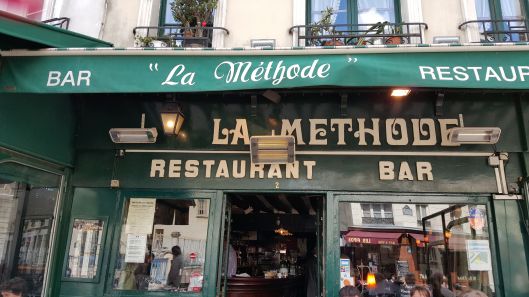
Two Situationists walks into a bar… (La Methode [1958])

We hereby present a set of documents relative to the bar “La Methode”, located at 2 Rue Descartes in Paris. Michèle Bernstein ran the bar from 10 to 29 October 1958. While her tenure was short-lived, it was productive: along with her husband Guy Debord, she produced a series of leaflets promoting the bar.

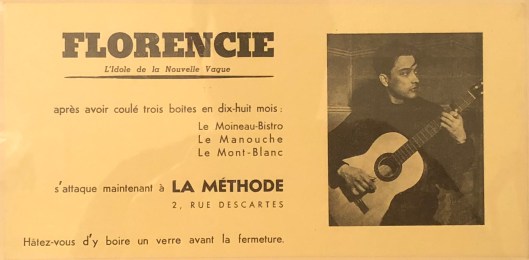
BERNSTEIN, Michèle; DEBORD, Guy. [La Méthode] Florencie, l’Idole de la Nouvelle Vague… n.p. [Paris]: n.p., n.d. [October 1958]. 1 p.; ill.; 13 x 27 cm; black ink on cream stock 

The text reads: “Florencie L’Idole de la Nouvelle Vague après avoir coulé trois boîtes en dix-huit mois Le Moineau-Bistro, Le Manouche, Le Mont-Blanc, s’attaque maintenant à La Méthode 2, rue Descartes. Hâtez-vous d’y boire un verre avant la fermeture” (Trans: Having driven three bars to bankruptcy – Le Moineau-Bistro, le Manouche, Le Mont-Blanc – Florencie, Star of the New Wave, is now taking on La Methode, located 2 rue Descartes. Come have a drunk before it closes permanently.”).

IMG_1682

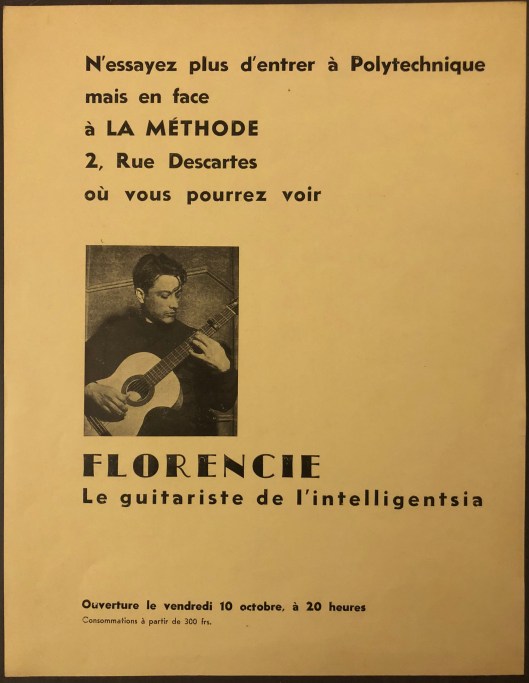
BERNSTEIN, Michèle; DEBORD, Guy. [La Méthode] N’essayez plus d’entrer a Polytechnique mais en face a La Méthode… n.p. [Paris]: n.p., n.d. [October 1958]. 1 p.; ill.; 28 x 22 cm.; black ink on yellow stock

The text reads: “N’essayez plus d’entrer à Polytechnique mais en face à La Méthode 2, rue Descartes où vous pourrez voir Florencie le guitariste de l’intelligenstia. Ouverture le vendredi 10 octobre à 20 heures. Consommations à partir de 300 frs.” (Trans: “Don’t try to get into Polytechnique – instead, come across the street to ‘La Methode’, 2 Rue Descartes, where you can see Florencie, the intelligentsia’s musician. Opening Friday, October 10 at 8pm. Drinks from 300 Francs.”). Polytechnique, France’s top engineering school (which also happens to be run by the military) was formerly located at 2, rue Descartes.

IMG_1681

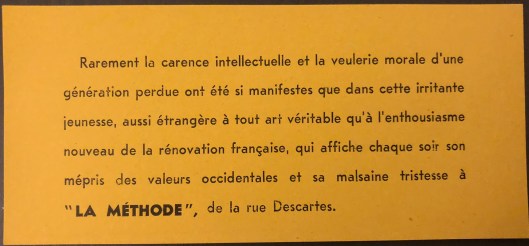
BERNSTEIN, Michèle; DEBORD, Guy. [La Méthode] Rarement la carence intellectuelle et la veulerie morale… n.p. [Paris]: n.p., n.d. [October 1958]. 1 p.; 5.5 x 12.5 m.; black ink on thin yellow stock

The text reads: “Rarement la carence intellectuelle et la veulerie morale d’une génération perdue ont été si manifestes que dans cette irritante jeunesse, aussi étrangère à tout art véritable qu’à l’enthousiasme nouveau de la rénovation française, qui affiche chaque soir son mépris des valeurs occidentales et sa malsaine tristesse à « La Méthode », de la rue Descartes” (Trans: Seldom have the intellectual deficiency and moral cowardice of a lost generation been so manifest as they are in this irritating youth. It is as divorced from any true art as it is in the new enthusiasm brought about by French renovation. Every evening, this youth displays its contempt for Western values and its unhealthy sadness at ‘La Methode’, on Descartes street”)

IMG_1680

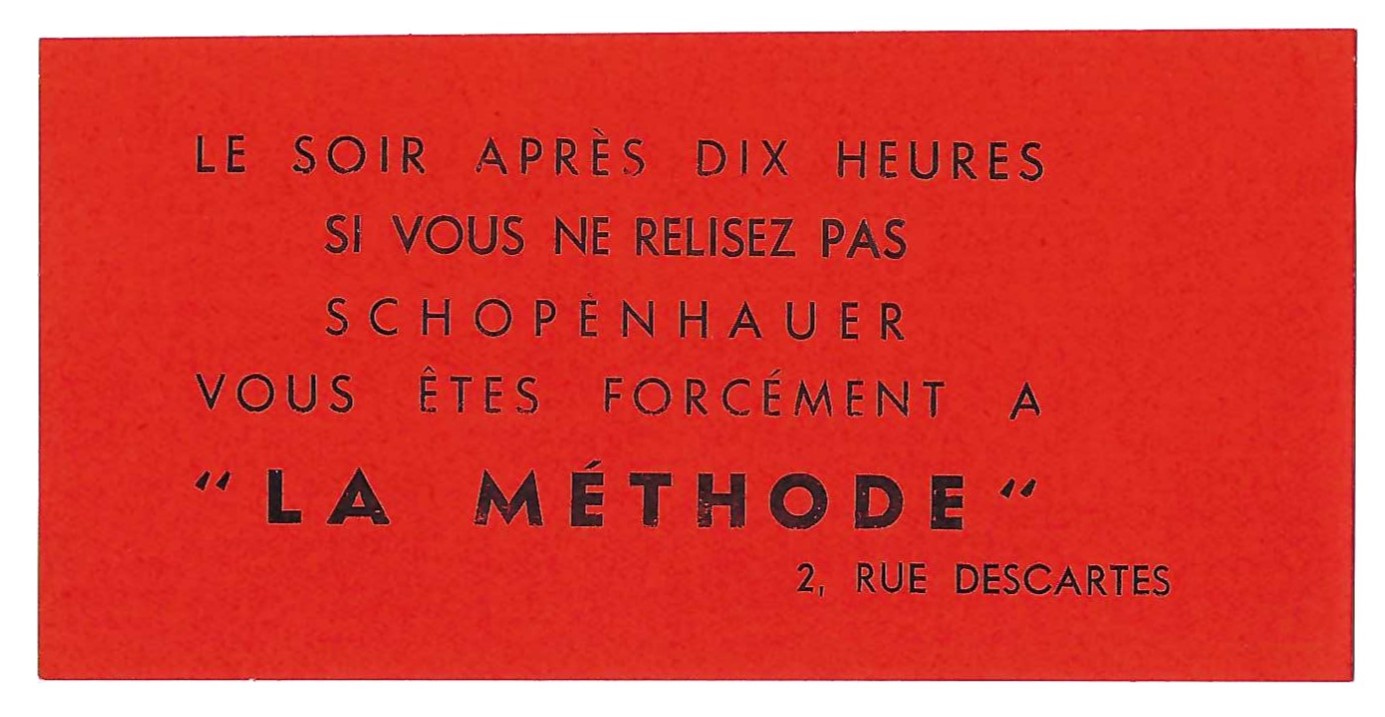
BERNSTEIN, Michèle; DEBORD, Guy. [La Méthode]. Le soir apres deix heures, si vous ne relisez pas Schopenhauer… n.p. [Paris]: n.p., n.d. [October 1958]. 1 p.; 5.5 x 12.5 m.; black ink on thin red stock

And this is what the bar looks like today

cc05c68eae44d2d78264c17ef9c4832f

Le Crépuscule des Bureaucrates [1975]

VANEIGEM, Raoul. Le Crépuscule des bureaucratesn.p.: n.p., n.d. [ca. 1975]. 121 p.; tape-bound with green covers.

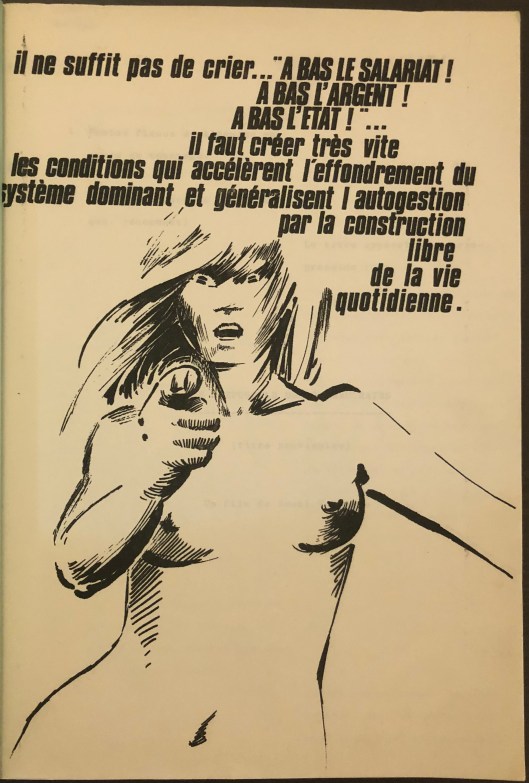
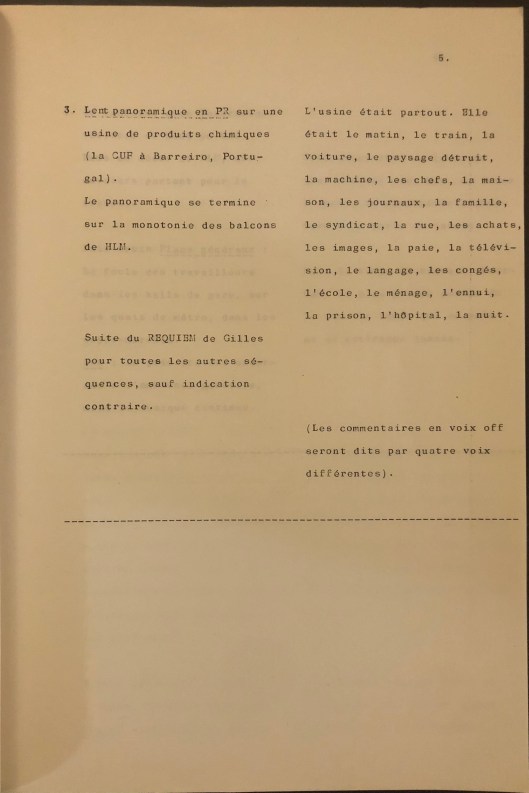
Original movie script written by Raoul Vaneigem, which remains unpublished to this dayFront page: “Il ne suffit pas de crier : À bas le salariat ! À bas l’argent ! À bas l’État !…il faut créer très vite les conditions qui accélèrent l’effondrement du système dominant et généralisent l’autogestion par la construction libre de la vie quotidienne” (“It is not enough to scream: Down with employment! Down with money! Down wit the State!…One must rapidly create the conditions that will precipitate the fall of the dominant system and spread self-management through the construction of daily life”)

The content and tone reminds us of Ratgeb’s (i.e. Vaneigem’s) in De la grève sauvage à l’autogestion généralisée (From wildcat strike to total self management), published by 10/18 in 1974. While somewhat reminscent of Debord’s film adaptation of La société du spectacle (Society of the Spectacle) from 1974 – there are plenty of detourned images of factories, subways, low income housing, and yes, young women – the content is more accessible and rooted in History (vs. theory).

The first third of the film outlines the misery of daily life in modern-day capitalist societies. Work and commodities are everywhere to be found, while passion is absent.  P.28: “Et pourtant, il y avait mieux a faire que de travailler. Il y avait mieux a faire que de vieillir dans l’ennui et le mensonge” (“Yet, there were better things to do than work. There were better things to do than do grow old in boredom and lies”). P. 29. “Sous le fatras des images, les désirs et les passions sont la, en nous, vivants et emprisonnés.” (“Under this hodge-podges of images, desire and passion remain, inside us, alive but locked up”)

The second third of the film is devoted to the history (and failure) of workers’ councils around the world: The Paris Commune in 1871, the Russian Soviets in 1905, the Italian Councils in 1920, The Durutti Column in 1937,  The Csepel councils in 1956, etc..). We’d like to call out guest appearances by Lenine, Staline, Trotsky and Mao-Tse-Tung (as talking dogs), among others.

The last third of the film is in B&W with no sound. As in silent film, dialogue is conveyed by the use of muted gestures and mime in conjunction with title cards. This part showcases the successful takeover of factories by workers – giving viewers a glimpse of the world that could be. P.88: “L’autogestion se généralise quand elle assure a tous, de façon irréversible, le passage de la survie a une vie passionnante” (“Self-management grows when it guarantees to all the shift from survival to a passionate life”). P.101: “Vous n’avez que l’ennui a perdre et un monde a construire” (“All you have to lose is boredom, and a new world that is yet to be built”)

Not on OCLC or in the trade.

IMG_1667IMG_1668IMG_1669img_1670.jpgIMG_1671IMG_1672IMG_1673IMG_1674IMG_1675


PSA – Situationist Times Exhibit at Torpedo (Oslo, Norway)

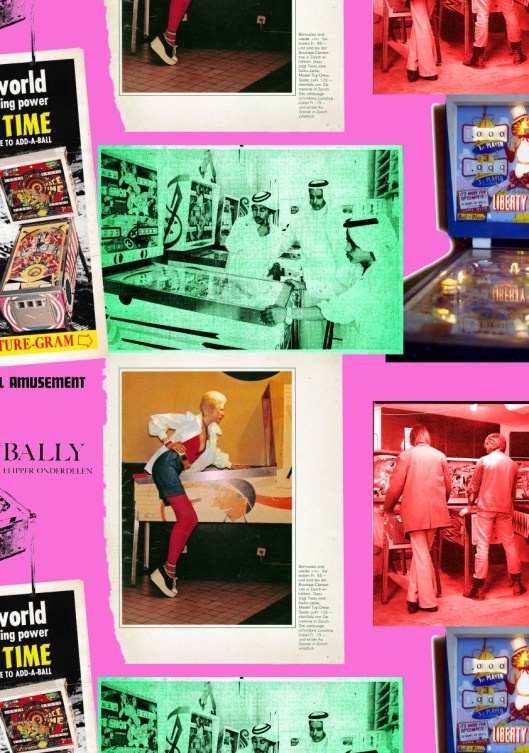
I would like to call readers’ attention to a particularly interesting exhibition on Jacqueline de Jong’s Situationist Times, more particularly on the mythical (never-released) seventh issues of the magazine devoted to pinball. More information below from http://torpedobok.no/torpedo-2


The Situationist Times: Same Player Shoots Again! International Tilt Exhibition (May-September 2018)

Torpedo (PUB)
Rostockgata 28, 0191 Oslo


Wed – Sun 12pm – 5pm

The Situationist Times: Same Player Shoots Again! unfolds the material assembled by de Jong and her co-editor Hans Brinkman in the early 1970s for a seventh, unrealized issue devoted to pinball. The documents – here presented to the public for the first time – testify to an extensive investigation of the culture and topology of pinball – arguably the quintessential situationist game. In collaboration with Koosje Ruigrok, Jacqueline de Jong has produced a special pinball wallpaper for the exhibition. The show also features a free-play electro-mechanical pinball machine by courtesy of Oslo Pinball Club.

Additionally, the exhibition provides a rare opportunity to browse original copies the Situationist Times 1-6. A digital interface developed by the Scandinavian Institute for Computational Vandalism invites you to navigate the riches of the magazine, its labyrinths, knots and controversies, as well as browse through the issues together with de Jong, who tells stories of their making in a series of newly produced video clips.

The Situationist Times: Same Player Shoots Again! inaugurates PUB, a project space run by Torpedo and Eller med a in Rostockgata 28, Oslo.

The exhibition is curated by Ellef Prestsæter and Torpedo and produced in collaboration with Konsthall Malmö and Museum Jorn. It forms part of These are Situationist Times, an exhibition, digitization and publication project developed by Torpedo and Ellef Prestsæter, in close collaboration with Jacqueline de Jong and generously supported by Nordic Culture Point and the Norwegian Arts Council. The Jacqueline de Jong Papers, including the archives of the Situationist Times, is held at Beinecke Rare Books and Manuscripts Library, Yale University.

pinball-wallpaper-nettside_rosa_84234134745_10155343322901746_3878703163070480384_n_96034033982_10155343322676746_6842283554257240064_n_960Screen-dump_1000Big-Valley_1340_c