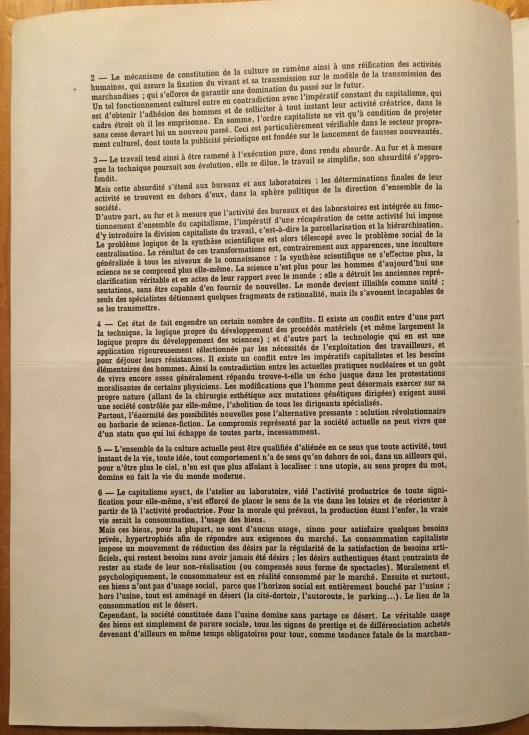
Préliminaires pour une définition de l’unité du programme révolutionnaire [1960]

Debord, Guy and Canjuers, P, [pseud. Daniel Blanchard]. Préliminaires pour une définition de l’unité du programme révolutionnaire. Paris: n.p., 20 July 1960. 4 p.; 26 x 19.5 cm.; black ink on off-white paper.

Important text meant to serve as a shared theoretical between the groups Internationale Situationniste and Socialisme ou Barbarie (S&B). Led by Cornelius Castoriadis, S&B was a radical libertarian group active from 1948 to 1965. Rejecting Leninism, it embraced and advocated for council communism. At its peak, the group had about a hundred members, including both workers and intellectuals. Popular figures who militated with S&B include French linguist Gerard Genette, (future) negationist Pierre Guillaume, Vietnamese Trotskyist Ngo Van, Philosopher Jean-Francois Lyotard, Marxist activist Henri Simon and, of course, both Daniel Blanchard and Guy Debord.

Debord joined Socialisme ou Barbarie in 1960 and left the following year. This brief membership is important because it constitutes an early manifestation of Debord’s desire to make the SI more of a political movement (by 1962, the bulk of the artists had been excluded from the organization).

A detailed account of the relationship between Debord and S&B, as well as how S&B might have influced Debord (and vice-versa) can be located here: https://collectiflieuxcommuns.fr/120-socialisme-ou-barbarie-et-l?lang=fr


The text was reprinted a number of times: in Notes critiques no.3 (1962), Mirella Bandini’s L’Estetico il politico. Da Cobra all’Internazionale Situazionista 1948-1957 (1977, 1999), Daniel Blanchard’s Debord, dans le bruit de la cataracte du temps, suivi de “Préliminaires pour une définition de l’unité du programme révolutionnaire” de P. Canjuers & G.-E. Debord [1960] (2000, 2005). In this latter text, Daniel Blanchard discusses the relationship between Debord and S&B in some detail.

The original text is available online at http://www.left-dis.nl/f/debart.htm. An English translation by Ken Knabb is available at the Bureau of Public Secrets (http://www.bopsecrets.org/SI/prelim.htm)

Gonzalvez 112. Raspaud & Voyer 11. BnF 134 & 219.

We locate two OCLC copies, at Yale and the Bibl. Nationale de France (BNF) in Paris.

2016-02-14 18.57.222016-02-14 18.57.452016-02-14 18.58.042016-02-14 18.58.18

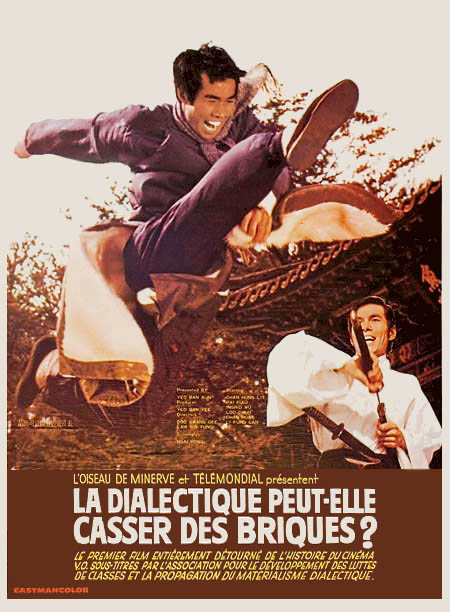
Crush Karate AKA La Dialectique peut-elle casser des briques [ALTERNATE POSTER] [1973]

Vienet, Rene. Crush Karate [aka La Dialectique Peut-elle Casser des Briques?] Paris: n.p., 1973. 160 x 120 cm; ill. poster with screenshot from the film.

Film poster for Vienet’s famous detourned film. “Le premier film entièrement détourné de l’histoire du cinéma, v.o., sous-titres par l’Association pour le développement des luttes de classes et la propagation du matérialisme dialectique” (“The first completely detourned film in the history of cinema, original soundtrack, subtitles by the Association for the promotion of class warfare and dialectical materialism”).

This is an alternate version of the poster that was made using the original film title. We were not aware of its existence until it surfaced in the trade recently.

We locate no OCLC copy

Untitled

Compare to the original, and better-known poster:

la-dialectique-peut-elle-casser-des-briques-1973

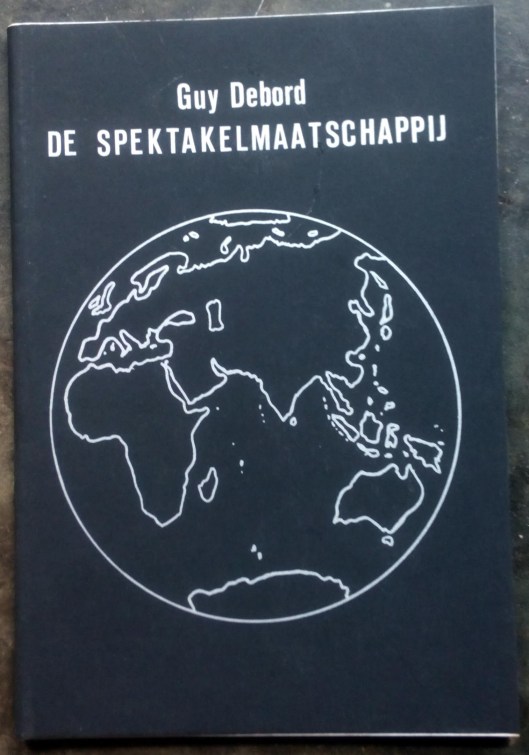
De Spektakelmaatschappij / La Societe du Spectacle [1976]

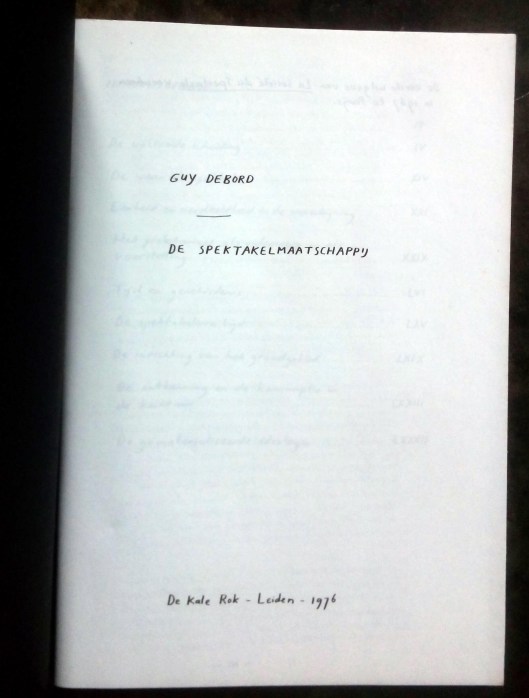
Debord, Guy. De Spektakelmaatschappij. Leiden (Netherlands): De Kale Rok, n.d. [1976]. 84 p.; 20.5 x 30 cm.; ill. Black silk screened cover with metallic grey text and world map

Debord’s seminal text. Pirate Dutch edition released the same year as the official Dutch translation (trans. Jaap Kloosterman; published by  Baarn : Het Wereldvenster). While no definitive information exists, it is believed this edition was part of a run of 100 or 200. The handwritten feel and silk screen give it a luxurious feel seldom found in such pirate reprints.

We locate a single OCLC copy at the International Institute of Social History (IISG) in Amsterdam

unnamed

unnamed (3)

unnamed (2)

unnamed (1)

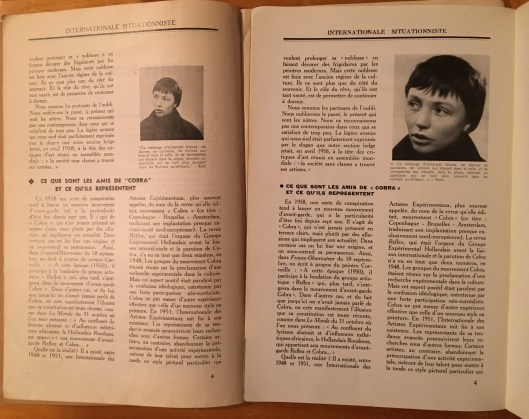
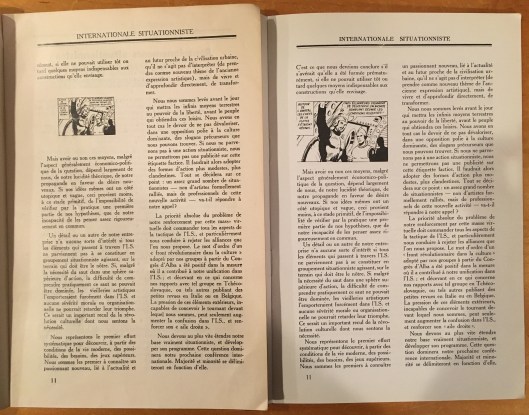
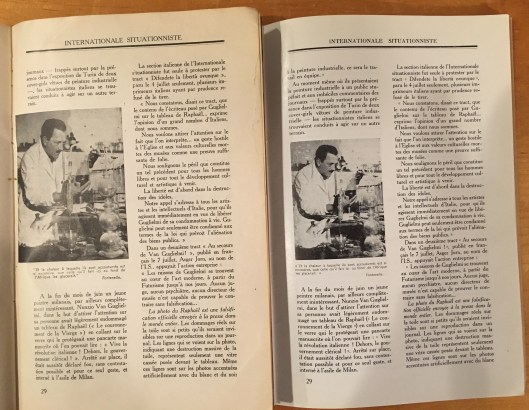
Internationale Situationniste 2 – First and Second Printing [1958, 1962]

[Internationale Situationniste] Internationale Situationniste: Bulletin central des sections de l’Internationale Situationniste 2. Paris: Internationale Situationniste, December 1958. 34 p.; ill.; 24.5 x 16 cm; silver metallic wrappers with text printed in black

[Internationale Situationniste] Internationale Situationniste: Bulletin central des sections de l’Internationale Situationniste 2. Paris: Internationale Situationniste, 2nd trimester 1962. 34 p.; ill.; 24.5 x 16 cm; silver metallic wrappers with text printed in black

The second issue of Internationale Situationniste is the only one to have been reprinted. Originally issued in December 1958, the aluminum foil used for the wrappers was of such poor quality that the majority of copies did not survive the printing process. A second printing was thus realized in the Spring of 1962. It is unknown how many copies of the first printing survive, but they are very rarely seen in the trade.

As stated in the colophon, the content of the second printing is indeed identical to that of the first printing (Tous les textes sont rigoureusement conformes a leur edition originale). However, there are numerous differences in layout, particularly as relates to the size of illustrations, the choice of upper/lower case fonts in titles, and more.

Astute readers can judge for themselves, as we have put the two printings side-by-side to allow a detailed comparison where the differences were most striking. The left-hand side of the picture is the first printing, with the right-sand side is the later reprint.

Full PDF scan of the facsimile reprint by “La Bibliotheque Fantastique” is available at http://www.larevuedesressources.org/IMG/pdf/internationale_situationniste_2.pdf

2016-02-02 18.25.012016-02-02 18.28.012016-02-02 18.28.372016-02-02 18.30.072016-02-02 18.30.512016-02-02 18.31.342016-02-02 18.32.012016-02-02 18.32.082016-02-02 18.32.18

Click to access internationale_situationniste_2.pdf

Mani di Ferro [1973]

Vienet, Rene. [La Dialectique peut-elle casser des briques?] Mani di Ferro [FILM POSTER]. n.p. [Italy]: n.p., 1973. 140 x 100 cm. ; ill. poster on white stock with text in red.

Original large-scale poster for the Italian release of Crush Karate (original title: Tang Shou Tai Quan Dao), the 1973 Hong Kong Kung-Fu film detourned by Vienet to create “La Dialectique peut-elle casser des briques?” The aesthetics are very similar to those Vienet used for his own “original” release.

We locate no OCLC copy.

$_57$_57

[Ralph Rumney] ICA Place – Guide to Place [1958-59]

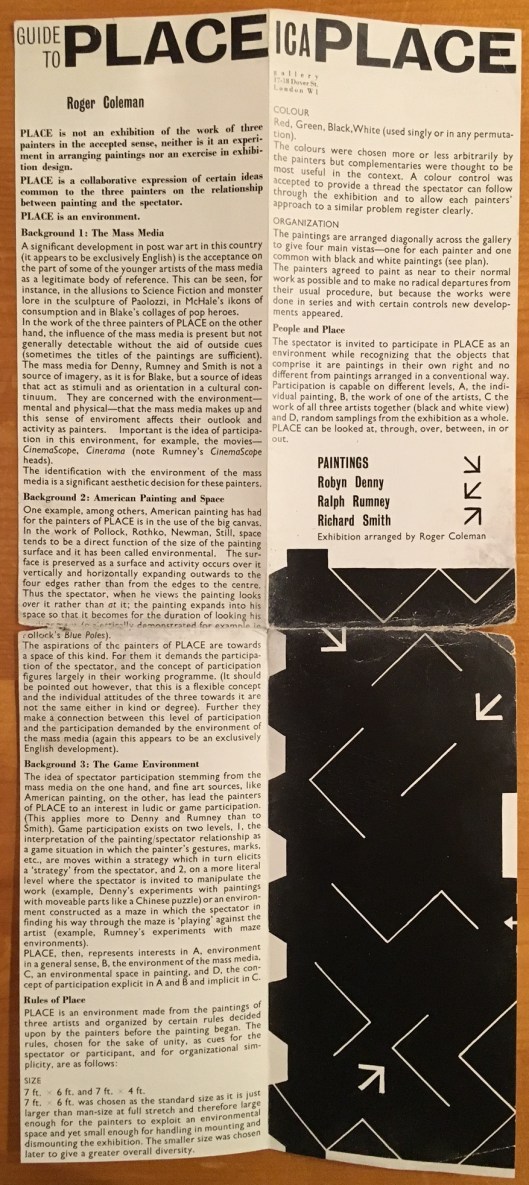
[Rumney, Ralph]. ICA Place: Guide to Place. London: ICA, n.d. [1958-59]. 1 p. leaflet; 20 x 45 cm. (folded into 10 x 22 cm); black ink on white stock.

This unassuming leaflet serves as the “catalog” of a collective exhibition held at the Tate Gallery in 1959. Curated by Roger Coleman (who also wrote the brief essay that appears here), the exhibition featured the paintings of Robyn Denny, Ralph Rumney and Richard Smith. The exhibition occurred only a few months after Rumney’s exclusion from the SI. 

“Back in what was becoming ‘Swinging London’ in 1959, Smith and Denny collaborated with Ralph Rumney on Place, an exhibition at the ICA exploring shared ‘ideas […] on the relationship between painting and the spectator’, according to Roger Coleman’s catalogue. One of the exhibition’s most immediate ways of achieving this was to stand the paintings directly on the ground, anticipating what Anthony Caro would go on to do with sculpture, and to make them uniformly large: the ‘Rules of PLACE’ stipulated” (British Pavilion in Venice, http://venicebiennale.britishcouncil.org/people/reference/robyn-denny)

Reproduced in Ralph Rumney: la Vie d’artiste (Paris: Allia, 2010), p.17.

We locate a single OCLC copy at the Tate.

IMG_4846


“Montages wrapped in flong: a material–archaeological investigation of Asger Jorn and Guy Debord’s Fin de Copenhague” (2015)

Kromann, Thomas Hvid. Montages wrapped in flong: a material–archaeological investigation of Asger Jorn and Guy Debord’s Fin de Copenhague. 2015. Longer Danish version originally published as “Montager svøbt i matricepap. En materialearkæologisk undersøgelse af Asger Jorn og Guy Debords Fin de Copenhague” in Fund & Forskning, no. 54, 2015, pp. 587–625. Copenhagen: Royal Library of Copenhagen, 2015.

Today, I’d like to share a scholarly article that could revolutionize the way we approach Debord and Jorn’s legendary Fin de Copenhague. Material evidence from a survey of over 30 copies in both Europe and the United States suggests that, contrary to what had been widely believed, the book could not have been produced in 24 hours. Instead, it appears to have been a much more deliberate endeavor that likely spanned a few months,

Below is the executive summary, which provides some more detail.

UntitledUntitled

The article presents and analyses Fin de Copenhague, which was published in 1957 by the Danish painter Asger Jorn and the French theorist and activist Guy Debord. According to legend, this famous avant-garde masterpiece was created in a 24-hour fit of vandalistic creativity and bound in a waste product from the production of newspapers, “flong,” making every copy in this edition of 200 unique. Until recently, Fin de Copenhague has been analyzed within the theoretical framework of the Situationist International (1957– 1972), focusing rather on the concept than the materiality of the book. In alignment with a heightened theoretical awareness of the importance of Jorn’s printed matter, the article closely examines Fin de Copenhague, drawing on a combination of art historical and book historical disciplines. The first part of the article is focused on the production, the distribution and the reception of the work. Hereby, the article presents the first thorough analysis of the intertextuality of the work as well as the international network the book circulated within. In the second part of the article, one finds an in-depth analysis of the flong. Until now, no research has focused on the variations of Fin de Copenhague. The author has collected photographic documentation of numerous covers from European and American libraries, copies owned by collectors, and copies sold at auction. In this way, the multiple covers can be studied, including the various aesthetic effects of each individual book cover. Furthermore, a material-archeology of the flong makes it possible to date the single pieces of flong, proving that Fin de Copenhague couldn’t possibly be created within these 24-hours. It is necessary to differentiate between finalizing the idea for the book, the printed work and the published work. In addition to this, the notion of the “social authorship” is underlined, stressing the importance of the printers Verner Permild and Bjørn Rosengreen.

The original full-length danish version of the article is at academia.edu

The shorter English version of the article is here: Kromann_Montages_English summary (1).

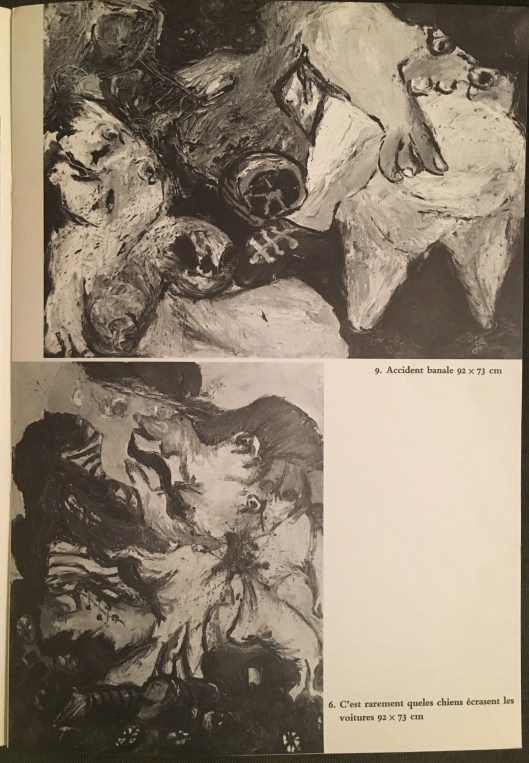
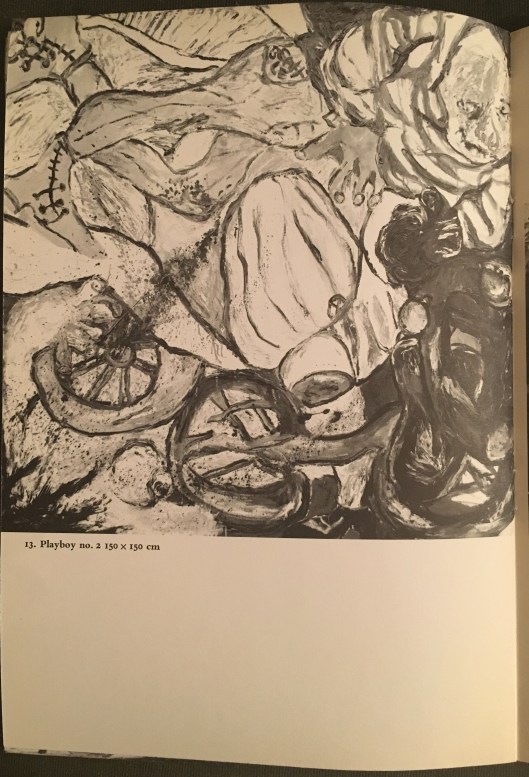
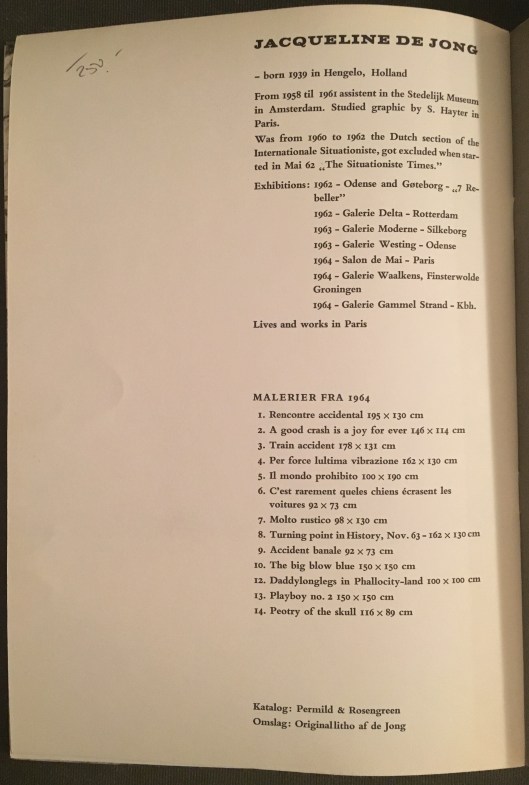
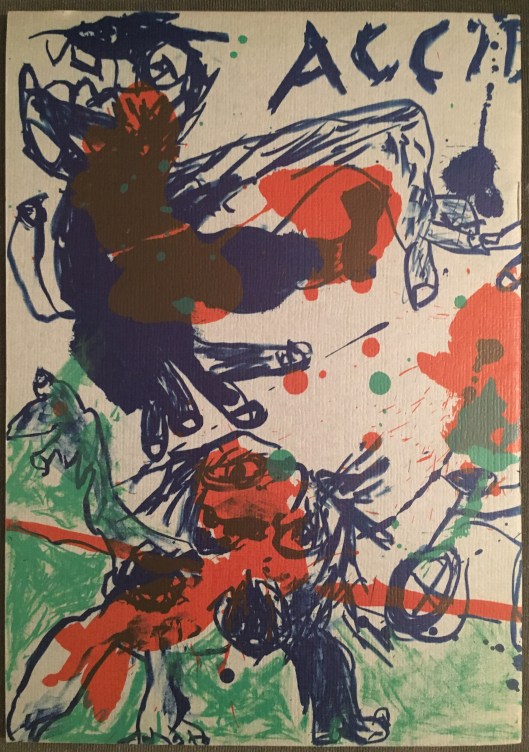
Jacqueline de Jong: Accidental Paintings [CATALOG]

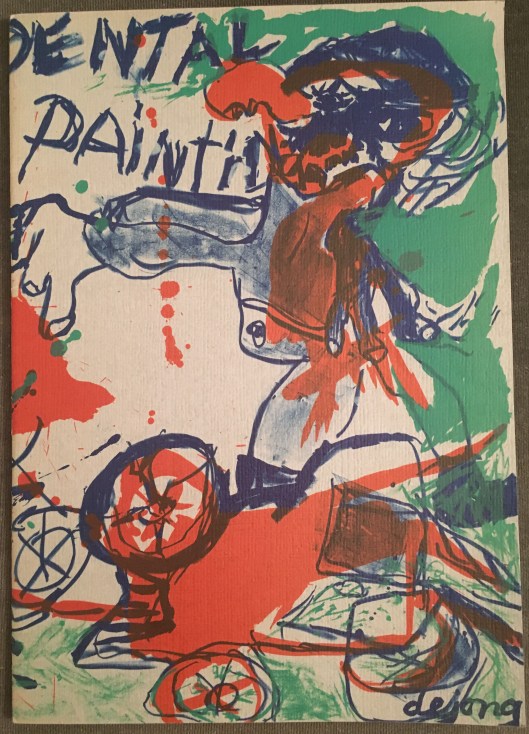
Jong, Jacqueline de. Accidental PaintingsOdense: Galerie Westing, 1964. n.p. [12 p.]; ill.; 25 x 31 cm.; ill. cover with original lithograph by the artist

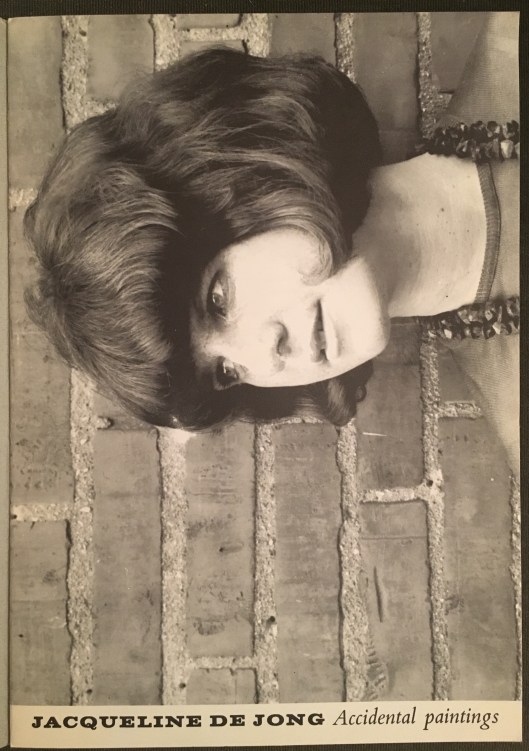
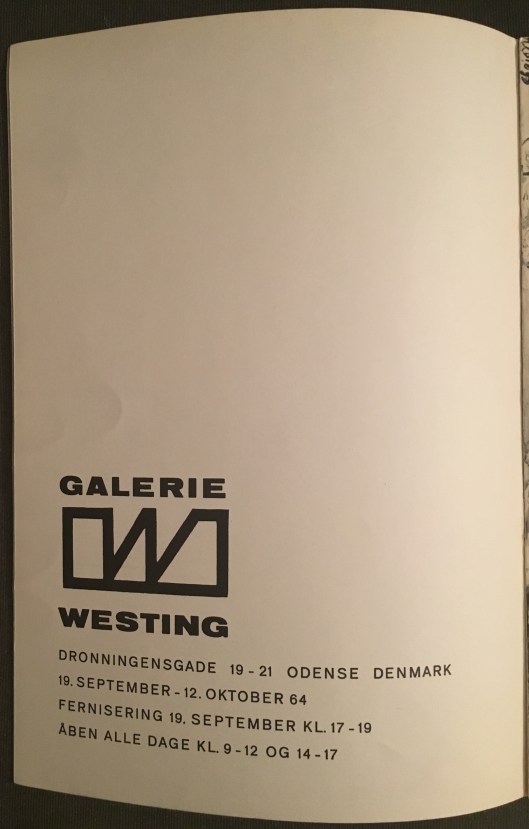
Catalog from the exhibition “Accidental Paintings” at Galerie Westing, Odense, Denmark, from 19 September to 12 October, 1964. This was Jacqueline de Jong’s third solo exhibiton (her eighth overall) amidst the productive “Situationist Times” era (1962-1967). Includes: frontispiece portrait of the artist,  checklist of 14 paintings and a short biographical sketch (“Was from 1960 to 1962 the Dutch section of the Internationale Situationiste [sic], got excluded when started in Mai 62 ‘The Situationiste [sic] Times.'”)

Earlier we posted a signed, original lithograph that was used to create the catalog’s cover. It thus appear that some copies of the lithograph were preserved “in sheets”, while others were cut to a smaller size and bound as covers to the catalog. For more detail on this original lithograph in sheets, see https://situationnisteblog.wordpress.com/2016/01/03/jacqueline-de-jong-accidental-paintings-1964-lithograph/

We locate five copies through OCLC

IMG_4822IMG_4823IMG_4824IMG_4825IMG_4826IMG_4827IMG_4828IMG_4829IMG_4830

Chinois, encore un effort pour etre revolutionnaires (Peking Duck Soup) [FILM POSTER]

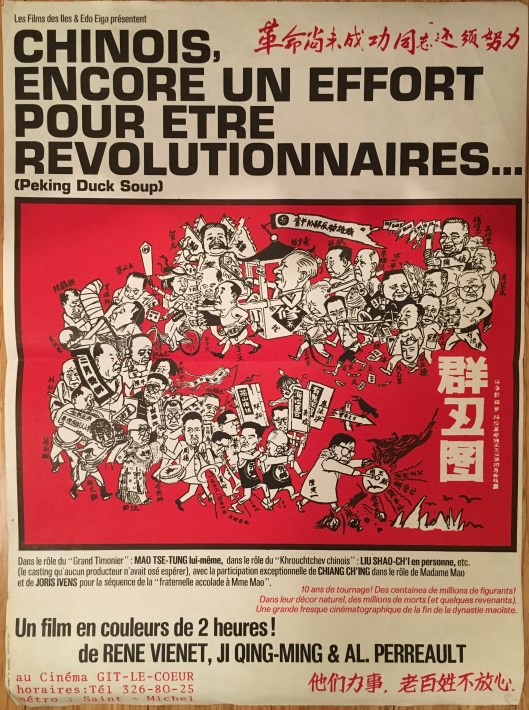
Vienet, Rene. Chinois, Encore un Effort pour Etre Revolutionnaires (Peking Duck Soup) [FILM POSTER]. n.p. [Paris]: n.p. [Film des Iles], n.d. [1977]. 56 x 41 cm. ; ill. poster with text in black and red.

Original poster for Rene Vienet’s  third film, Chinois Encore Un Effort pour Etre Revolutionnaires (120 min; color; 35mm), released in 1977. The film title is a tongue-and-cheek reference to the pamphlet “Français, encore un effort si vous voulez être républicains”, which appears in the Marquis de Sade’s novel Philosophie dans le boudoir.

“Using official photographs, newsreels and other archival material, Peking Duck Soup presents an irreverent alternative view of the rise and fall of the Maoist dynasty (‘a social-Fascist dictatorship of the Feudal type’) based on Jean Pasqualini’s dictum in Prisoner of Mao that ‘in China it is the past that is unpredictable’. It was made… specifically to counter the sycophantic endorsements on film of the Cultural Revolution by Joris Ivens, Felix Green, Shirley Maclaine and others” (National Film and Sound Archive, Canberra, Australia).

It is worth noting that an alternate version of the poster appears to exist. While our copy features the name and address of the cinema where the film was screened (Cinema Git-le-Coeur in Saint-Michel) on the bottom left hand corner, other copies appear to be missing this information. See http://www.causeur.fr/wp-content/uploads/2015/05/chinois-encore-effort-revolutionnaires-223×300.jpg

Chinois encore un effort…was shown as part the Rene Vienet retrospective at the Cinematheque Francaise in Paris from March 20 to May 22, 2015. To my knowledge, it had not been publicly screened since its release in the 1970s. The full-length feature is now available to all courtesy Ubuweb (http://www.ubu.com/film/vienet_chinois.html)

We locate a single copy on OCLC (Bibliotheque Nationale de France)

IMG_4821

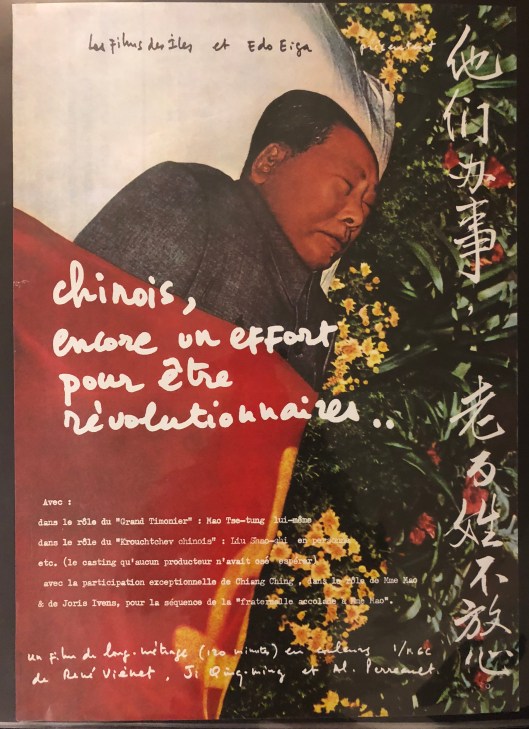
Edit: We located an alternate version of the poster, showing Mao on his death bed. It is reproduced below.

Vienet, Rene. Chinois, Encore un Effort pour Etre Revolutionnaires (Peking Duck Soup) [FILM POSTER]. n.p. [Paris]: n.p. [Film des Iles], n.d. [1977]. 59.5 x 40 cm. ; ill. poster with text in white

IMG_1603

Love is happening the new Little Mermaid

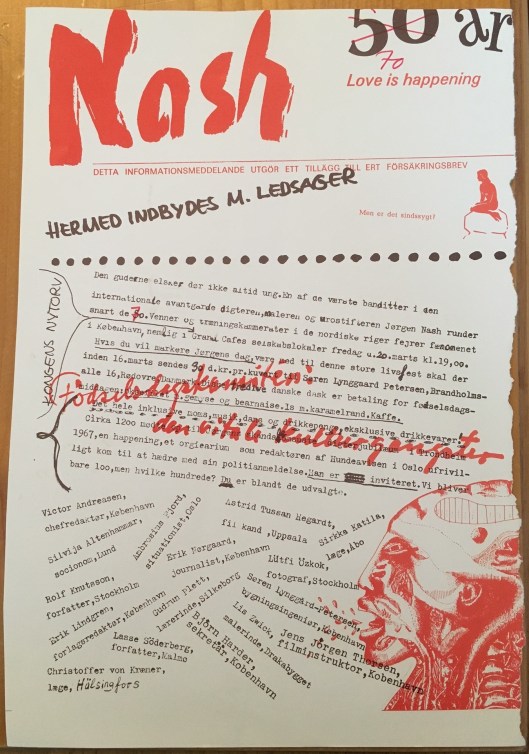
[BAUHAUS SITUATIONNISTE]. Nash – Love i happening – detta informationsmeddelande utgör ett tillägg till ert försäkringsbrev [ORIGINAL LEAFLET]n.p. [Örkelljunga, Sweden]: n.p. [Bauhaus Situationniste], n.d. [1970? 1990?]. Two-sided leaflet (with detourned comic); 21 x 30 cm. Small paper loss at edges not affecting text.

Exceptional leaflet by the Second Situationist commemorating the Little Mermaid scandal as well as Jorgen Nash’s 50th (or 70th?) birthday. On April 24, 1964, Jorgen Nash and other members of the Second Situationist decapitated the world-famous Little Mermaid statue in an “anti-happening” protest . The head was never recovered, and a new one was produced and placed on the statue.

On one side, the following text (google translation is mine) “One of the worst bandit in the international avant-garde poet, painter and troublemaker Jorgen Nash will soon turn 50 (crossed) 70. Friends comrades in the Nordic realms will celebrate the occasion in Copenhagen at namely the Grand Cafe Seiskabslokaler on Friday, 20 March at 19:00. To mark Jorgens’ birthday and be involved in this great life celebration, you must send 30 DKK per person to Lyngaard Soren Petersen, Fire Holm, Rodovre, Denmark by 16 March. These 30 Danish krones pay for the birth day dinner: beef fillet with  Bearnaise. Caramel ice cream. Coffee. This is inclusive of music, dance and tips, but excludes drinks.Approximately 1,200 people came to Jorgen’s poetry jubilee in Trondheim in 1967…You are among the chosen few.

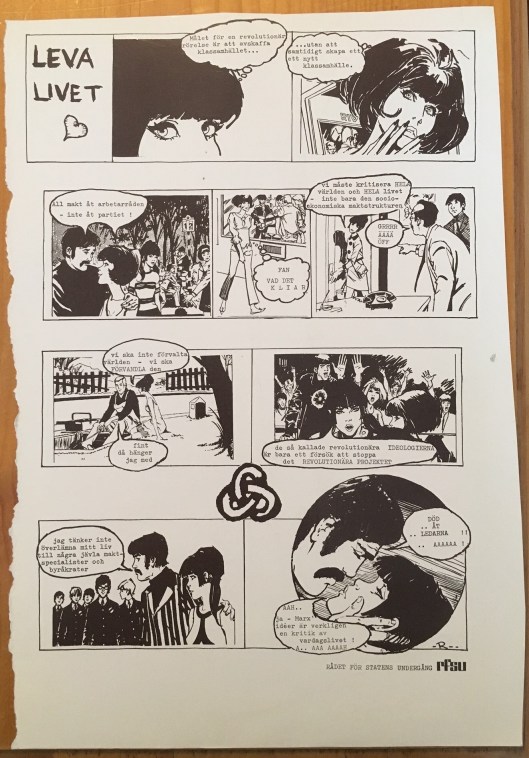
On the other side, a detourned copy “Leva Livet”: LINE 1: “The goal of a revolutionary movement is to abolish class society…without creating a new class.” LINE 2: “All the power to the work councils, not the party!” “Damn. It itches.” “We must criticize the world and life – not just the socioeconomic market structure” “GRRRR AAA OUT!”. LINE 3: “We should not manage the world, but transform it!” “The so-called revolutionary ideologies are merely an attempt to stop the revolutionary project!”. LINE 4: “I will not surrender my life to some damn technocrats and bureaucrats.” “Death to the leaders!!!! Ahhhh!!!” “Yes. Marx’s theories are really a critique of everyday life! Ah!”


We locate a single OCLC copy at the Beinecke (Postwar Culture archive), Yale University. http://www.beineckepostwar.com/#!situationist-international/c1ae6

IMG_4812IMG_4813