Le Secret c’est de tout dire! [1989]

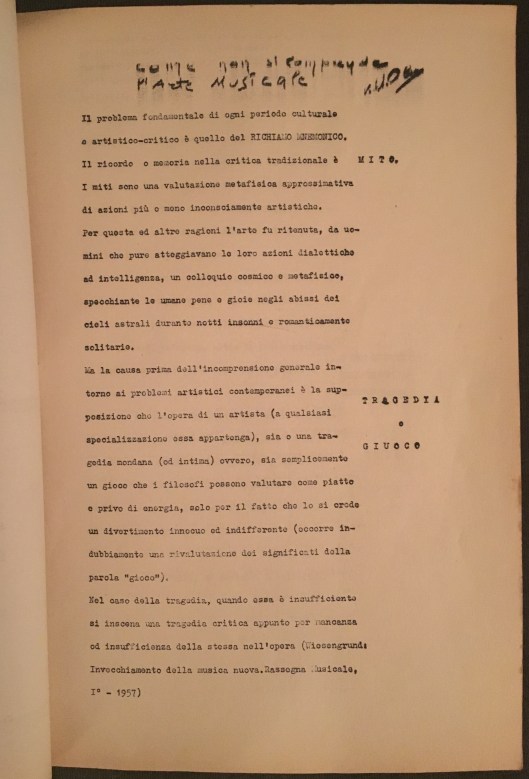
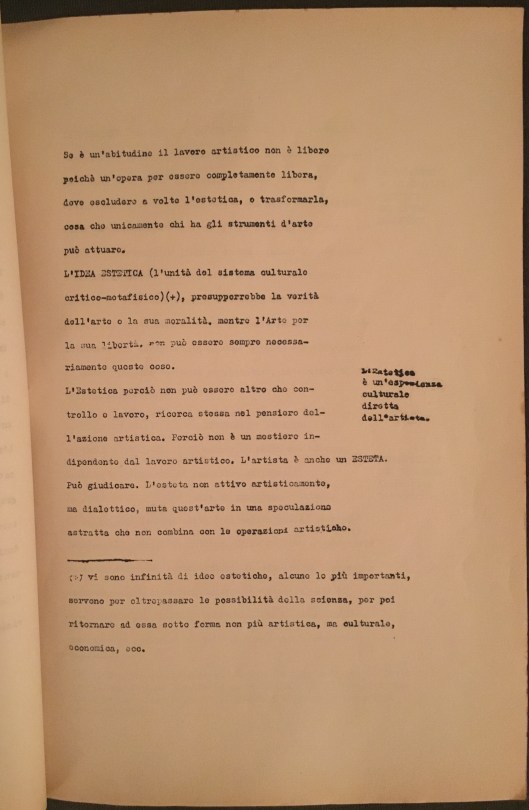
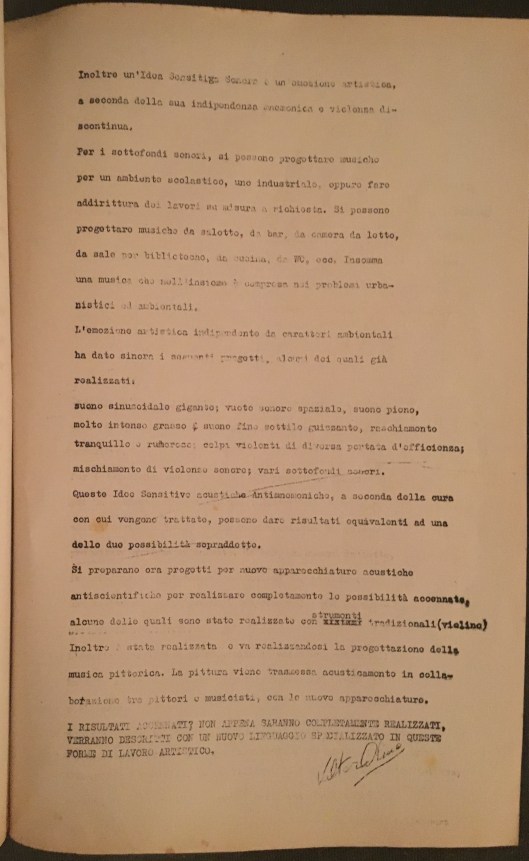
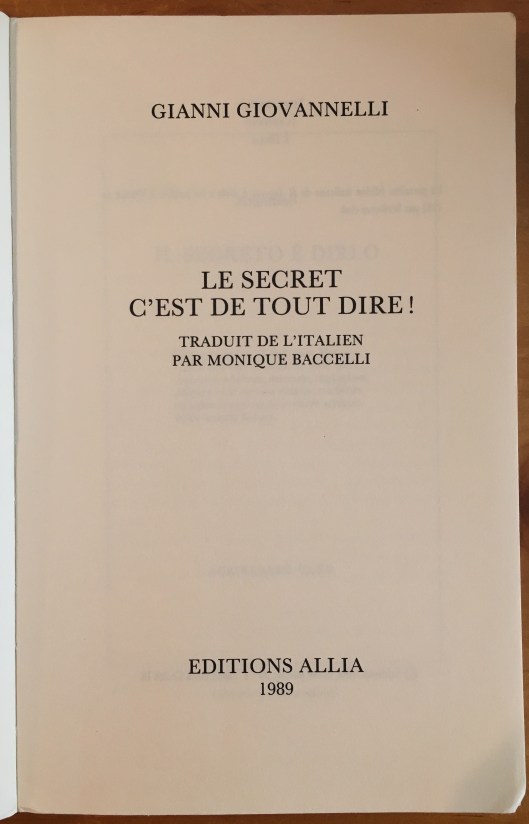
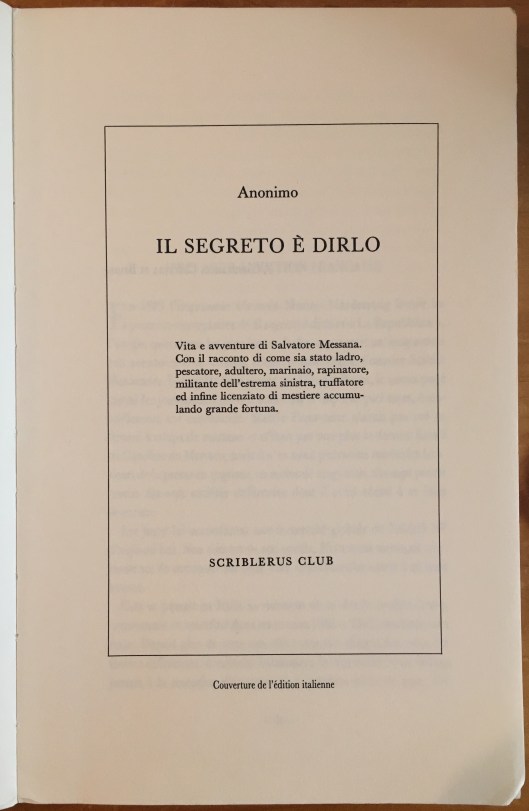
[Sanguinetti, Gianfranco]. Giovannelli, Gianni (pseud). Le Secret c’est de tout dire! Paris: Allia, 1989. 141 p.; 14 x 22 cm.; off-white wrappers with text in black and grey. First published in Italian as Il Segreto e dirlo (Verone: Scriberus Club, 1983). Trans. Monique Baccelli.

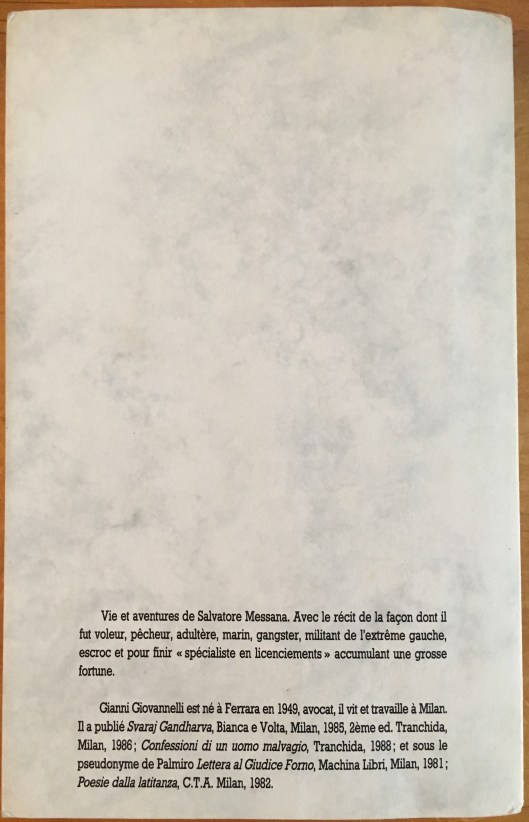
“This book is the fictional autobiography of Salvatore Messana, a clever; determined and financially successful enemy of salaried work, bosses and bureaucrats. Written by Gianna Giovannelli, it was first published in Italian in 1983 & translated into French in 1989” (AK Press).

Gianna Giovannelli is believed to be a pseudonym for Gianfranco Sanguinetti. In a letter to Charles Vincent from 25 February 1991, Guy Debord writes: “Did you know of this recent book by Gianfranco? There are a few nice things in it” (Correspondance Vol. VII, p. 262). As Bill Brown notes in the introduction to his English translation of the text (under the title Never Work: The Autobiography of Salvatore Messana): “Note that the identification of ‘Giovannelli’ as a pseudonynm used by Sanguinetti – which is something that Gianfranco himself has denied – is repeated by the index included in the very last volume of Guy Debord’s Correspondance, published by Librairie Artheme Fayard in 2010. Under “Giovannelli, Giovanni” it says ‘see Sanguinetti, Gianfranco'” (Brown, p. v)

Scarce in the trade with 8 copies on OCLC.

IMG_6304IMG_6305IMG_6306IMG_6307

Papillons de Paris: quinze papillons autocollants a decouper [2016]

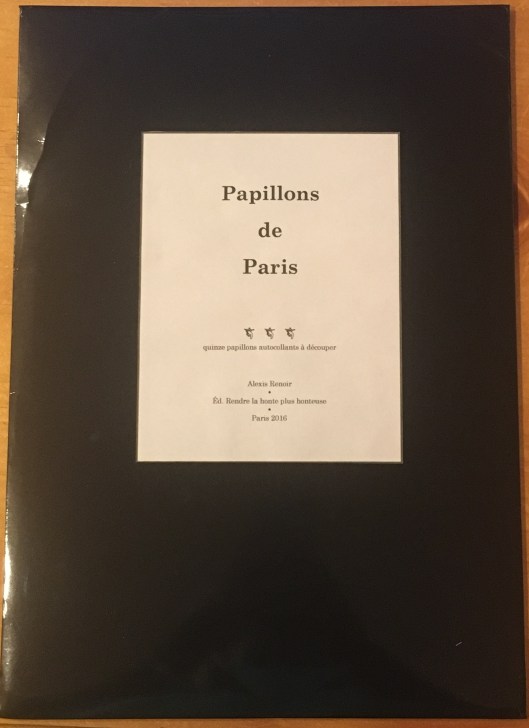
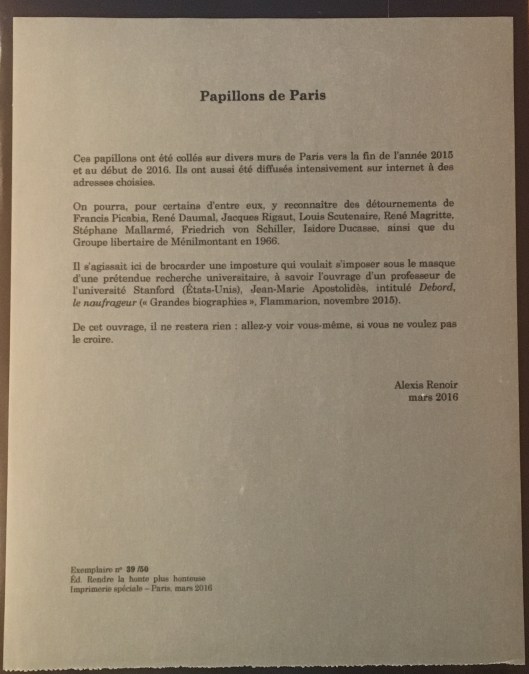
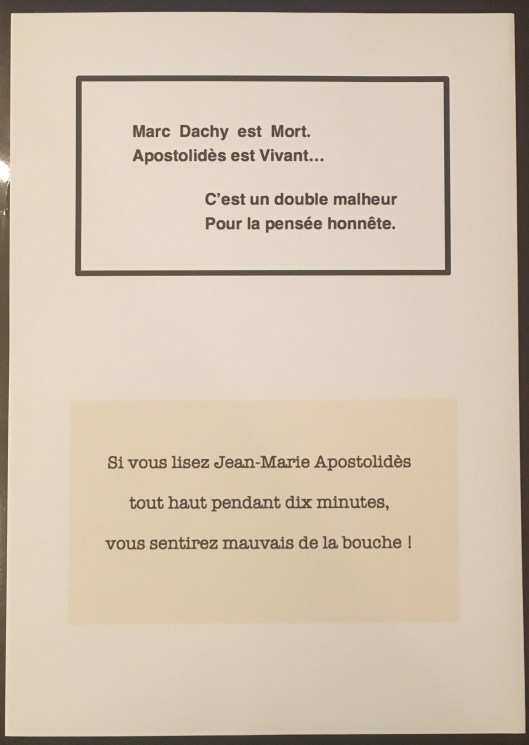
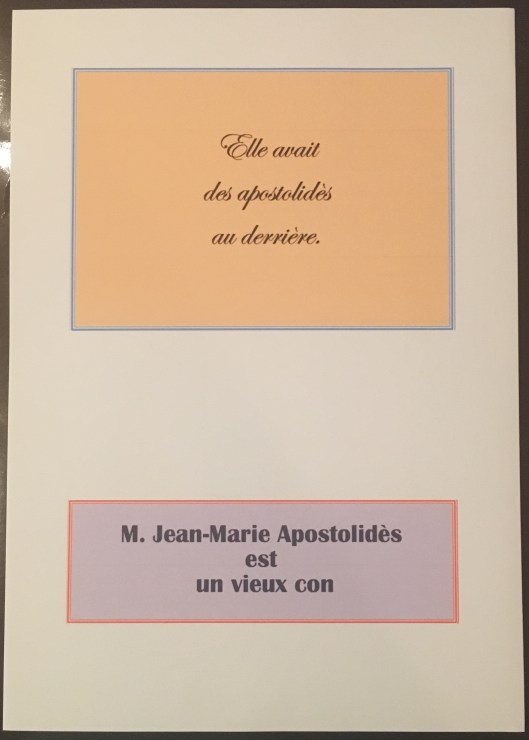
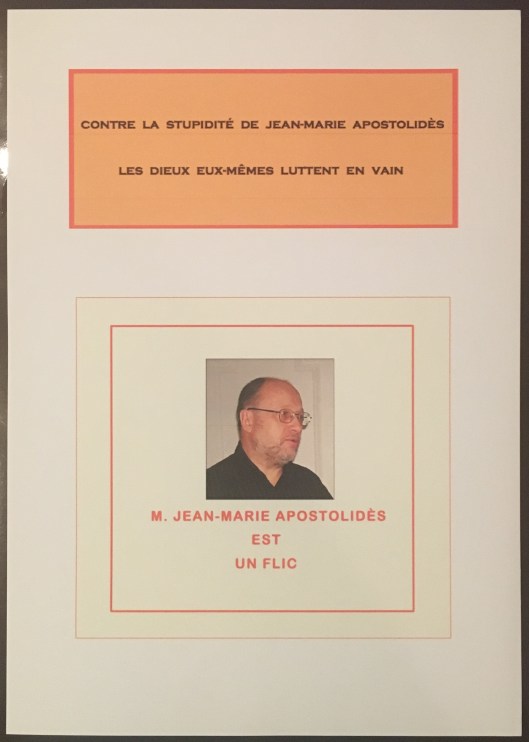
Renoir, Alexis (pseud?). Papillons de Paris: quinze papillons autocollants a decouper. Paris: Rendre la honte plus honteuse, Mars 2016. Edition of 50 (ours no. 39). 15 self-adhesive stickers (various formats) printed on 9 thick pages (21 x 30 cm.), loosely laid inside a black enveloppe  (23 x 32 cm.).Also includes an explanatory statement, printed on a single semi-transparent sheet of paper.

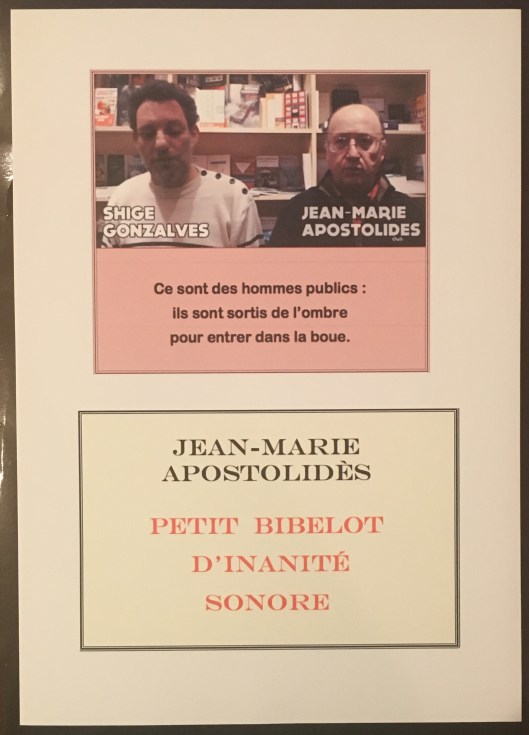
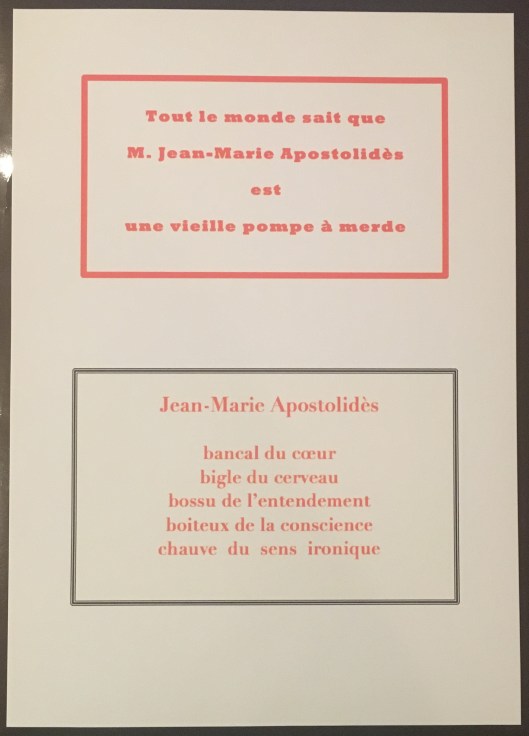
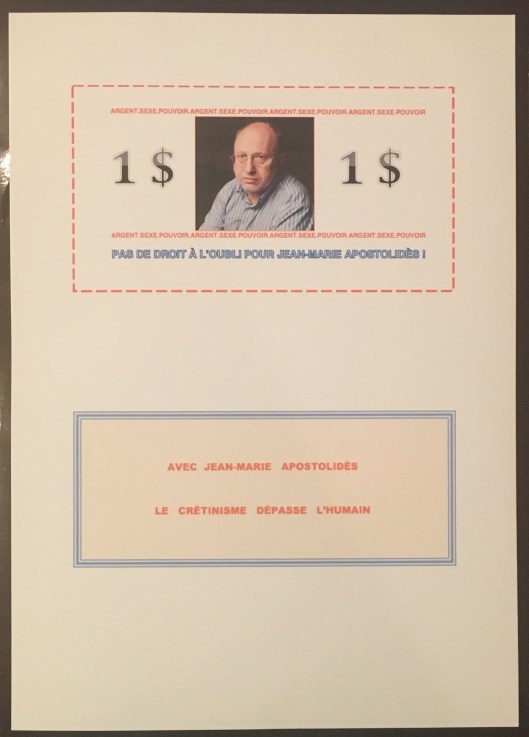
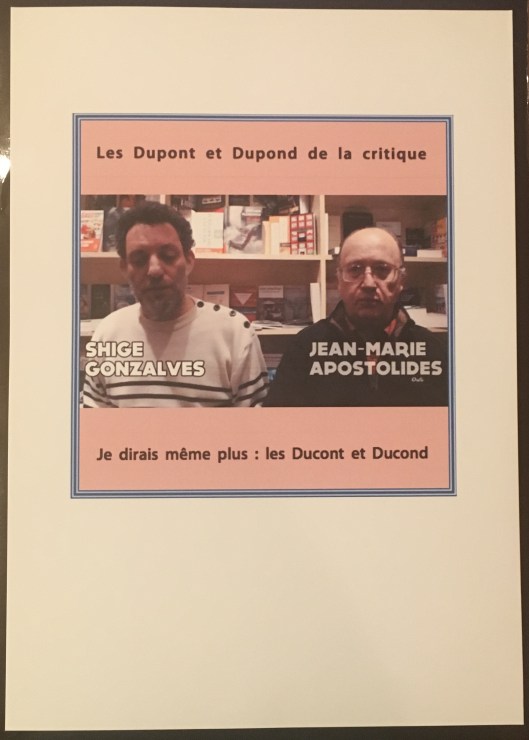
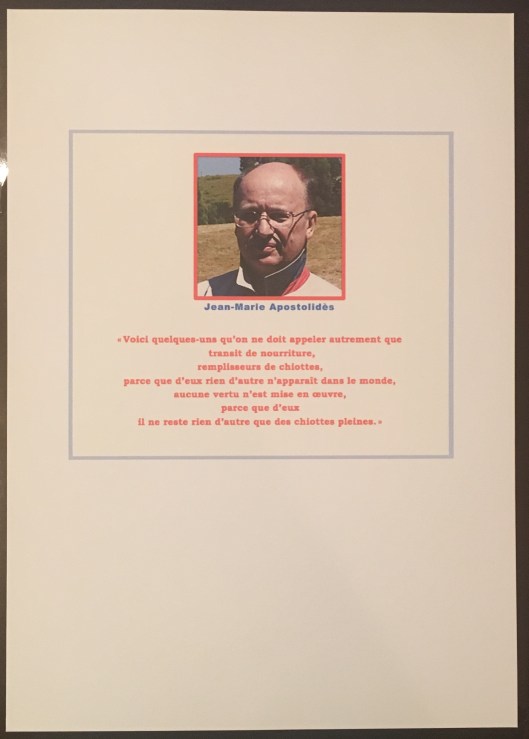
As the author indicates, these stickers were posted across Paris (as well as distributed through the internet) in late 2015 and early 2016. The self-proclaimed objective was to publicly denounce Jean-Marie Apostolides’ biography of Guy Debord, released by Flammarion in 2015 under the title Debord, le naufrageur. Apostolides’ biography was indeed divise – lauded by some, it was severely denounced by others. As usual, this blog takes a strictly bibliographical stance and the choice to present this document does not reflect any ideological positioning.

A Professor of French emeritus at Stanford University, J-M Apostolides is also the author of Les Tombeaux de Guy Debord, précédé de “Guy-Ernest en jeune libertin. Paris:Exils, 1999 ; Paris: Flammarion, 2006. He has edited or co-edited numerous works on “minor” figures of the Internationale Situationniste, such as Ivan Chtcheglov or Patrick Straram.

While many of the stickers rely on puns and detournements (and are thus difficult to translate), we have attempted to transcribe the meaning of the first half below:

1) Marc Dachy is dead, Apostolides is alive…It’s a double tragedy for honest thinking

2) If you read Jean-Marie Apostolides out loud for ten minutes, you will get a bad breath

3) She had Apostolides from behind

4) Mr. Jean-Marie Apostolides is an old fart

5) Against Jean-Marie Apostolides’ stupidity, the Gods themselves struggle helplessly

6) Mr. Jean-Marie Apostolides is a pig

7) Shige Gonzalvez, Jean-Marie Apostolides. These are public men: they have left the shadows to be dragged into the mud

IMG_6291IMG_6292IMG_6293IMG_6294IMG_6295IMG_6296IMG_6297IMG_6298IMG_6299IMG_6300IMG_6301


La Societe du Spectacle [1967] – Pierre Ansart’s copy

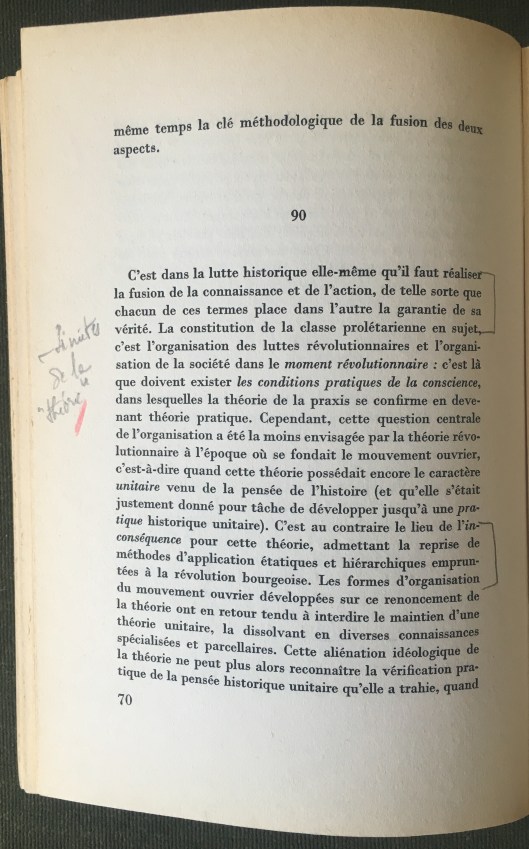
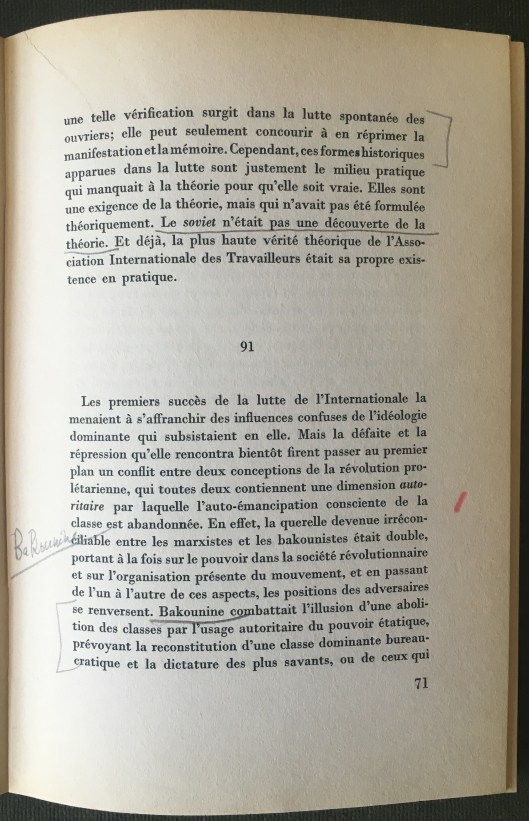
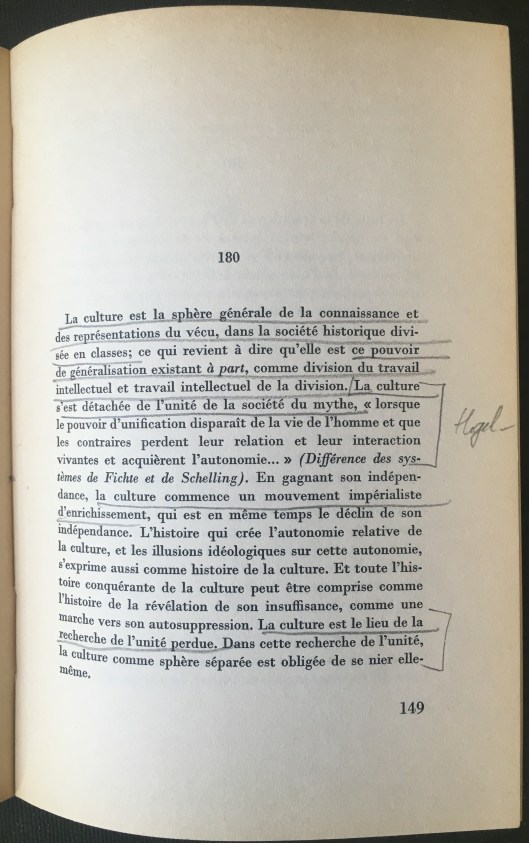
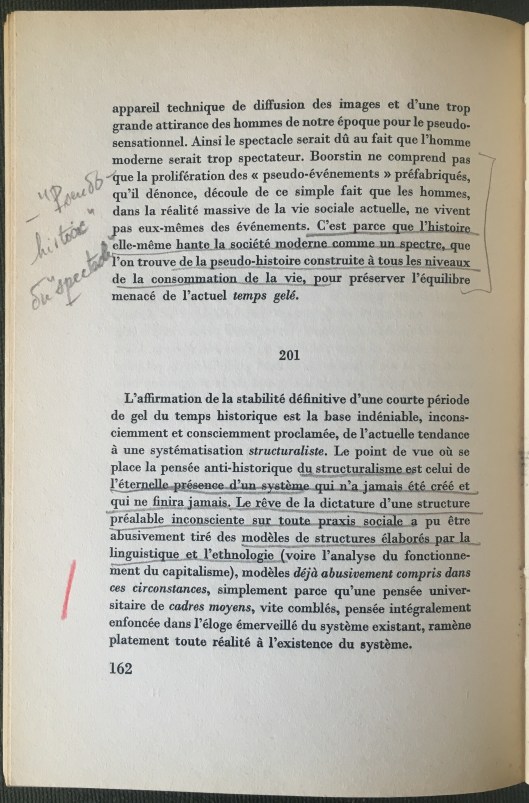
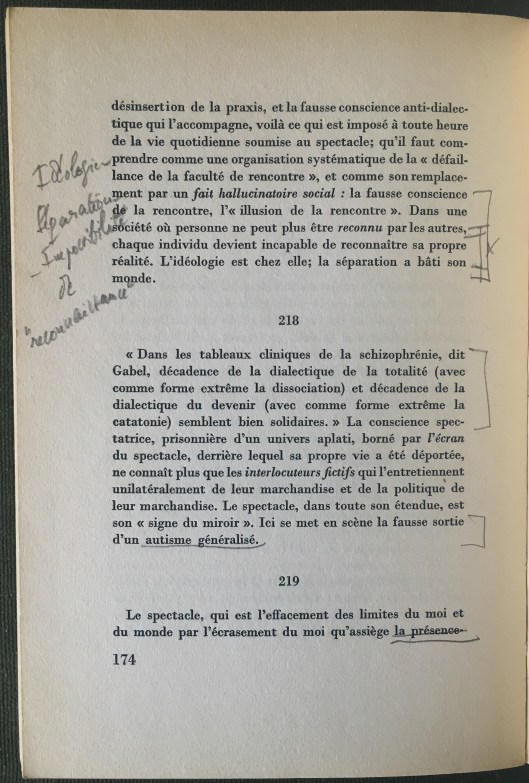
Debord, Guy. La Société du Spectacle. Paris: Buchet-Chastel, 1967. First edition, first printing (4eme trimestre 1967). 176 p.; 20.5 x 14 cm; White cover with text in black. Pierre Ansart’s working copy. The text is heavily underlined and annotated throughout, with several indications of Debord’s philosophical sources (e.g., pp. 58 & 149: “Hegel”).

Below are translated excerpts from the Wikipedia entry on Pierre Ansart: Born in 1922, Pierre Ansart is Professor Emeritus of Philosophy at the University of Paris and one of the world’s leading scholars on (pre-)anarchist thinker Pierre-Joseph Proudhon. After a dissertation on “Marx and Anarchism” (1967), Ansart becomes an Assistant Professor at University of Paris – Sorbonne and then at the University of Paris – Denis Diderot. His research centers around ideologies like Marxism, Proudhonism and Anarchism, particularly in their emotional and affective dimension. He has written extensively on Proudhon, Saint-Simon, Freud, Marx, Balandier, Weber.

Provenance: Pierre Ansart, through the trade.

IMG_6274IMG_6275IMG_6276IMG_6277IMG_6278IMG_6279IMG_6280IMG_6281IMG_6282IMG_6283


Interlude – short hiatus

Dear readers and subscribers,

My apologies for the current lack of posts/updates. Due to unforeseen personal circumstances, the blog is on a temporary hiatus. I expect to resume posting in the next few weeks, so stay tuned for new and exciting items, including some not listed in the current bibliographies.

Cheers

Situationnisteblog

PLANKTON The Quarterly Bulletin of the Plankton Society // Internationale Situationniste 12 [1969]

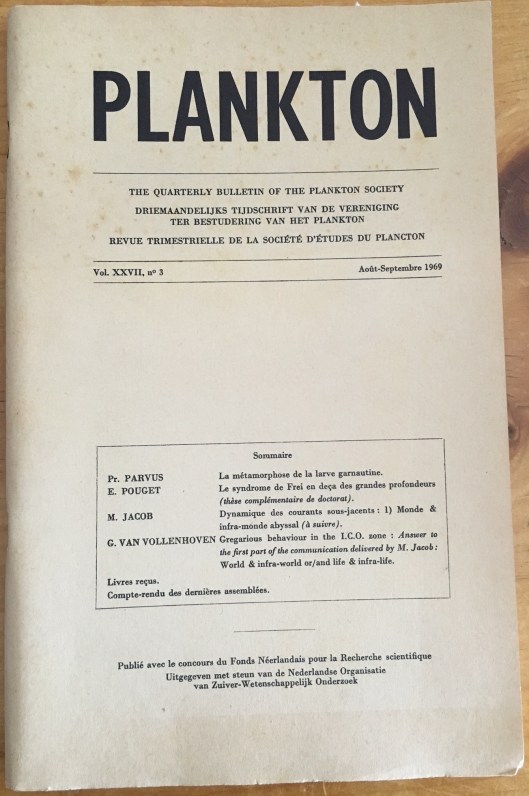
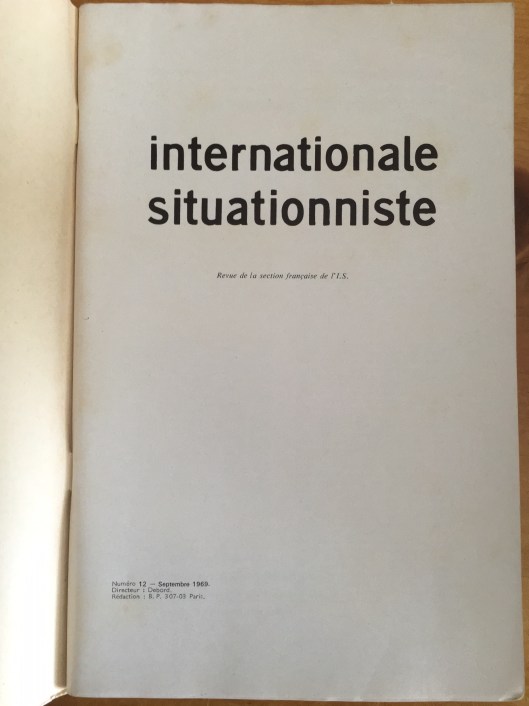
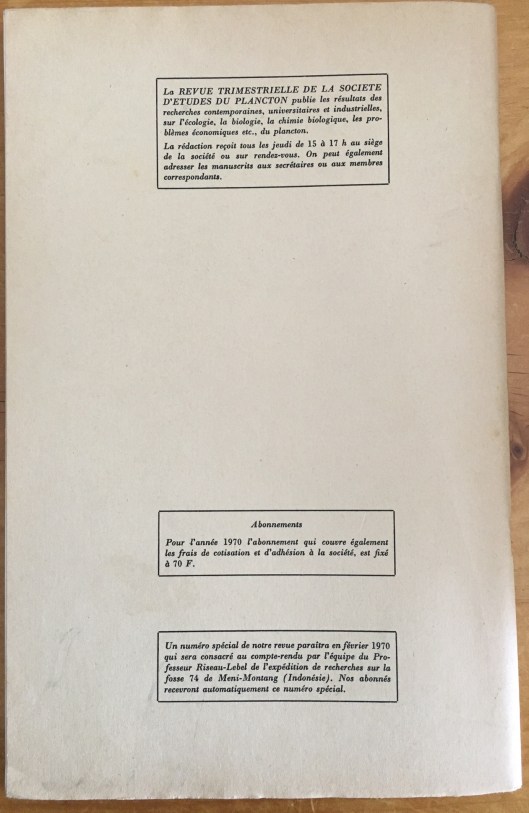
[Internationale Situationniste] PLANKTON The Quarterly Bulletin of the Plankton Society / Driemaandelijks tijdschrift van de Vereniging ter Bestudering van het Plankton / Revue trimestrielle de la Societe d’Etudes du Plancton, Vol. XXVIII, no.3, Aout-Septembre 1969 [wrappers]. Internationale Situationniste – Revue de la Section Francaise de l’I.S., Numero 12 [title page].  Paris: Internationale Situationniste, September 1989. 120 p.; ill.; 24.5 x 16 cm; beige/off-white wrappers with text printed in black.

Twelth and last issue of Internationale Situationniste, which was characterized by its length (at 120 pages, vs. 34-83 pages for earlier issues) and had a larger print run (10,000 according to Rapaud & Voyer). This was also one of only two issues (the other being no.10) to have some copies bound in fictitious, beige/off-white wrappers – in this case those of an apocryphal Plankton Society – instead of the typical glossy, SI-branded wrappers.

Shall we read into this substitution a clever form of detournement? Was this a way for the S.I. to mock its own “flashy” wrappers? Evidence points to a much more pragmatic reasons: such precautions were taken to facilitate clandestine distribution in Eastern Europe, where the S.I.’s subversive political writings may have elicited an undue amount of interest from the authorities. Specifically, the article “Reforme et contre-reforme dans le pouvoir bureaucratique” (translated by Ken Knabb at “Reform and Counterreform in the Bureaucratic Bloc) – an account of the USSR’s brutal intervention in Czechoslovakia – would likely have proven problematic.

We locate a single OCLC copy at the International Institute for Social History (IISG) in Amsterdam.

NOTE: The owner states that, in this case, some copies would cross into Francoist Spain via networks of Spanish anarchist militants (from the C.N.T./F.A.I.) exiled in Northern (French) Catalonia.

IMG_6198IMG_6200IMG_6199

Conseil pour le Maintien des Occupations (CMDO) Posters [1968]

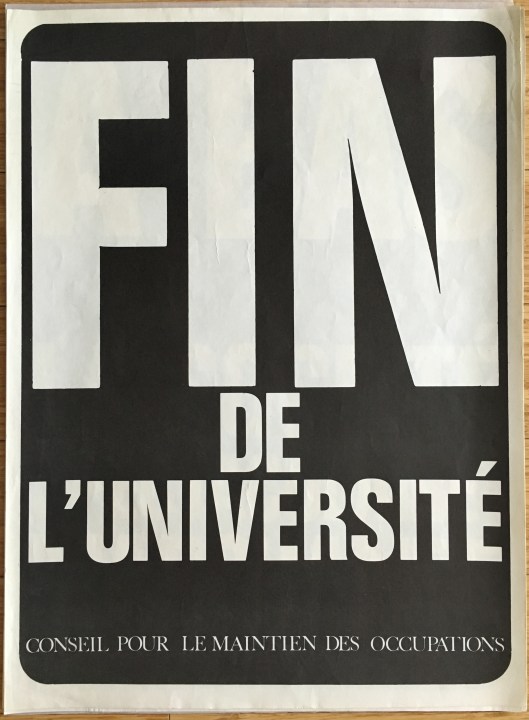
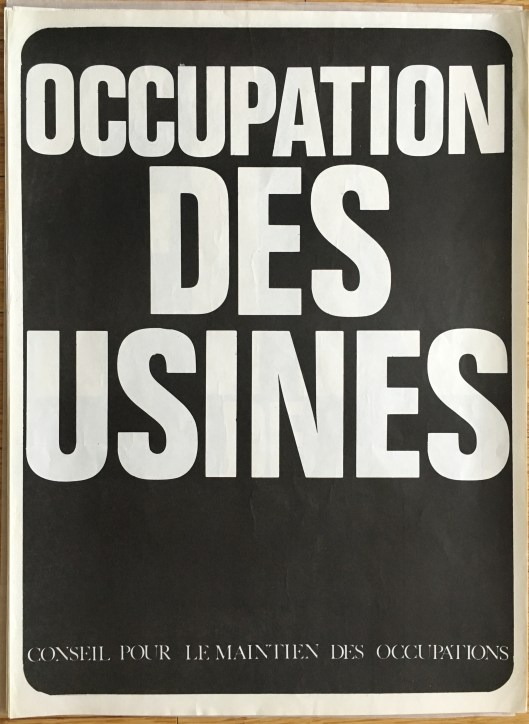
Series of six posters produced by the Conseil pour le Maintien des Occupations (CMDO) during the May 68 riots in Paris. “The Council for the Maintenance of Occupation (CMDO) was formed on the evening of May 17 [1968] by those supporters of the first Occupation Committee of the Sorbonne who had left with it and who proposed to uphold for the rest of the crisis the program of council democracy which was inseparable from a qualitative expansion of the occupation movement…The CMDO was more or less constantly made up of about ten situationists and Enrages (among them Debord, Khayati, Riesel and Vaneigem) and as many workers, high school students or ‘students’, and other councilists without specific social functions” (Rene Vienet, Enrages and Situationists in the Occupation movement, p.95-96).  On June 15 [1968], the CMDO dissolved itself, with “some of [its members] among them, who recognized in the Situationist International the extension of their own activity, continued to work together in that organization.” (ibid, pp. 104-105)

The posters’ message can be translated as follows: “Down with the Spectacle-Commodity Society”; “Abolition of Class Society”; “Occupation of Factories”; “End of Universities”; “Power to Workers Councils”; and “What Can the Revolutionary Movement Do Now? Everything. What Does It Become in the Hands of the Parties and the Unions? Nothing. What Does the Movement Want? The Realization of a Classless Society through the Power of the Workers Councils.”

For more on the CMDO, see Vienet, Rene. Enrages and Situationists in the Occupation MovementNew York / London: Autonomedia / Rebel Press, 1992. This is the translation from the French original (Paris: Gallimard, 1968). In particular, see chapter 6 (“The Council for the Maintenance of Occupations” and councilist tendencies), pp. 95-106.

OCLC locates three institutions with holdings (BnF, Yale, Michigan)

Interesting tidbit: five of the six posters (all large ones) once greeted visitors to Yale’s Beinecke library. See below (from a documentary on the Voynich Manuscript, https://www.youtube.com/watch?v=awGN5NApDy4, 4’47)

Untitled

Individual items below:

Conseil pour le Maintien des Occupations [CMDO]. A Bas la Societe Spectaculaire-Marchande! n.p. [Paris, France]: n.p. [CMDO], n.d. [May 1968]. 36.5 x 49.5 cm.; offset-printed in black and white inks

IMG_5098

Conseil pour le Maintien des Occupations [CMDO]. Abolition de la Societe de Classe n.p. [Paris, France]: n.p. [CMDO], n.d. [May 1968]. 36.5 x 49.5 cm.; offset-printed in black and white inks

IMG_5099

Conseil pour le Maintien des Occupations [CMDO]. Fin de l’Universite. n.p. [Paris, France]: n.p. [CMDO], n.d. [May 1968]. 36.5 x 49.5 cm.; offset-printed in black and white inks

IMG_5097

Conseil pour le Maintien des Occupations [CMDO]. Le Pouvoir aux Conseils de Travailleursn.p. [Paris, France]: n.p. [CMDO], n.d. [May 1968]. 36.5 x 49.5 cm.; offset-printed in black and white inks

IMG_5100

Conseil pour le Maintien des Occupations [CMDO]. Occupations des Usines. n.p. [Paris, France]: n.p. [CMDO], n.d. [May 1968]. 36.5 x 49.5 cm.; offset-printed in black and white inks

IMG_5096

Conseil pour le Maintien des Occupations [CMDO]. Que Peut le Mouvement Revolutionnaire Maintenant? n.p. [Paris, France]: n.p. [CMDO], n.d. [May 1968]. 24.5 x 15 cm.; offset-printed in black and white inks

IMG_5101 (1)

Guy Debord – Original Correspondence with Anita Blanc [1988-1990]

Original correspondence between Guy Debord and Anita Blanc on the back of 14 signed postcards (ca. 10.5 x 15 cm. in size). Written between 1988 and 1990, all are accounted for in Correspondance, Vol. VII (Paris: Fayard, 2008).

Anita Blanc was one of a handful of employees (and Debord’s day-to-day contact) at Editions Champ Libre / Gerard Lebovici. She was the cousin of Gerard Lebovici, a famed film producer, editor and impresario who doubled as Debord’s patron until his mysterious assassination in 1984.

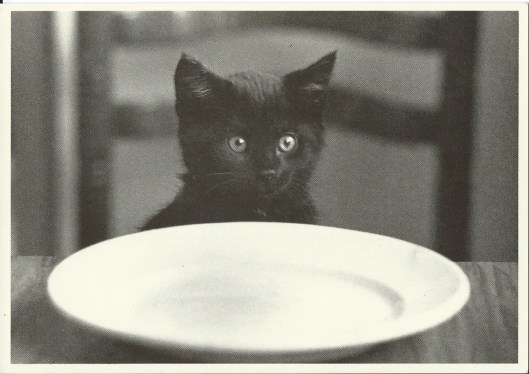
Anita Blanc and Guy Debord developed a warm relationship, as evidenced by the tone of some of their exchanges. They had a shared passion for cats, which explains the deliberate and consistent choice of postcards representing felines. All in all, Debord wrote to Blanc at least 25 times between July 29, 1988 and February 23, 1990 (see Correspondance, Vol “0”, pp. 352). The back-and-forth ended when Debord had a falling out with Editions Gerard Lebovici a few months after the death of Floriana Lebovici (Gerard Lebovici’s widow) from a devastating cancer on February 19, 1990. Two years later, Editions Lebovici became Editions Ivrea and Debord had jumped ship.

In this correspondence, Debord tackles a number of meaningful matters (such as the translation of his works into English and Spanish) but also some more pedestrian ones (for instance, the make-up of a display case for his new book). A detailed read of each piece is provided below:

01. Debord, Guy. [CORRESPONDENCE] Signed autograph postcard dated 01/10/[19]88. Accounted for in Correspondance, Vol. VII, p. 42. 

Debord asks Anita Blanc whether Olivier Lutaud [a famed historian and the author of Les Nivelleurs, Cromwell et la Republique, which Debord had read – see Correspondance Vol V, pp. 274, note 3] has sent his translation of a newly discovered text on the English revolution.
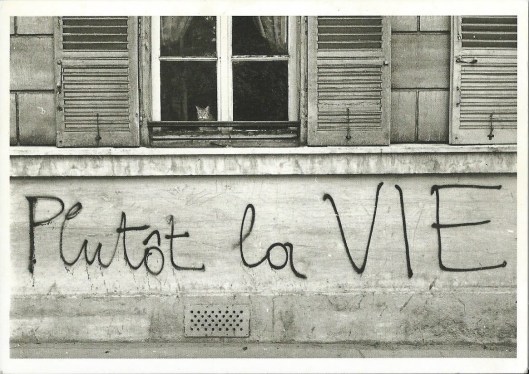
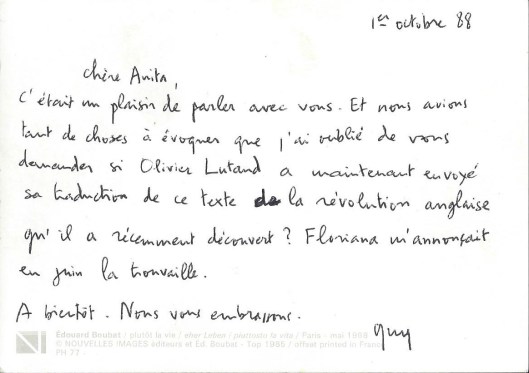
Scan0001Scan0002

02. Debord, Guy. [CORRESPONDENCE] Signed autograph postcard dated 14/10/[19]88. Accounted for in Correspondance, Vol. VII, p. 43-44.

Debord states that half of his knowledge on the English revolution comes from Lutaud, while the other half comes from Guizot, which he views as a bit outdated [Guizot was the author of  Pourquoi la révolution d’Angleterre a-t-elle réussi ? Discours sur l’histoire de la révolution d’Angleterre in 1850 and Études biographiques sur la révolution d’Angleterre the following year, among others]. He also wonders that he may be the last man in France who cannot read English. He asks about Michele Duval [who had edited Saint-Just’s Oeuvres Completes and Anacharsis Cloots’ Ecrits Revolutionnaires for Champ Libre] and confirms that the third printing [of an unidentified] was exempt of typos.
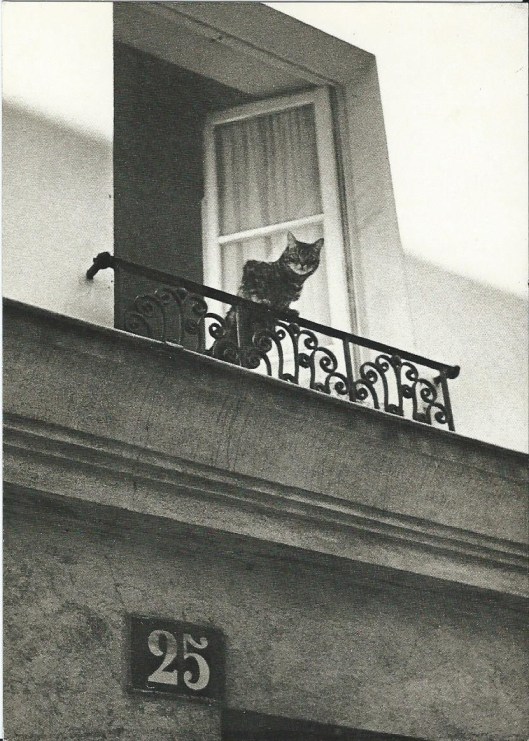
Scan0003Scan0004

03. Debord, Guy. [CORRESPONDENCE] Signed autograph postcard dated [28/10/1988]. Accounted for in Correspondance, Vol. VII, p. 47-48.

Debord wonders about the possibility that he (or other authors published by Gerard Lebovici) may be considered for a literary prize. In this unlikely event, and to avoid any confusion, Debord writes a brief “Memoradum” to Anita Blanc. He explains that Editions Gerard Lebovici are hostile to any literary prize, and that such a position is shared by all of its published authors.

Scan0005Scan0006

04. Debord, Guy. [CORRESPONDENCE] Signed autograph postcard dated 03/11[19]88. Accounted for in Correspondance, Vol. VII, p. 48.

Debord gives Anita Blanc some guidance regarding the display case [in which his new book, Commentaires sur la Societe du Spectacle, is to be promoted]. He expresses a desire to see only three of his other works (namely, Considerations  [sur l’assassinat de Gerard Lebovici], [Societe du] Spectacle, and Le Jeu de la Guerre)  placed on the shelf alongside this new title. However, he also wishes to see works by Sexby, Junius, Cravan and Orwell placed on a separate shelf underneath or above. The fact that all four of these authors are English, he muses, is quite timely in light of Mrs Thatcher’s visit to Poland.

Scan0007Scan0008

05. Debord, Guy. [CORRESPONDENCE] Signed autograph postcard dated 04/12/[19]88. Accounted for in Correspondance, Vol. VII, p. 53.

Debord is pleased with the display case that was prepared for his books [see postcard dated 3/11/1988]. He asks that a new display case be prepared to showcase [Jean-Francois] Martos’ new book [Histoire de l’Internationale Situationniste, published by Champ Libre in 1989]. He proposes to lend (but not gift) broadsides and original documents [from the Internationale Situationniste] on this occasion.

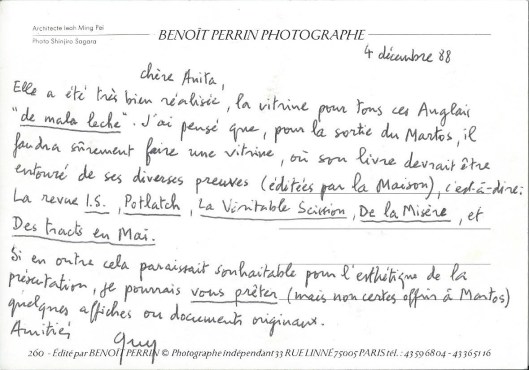
Scan0009Scan0010

06. Debord, Guy. [CORRESPONDENCE] Signed autograph postcard dated 07/01/[19]89. Accounted for in Correspondance, Vol. VII, p. 66.

Debord tells Anita Blanc that he gave Nico[las Lebovici, Gerard Lebovici’s son] the documents for the display case [see postcard dated 04/12/1988].

Scan0011Scan0012

07. Debord, Guy. [CORRESPONDENCE] Signed autograph postcard dated 10/03/[19]89. Accounted for in Correspondance, Vol. VII, p. 74. 

Debord acknowledges the receipt of a letter from the University of Montana at Missoula in which he is asked to partake in a conference alongside Baudrillard [Indeed, the conference Jean Baudrillard in the Mountains, or Modern Communication and the Disappearance of Art and Politics  was held from 11-13 May 1989 in Missoula, MT] and congratulates Anita for responding in a rather uncivil manner to said invitation.

Scan0013Scan0014

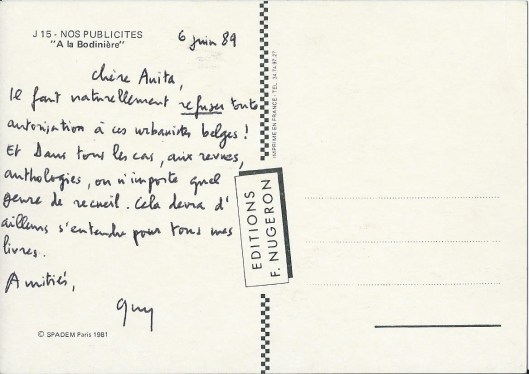
08. Debord, Guy. [CORRESPONDENCE] Signed autograph postcard dated 06/06/[19]89. Accounted for in Correspondance, Vol. VII, p. 92.

Debord asks that Anita Blanc reject a request by Belgian urbanists [to publish excerpts from Debord’s writings] and, more generally, any similar request made by periodicals, anthologies, etc. This “it goes without saying”, should apply to all of his books.

Scan0015Scan0016

09. Debord, Guy. [CORRESPONDENCE] Signed autograph postcard dated 29/09/[19]89. Accounted for in Correspondance, Vol. VII, p. 110.

Debord expresses his dismay at the fact that [Jean-Edern] Hallier [editor of the periodical l’Idiot International] reprinted some pages from Panegyrique without his explicit permission. However, he does not wish to dignify the journalist with a response. He also instructs Anita that, should similar requests be made in the future, they ought to be met with a flat-out rejection. See postcard dated 06/06/1989 for a similar ask.

Scan0017Scan0018

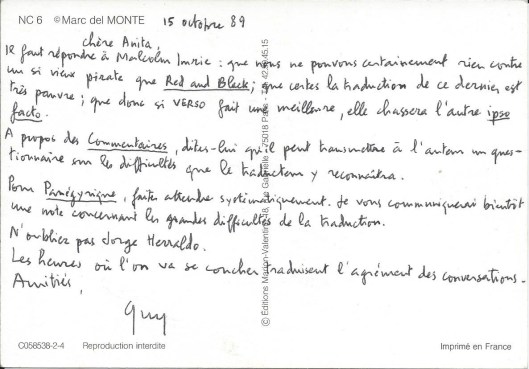
10. Debord, Guy. [CORRESPONDENCE] Signed autograph postcard dated 15/10/[19]89. Accounted for in Correspondance, Vol. VII, p. 114. 

Debord asks Anita Blanc to respond to Malcolm Imrie [who is then preparing an English translation of La Societe du Spectacle for Verso, though the political treatise will ultimately be published by Zone in 1990] regarding the old pirate Black & Red translation. He also asks that Imrie send a letter detailing challenges with his translation of Commentaires sur la Societe du Spectacle  [Imrie did comply, and Debord’s response can be found in Correspondance Vol. VII, pp. 204-209. Imrie’s translation was ultimately published by Verso in 1990]. Finally, Debord asks that the translation of Panegyrique be be delayed, and that [Jorge] Herraldo not be forgotten [more on this in the next letter].

Scan0019Scan0020

11. Debord, Guy. [CORRESPONDENCE] Signed autograph postcard dated 23/10/[19]89. Accounted for in Correspondance, Vol. VII, p. 115.

Debord asks Anita Blanc for a payment of 250,000 Francs on behalf of Editions Gerard Lebovici, partly as an advance on his latest book, Panegyrique. He also inquires about the status of “Societe des jeux strategiques et historiques” [a company he had initially founded with Gerard Lebovici and that would have marketed his board game “Kriegspiel”]. Finally, he expresses satisfaction with Pascal Dumontier’s manuscript [Les Situationnistes et Mai 68, which Champ Libre will ultimately publish in 1990] and says he will write to him [as he does the next day, in an unusually warm letter – see Correspondance, Vol. VII, pp. 117-121].

Scan0022Scan0023

12. Debord, Guy. [CORRESPONDENCE] Signed autograph postcard dated 19/[12/1989]. Accounted for in Correspondance, Vol. VII, p. 150.

Debord thanks Anita for sending a check [for 250,000 Francs, see postcard dated 23/10/1989] on December 15. He also asks her to clarify the situation with the “senor editor de ANAGRAMA” [i.e., Jorge Herraldo, head of said Spanish publishing house]. In June 1988, Debord had written a first letter to Herraldo detailing some of the issues he saw with the Spanish translation of Commentaires sur la Societe du Spectacle  (see Correspondance, Vol. VII, p. 92) .

Scan0024Scan0025

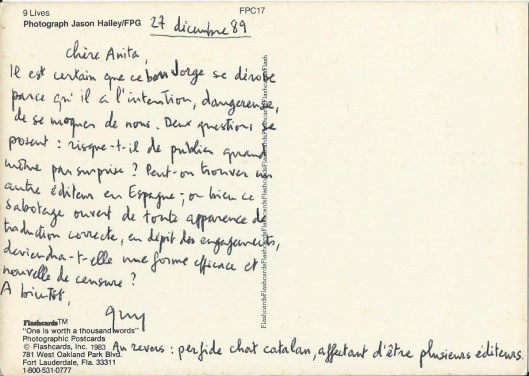
13. Debord, Guy. [CORRESPONDENCE] Signed autograph postcard dated 27/12/[19]89. Accounted for in Correspondance, Vol. VII, p. 153.

Debord expresses his worries once more regarding the Spanish translation of Commentaires sur la Societe du Spectacle . He now believes Jorge [Herraldo] is playing him for a fool.  The back of the postcard is a metaphor for the duplicitous Spanish publisher…

Scan0026Scan0027

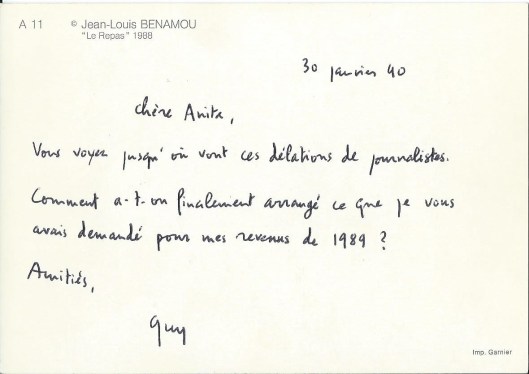
14. Debord, Guy. [CORRESPONDENCE] Signed autograph postcard dated 30/01/[19]90. Accounted for in Correspondance, Vol. VII, p. 169.

Debord laments how he is being treated by journalists [in reference to the article “Enquete sur les grands silencieux” published in Globe, February 1990,  in which he is essentially compared to the Guru of a cult] and reminds Anita about additional monies owed to him.
Scan0028Scan0029


Debat d’orientation de l’ex-Internationale Situationniste [1974]

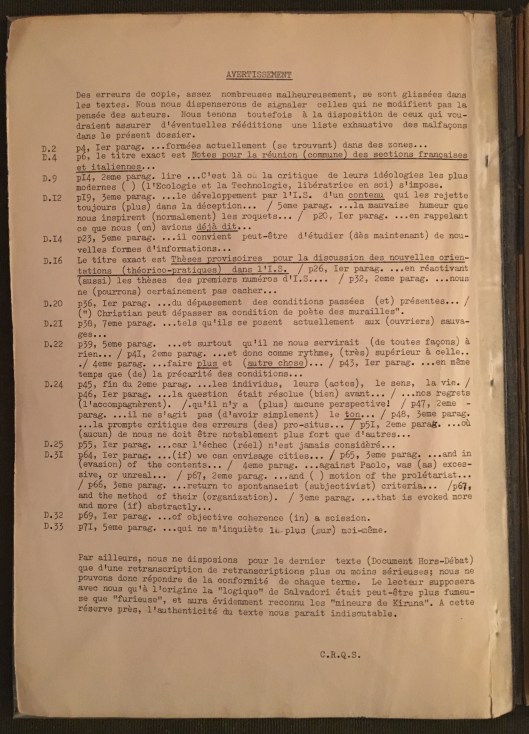
Internationale Situationniste. Debat d’orientation de l’ex-Internationale Situationniste. Paris: Centre de Recherche sur la Question Sociale (CRQS), 1974.

Scarce compilation of 35 internal documents of the SI debating possible strategies in the aftermath of May 1968. The documents were published between 26 August 1969 and 28 January 1971 and are chiefly in French, with two documents in English.

The Debat d’orientation contains a series of written texts, some deeply theoretical in nature, that served as a basis for a series of meetings held by members of the Situationist International in 1969 and 1970. They help understand the growing divides among the remaining members of the organization, and lay the ground for the dissolution of the SI a few years later. As Bill Brown remarks, the debate “was accompanied by a slew of exclusions…and resignations”, with most members of the American and French sections (or whatever was left of them at that point in time)  departing the group, voluntarily or not. In many way, the Debat is an indispensable companion to La Veritable Scission dans l’Internationale Situationniste (Paris: Champ Libre, 1972), which gives Debord and Sanguinetti’s (biased) perspective on the events that led to the “real split” in 1972.

As must be clear by now, these internal documents were not meant for publication. Brown notes that “when such a collection was finally put together by a fan of the situationists named Daniel Denevert and submitted to Editions Champ Libre, Guy Debord declined to help and Champ Libre turned the book down”. It was not until 1974 that Joel Cornuault, an early translator and publisher of Ken Knabb’s works in French, compiled them into an 80-page, primarily type-written mimeographed volume. The thin volume was circulated in small numbers within the Parisian pro/post-situationist milieu of the early to mid-1970s.

Unlike most other texts by the SI, the Debat d’orientation de l’ex-Internationale Situationniste cannot be found in full online. At some point in time, it had been made available by Franck Einstein here, but the link has been dead for a few years (and the original text may not have even been complete to begin with). For now, select letters have been reposted at Debord-encore. Remarkably, however, a complete English language translation – primarily the work of Bill Brown, with contributions by Ken Knabb and a few others – may be found here.

There appears to have been a reprint by Editions du Cercle Carre in 2000 (see here). However, we find no record of this edition on either OCLC or in the trade.


We locate 5 OCLC copies at the Bibliotheque Nationale de France (BnF), Bibliotheque Sainte-Genevieve, Nanterre’s BDIC, UC-Berkeley, and Michigan.

Ford 32. Gonzalvez 146.

IMG_5091IMG_5092IMG_5093IMG_5094IMG_5095

King Mob 1-6 [1968-70]

Complete run in 5 issues (no.4 was never published) of this legendary British counter-culture magazine put out by David & Stuart Wise, later joined by Christopher Gray, Donald Nicholson-Smith and TJ Clark (all former members of the British Section of the Situationist International).Also included here is a leaflet listing all King Mob publications.

Retracing the history of King Mob, its evolution, and its linkages with Black Mask / Up Against the Wall Motherfuckers would be too long and has already been done. I encourage readers to learn more by reading Tom Vague’s “King Mob Echo: From Gordon Riots to Situations & Sex Pistols” (London: Dark Star, 2000; in print); Tom Vague’s “King Mob: English Section of the Situationist International” (London: Dark Star, 2000; in print) and, online, the Wise Brothers’ own “King Mob: A Critical Hidden History” (available online at http://www.revoltagainstplenty.com/index.php/archive-local/93-a-hidden-history-of-king-mob.html).

King Mob. King Mob 1: King Mob Echo. London: BCM/King Mob, April 1968. n.p. [12 p.]; ill.; 24 x 34 cm.; ill. B&W wrappers with picture of a menacing masked man with text in white.

This first issue includes a front cover image of a menacing masked man (from Louis Feuillade’s film “Fantomas”) above a Karl Marx quotation (from “The Eighteenth Brumaire of Louis Napoleon”). Contents include: “The Return of the Repressed” by radical psychoanalysis scholar Norman O. Brown; “Desolation Row”, an excerpt “free translated from Raoul Vaneigem’s Traite de Savoir Vitre a l’Usages des Jeunes Generations” (1967); “Urban Gorilla Comes East”, the magazine’s only original King Mob statement, co-written by Phil Cohen (also known for his involvement with the London Street Commune and the 144 Piccadilly squat) and Donald Nicholson Smith. Reprinted in King Mob Echo: English Section of the Situationist International (London: Dark Star, 2000), pp. 71-81

2016-04-17 20.19.222016-04-17 20.19.47

King Mob. King Mob 2: Letters on Student Power. London: BCM/King Mob, November 1968. n.p. [4 p.]; ill.; 24 x 36 cm.; ill. B&W wrappers with text in black.

This second issue, entitled “King Mob: Two Letters on Student Power”, contains the group’s response to and critique of the student revolts and the anti-university movement, with the central text by Christopher Gray (formerly of the Situationist International). Also included is a brief article by Richard Huelsenbeck on the same topic, which mentions Trocchi.  Reprinted in King Mob Echo: English Section of the Situationist International (London: Dark Star, 2000), pp.85-90

2016-04-17 20.20.152016-04-17 20.20.35

King Mob. King Mob 3. London: BCM/King Mob, May 1969. 16 p.; ill.; 25 x 36 cm.; ill. White wrappers with picture of a menacing werewolf, text in black and white.

This third issue features a striking front cover with a picture of a werewolf. It reprints content from Ben Morea’s Black Mask journal and advertizes Black Mask / Up Against the Wall Motherfucker’s actions in the United States (“The first year Black Mask seized every possible opportunity of fucking up culture”) . It includes the famous action to close the Museum of Modern Art in New York. As always, illustrations are stunning and speak to the group’s radicalism and nihilistic outlook. Reprinted in King Mob Echo: English Section of the Situationist International (London: Dark Star, 2000), pp.101-122

2016-04-17 20.21.002016-04-17 20.21.16

King Mob. King Mob 5. Inglewood (Australia): The King Mob Collective, n.d. [1970]. n.p. [8 p.]; ill.; 22.5 x 36 cm.; ill. B&W with text in black.

This scarce fifth issue was published in Australia, seemingly independently from the British group but with similar layout and content. Contents include: “Those Still  in Prison” (a criticism of the prison system from an anarchist standpoint); “Editorial”; “Join the Revolution”; “Total self-management” (a discussion of workers councils and self-management); “The Last Puppet Show” (a criticism of students and Universities), etc. Also reprints excerpts from Fredy Perlman’s The Reproduction of Daily Life  and comics from old King Mob leaflets and journals. Provides a number of contacts, primarily of Anarchist bookstores in Australia and New Zealand. Incompletely reprinted in King Mob Echo: English Section of the Situationist International (London: Dark Star, 2000), pp.123-124

2016-04-17 20.21.322016-04-17 20.21.52

King Mob. King Mob 6: Notes from the Underground. London: BCM/King Mob, n.d. [1970]. n.p. [4 p.]; ill.; 25 x 34 cm.; ill. B&W wrappers with text in black.

This scarce sixth issue contains of a single, lengthy article on the revolutionary struggle against monopoly capitalism and the commodity hierarchy. Christopher Gray has suggested that it may have been written by Dave Wise, who has stated that it was mainly written by Ian and Diana Clegg “with a little distant help from their…friends from Newcastle”. One section reads: “Monopoly capitalism will construct its Ministry of Leisure over Western Europe: Butlins camps or rarified Belsens all along the Costa Brava”, a meme that found its way into the lyrics for “Holidays in the Sun” and Jamie Reid’s punk slogan, “Cheap Holidays in Other Peoples Misery”. Reprinted in King Mob Echo: English Section of the Situationist International (London: Dark Star, 2000), pp.125-129.

2016-04-17 20.22.262016-04-17 20.22.40

King Mob. King Mob Publications. London: BCM/King Mob, n.d. [1970]. 1 p.; 20.5x 34 cm.; black ink on white stock.

Leaflet that lists the titles and prices of the group’s publications: The first three issues of the journal (“King Mob no.1 – Vaneigem on Situationism and Norman O Brown on Genitality”; “King Mob no.2 – Two Letters on Student Power”; “King Mob no.3 – The Great Motherfucker Revolution), two posters (“King Mob Motherfucker Poster” and “Luddites’69”), a number of Situationist publications (“Ten Days that Shook the university (Situationist International); “Vaneigem: ‘Totality for Kids’ (Situationist International); “Situationist Comic”; “Theses on the Commune”). Three handwritten additions are made in red pen: “Unitary Urbanism”; “SMASHIT Cartoon”; and “King Mob 6 – Work / out shortly”. Includes the King Mob stamp with the group’s W.C.1 address in London.

2016-04-17 20.18.56


Three items by Radical Action Cooperative (RAC) [1968]

Radical Action Cooperative (i.e., Collins, King; Corwin, Liz; Verlaan, Tony; Waring, Peter; et al.). Critique of Columbia S.D.S. New York, NY: Radical Action Cooperative, n.d. [1968]. 5 p.; 21 x 29.5 cm.; black ink on  three white, stapled mimeographed sheets.

Radical Action Cooperative (i.e., Collins, King; Corwin, Liz; Verlaan, Tony; Waring, Peter; et al.). Life, Not Survival – A Manifesto. New York, NY: Radical Action Cooperative, 28 July 1968. 4 p.; 21 x 29.5 cm.; black ink on two yellow, stapled mimeographed sheets.

Radical Action Cooperative (i.e., Collins, King; Corwin, Liz; Verlaan, Tony; Waring, Peter; et al.). Nantes – An Entire Town Discovers Popular Power. New York, NY: Radical Action Cooperative, 22 September 1968. 15 p.; 21 x 29.5 cm.; black ink on eight blue, stapled mimeographed sheets.

Rare set of items published by Radical Action Cooperative (RAC), described by Beni as “a communal organization which evolved during the Columbia University struggle of Spring 1968. Tony Verlaan participated in it on and off from about March to about October 1968. Migrated to Cambridge in late 1969, where King Collins and others in it became the Council for Conscious Existence, a situationist or pro-situationist group hostile to Verlaan and other New York city Situationists” (Reference: A Bibliography of North American Situationist Texts, 1975, p. 103).

King Collins, one of the group’s co-founders and main contributors, explains the context within which RAC was born, with a specific reference to the item Critique of Columbia S.D.S. featured here: “After the bust, SDS [Students for a Democratic Society] set about the construction of a “strike committee” dominated by their own cadre. Peter [Waring] and I and other new found friends, declined to tie in with SDS and instead set up our own organizational space at Columbia Teachers College, just across the street from the Columbia campus. The administration of Teachers College, trying to avoid any direct confrontation, agreed to give us some office space and access to typewriters and some duplicating equipment. We met often and did a few actions, some of them perhaps deserving of mention (later). We wrote a critique of the college and of SDS, from our homegrown sociological and anarchist perspective.”(Reference: From Student Life to Political Commune: The Radical Action Cooperative And The Situationist International, revised August 2014, available online at http://www.greenmac.com/CCE/RAC_01.html).

Another item discussed here (Life, Not Survival: A Manifesto) played a critical role in connecting RAC with Situationist International members in New York: “Chasse and Elwell wrote to RAC shortly after we published a document (It was called “RAC Manifesto: Life not Survial.”) Their letter raised some interesting questions and I met briefly with Chasse, and he made it clear that my thinking about revolution was not adequate in his eyes.” (From Student Life…).  Tony Verlaan, on the other hand, developed a much closer relationship with RAC members, eventually joining the group and influencing its members. As Fabrice de San Mateo notes in his preface to the French translation of Situationist International (review of the American section of the S.I.): “Verlaan engaged in discussion with some of its members and, as a result of this contact, the RAC proclaimed its affinities with the SI. Rapidly, the situationist came to share the communal dwelling of the RAC and to participate in its activities.”

Verlaan’s participation, however, was a “major source of disagreement” within the American section of the S.I. The first issue of Situationist International features a short article (“Opposition Falsified”) that points at this very tension:”Out of the Columbia strike came a bizarre communitarian grouping called the Radical Action Cooperative (RAC). They opposed themselves to the subleninists all around them, claimed to start from a critique of daily life and declared affinities with the thought of the SI. But they quickly exposed themselves as inflictions of their own boredom and confusion, as ideologists of daily life. RAC migrated to Harvard where they provoked the unimaginative ‘confrontations’ from which the well-disciplined zombies of PL tried to profit.”(translated from the French by Bill Brown, 2012, http://www.notbored.org/ecrits-preface.html)

For more information on the relationship between RAC and the SI, consult King Collins’ excellent piece at http://www.greenmac.com/CCE/RAC_01.html

I welcome corrections, additions, suggestions, etc. from original members of RAC or those who may have more insight into this material.

Rare. RAC items are found in neither the trade nor on OCLC (though the Tamiment library of NYU mentions some printed material related to the group in one of its finding aids)

IMG_5046IMG_5047IMG_5048