The Death of Art Spells the Murder of Artists. The Real Anti-Artists Appear [1968]

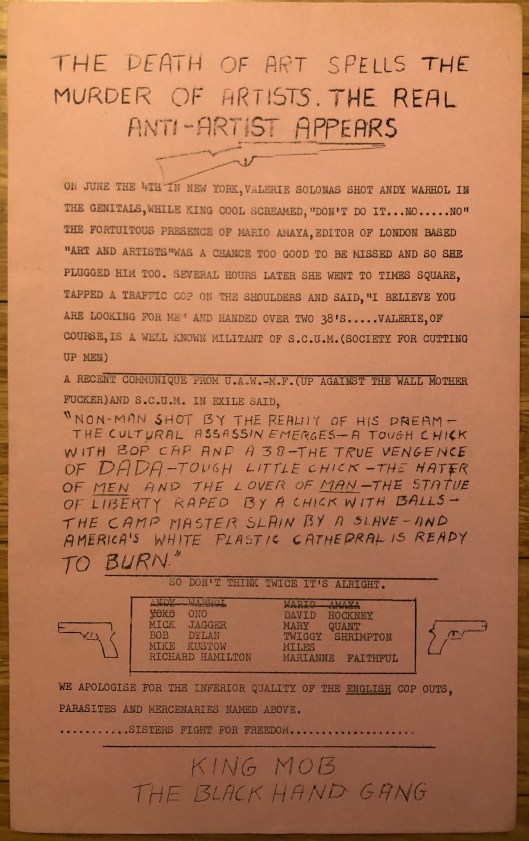
KING MOB. The Death of Art Spells the Murder of Artists. The Real Anti-Artists Appear. n.p. [London, United Kingdom]: King Mob / The Black Hand Gang, n.d. [1968]. 1 p.; ill.; 21 x 34 cm.; black ink on pink stock.

2020-07-11 16.42.08

Violent anti-art leaflet calling for the imitation of Valerie Solanas’ shooting of Andy Warhol, followed by a list of potential targets- Yoko Ono, Mick Jagger, Bob Dylan, Mike Kustow, Richard Hamilton, David Hockney, Mary Quant, Twiggy Shrimpton, Miles, Marianne Faithful. The names of Andy Warhol and Mario Amaya are crossed out, as both had both been shot by Solanas (Warhol was severely wounded in the attack)

“Gradually, the attack on art acquired a quasi-terrorist edge later highlighted in the leaflet celebrating Valerie Solanas’ attempted offing of Andy Warhol in New York. A leaflet was rapidly produced entitled, ‘The death of art spells the murder of artists. The real anti-artist appears.‘ which rounded off with a death list of mainly English artists playing on and detourning the Bob Dylan lyric; ‘so don’t think twice, it’s alright.’ Again, though our leaflet said little or nothing about this and despite having this leaflet to hand, an intervention was done without sufficient explanation, though for sure it helped promote our terrifying image but not much else. A band of King Mob adherents with masks covering their heads and faces burst into a meeting of students occupying Hornsey College of Art, in north London and showered the gathering with leaflets. Insults were traded, ‘fucking art students without an idea’ and inevitably the protagonists were thrown out. To be sure, the level of action and discussion among Hornsey students was fairly abysmal – even stupid – but perhaps there were better ways of getting something essential across rather than exclusively utilizing threatening images. Well, maybe because nonetheless a tiny minority of these art students did pick something up from the King Mob, Valerie Solanas leaflet even though we weren’t aware at the time. Our mock death threats had however been building up over the previous months…Finally it must be emphasised that these death threats were nothing more than aggressive image making tactics to purposefully inspire fear as none of us entertained the slightest intentions of offing artists; we merely wanted to encourage them on their way, pushing them towards the self-destruction of their own artistic roles” (David and Stuart Wise, King Mob: A Hidden Critical History, pp. 79-80)

We locate a copy at the Tate as part of the King Mob archive

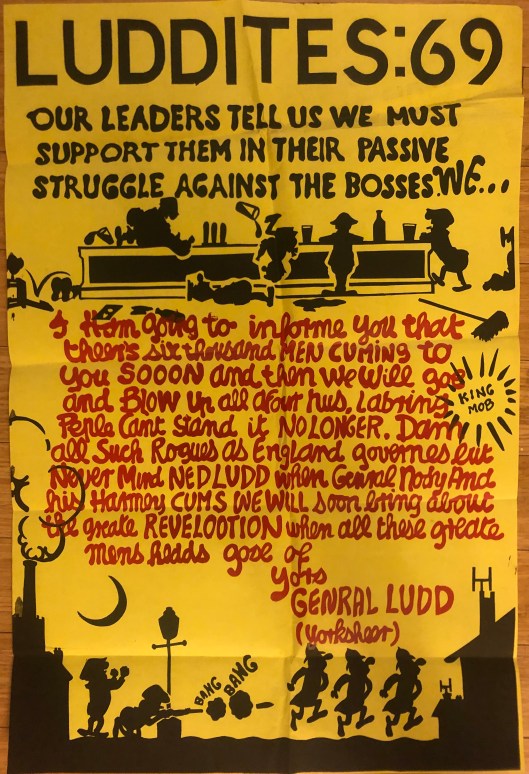
Boredometer of the Rise and Fall of the New Proletarian Poverty, Figuring Lancaster Student Occupation [1970s]

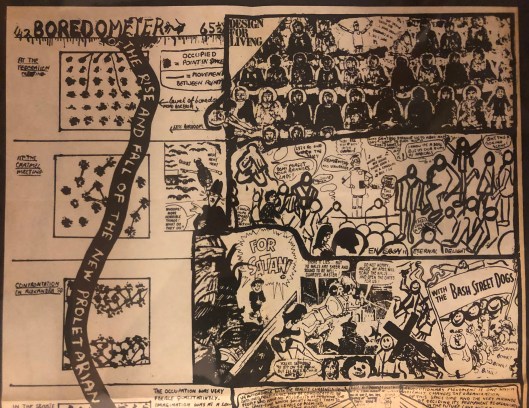
[KING MOB / Ron Hunt?]. Boredometer of the Rise and Fall of the New Proletarian Poverty, Figuring Lancaster Student Occupation. n.p. [United Kingdom]: n.p., n.d. [1970s]. 1 p.; ill.; 42 x 59 cm.; black ink on white stock

Little is known about this spectacularly visual poster. It offer a critical commentary on the Lancaster Student Occupation, which allows us to date it back to the early 1970s. This situ-style detournement of “Bash Street” comics suggests it could have been produced by Ron Hunt or members of King Mob (the language is very similar to the Bash Street Kids to go the Sit-in leaflet, which we posted about early this week) but we are not altogether certain). Readers with more information should contact us

“The occupation was very feeble qualitatively. Imagination was at a low bar. ‘Politics’ was in charge. People sat on their arses listening to people talking (a la J.C.R or seminar group or lecture) rather than extending themselves as far as the creative social imagination could reach; thus a good opportunity for a collective celebration was lost due to basically sexual timidity and deferential respect for property and persons, two major blocks to the realisation of the human imagination in life”

We do no locate copies on OCLC or in the trade

2020-07-11 16.30.392020-07-11 16.30.51

2020-07-11 16.30.56

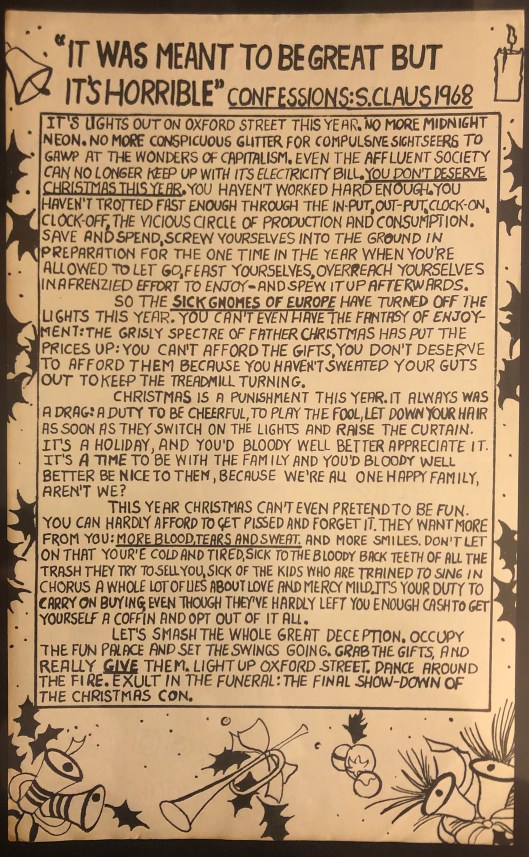
It Was Meant To Be Great But It’s Horrible” Confessions: S. Claus 1968 [1968]

[KING MOB]. It Was Meant To Be Great But It’s Horrible” Confessions: S. Claus 1968 . n.p. [London, United Kingdom]: n.p. [King Mob], n.d. [Dec. 1968]. 1 p. (two-sided); 21 x 34 cm.; black ink on white stock. 1 p.; ill.; 21 x 34 cm.; black ink on white stock

Description below courtesy of bookseller Andrew Sclanders at beatbooks. See here. I could not have written a better description of this item.

2020-07-11 16.05.56

“Written by Dave Wise and Ian and Diana Clegg, and distributed to shoppers in Oxford Street by King Mob during their anti-consumer intervention at Selfridges department store in December 1968. Text, with Christmas decorative illustrations designed by Dave Wise.

A King Mob contingent (including Fred Vermorel and Malcolm McLaren) visited Selfridges during Christmas 1968 and, with an amphetamine-fueled Ben Trueman dressed as Santa Claus, proceeded to give away free gifts to children. After the police were called, ‘Santa’ was arrested and the kids were made to give their presents back.

The texts reads [in part]: “It’s lights out on Oxford Street this year. No more midnight neon. No more conspicuous glitter for compulsive sightseers to gawp at the wonders of capitalism…You don’t deserve Christmas this year. You haven’t worked hard enough. You haven’t trotted fast enough through the in-put, out-put, clock-on, clock-off, the vicious circle of production and consumption. Save and spend, screw yourselves into the ground in preparation for the one time in the year when you’re allowed to let go, feast yourselves, overreach yourselves in a frenzied effort to enjoy – and spew it up afterwards”.

McLaren, who incorporated King Mob’s ideas into his promotion of the Sex Pistols (he based his ragged handwritten ‘Anarchy in the UK Christmas Day’ flyer for their Christmas 1977 concert in Huddersfield on this broadside), later mythologized the event in his 1991 film, ‘Ghosts of Christmas Past’ (Beatbooks)

See David Wise – King Mob: A critical Hidden History, p. 232

We locate a copy at the Tate (part of the King Mob collection) and another one at Yale.

The Bash Street Kids Go to the Sit-in [1969]

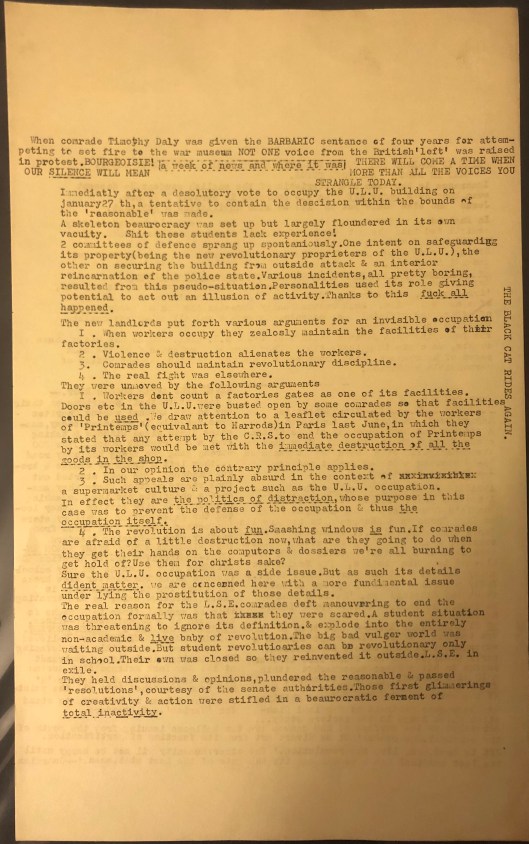
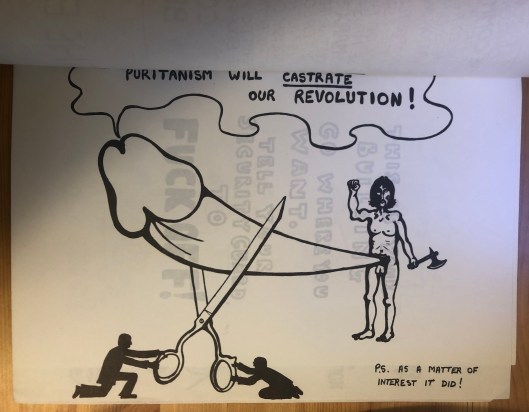
[KING MOB / Ron Hunt]. The Bash Street Kids Go to the Sit-in. n.p. [London, United Kingdom]: n.p., n.d. [ca. 1969]. 1 p. (two-sided); 21 x 34 cm.; black ink on white stock.

Leaflet passing a harsh judgment on student sit-ins in Cambridge and at the LSE: “And with this void at its heart the student participators in the sit-in could never achieve anything…How many lessons will the student need?? We shall be fortunate indeed if his puerile masochism cannot withstand the necrophilia that was the sit-in…”

Then, authors state the need for the revolution to be one of everyday life “Our theory is one of total liberation, our practice to bring this about as completely as possible at every level and every stage before the revolution. We therefore only come together in small groups, we groove together, make love together…We find affirmation in each other of our will to LIVE”.

The text ends with a call to action: “To despise the bourgeoisie means : EVERYTHING IS PERMITTED. Let nothing we hate, let no symbols of our alienation remain. We shall strike against our oppressors whenever and wherever we can. PAINTING WALLS, FLY POSTING, THEFT, SABOTAGE, ARSON. SHEER DELIGHT. TO LIVE MEANS TO ENJOY. ALL STUDENTS ARE POTENTIAL PROLETARIANS”

We locate copies at the Tate (part of the King Mob archive) and at the British Library. Not in David Wise’s King Mob – A Critical Hidden History.

Readers who have more context and information on this leaflet are encouraged to comment or contact me

2020-07-11 15.40.552020-07-11 15.41.06

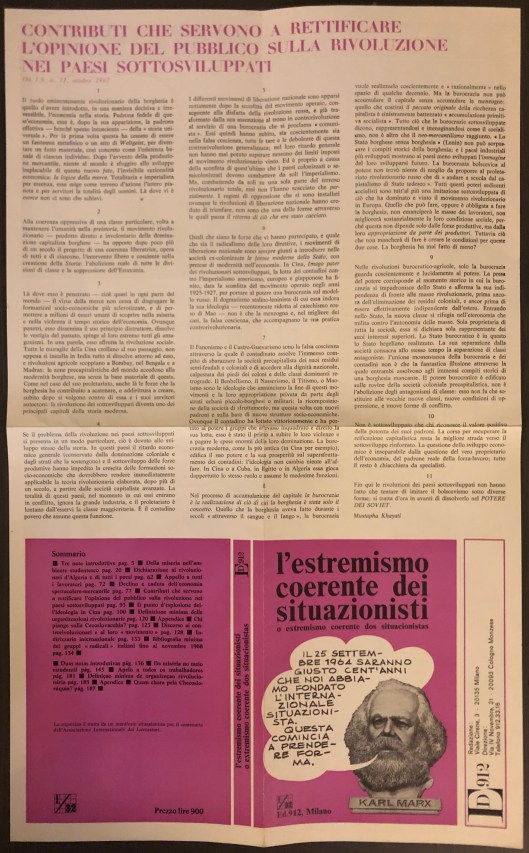
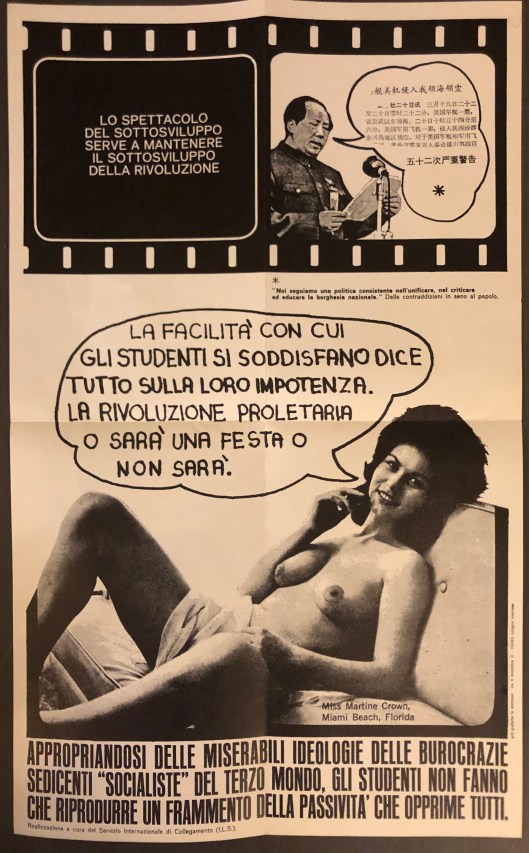
Contributi Che Servono a Rettificare l’Opinione del Publico Sulla Rivoluzione nei Paesi Sottosviluppati [1968]

KHAYATI, Mustapha. Contributi Che Servono a Rettificare l’Opinione del Publico Sulla Rivoluzione nei Paesi Sottosviluppati. Milan: Ed. 912, n.d. [1968]. 1 p. (two sided); ill.; 31 x 50 cm.; black and purple ink on white stock.

Two-sided poster released by Ed. 912 to promote the publication of l’estremismo coerente dei situazionisti, the first Italian language compendium of Situationist texts.

Side A: (1) Italian translation of Khayati’s “Contributions servant à rectifier l’opinion du public sur la révolution dans les pays sous-développés” (which was initially published in Internationale Situationniste 11 in October 1967); (2) front and back covers of the book L’estremismo coerente dei situazionisti.

Side B: Two detournements: (1) Mao shown reading a speech, stating “Noi seguiamo una politica consistente nell’unificare, nel criticare ed educare la borghesia nazionale” (Trans: “We do not follow a policy of unifying, criticizing and educating the national bourgeoisie”). The text is taken from Mao’s speech at the Eleventh Session of the Supreme State Conference, and was published in the People’s Daily on June 19, 1957. A longer excerpt (for context) follows

The contradiction between the national bourgeoisie and the working class is one between exploiter and exploited, and is by nature antagonistic. But in the concrete conditions of China, this antagonistic contradiction between the two classes, if properly handled, can be transformed into a non-antagonistic one and be resolved by peaceful methods. However, the contradiction between the working class and the national bourgeoisie will change into a contradiction between ourselves and the enemy if we do not handle it properly and do not follow the policy of uniting with, criticizing and educating the national bourgeoisie, or if the national bourgeoisie does not accept this policy of ours

(2) A naked Miss Martine Crown, from Miami Beach Florida, stating “La facilita con cui gli studenti si soddisfano dice tutto sulla lor impotenza. La rivoluzione proletaria o sara una festa o non sara” (trans: The ease with which students are satisfied says everything about their impotence. The proletarian revolution will either be a celebration or it will not be”). At the bottom of the page: “appropriandosi delle miserabili ideologie delle burocrazie sedicente socialiste del terzo mondo, gli studendi non fanno che riprodurre un frammento della passivita’ che opprime utti” (trans: “appropriating the miserable ideologies of the self-styled socialist bureaucracies of the third world, the students only reproduce a fragment of the passivity that oppresses all”)

Not on OCLC or in the trade

For an English language broadside of the same text, see: https://situationnisteblog.com/2013/06/04/contributions-serving-to-rectify-the-opinion-of-the-public-concering-the-revolution-in-underveloped-countries-1973/

For a Spanish language broadside of the same text, see: https://situationnisteblog.com/2014/08/13/la-verdad-de-los-paises-subdesarrollados-en-la-revolucion-internacional-1973/

For the book l’Estremismo coerente dei situazionisti, see https://situationnisteblog.com/2020/02/18/lestremismo-coerente-dei-situazionisti-1968/
2020-07-06 19.05.562020-07-06 19.06.20

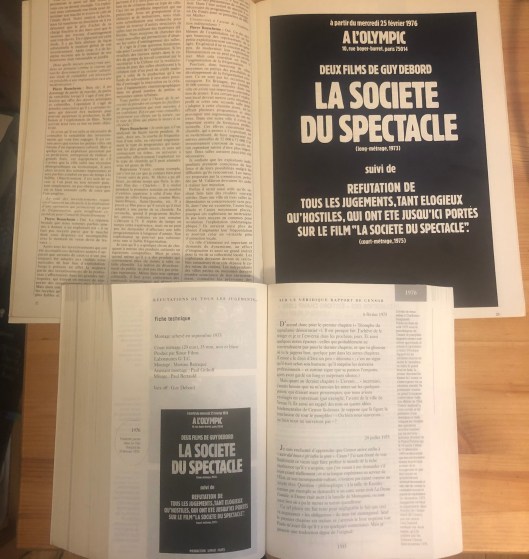
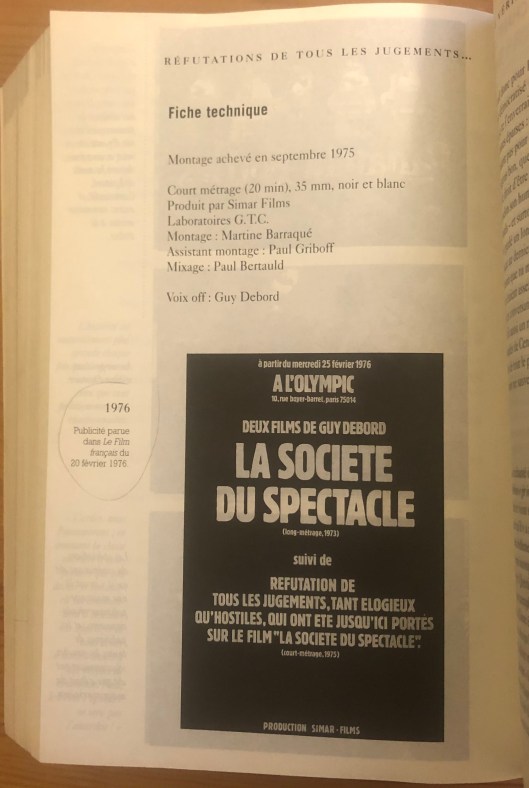
A partir du mercredi 25 fevrier 1976 a l’Olympic…deux films de Guy Debord [1976]

[DEBORD, GUY]. [“A partir du mercredi 25 fevrier 1976″…] in Le Film Francais 1613. Paris: Le Film Francais, 20 Feb 1976.

Full page advertisement promoting the screening of Guy Debord’s films La Societe du Spectacle and Refutations de tous les jugements… at the Olympic Cinema in Paris, starting on February 25, 1976. The Olympic was the property of Frederic Mitterand, a nephew of French President Francois Mitterand (he would go on to become Minister of Culture and Communiation under Nicolas Sarkozy in 2009).

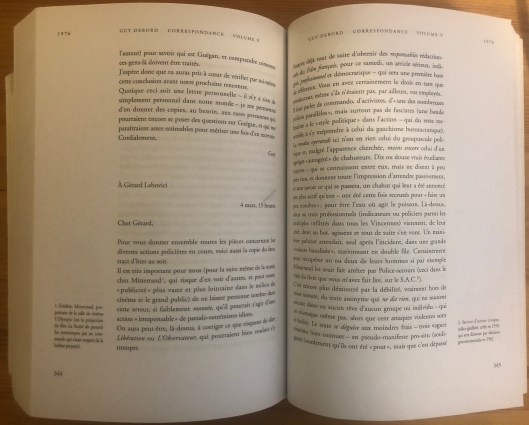
The screening of Debord’s films was disrupted when a commando unit seized the film reel. In a letter to Gerard Lebovici dated 5 March 1976, Debord discusses the incident and recommends that Lebovici follow a defined course of action, including press coverage of the incident (“an indignant, professional and democratic article” in Film Francais — which would never be written…)

The ad is reproduced in Oeuvres, p. 1314

2020-07-03 22.49.062020-07-03 22.49.492020-07-03 22.59.042020-07-03 22.59.332020-07-03 23.02.362020-07-03 23.03.55

Asger Jorn – Peintures et Gouaches-Decollages, Calligraphie desorientee [1965]

[JORN, Asger]. Asger Jorn – Peintures et “Gouaches-Collages”. “Calligraphie désorientéee. Paris: Galerie Rive Gauche, June 1965. n.p. [16 p.]; ill.; 21 x 18 cm.; ill. Wrappers reproducing one of Jorn’s paintings.

Catalog from the exhibition held at the Galerie Rive Gauche in France in June 1965. Includes excerpts of an article by H.C.L. Jaffe, which was originally published in “De Groene Amsterdammer” on the occasion of Jorn’s exhibition at the Stedelijk Museum, Amsterdam in 1965. 6 B&W illustrations. Presentation of works published by the Institut Scandinave de Vandalisme Compare.

Lacroix 237. We locate 7 copies on OCLC.

2020-07-03 17.49.362020-07-03 17.49.472020-07-03 17.50.022020-07-03 17.50.102020-07-03 17.51.042020-07-03 17.51.132020-07-03 17.51.272020-07-03 17.51.382020-07-03 17.51.492020-07-03 17.51.582020-07-03 17.52.102020-07-03 17.52.192020-07-03 17.52.322020-07-03 17.52.422020-07-03 17.53.04

L’Estetico il Politico da Cobra all’Internazionale Situazionista 1948-1957 [1977]

BANDINI, Mirella.L’Estetico il Politico da Cobra all’Internazionale Situazionista 1948-1957.  Rome: Officina Edizioni, October 1977. 391 p.; ill.; 24 x 15.5 cm.; black cover with text in white and green.

“A comprehensive, well-illustrated work, covering the early years of the S.I. and divided into three majors sections; ‘L’Internazionale Situazionista’, ‘Documenti’, and ‘Cronologia, Schede bio-bibliografiche, Glossario, Bibliografia’. The documents section includes any key texts, some reproduced in facsimile (eg part of Jorns ‘Peinture detournee’ – 1959, and ‘Ein Kultureller Putsch – wahrend Ihr schlaft! – 1959). The ‘bio-bibliographies’ are of Constant, Guy Debord, Pinot-Gallizio, and Asger Jorn. There is also a general bibliography of much continental material (mostly Italian) not included in this bibliography.” (Ford,  p. 2)

Guy Debord was made aware of Bandini’s project in 1975, as she had reached out to him for more information. In a letter to Gianfranco Sanguinetti dated 10 October 1975, he writes “”An Italian woman, who will soon publish a collection about Gallizio, with a very unintelligent but quite honest introduction, and full of charming documents, and who also is preparing a book on the origins of the SI, has written to me and asks for your address. Do you want me to give it to her, and which one (c/o the Doge)?” (Correspondance Vol. 5, p. 298; emphasis is mine) translation courtesy of NOTBORED!). It is unclear whether Debord and Bandini corresponded further on the subject; the Correspondance does not include any letter.

Bandini’s book is an important and lasting contribution to SI scholarship. The book, which had been out of print for many years, was published once more in 1999 (Ed. Costa & Nolan). A French translation was published by Editions Sulliver in 1998, but is out of print.

Chollet 344; Correspondance Vol. 5, p. 298 ; Ford 4; Gonzalvez 180-181; Trespeuch 67

2020-07-03 14.00.332020-07-03 14.00.472020-07-03 14.01.562020-07-03 14.02.042020-07-03 14.02.112020-07-03 14.02.182020-07-03 14.02.312020-07-03 14.02.462020-07-03 14.02.552020-07-03 14.03.042020-07-03 14.03.15


Pourquoi je ne vote pas [2019]

VANEIGEM, Raoul (Ill. GHIN, Joseph). Pourquoi je ne vote pas et autres inedits – Tome 2. In sheets (8 sheets); ill.; 54 x 36 cm. (folded to 27 x 36 cm.); black ink (Garamond 28 font) on 250 gr. Fabriano Rosaspina paper

One of 30 copies (our #1), numbered and signed at the Colophon by author Raoul Vaneigem and illustrator Joseph Ghin. Housed in a tailor-made case by Patricia Demylle.

The is the second of two volumes of the original edition of Raoul Vaneigem’s Pourquoi je ne vote pas et autres inedits. A trade edition book was also published by “Cactus inebranlable” in 2017 Each of the sheets include an aphorism by Raoul Vaneigem and an engraving.

For the first volume, published in 2017 and now out of stock, see here

We do not locate copies in the trade or on OCLC.

2020-06-25 00.56.562020-06-25 00.57.332020-06-25 00.57.422020-06-25 00.58.052020-06-25 00.58.542020-06-25 00.59.092020-06-25 00.59.492020-06-25 01.00.302020-06-25 01.00.482020-06-25 01.01.062020-06-25 01.01.232020-06-25 01.01.46

[DEBORD, Guy] Déclaration des « Éditions Champ Libre » (in Le Monde no. 9669, 24 Feb 1976, p.7)

[DEBORD, Guy]. Déclaration des « Éditions Champ Libre » (in Le Monde no. 9669, 24 Feb 1976, p.7). Paris, 24 Feb. 1976.  36 p.; 34 x 50 cm.; black ink on newspaper stock

The “Declaration des ‘Editions Champ Libre’ “, which first appeared as a half-page ad in issue 9669 (24 February 1976) of Le Monde, was written in the aftermath of Gianfranco Sanguinetti’s arrest and expulsion at the French border on 11 February 1976. In a letter to Jaime Semprun, Debord states that he is the author of this text: “Tu as très justement reconnu mon style dans le communiqué sur la dernière aventure frontalière de Sanguinetti, et parfois ailleurs” (Letter to Jaime Semprun, 26 Dec. 1976 — reproduced in DEBORD, Guy. Correspondance Vol 5, p. 396).

The Declaration appears on the back cover of Correspondance des Editions Champ Libre. Volume 1 (October 1978). It is also reproduced in Guy Debord’s Oeuvres (p. 1316). Online version available here: http://debordiana.chez.com/francais/preuves.htm and in translation at https://libcom.org/library/declaration-editions-champ-libre

We locate a copy at Yale’s Beinecke Library as part of the Gianfranco Sanguinetti papers (binder 15bis, box 23)

The full text, in translation, is reproduced below

Declaration of Editions Champ Libre

Gianfranco Sanguinetti, Italian, author of a Truthful Report on the Last Chances to Save Capitalism in Italy, the [French] translation of which Editions Champ Libre published on 8 January [1976], having presented himself at the French border on 11 February, was turned back due to the application of a “refusal of stay” decision taken on 21 July 1971 by Marcellin, the Minister of the Interior. We know that this kind of administrative manifestation of national security requires no judicial approval, cannot be appealed and thus is permanent. Even though the political regimes in Europe want to make small changes in their continuity, this naturally does not have any bearing on those who contest all of those regimes equally.

We are modestly aware of the fact that it is only fair to have recourse to advertising to put before the eyes of the reader – at every instant occupied with so much other pertinent and important news that is constantly of universal relevance and that concerns him personally – a simple, particular phenomenon that can only interest a few private individuals.

In fact, we do not have the presumptuousness to insinuate that the critique of capitalism could at all concern our contemporaries, their work, their ways of making a living, their ideas or their pleasures. We do not ignore the facts that, even as a subject for scholarly discussion limited to a small number of experts, the very justness of the concept of that critique has been controversial and that capitalism, as a hypothesis, is no longer of contemporary interest, because the Thought of Vincennes – at which the best-recycled professors have decided upon the dissolution of history and the prohibition of the criteria of truthfulness in discourse, which is something that is very rich in consequences for them – recently leapt beyond it.

Furthermore, we are not assured that, somewhere, there really exists a geographical (and an economically quite weak) entity called Italy. And, where Italy’s economy is concerned, the eminent leaders of the Common Market – even if the principle of the free circulation of commodities is as much their affair as the free circulation of people – have other reasons to doubt its existence.

The actual existence of Gianfranco Sanguinetti himself – either as the author of a Western samizdat or as the target of some liberal-advanced Gulag – is highly questionable. If we, on the unique basis of the magnitude of a public rumor (which also remains outside of our borders), allow ourselves to positively affirm the reality of his existence, his writings and the diverse and harmless police persecutions that have followed from them, one could retort that no one here in France has ever heard of him, and we [as his publisher] feel all the weight of such an objection.

We will also frankly state that we know a number of estimable people who, working for the newspapers or the distributors of books, do not hide the fact that they have been led to conclude that Editions Champ Libre also does not exist, and, for our part, we do not pretend to have the boldness to settle such an obscure question and thus go against the honest convictions of so many competent people by basing ourselves only upon our contingent desires and limited personal interests.

Given all this, we nevertheless will not allow ourselves to leave open the question of knowing if the world in which we live – the world of which you read all the most up-to-date news every day – truly exists. We are in a position to be assured that, for the moment, it still does.

2020-06-15 20.37.212020-06-15 21.13.372020-06-15 21.34.522020-06-15 22.22.25