The Situationist International at the Antwerp Congress – original photograph by Leo Dohmen [1962]

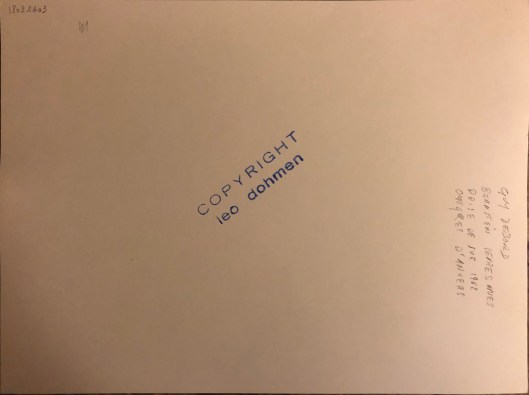
[The Situationist International at the Antwerp Congress – original photograph by Leo Dohmen]. n.p. [Antwerp]: n.p. [Leo Dohmen], n.d. [November 1962]. 17.8 x 23.8 cm.; B&W photograph on photographic paper with Leo Dohmen’s copyright stamp.

IMG_3246IMG_3247

Original photograph documenting the 6th congress of the Situationist International, held in Antwerp (Belgium) from 12 to 15 November 1962. One can recognize Guy Debord and Attila Kotanyi in deep conversation underneath a “Guide Psychogeographique de Paris” (1957), while Michele Bernstein is not far away in the background.

Photograph Leo Dohmen took the picture. “Leo Dohmen was with Raoul Ubac and Marcel Lefrancq one of the few representatives of the surrealist photography in Belgium. He was a legendary figure in the post-war Antwerp artistic circle. Because of his tumultuous and flamboyant lifestyle he was his friends gave him the nickname ‘the Pirate’. Dohmen was a man of seven crafts: chemist and engineer at Agfa Gevaert and Esso, a bartender from an illegal nightclub, an art dealer and a gallery owner and – especially – photographer. In his surrealist photographs, collages and assemblages he was always looking for a shock effect that he reached through the combination of strange elements. He was inspired by Marcel Duchamp and Man Ray, whom he often met. In 1959 he worked on the scandal film ‘L’imitation du Cinema’ with his eternal accomplice Marcel Mariën. Together with Mariën he also made the photo montage for the famous pamphlet ‘Grande Baisse’ (1962), which was ridiculizing the success of Rene Magritte” (Ronny Van de Velde)

Galerie Taptoe: Baj, Rein d’Haese, Roel d’Haese, Ting, Wyckaert…[1956]

Galerie Taptoe Baj, Rein d’Haese, Roel d’Haese, Ting, Wyckaert…[1956]. Brussels: Galerie Taptoe, 1956. 1 p.; ill.; 40 x 87 cm.; black and red ink on yellow stock

Poster announcing the famed collective exhibition of COBRA artists held at Galerie Taptoe between July 31 and September 26, 1956. The lithograph is the work of Maurice Wyckaert, while the design is by polish typographer and artist Corneille Hannoset.

Scarce, with a single copy located on OCLC (Yale)

We have already featured the leaflet issued on the occasion of this exhibition: https://situationnisteblog.wordpress.com/2018/09/26/alechinsky-appel-baj-jorn-rein-dhaese-roel-ting-wyckaert-et-dotremont-avec-cobra-1956/

For more about Galerie Taptoe, see Yale’s Beinecke Library page: https://www.postwarcultureatbeinecke.org/taptoegallery

IMG_3242

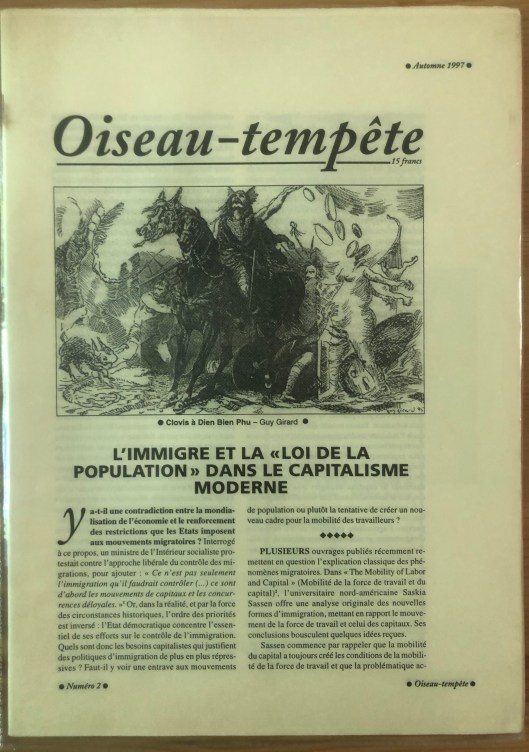
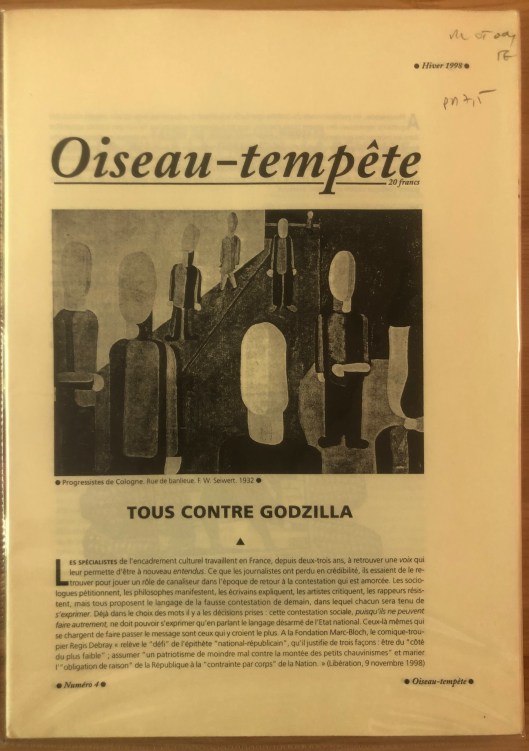
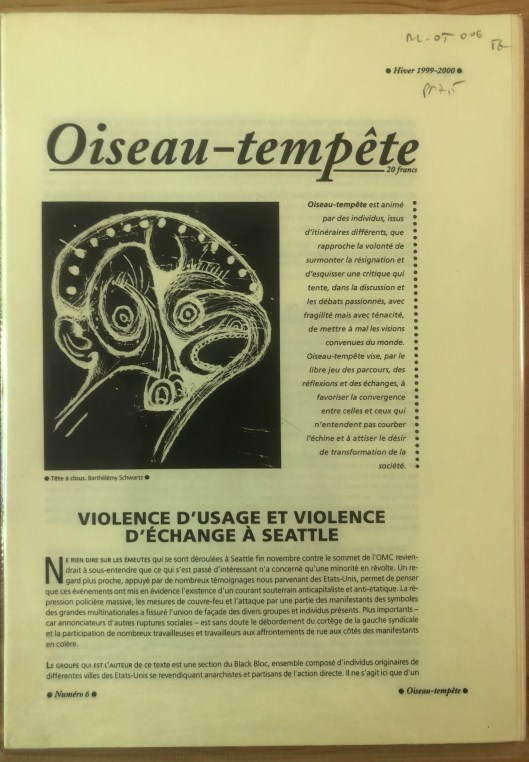
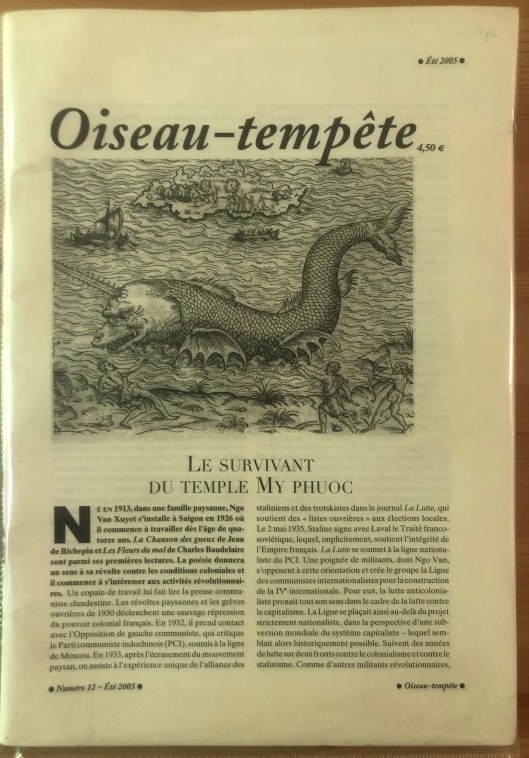
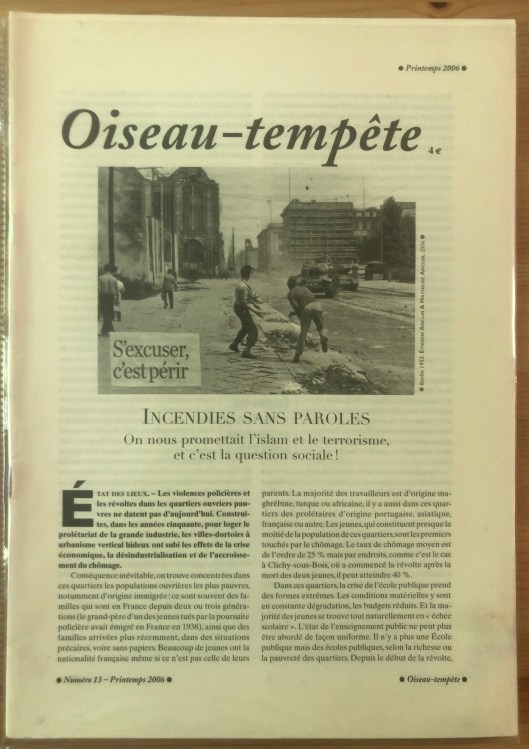
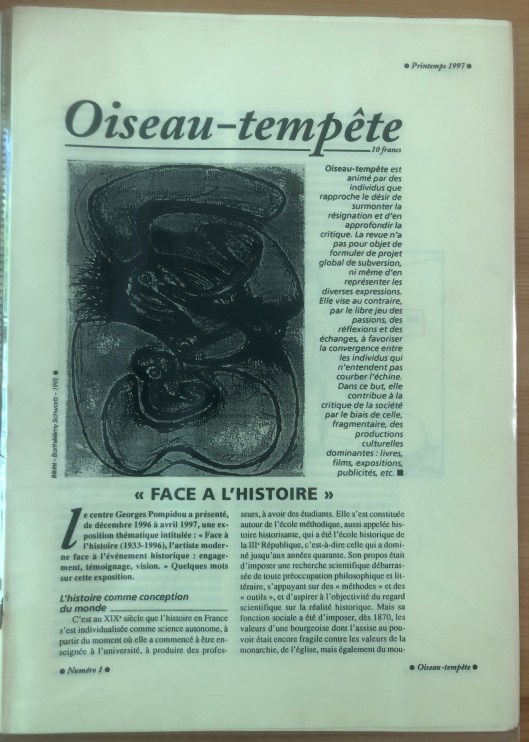
Oiseau-tempête 1-13 [1997-2006]

Oiseau-tempête: revue de critique sociale 1-13. Paris: Ab Irato, 1997-2006. 13 issues (20-80 pp. each), 21 x 30 cm.; ill.; black ink on cream stock + 1 “Hors Serie” (December 2001), 4 p.; ill.; 42 x 60cm; Blue and white ink on plain stock.

Launched in 1997, Oiseau-tempête “stood at the confluence of Situationist ideas and Surrealist aesthetics” (Marcolini 220, translation is mine). It was put together by a “collective of a dozen individuals with varied perspectives, inspired by anarchist, marxist, situationist and surrealist ideas” (ibid). Barthélémy Schwartz, who later launched “Editions Ab Irato”, was a major figure of the periodical. The name Oiseau-tempête refers to a a seabird (the petrel) that foretells tempests. It also alludes to Edward Sexby.
For additional information, see this interview . All the issues are available in PDF format at Archives Autonomie and can be downloaded free of charge.

2019-06-01 11.34.252019-06-01 11.34.392019-06-01 11.34.572019-06-01 11.35.112019-06-01 11.35.282019-06-01 11.35.552019-06-01 11.36.162019-06-01 11.36.462019-06-01 11.37.032019-06-01 11.37.182019-06-01 11.37.342019-06-01 11.37.522019-06-01 11.38.072019-06-01 11.38.38


Théâtre/Public no. 231 – Internationale Situationniste: Theatre, Performance

Théâtre/Public no. 231. Internationale Situationniste: Theatre, Performance. Montreuil: Editions Theatrales, January 2019. 184 p.; 21 x 30 cm.; ill. cover.

231_001def.indd

Issue of the periodical Theatre/Public devoted to the Internationale Situationniste and its relationship with theater and performance.

Théâtre/Public is a quarterly periodical focused on theater, considered from an aesthetic, cultural and political angle. Its editorial committee incudes Jean-Louis Besson, Christian Biet, Claire Finburgh, Alain Girault, Jean Jourdheuil, Olivier Neveux, Michèle Raoul-Davis, and Bernard Sobel. Olivier Neuveux serves as editor-in-chief.

This issue includes the following articles:

  • Clare Finburgh Delijani. Déborder le cadre. L’Internationale situationniste, le théâtre et la performance
  • Cristina De Simone. Le dire de Debord. Esquisse d’une généalogie lettriste
  • Clare Finburgh Delijani. « Élargir la part non médiocre de la vie ». La situation construite et le théâtre contemporain
  • Gary Winters and Claire Hind. Les Masses noires. Subversion d’un concept du XVIIIe siècle ou La transformation de la Page noire de Laurence Sterne en fenêtre sur le paysage shandynien
  • Dominic Paterson. Possessions. Scott Myles et l’invocation-évocation artistique de l’Internationale situationniste
  • Entretien avec Graeme Miller, réalisé par Clare Finburgh Delijani. « Ces portes entrouvertes qui filtrent le monde »
  • Karolina Svobodova. Le situationnisme en Belgique. Histoires, coïncidences, détournements
  • Entretien avec Noël Godin, réalisé par Karolina Svobodova. Intervenir. Interrompre. Perturber
  • Karolina Svobodova. Liège, le Cirque Divers, un espace, un temps
  • Karel Vanhaesebrouck. Jan Bucquoy ou l’art du dérèglement
  • Entretien avec Benjamin Verdonck et Emilio López-Menchero, réalisé par Karel Vanhaesebrouck. « Démanteler le spectacle en utilisant le spectacle »
  • Marielle Pelissero. L’écho des situs à New York : un gouffre atlantique qui s’élargit ?
  • Entretien avec Peter Eckersall, réalisé par Marielle Pelissero. « L’authenticité est expérimentée à travers le corps »
  • Entretien avec Esther Neff, réalisé par Marielle Pelissero. « Les théories de l’I.S. sont incroyablement “européennes” »
  • Entretien avec Tim Griffin, réalisé par Marielle Pelissero. « Derrière chaque projet, une économie entière structure l’expérience »
  • Guy Spielmann. Du « situationnisme »au punk (1967-1977). La bande-son qu’il manquait à Mai 68
  • François Coadou. Les situationnistes et l’exposition. Entre laboratoire et manifeste : à la recherche de nouvelles formes d’action
  • Vanessa Theodoropoulou. Lutte et représentation. Modalités de l’action et performativité chez les situationnistes
  • Patrick Marcolini. La fin de l’art et ses suites. Sur un paradoxe situationniste
  • Marcello Tarì. « Une terrible beauté est née ». Sur la relation entre les situationnistes et le Mouvement de 77 en Italie

Constant’s “Niewu Urbanisme” in Provo 9 [1966]

CONSTANT (Nieuwenhuis). Nieuw Urbanisme (in Provo 9). Provo: Amsterdam, 12 May 1966. 48 pp.; ill.; offset-printed, 29.7 x 10.5 cm. Ill. white wrappers with text in black and red.

Constant’s article is his intellectual contribution to the Provo movement.

“Nieuw Urbanisme” was first translated into English and published by The Friends of Malatesta, Buffalo NY, 1970. It is available at http://www.notbored.org/new-urbanism.html. The text in the original Dutch is available here: https://stichtingconstant.nl/system/files/pdf/1966%20Nieuw%20Urbanisme_0.pdf

IMG_2507IMG_2508IMG_2509IMG_2510


Andre Frankin in Arguments (1960 and 1962)

About Andre Frankin. “André Frankin is not well-known and his impact on the lettrist and situationist movements are hard to measure” states scholar Jean-Marie Apostolides. André Frankin (also know “Robert Rivier” and “Léonard Rankine”) was born on 16 June 1925 in Liege, Belgium and died in the same city on 28 March 1990. Born into a middle class family, he suffered from neurological issues as a child that left him partially disabled – he walked and, at times, spoke with difficulty. Yet, he was viewed as intelligent and well-read. He first met Debord and the Internationale Lettriste through the Metagraphies exhibition in Paris in 1954. He then wrote several articles in Potlatch under the pseudonym “Leonard Rankine”, including “Perspectives of the Paris and London agreements” (Potlatch 15, December 1954). His contributions to the SI include: “Platform for a cultural Revolution” (Internationale Situationniste 3, December 1959), “Programmatic Outlines” (Internationale Situationniste 4, June 1960), and “Preface to the Scenic Unity” (Internationale Situationniste 5, December 1960).

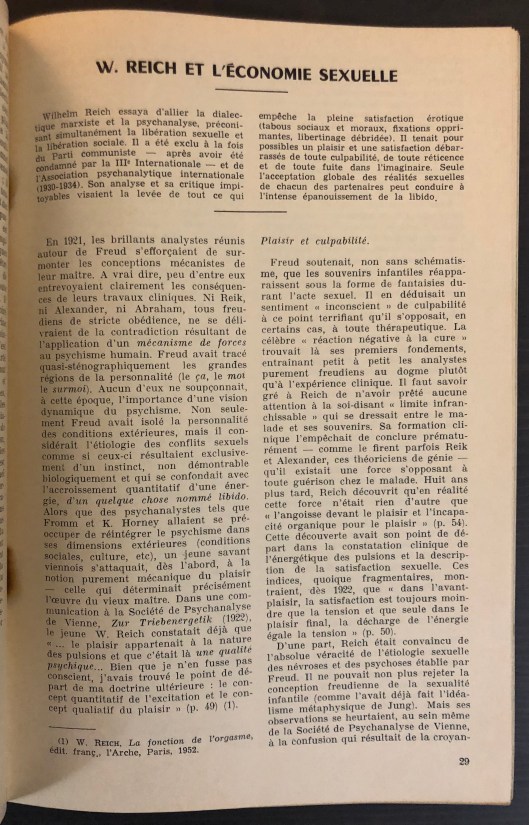
FRANKIN, Andre. Wilhelm Reich et l’economie sexuelle (in Arguments 18, 1960). Paris: Editions de Minuit, 1960. 64p.; 14 x 22.5 cm.; cream wrappers with text in black and red.

Writte while he was a member of the Internationale Situationniste, Andre Frankin’s “W. Reich et l’economie sexuelle” was published in issue 18 of Arguments (pp. 29-35). In this substantial article, Frankin provides an introduction to controversial psychoanalyst Wilhelm Reich, who had passed away 3 years before in New York. According to Frankin, “Wilhelm Reich attempted to combine Marxist dialectics and psychonalaysis, advocating for both sexual and social liberation. He was excluded from both the Communist Party…and the International Psychoanalytical Association (1930-1934). His analysis and strong criticism sought to remove all obstacles to full erotic satisfaction…” (pp.29). Post-situationist figure Jean-Pierre Voyer authored an important essay on Wilhelm Reich which was published by Champ Libre in 1971 and subsequently translated into Spanish, Italian, English, German and other languages.


IMG_2460IMG_2461IMG_2462IMG_2463IMG_2464

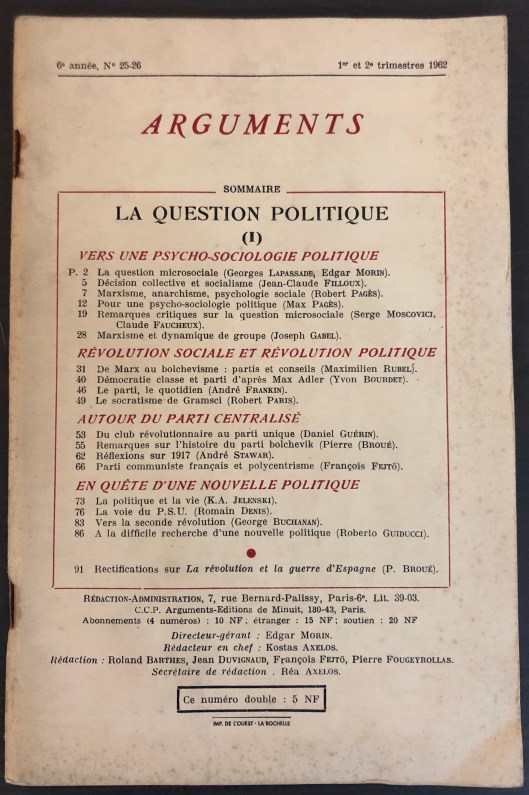
FRANKIN, Andre. Le parti, le quotidien (in Arguments 25-26, 1962). Paris: Editions de Minuit, 1962. 96 p.; 14 x 22.5 cm.; cream wrappers with text in black and red.

Written a few months after his resignation from the Internationale Situationniste in March 1961, Andre Frankin’s “Le parti, le quotidien” was published in issue 25-26 of Arguments (pp. 46-48), The article opens with a quote from noted sociologist Henri Lefebvre, then goes on to argue that the failure of Europen’s political parties can be explained by their inability to access workers’ everyday live. “The party, everyday life: there is no possible balance between the two, there is only a dialectical relationship” argues Frankin (pp. 46). Though Frankin is no longer an official member of the SI, the Situationist overtones are clear here. Debord and Lefebvre had met in 1960 and, despite a relatively quick falling out, the sociologist and his ideas had a major impact on the SI.

IMG_2465IMG_2466IMG_2467


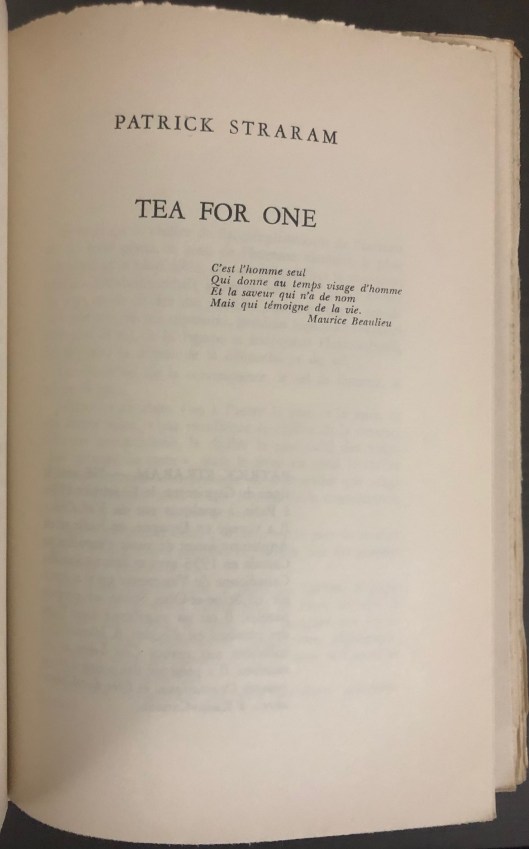
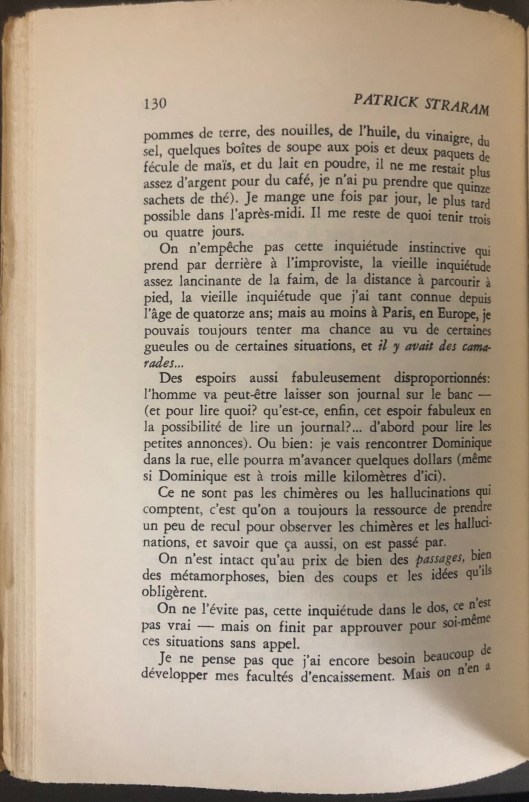
Patrick Straram – Tea for One (in Ecrits du Canada Francais VI) [1960]

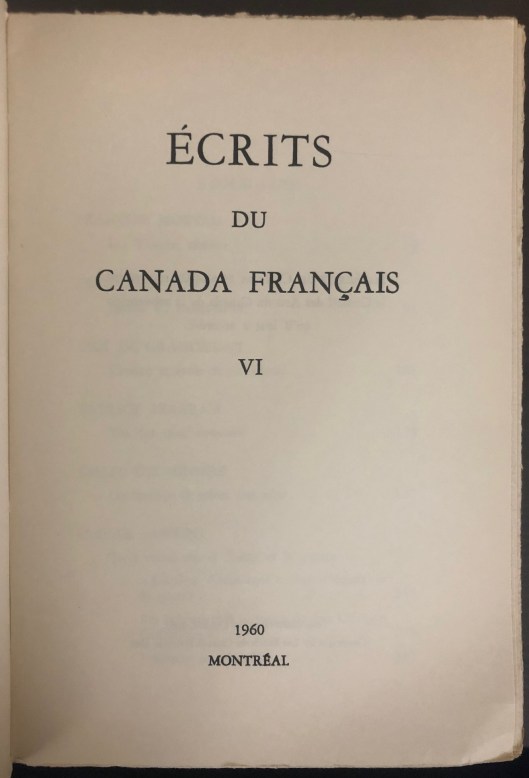
STRARAM, Patrick. Tea for one (in Ecrits du Canada Francais VI). Montreal, 23 Feb. 1960. 347 p.; 14 x 20 cm.; white cover with text in black.

This often-neglected Straram text is a critical milestone in the young man’s personal and intellectual journey.

From a bio-bibliographical standpoint, “tea for one” is important because it is Straram’s first text published in North America. The Frenchman had left Paris in April 1954 – both to flee conscription and settle with his young wife, Lucille – and settled in Vancouver, Canada. After 4 years in British Columbia, where he mostly worked as a woodcutter, Straram relocated to Montreal in June 1958 and resumed the literary life he had put on hold for half a decade. “Tea for one”, which was written in June 1959 and published in February 1960, was praised by literary critics (e.g., Gilles Marcotte in Le Devoir, «Vie des lettres, Tea for one de Patrick Straram», 19 March 1960) and allowed Straram to start building a reputation in Montreal’s literary circles.

“Tea for one” is also important intellectually because it precedes (if only by a few months) the Cahier pour un Paysage a Inventer (see more here: https://situationnisteblog.wordpress.com/2014/02/13/cahier-pour-un-paysage-a-inventer/) This is around the time that Straram had resumed his correspondence with Guy Debord — Debord’s letters to Straram have been translated by Not Bored! and are available here: http://www.notbored.org/debord.html.

The text itself is the account of a type of “urban derive” through Montreal — the Situationist overtones are very clear in it.

“Tea for one” was reprinted in Blues Clair (Montreal: Herbes Rouge, pp.7-42) in 1983

IMG_2448IMG_2449IMG_2450IMG_2451IMG_2452IMG_2453IMG_2454IMG_2455IMG_2457


Die Welt als Labyrinth [2018]

Die Welt als Labyrinth. n.p. [Geneva]: n.p. [MAMCO], n.d. [2018]. 1 p.; ill.; 89,5 x 128 cm; white and red ink on black stock. One of 50 printed.

Poster of the exhibition “Die Welt als Labyrinth” held at the Musee d’Art Moderne et Contemporain (MAMCO) in Geneva from 28 February to 6 May 2018. The illustration is an untitled darboard collage from the Situationist exhibition Destruktion af RSG-6 at the gallery Exi, Odense, Denmark in 1963.

The title of the exhibition “refers to an unfulfilled project for a Situationist exhibition at the Stedelijk Museum Amsterdam in 1960, and shows up one of the questions that are raised by any presentation of these avant-garde movements: how to exhibit in a museum people who were systematically opposed to cultural institutions? Going further than a sabotaging of art through an unconventional register of forms and techniques, it was art as distinct social territory, governed by institutions, and determined by the market economy, that was in these movements’ crosshairs.” (MAMCO)

For more information and pictures of the exhibition, see https://www.galleriesnow.net/shows/die-welt-als-labyrinth/. For a video, see https://vimeo.com/288680033

IMG_2424


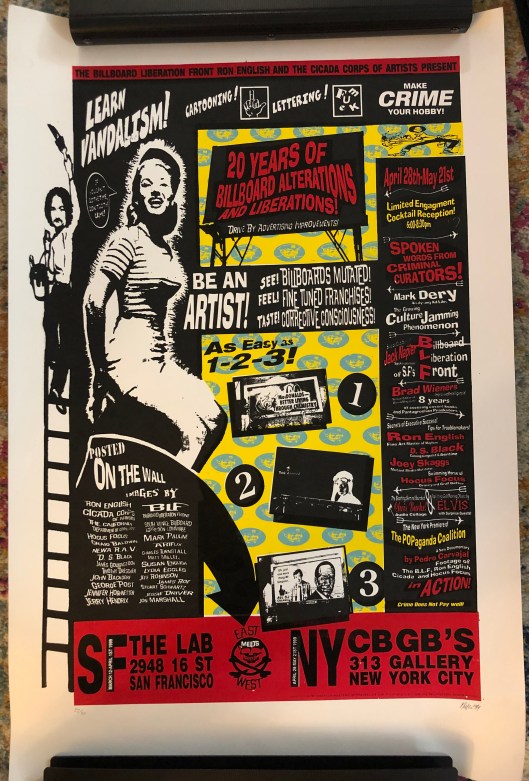
Billboard Liberation Front [1997]

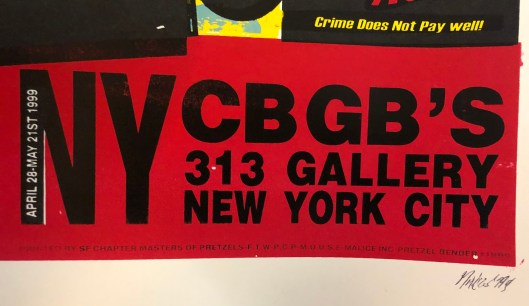
BILLBOARD LIBERATION FRONT. Twenty Years of Billboard Alterations and Liberations. San Francisco: Masters of Pretzels, n.d. [ca. 1999]. 1 p.; 82 x 53.5; ill. Multiple inks on thick white stock. Numbered and signed by the artist (23/50)

This poster commemorates the 20th anniversary of the Billboard Liberation Front, which coincides with retrospectives held in San Francisco (The Lab, 12 March to 1 April 1999) and New York (CBGB, 28 April to 21 May 1999) .

The Billboard Liberation Front (BLF) was a Situationist-influenced group formed in December 1977 by Jack Napier (John Law) and Irving Glikk. The two men practiced cultural jamming by altering billboards around San Francisco and other major U.S. cities, changing key words to radically alter the message and make it anti-corporate. This detournement-like practice continued for the next several decades. In 2013, Complex Magazine named the BLF #27 of The 50 Most Influential Street Artists of All Time. The BLF maintains an active website documenting its history and current practices at http://www.billboardliberation.com/

Founder John Law will be the subject of a major retrospective at the ProArts Gallery and Commons in Oakland, CA this summer. See https://proartsgallery.org/event/signman-john-law/


IMG_2420IMG_2421IMG_2422


The Most Dangerous Game: Der Weg der Situationistischen Internationale in den Mai 68 [2018]

The Most Dangerous Game: Der Weg der Situationistischen Internationale in den Mai 68. n.p. [Berlin]: n.p. [HKW], n.d. [2018]. 1 p.; 33 x 59.5 cm.; red ink on white stock

The Most Dangerous Game: Der Weg der Situationistischen Internationale in den Mai 68. n.p. [Berlin]: n.p. [HKW], n.d. [2018]. 1 p.; 33 x 59.5 cm.; B&W photograph on white stock

Set of two posters released for the exhibition The Most Dangerous Game: Der Weg der Situationistischen Internationale in den Mai 68 held at the Haus der Kulturen der Welt in Berlin between 27 September and 10 December 2018.

IMG_2418IMG_2419