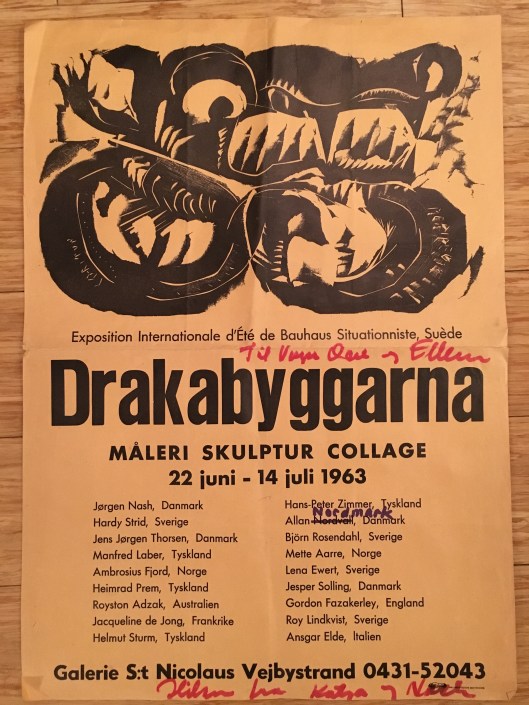
Drakabyggarna – Exposition Internationale d’Ete du Bauhaus Situationniste, Suede [POSTER]

[BAUHAUS SITUATIONNISTE]. Drakabyggarna: Exposition Internationale d’Ete du Bauhaus Situationniste  [ORIGINAL POSTER]n.p. [Vejbystrand, Sweden]: n.p. [Galerie St. Nicolaus], n.d. [1963].One-sided poster; 31.5 x 43 cm. Exceptionnally signed by Nash.

Advertising poster for “Drakabyggarna”, the international summer exhibition for the newly-founded Bauhaus Situationniste. It took place at Galerie St. Nicolaus in Vejbystrand, Sweden between 22 June and 14 July 1963 and featured the following artists: Jorgen Nash, Hardy Strid, Jens Jorgen Thorsen, Manfred Laber, Ambrosius Fjord [Asger Jorn’s horse!], Heimrad Prem, Royston Adzak, Jacqueline de Jong, Helmut Sturm Hans-Peter Zimmer, Allan Nordmark, Bjorn Rosendahl, Mette Aarre, Lena Ewert, Jesper Solling, Gordon Fazakerley, Roy Lindkvist and Ansgar Elde.

This is an important document because it highlights the rivalry between the Internationale Situationniste and the Bauhaus Situationniste, which included a large number of the artists that were expelled from the first SI in 1962. Indeed, the exhibition opened on the same day as the Internationale Situationniste’s “Destruktion af RSG-6″did in Odense, Denmark – namely, June 22 – and closed around the same time as well (July 14 vs. July 7).

This copy was exceptionally presented by”Katja” [Katja Lindell] and “Nash” [Jorgen Nash] to one of their friends.

We locate no OCLC copy.
2016-01-09 02.05.45


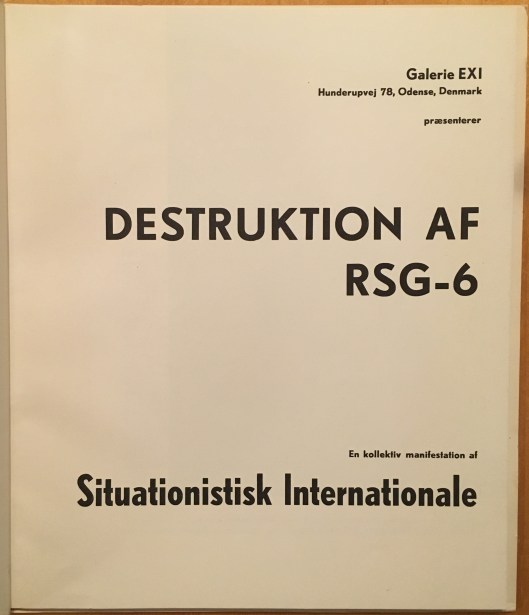
Destruktion af RSG-6 – En kollektiv manifestation af Situationistisk Internationale [1963]

[DEBORD, GUY]. Destruktion af RSG-6 – En kollektiv manifestation af Situationistisk Internationale. Odense: Galerie Exi, n.d. [1963]. 28 p.; ill.; 25 x 18 cm; ill. White wrappers with text in black and red

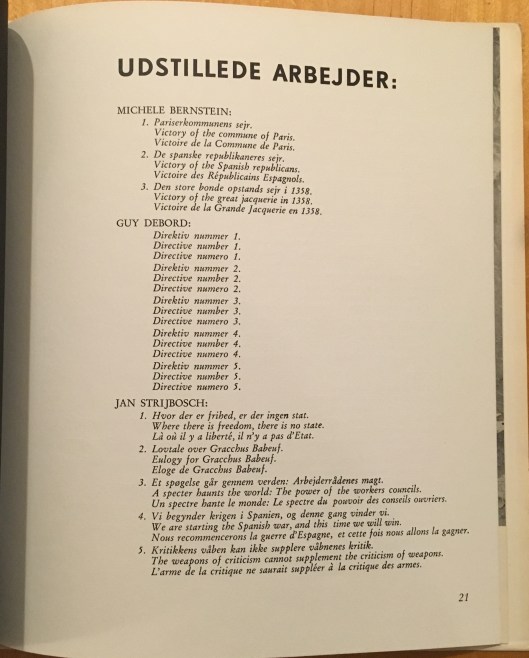
Original catalog of the Internationale Situationniste exhibition held at Galerie EXI in Odense, Denmark between June 22 and July 7, 1963.

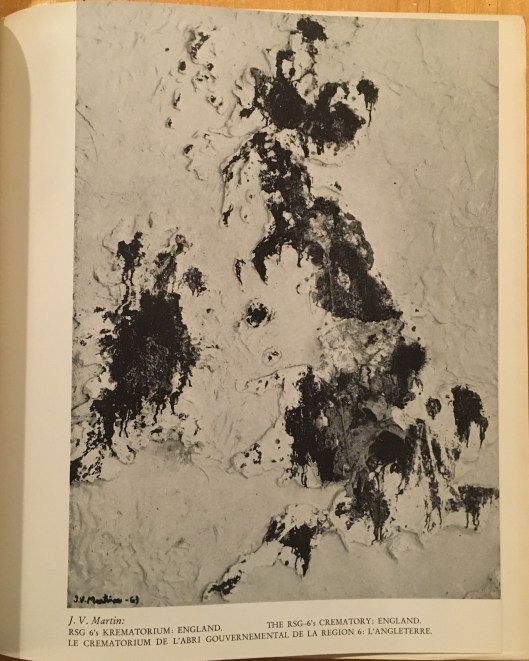
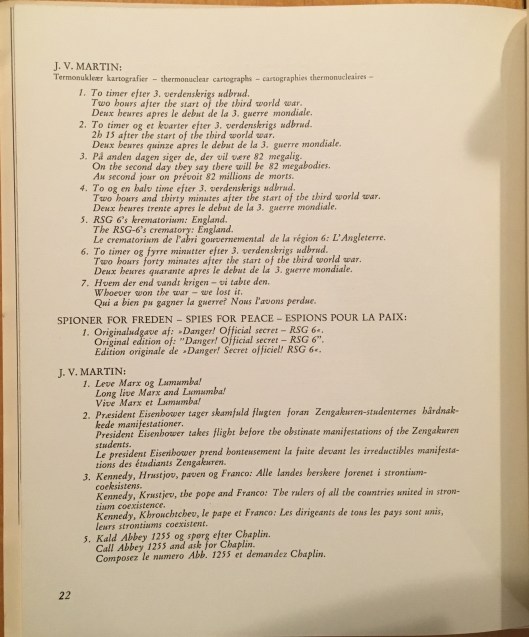
The name of the exhibition is an homage to Spies for Peace’s Official Secret – RSG6 action, in which the anti-war activist group revealed that, in the event of a nuclear attack, the British government had conceived a plan to house key central government personnel in a secret bunker known as Regional Seat of Government number 6 (RSG-6). The intent was to insure continuity of law and order in the event of a nuclear holocaust. The information was published in the Danger! Official Secret RSG-6 pamphlet, of which 4,000 copies were produced, then mailed to key officials and distributed on the streets. More can be found here: http://www.bl.uk/learning/histcitizen/21cc/counterculture/civildisobedience/spiesforpeace/spiesforpeace.html

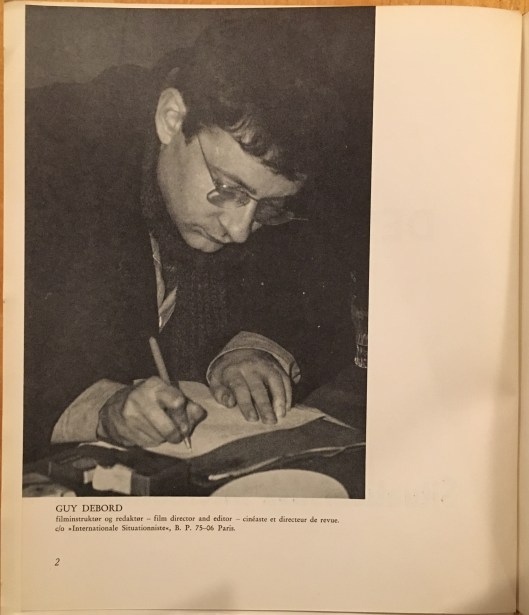
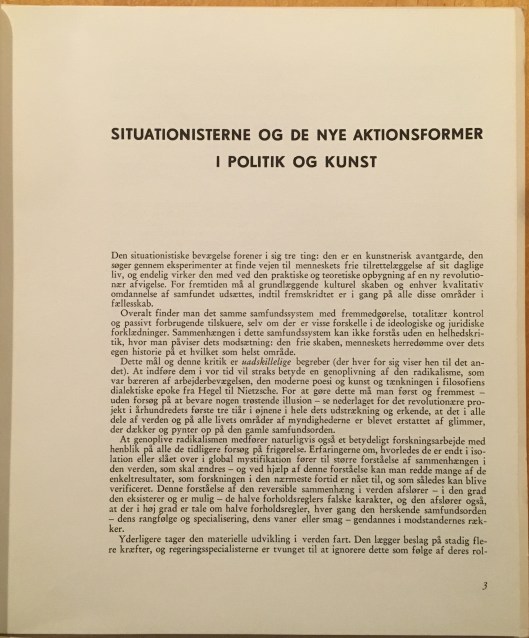
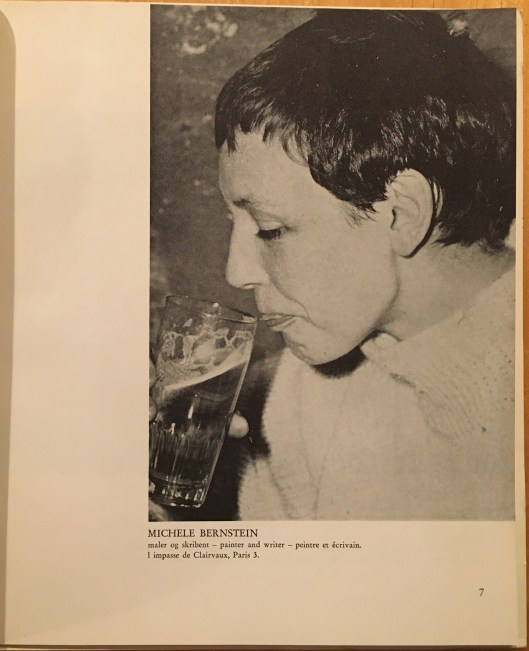
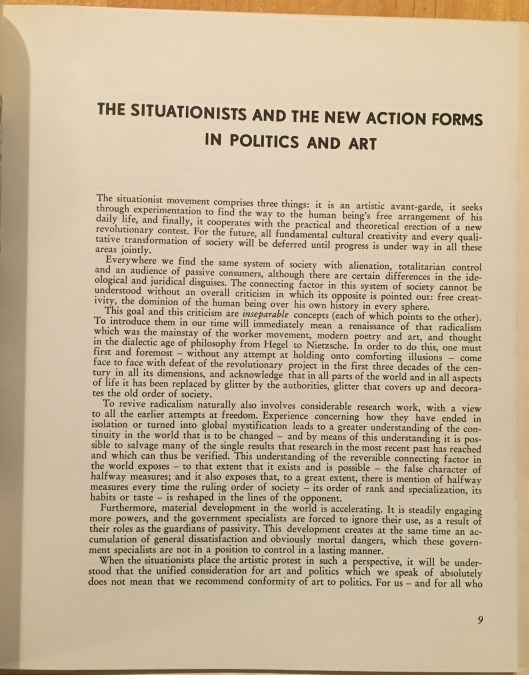
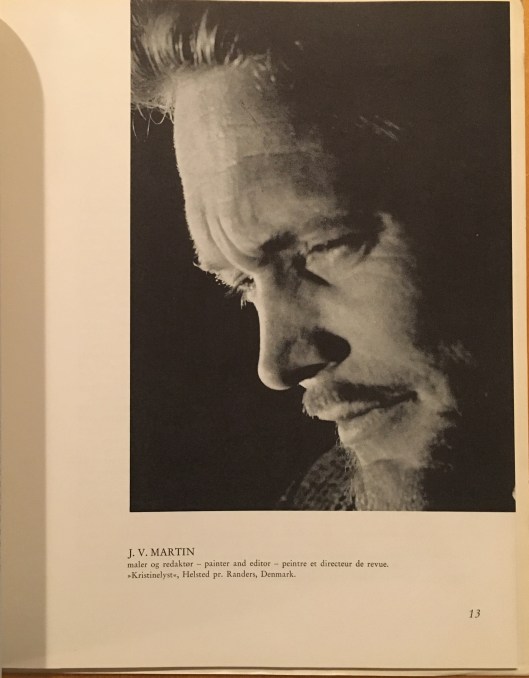
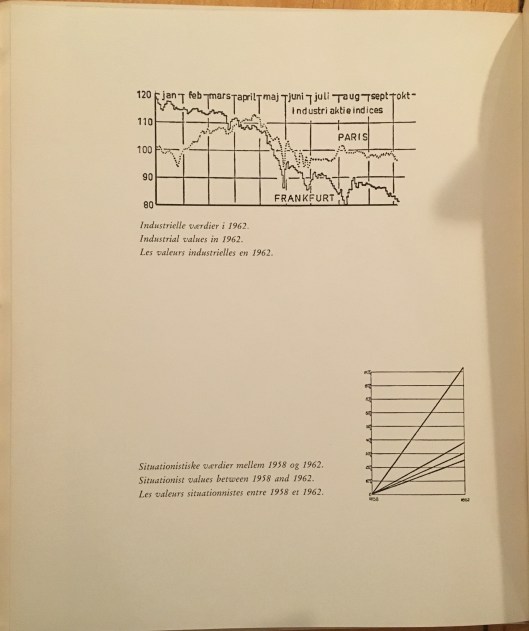
The catalog includes photographic portraits of Guy Debord, Michele Bernstein, J.V Martin and Jan Strijbosch, as well as reproduction of original artwork by these members of the S.I. It also serves as the first edition of Guy Debord’s important text Les Situationnistes ou les nouvelles formes d’action dans la politique ou l’art, published in the original French as well as in Danish and English translations.

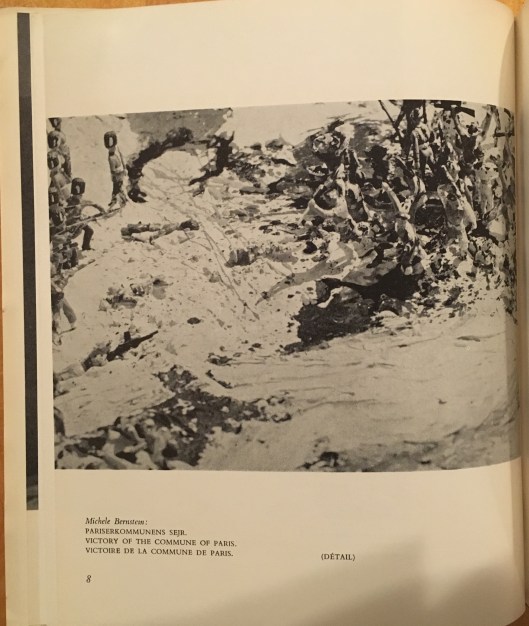
Featured pieces – all the result of some form of “detournement – include Debord’s “Directives” (which “should be considered as slogans that one might see written on walls… intended, of course, as a simultaneous ridicule and reversal of that pompous academicism currently in fashion which is trying to base itself on the painting of incommunicable “pure signs.””), Bernstein’s “Victories”, and J.V. Martin’s “Thermonuclear maps” (paintings representing various regions of the globe during World War III), among others. All the artwork is shown in a gallery setting that invokes a post-nuclear world – one area, for instance, was a reconstruction of an oppressive nuclear bomb shelter.

This catalog is particularly scarce because most copies (and, in a rather ironic twist of the fate, the bulk of the artwork shown at EXI) were destroyed by a fire bomb on March 18, 1965 . More detail about this incident be found in issue 10 of Internationale Situationniste (“L’I.S. et les incidents de Randers”, http://debordiana.chez.com/francais/is10.htm)

Yale University’s Beinecke library has made a full facsimile of this important but rare piece of Situationist history available on its website at http://brbl-dl.library.yale.edu/vufind/Record/3839317

Since thanks to TK and PB for this.

Gonzalvez 119. Raspaud 115-1162016-01-08 20.17.502016-01-08 20.18.112016-01-08 20.18.382016-01-08 20.18.482016-01-08 20.19.122016-01-08 20.20.022016-01-08 20.20.182016-01-08 20.22.10

2016-01-08 20.19.512016-01-08 20.21.062016-01-08 20.21.292016-01-08 20.22.402016-01-08 20.22.48

Opus 27 – Constant and New Babylon

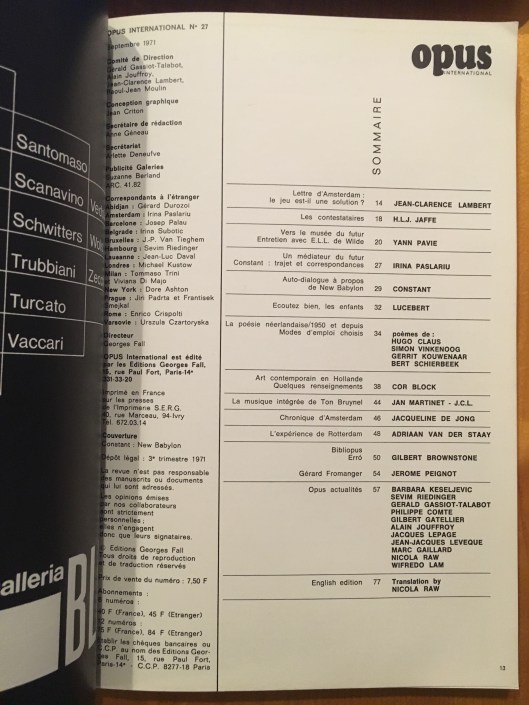
[CONSTANT]. Opus International no. 27. Paris: Editions Georges Fall, September 1971. 84 p.; ill.; 18 x 27 cm.; ill. Wrappers with striking New Babylon reproduction.

Special issue of this magazine dedicated to contemporary Dutch art, with a significant emphasis on Constant and New Babylon. Includes, among others, “Lettre d’Amsterdam: le jeu est-il une solution?” by Jean-Clarence Lambert; “Les contestaires” by H. L-J. Jaffe; “Un mediateur du future – Constant: trajet et correspondances” by Irina Paslariu; “Auto-dialogue a propos de New Babylon” by Constant; “Chronique d’Amsterdam” by Jacqueline de Jong and more.

2016-01-08 16.45.102016-01-08 16.45.322016-01-08 16.46.38

Interlude: How you can contribute

It is this time of the year again when I remind readers of the many ways can contribute to this blog:

(1) Write a blog post sharing interesting or unusual Situationist (or Situ-related) material that you own. This may include anything from original Debord correspondence to a contemporary post-Situ publication you’d like others to know about

(2) Gift to, sell to or trade material with the archive. As you can see in the “about” section, my ultimate goal is to place this collection at a major research institution where it is accessible by all, free of charge. I will gladly accept donations  and I am prepared to make serious financial offers when necessary. No item is too small – ephemera (postcards, leaflets, etc.) is awesome.

(3) Retweet, reblog, facebook share or otherwise spread the word so that many others can learn about it

(4) Invite me to speak about the archive. I travel a lot for work and I now have a 45-minute presentation with PowerPoint and audio/video that introduces the S.I. and its unique material to a general audience. So let me know if this is of interest.

(5) Introduce yourself to me – lets get to know each other. It’s good to know who reads and appreciates this blog. And we could find new grounds for collaboration (cheers to Ian Thompson, whom I assisted with his first-ever English translation of Debord’s “Memoires”)

To reach me: elhajoui (.AT.) gmail (.DOT.) com

Happy new year to all

download

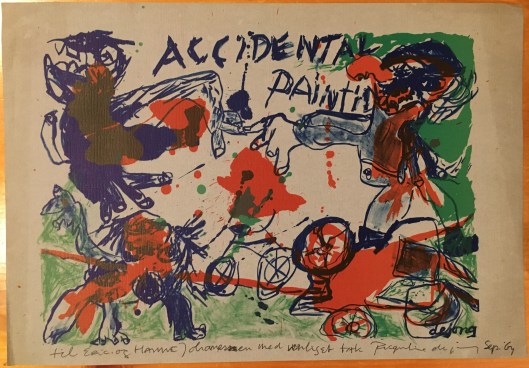
Jacqueline de Jong – Accidental Paintings [1964] [LITHOGRAPH]

Jong, Jacqueline de. Accidental Paintingsn.p. [Netherlands or Denmark], 1964. 50 x 36 cm.; large lithographed sheet on thick grey paper. Signed by De Jong

Signed lithograph from the exhibition “Accidental Paintings” at Galerie Westing, Odense, Denmark, from 19 September to 12 October, 1964. This original lithograph, which dates from the “Situationist Times” period (1962-1967) also constitutes the cover to the exhibition catalog.

This lithograph is unnumbered, but we locate no other copy sold at auction.

IMG_4785

Constant’s New Babylon exhibit in Madrid through February 29, 2016

Another public interest announcement about a major Constant exhibit at the Museo Nacional Reina Sofia in Madrid through February 29, 2016. The exhibit is co-organized by Gemeentemuseum Den Haag and the Museo Nacional Centro de Arte Reina Sofía, and it is co-curated by Laura Stamps and Doede Hardemann

The focus is on Constant’s New Babylon project, which was a key component of Situationist urban theory.

Untitled

For more detail, check out the exhibition’s website at http://www.museoreinasofia.es/en/exhibitions/constant-new-babylon

You may also glimpse at the actual exhibit at Borzo Gallery’s website (about 25 pictures in total): http://www.borzo.com/en/news/news/501-constant-s-new-babylon-in-madrid

Below is the full announcement:

————————————————————-

“I am not a designer, just a mere provocateur. I confine myself to making suggestions. What has been defined is the concept of New Babylon, not its physical form.”

For almost twenty years, Constant (Constant Anton Nieuwenhuys, Amsterdam, 1920 – Utrecht, 2005) realised scale models, paintings, drawings and collages displaying his concept of a nomad city of the future – New Babylon – a complex and expansive labyrinth that transformed the whole world into one sole network. The earth would be collective property, work would be completely automated and run by robots and people would have the freedom to devote their time to creative play.

With this exhibition, which will bring together 150 works and large amounts of documentary material, the Museo Reina Sofía and Gemeentemuseum Den Haag aim to bring a wide audience closer to Constant’s project, which has sparked the growing interest of artists, architects and curators in recent years. The cornerstone of the show is New Babylon as a “work of art” inside the social context of its conception, whereby drawings, collages, models, paintings and prints are complemented with a series of reconstructions, fragments of historical films and archive materials.

However, the exhibition is not solely circumscribed by the period between 1956 and 1974, the years New Babylon is usually classified within. It also encompasses other phases as it aims to demonstrate that the ideas expressed in theNew Babylon project were already present in Constant’s work. Although they were formulated with less clarity – from a period some time before, when he was a member of the CoBrA group between 1948 and 1951 – they did not disappear altogether after 1974. A section will also be devoted to the influence in Constant’s work of a widespread cultural imaginary (gypsy, flamenco and lumpen aspects), which could be identified with Spanish culture.

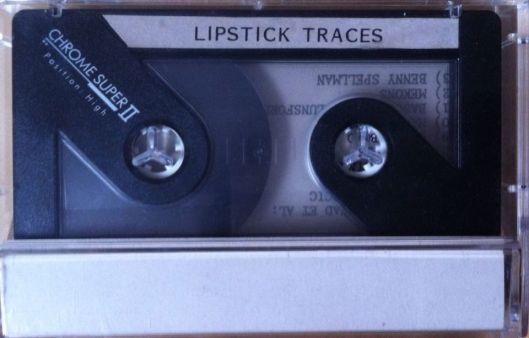
Lipstick Traces [SOUNDTRACK DEMO TAPE] [1993]

Various Artists. Lipstick Traces. n.p. [London?]: Rough Trade Records, 29 June 1993. 1 cassette tape (two-sided); 10.5 x 7 cm; plain cover with song listing

“This is a soundtrack to Lipstick Traces : A secret History of the 20th Century (1989), by Greil Marcus, published in the US by Harvard University PRess, in the UK by Penguin Books, in Germany by Rogner & Bernhard, in Italy (as Trace di Rossetto) by Leonardo Editore, and in Spain (as Rastros de Carmin) by Anagrama” (inside leaflet)

“This is a sort of accompanying soundtrack to Greil Marcus’ book Lipstick Traces. It features music by The Slits and The Buzzcocks, ambiences of London concert halls (such as the Roxy and Roundhouse), Dada (Tzara, Janco, Huelsenbeck, Haussmann) and Lettrist (Brau, Wolman) sound poetry, and excerpts from the soundtrack to Debord’s Howls for Sade and Critique of Separation” (Gonzalvez 162, traduction is mine)

This is similar to the CD version I posted about a few days ago. However, this demo cassette tape is unaccounted for on both Discogs and OCLC. Only artists are listed, not song titles. But the key difference is that the song “A Boring Life” by The Slits is missing here, (it will appear as the opening track in the commercially-released CD and LP versions), perhaps because the copyright had not been obtained yet when the tape was released.

Full tracklist on Discogs  (http://www.discogs.com/Various-Lipstick-Traces/release/906706) ; accurate except for “A Boring Life” by the Slits.

All audio track available at Ubuweb (http://www.ubu.com/sound/lipstick.html)

$_57$_57 (1)

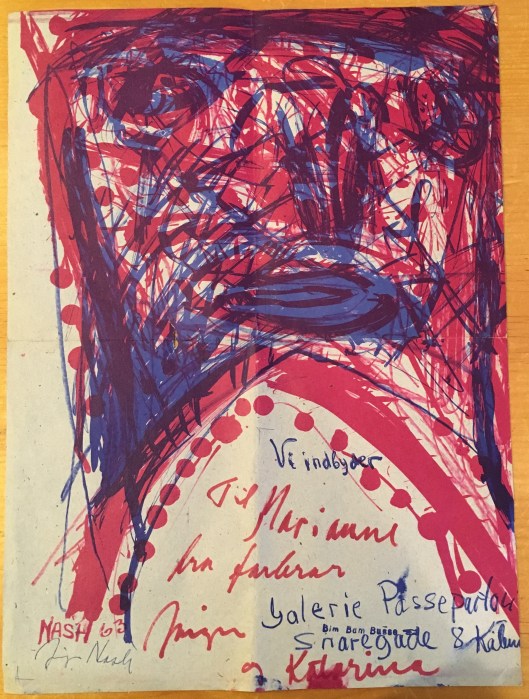
Nash og Thorsen – Galerie Pass-Partout – Kobenhavn – 16.3.1963 [ORIGINAL LITOGRAPHED POSTER]

[Nash, Jorgen and Jens Thorsen]. Nash og Thorsen – Galerie Pass-Partout – Kobenhavn – 16.3.1963 [ORIGINAL LITHOGRAPHED POSTER]. Copenhagen: Galerie Passe-Partout, 1963. Two-sided lithographed poster;  31 x 43 cm. Signed by Nash.

Poster for the 1963 exhibit by Nash and Thorsen at Galerie Pass-Partout in Copenhagen, Denmark. Tommy Kirkegaard notes that “1963 was an important and scandalous year in Danish Situationism including the Little Mermaid scandal, the decapitating the statue in Copenhagen Harbour and Asger Jorn refusing the Guggenheim Prize”. The “Nashists” were excluded in 1962, so this is one of the very early works of the “Second Situationist International”

2015-12-26 15.42.192015-12-26 15.42.36

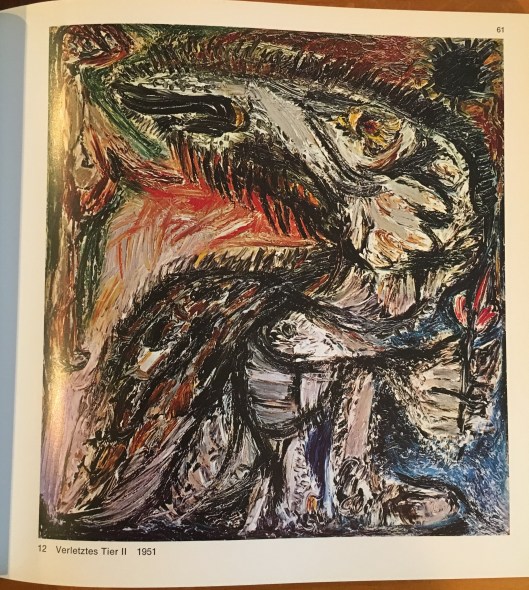
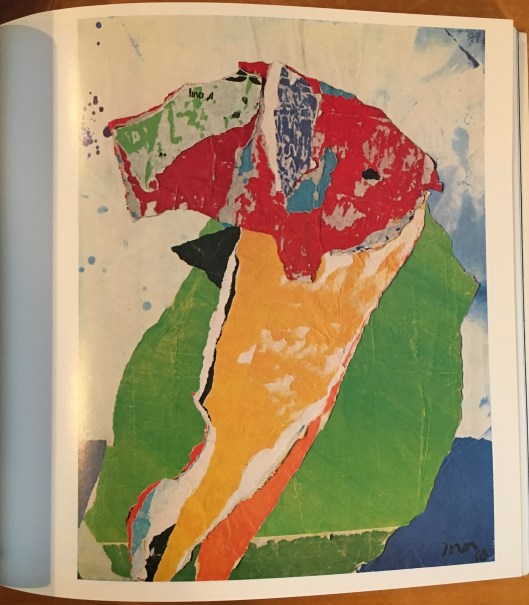
Asger Jorn – Kestner Gesellschaft Hannover [1973] [PRESENTATION COPY]

[Jorn, Asger]. Asger Jorn – Kestner Gesellschaft Hannover Katalog 2 / 1973. Hanover: Kestner-Gesellschaft Hannover, 1973. n.p. [191 p.]; ill.; 20.5 x 20.5 cm.; orange and black publisher wrappers with text in black. Signed by the artist 

Catalog of Jorn exhibition at the Kestner-Gesellschaft Hannover (Germany) between 16 February and 18 March 1973. Bibliography. Heavily illustrated. Unusual presentation copy from Asger Jorn to his son, Ole (“To Ole, from Papa, Asger Jorn”).

2015-12-26 14.50.332015-12-26 15.08.162015-12-26 15.08.442015-12-26 15.08.542015-12-26 15.09.382015-12-26 15.09.502015-12-26 15.10.322015-12-26 15.11.012015-12-26 15.11.34

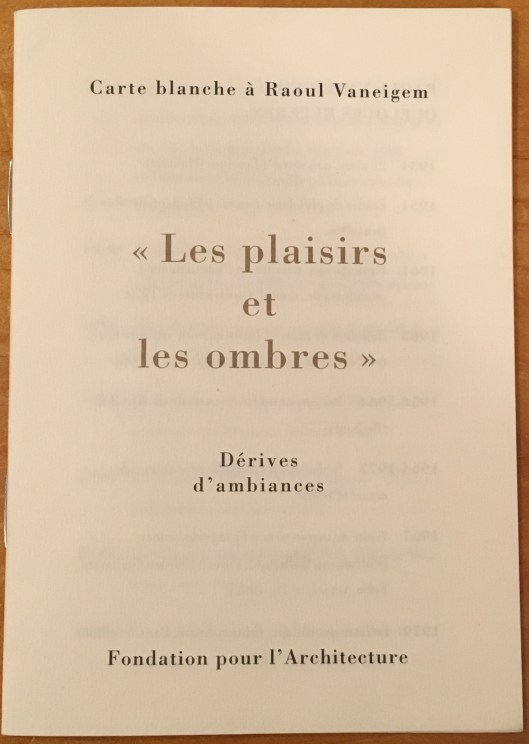
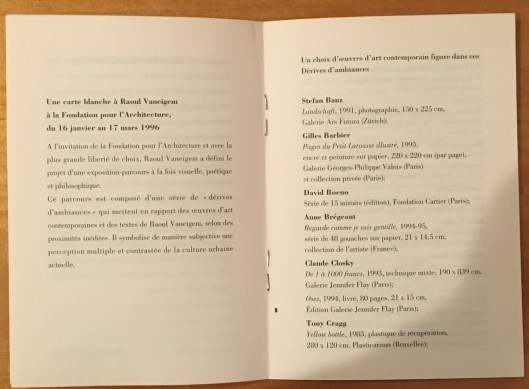
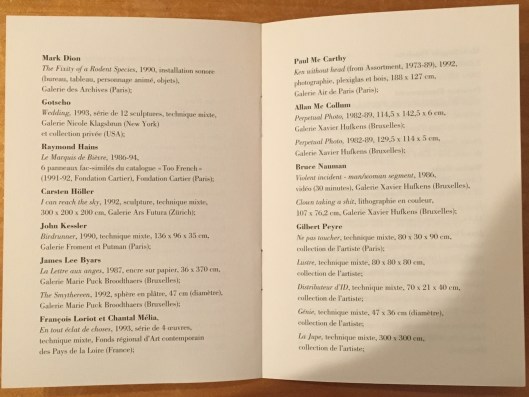
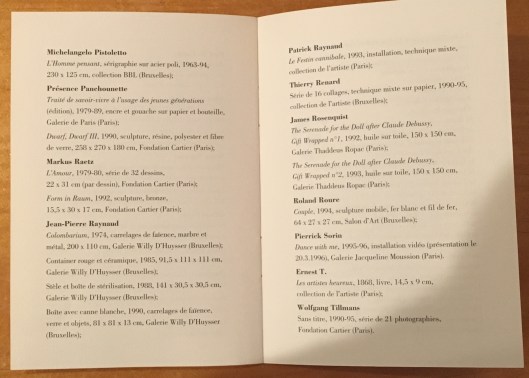
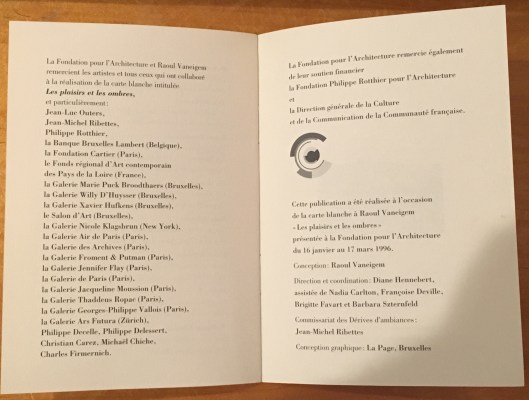
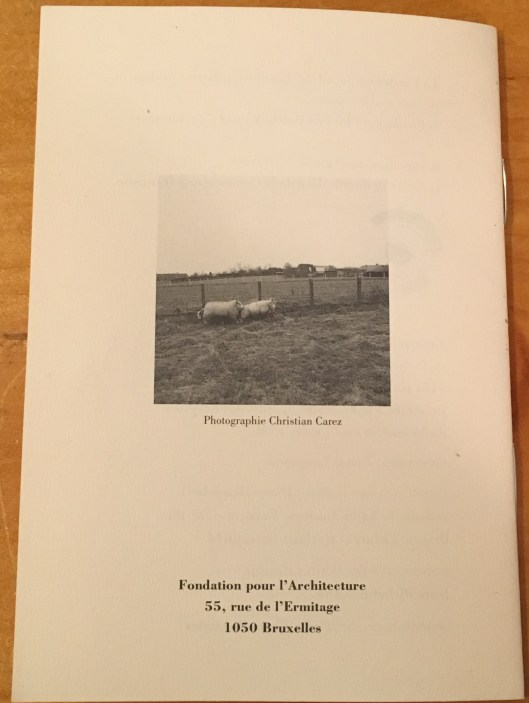
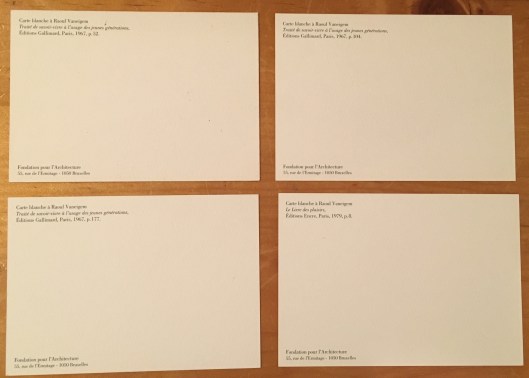
Carte Blanche a Raoul Vaneigem – Les Plaisirs et les Ombres, Derives d’Ambiance [1996]

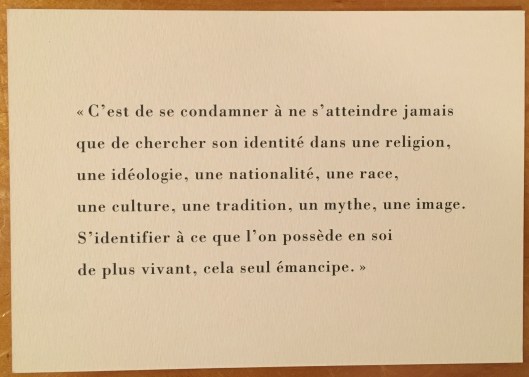
[Vaneigem, Raoul]. Carte blanche a Raoul Vaneigem – “Les plaisirs et les ombres”, Derives d’ambiances.  Bruxelles: Fondation pour l’Architecture, n.d. [1996]. One Booklet (n.p. [16 p.]; 11 x 15 cm.; off-white wrappers with text in black) and ~25 cards (11 x 15 cm.; black ink on thick, off-white stock).

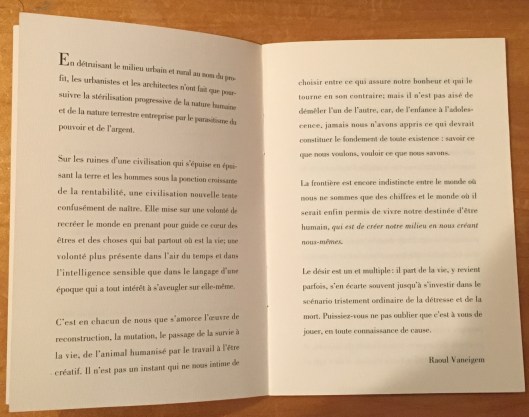
Catalog-like publication issued on the occasion of the exhibition Carte Blanche a Raoul Vaneigem at the Fondation pour l’Architecture in Bruxelles, Belgium between 16 January and 17 March 1996. The principle of the exhibition was as follows: “Responding to an invitation by the Foundation for Architecture and with the greatest liberty afforded to him, Raoul Vaneigem defined the project of an exhibition-itinerary, which is all at once visual, poetic, and philosophical. This itinerary is composed of a series of “derives d’ambience” that link contemporary works of art with texts by Raoul Vaneigem in original ways. It symbolizes, in a subjective manner, the multiple and contrasted perception of our current urban culture.” (translation is mine).

The exhibition included works by artists Stefan Branz, Gilles Barbier, David Boeno, Anne Bregeaut, Claude Closky, Tony Cragg, Mark Dion, Gotscho, Raymond Hains, Carsten Hoeller, John Kessler, James Lee Byars, Francois Loriot & Chantal Melia, Paul McCarthy, Allan Mc Collum, Bruce Nauman, Gilbert Peyre, Michelangelo Pistoletto, Presence Panchounette, Markus Raetz, Jean-Pierre Raynaud, Patrick Raynaud, Thierry Renard, James Rosenquist, Roland Roure, Pierrick Sorin, Ernest T., Wolfgang Tillmans.

The small booklet includes a short bio-bibliographical sketch, a brief text by Raoul Vaneigem, a brief essay by Jean-Michel Ribettes, and a comprehensive list of work of arts exhibited. Each of the 20-odd cards features a quotation from one of Vaneigem’s works.

We locate a single OCLC copy.
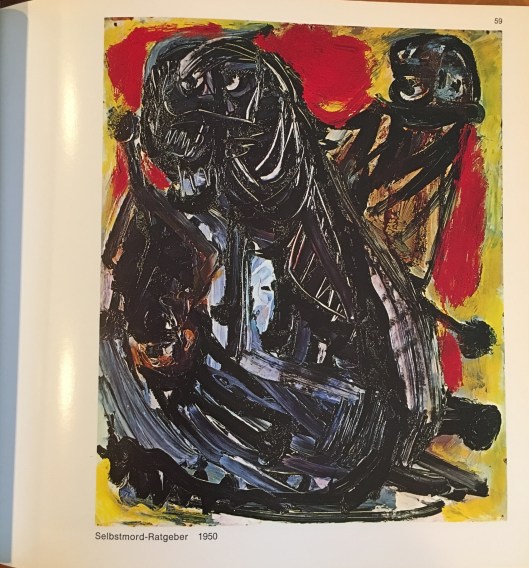
2015-12-23 22.33.452015-12-23 22.34.212015-12-23 22.34.442015-12-23 22.35.062015-12-23 22.35.172015-12-23 22.35.292015-12-23 22.35.452015-12-23 22.35.582015-12-23 22.36.172015-12-23 22.37.182015-12-23 22.37.502015-12-23 22.39.342015-12-23 22.39.452015-12-23 22.40.022015-12-23 22.40.14