Constant’s New Babylon exhibit in Madrid through February 29, 2016

Another public interest announcement about a major Constant exhibit at the Museo Nacional Reina Sofia in Madrid through February 29, 2016. The exhibit is co-organized by Gemeentemuseum Den Haag and the Museo Nacional Centro de Arte Reina Sofía, and it is co-curated by Laura Stamps and Doede Hardemann

The focus is on Constant’s New Babylon project, which was a key component of Situationist urban theory.

Untitled

For more detail, check out the exhibition’s website at http://www.museoreinasofia.es/en/exhibitions/constant-new-babylon

You may also glimpse at the actual exhibit at Borzo Gallery’s website (about 25 pictures in total): http://www.borzo.com/en/news/news/501-constant-s-new-babylon-in-madrid

Below is the full announcement:

————————————————————-

“I am not a designer, just a mere provocateur. I confine myself to making suggestions. What has been defined is the concept of New Babylon, not its physical form.”

For almost twenty years, Constant (Constant Anton Nieuwenhuys, Amsterdam, 1920 – Utrecht, 2005) realised scale models, paintings, drawings and collages displaying his concept of a nomad city of the future – New Babylon – a complex and expansive labyrinth that transformed the whole world into one sole network. The earth would be collective property, work would be completely automated and run by robots and people would have the freedom to devote their time to creative play.

With this exhibition, which will bring together 150 works and large amounts of documentary material, the Museo Reina Sofía and Gemeentemuseum Den Haag aim to bring a wide audience closer to Constant’s project, which has sparked the growing interest of artists, architects and curators in recent years. The cornerstone of the show is New Babylon as a “work of art” inside the social context of its conception, whereby drawings, collages, models, paintings and prints are complemented with a series of reconstructions, fragments of historical films and archive materials.

However, the exhibition is not solely circumscribed by the period between 1956 and 1974, the years New Babylon is usually classified within. It also encompasses other phases as it aims to demonstrate that the ideas expressed in theNew Babylon project were already present in Constant’s work. Although they were formulated with less clarity – from a period some time before, when he was a member of the CoBrA group between 1948 and 1951 – they did not disappear altogether after 1974. A section will also be devoted to the influence in Constant’s work of a widespread cultural imaginary (gypsy, flamenco and lumpen aspects), which could be identified with Spanish culture.

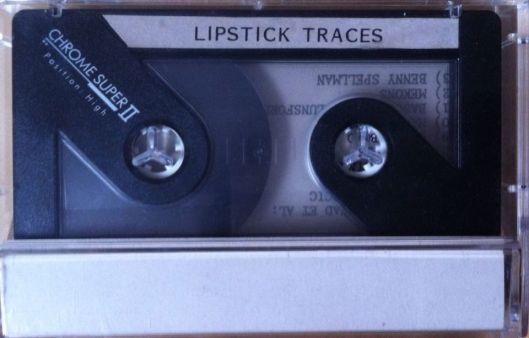
Lipstick Traces [SOUNDTRACK DEMO TAPE] [1993]

Various Artists. Lipstick Traces. n.p. [London?]: Rough Trade Records, 29 June 1993. 1 cassette tape (two-sided); 10.5 x 7 cm; plain cover with song listing

“This is a soundtrack to Lipstick Traces : A secret History of the 20th Century (1989), by Greil Marcus, published in the US by Harvard University PRess, in the UK by Penguin Books, in Germany by Rogner & Bernhard, in Italy (as Trace di Rossetto) by Leonardo Editore, and in Spain (as Rastros de Carmin) by Anagrama” (inside leaflet)

“This is a sort of accompanying soundtrack to Greil Marcus’ book Lipstick Traces. It features music by The Slits and The Buzzcocks, ambiences of London concert halls (such as the Roxy and Roundhouse), Dada (Tzara, Janco, Huelsenbeck, Haussmann) and Lettrist (Brau, Wolman) sound poetry, and excerpts from the soundtrack to Debord’s Howls for Sade and Critique of Separation” (Gonzalvez 162, traduction is mine)

This is similar to the CD version I posted about a few days ago. However, this demo cassette tape is unaccounted for on both Discogs and OCLC. Only artists are listed, not song titles. But the key difference is that the song “A Boring Life” by The Slits is missing here, (it will appear as the opening track in the commercially-released CD and LP versions), perhaps because the copyright had not been obtained yet when the tape was released.

Full tracklist on Discogs  (http://www.discogs.com/Various-Lipstick-Traces/release/906706) ; accurate except for “A Boring Life” by the Slits.

All audio track available at Ubuweb (http://www.ubu.com/sound/lipstick.html)

$_57$_57 (1)

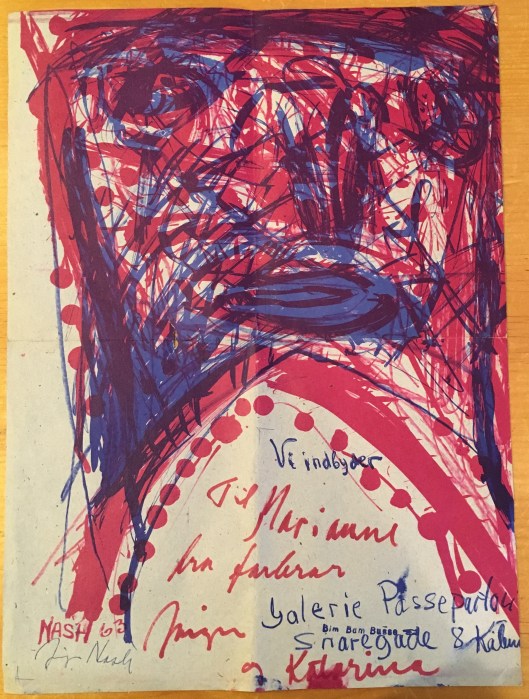
Nash og Thorsen – Galerie Pass-Partout – Kobenhavn – 16.3.1963 [ORIGINAL LITOGRAPHED POSTER]

[Nash, Jorgen and Jens Thorsen]. Nash og Thorsen – Galerie Pass-Partout – Kobenhavn – 16.3.1963 [ORIGINAL LITHOGRAPHED POSTER]. Copenhagen: Galerie Passe-Partout, 1963. Two-sided lithographed poster;  31 x 43 cm. Signed by Nash.

Poster for the 1963 exhibit by Nash and Thorsen at Galerie Pass-Partout in Copenhagen, Denmark. Tommy Kirkegaard notes that “1963 was an important and scandalous year in Danish Situationism including the Little Mermaid scandal, the decapitating the statue in Copenhagen Harbour and Asger Jorn refusing the Guggenheim Prize”. The “Nashists” were excluded in 1962, so this is one of the very early works of the “Second Situationist International”

2015-12-26 15.42.192015-12-26 15.42.36

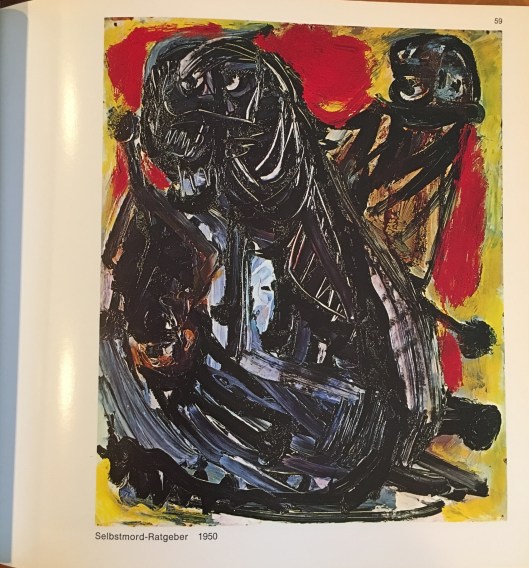
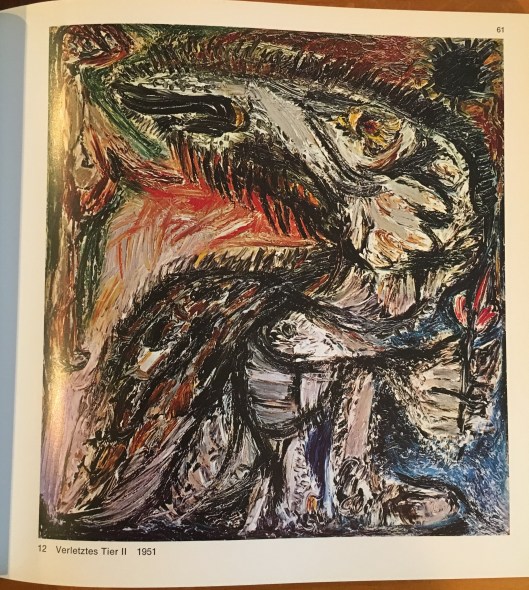
Asger Jorn – Kestner Gesellschaft Hannover [1973] [PRESENTATION COPY]

[Jorn, Asger]. Asger Jorn – Kestner Gesellschaft Hannover Katalog 2 / 1973. Hanover: Kestner-Gesellschaft Hannover, 1973. n.p. [191 p.]; ill.; 20.5 x 20.5 cm.; orange and black publisher wrappers with text in black. Signed by the artist 

Catalog of Jorn exhibition at the Kestner-Gesellschaft Hannover (Germany) between 16 February and 18 March 1973. Bibliography. Heavily illustrated. Unusual presentation copy from Asger Jorn to his son, Ole (“To Ole, from Papa, Asger Jorn”).

2015-12-26 14.50.332015-12-26 15.08.162015-12-26 15.08.442015-12-26 15.08.542015-12-26 15.09.382015-12-26 15.09.502015-12-26 15.10.322015-12-26 15.11.012015-12-26 15.11.34

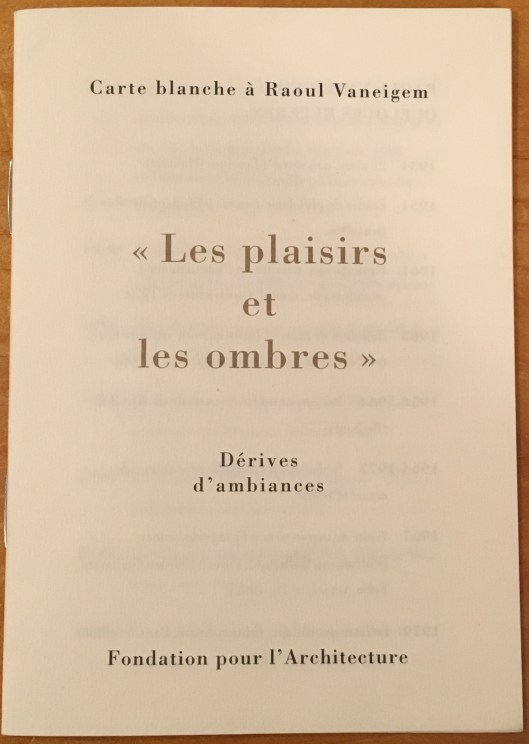
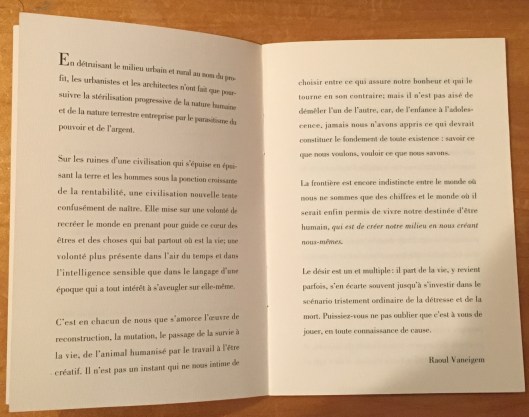
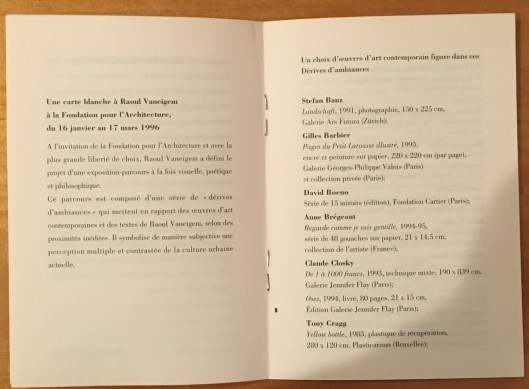
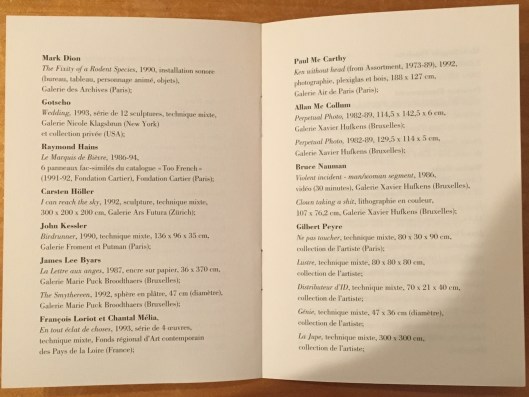
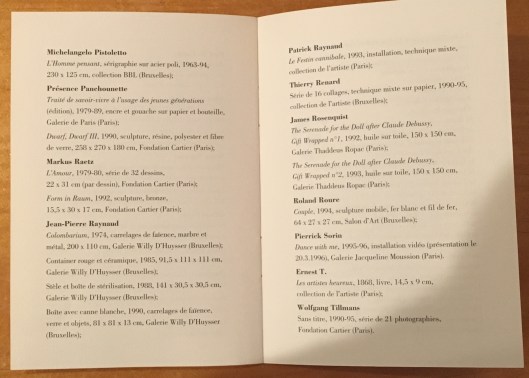
Carte Blanche a Raoul Vaneigem – Les Plaisirs et les Ombres, Derives d’Ambiance [1996]

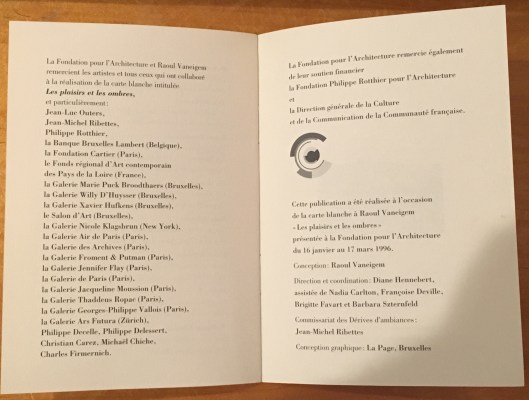
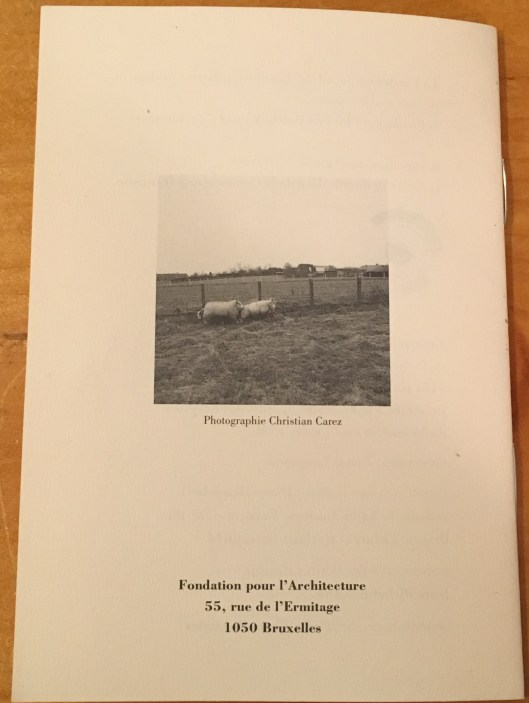
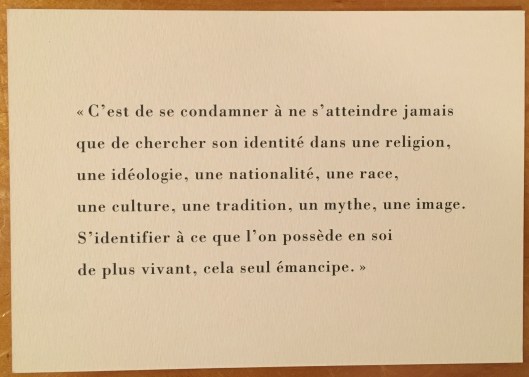
[Vaneigem, Raoul]. Carte blanche a Raoul Vaneigem – “Les plaisirs et les ombres”, Derives d’ambiances.  Bruxelles: Fondation pour l’Architecture, n.d. [1996]. One Booklet (n.p. [16 p.]; 11 x 15 cm.; off-white wrappers with text in black) and ~25 cards (11 x 15 cm.; black ink on thick, off-white stock).

Catalog-like publication issued on the occasion of the exhibition Carte Blanche a Raoul Vaneigem at the Fondation pour l’Architecture in Bruxelles, Belgium between 16 January and 17 March 1996. The principle of the exhibition was as follows: “Responding to an invitation by the Foundation for Architecture and with the greatest liberty afforded to him, Raoul Vaneigem defined the project of an exhibition-itinerary, which is all at once visual, poetic, and philosophical. This itinerary is composed of a series of “derives d’ambience” that link contemporary works of art with texts by Raoul Vaneigem in original ways. It symbolizes, in a subjective manner, the multiple and contrasted perception of our current urban culture.” (translation is mine).

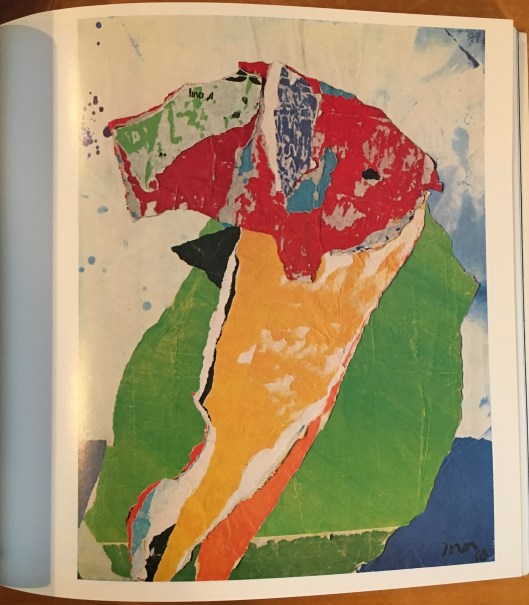
The exhibition included works by artists Stefan Branz, Gilles Barbier, David Boeno, Anne Bregeaut, Claude Closky, Tony Cragg, Mark Dion, Gotscho, Raymond Hains, Carsten Hoeller, John Kessler, James Lee Byars, Francois Loriot & Chantal Melia, Paul McCarthy, Allan Mc Collum, Bruce Nauman, Gilbert Peyre, Michelangelo Pistoletto, Presence Panchounette, Markus Raetz, Jean-Pierre Raynaud, Patrick Raynaud, Thierry Renard, James Rosenquist, Roland Roure, Pierrick Sorin, Ernest T., Wolfgang Tillmans.

The small booklet includes a short bio-bibliographical sketch, a brief text by Raoul Vaneigem, a brief essay by Jean-Michel Ribettes, and a comprehensive list of work of arts exhibited. Each of the 20-odd cards features a quotation from one of Vaneigem’s works.

We locate a single OCLC copy.

2015-12-23 22.33.452015-12-23 22.34.212015-12-23 22.34.442015-12-23 22.35.062015-12-23 22.35.172015-12-23 22.35.292015-12-23 22.35.452015-12-23 22.35.582015-12-23 22.36.172015-12-23 22.37.182015-12-23 22.37.502015-12-23 22.39.342015-12-23 22.39.452015-12-23 22.40.022015-12-23 22.40.14

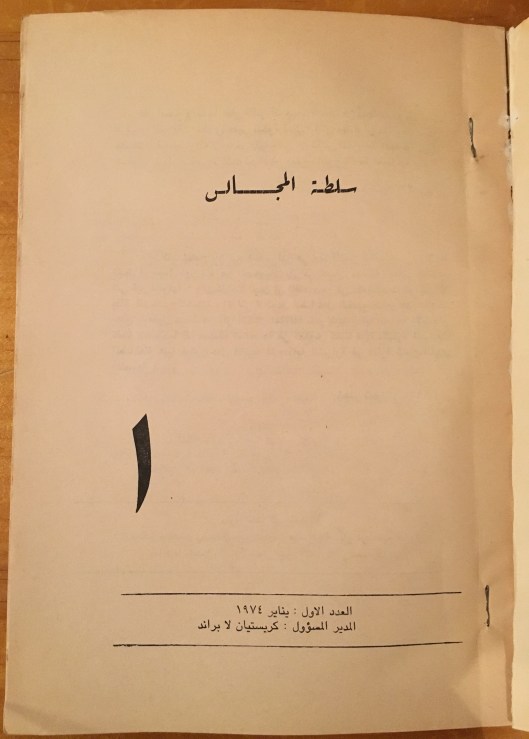
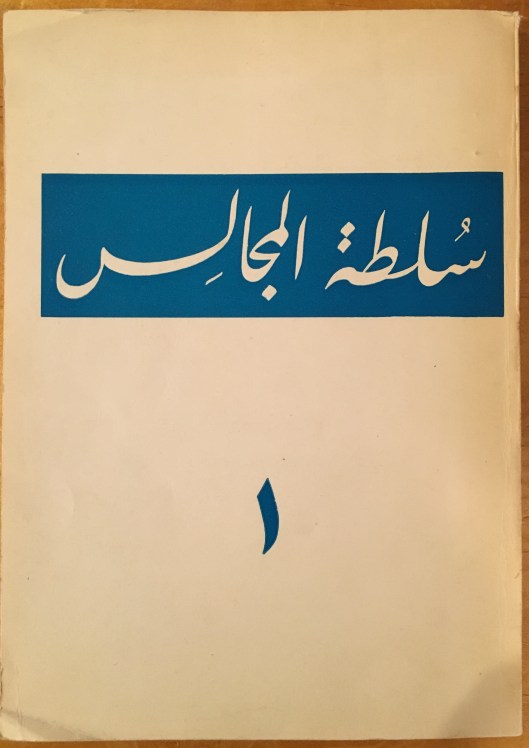
Sulta-Al-Majaliss [Le Pouvoir aux Conseils / The Powers of Councils] no.1. [1974]

Labrande, Christian [Khayati, Mustafa and Lakhdar, Latif] (Eds.). Sulta-Al-Majaliss [Le Pouvoir aux Conseils / The Powers of Councils] no.1. Paris [Beirut], January 1974. 160 p.; 17 x 24 cm. First and only issue.

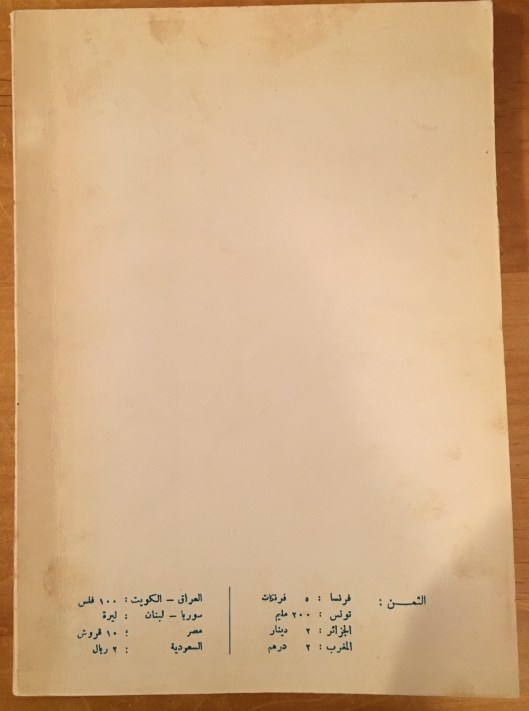
Rare Arabic-language periodical, inspired by Council Communism and Situationist ideas. Christian Labrande, author of La Premiere Internationale (Paris: UGE, 1976), is listed as its (fictitious?) editor-in-Chief. While a French P.O. Box is given as the address of the journal, it was conceived and published in Beirut. Mustapha Khayati and Latif Lakhdar collaborated on this first iteration recruiting other Arab leftist sympathizers along the way. The promising publication was to be short-lived, however, as the civil war broke out in Lebanon and no more issues were released. A price list on the back cover offers clues as to the journal’s ambitious distribution: France (5 Francs), Tunisia (200 millimes), Algeria (2 Dinars), Morocco (2 Dirhams), Iraq and Kuweit (100 Fils), Syria and Lebanon (Lira), Egypt (10 Ersh), Saudi Arabia (2 Rial). It cost 5,000 Francs to produce.

By means of background, Latif Lakhdar (1934-2013) was “a Tunisian thinker [who] fought in the Algerian revolution and later was a leader in the Democratic Front for the Liberation of Palestine in the early seventies… He was the first Arab writer to introduce the anarchist and Marxist critiques of Leninism and Marxism-Leninism….He established network of “Majalis” (councils or societies) in Beirut during the war and popularized leftist/anrachist/Marxist/ critiques of the Arab left.” (http://angryarab.blogspot.com/2013/06/al-afif-al-akhdar-is-dead.html).

Mustapha Khayati was a member of the Internationale Situationniste. He is primarily known as the author of the pamphlet De la Misere en Milieu Etudiant  (translated as the Misery of Student Life or Ten Days That Shook the Universities) and for the key role he played during the Strasbourg scandal (1966) and, later on, the Paris uprisings (May-June 1968). He left the Internationale Situationniste in October 1969 to join the Democratic Front for the Liberation of Palestine in Jordan.

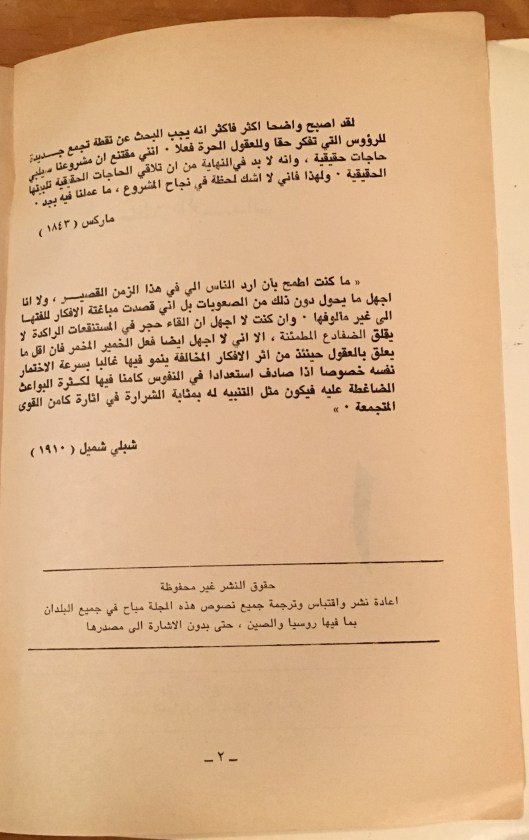
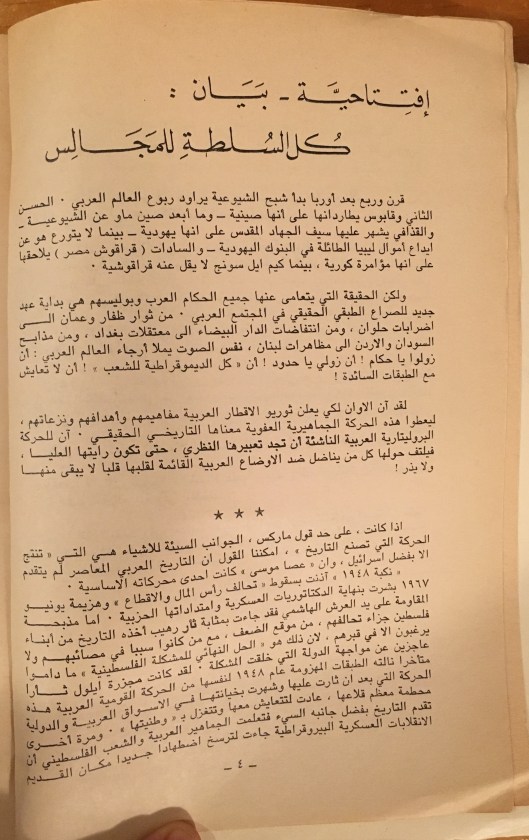
This first issue, then, opens with two long quotes, one by Karl Marx and the other by Schibli Schumayyil (p.2) A physician and intellectual of Greek origin, Schumayyil (1850-1917) was the first to introduce Darwin’s theories to the Arab world. He embraced German materialist philosophy and was an advocate of secularism. The next page provides an introduction to the publication (p.3). Soulta-al-Majaliss seeks to “facilitate the entry of Arab countries into the History of nations, through the door of proletarian revolution” (all translations are mine). “Our journal”, the editors claim, “is the first Arab Marxist journal” that advocates for “the dictatorship of the proletariat and of workers’ councils in the Arab world”

Like the Internationale Situationniste journal, Soulta-al-Majaliss features an Anti-copyright notice: “All texts published in this journal may be freely reproduced, translated and adapted in all countries, including China and Russia, even without indication of origin” (p.2). The tradition of collective authorship is also preserved for the majority of the articles.

Contents include: “Introduction / Manifest: All the Power to the Councils” (p.4-36); “The Origins of Councils: The Revolution of 1905” (p. 37-63); “A Critique of Religion: Life Against Religion” (p.64-72); “An Adress to Egyptian Workers” (p. 73-85); “The Uprising and the Revolution in Morocco” (p.86-92); “After the Fourth Defeat: The True Outcomes of the Spectacular War” (p.93-124); “The Organization of Councils” (p.125-130); “Revolutionary Defeat” (p.131-136); and more.

We locate a single OCLC copy at the University of California – Los Angeles (UCLA).
2015-12-23 17.08.272015-12-23 17.08.502015-12-23 17.09.402015-12-23 17.09.562015-12-23 17.10.172015-12-23 17.10.492015-12-23 17.11.002015-12-23 17.11.17


Les Filles de Kamare [LARGE POSTER] [1974]

Vienet, Rene. Les Filles de Kamare (une Petite Culotte pour l’Ete) Paris: n.p., 1974. 160 x 120 cm; ill. poster with screenshot from the film. Film poster for Vienet’s famous detourned film.

“Unlike Viénet’s previous work, Can dialectics break bricks? (1973), The Girls of Kamare includes original 16 mm hardcore inserts shot by Viénet.  The film is the detournement of the Tōei sukeban film Terrifying Girls’ High School: Lynch Law Classroom (1972) directed by Norifumi Suzuki. The title of the original film is given as Une petite culotte pour l’été, the director credited as “Suzuki Noribumi”. Opening credits are taken from the 1973 film Female Yakuza Tale: Inquisition and Torture of Teruo Ishii. While Can dialectics break bricks? was essentially a dub parody, this film keeps the original Japanese sound track with indelicate French subtitles.
The plot follows a team of female heroes, forced into a disciplinary school, who revolt against the authorities and their assistants. The original Japanese film ends in a successful riot which plays directly into Viénet’s detournement. Unlike Dialectics, The Girls of Kamare is less self-critical and relies more on traditional conceptions of heroism.” (Wikipedia)
Full feature available online at http://www.ubu.com/film/vienet_kamare.html

We locate no OCLC copy

2015-12-22 20.54.42

La Dialectique peut-elle casser des briques [LARGE POSTER] [1973]

Vienet, Rene. La Dialectique Peut-elle Casser des Briques? Paris: n.p., 1973. 160 x 120 cm; ill. poster with screenshot from the film.

Film poster for Vienet’s famous detourned film. “Le premier film entièrement détourné de l’histoire du cinéma, v.o., sous-titres par l’Association pour le développement des luttes de classes et la propagation du matérialisme dialectique” (“The first completely detourned film in the history of cinema, original soundtrack, subtitles by the Association for the promotion of class warfare and dialectical materialism”).

We locate no OCLC copy

$_57

La Societe du Spectacle [1969/1970] – Hannah Ziegellaub’s working copies

Debord, Guy. La Société du Spectacle. Paris: Buchet-Chastel, 1967. First edition, second printing (3 March 1969). 176 p.; 20.5 x 14 cm; White cover with text in black. Hannah Ziegellaub’s working copy, inscribed as such (“Hannah Ziegellaub / Aug, 1969 / Paris). It contains a wealth of annotations that were used in preparing the text’s first translation by Black & Red and 1970 (see below)

Debord, Guy. The Society of the Spectacle. Detroit: Black & Red, 1970. First English edition, first printing (1970). np [120p.].; 21.5 x 13.5 cm.; B&W ill. wrappers with picture of a building. Hannah Ziegellaub’s copy, inscribed with her name and telephone number. The text was a group translation, and Hannah Ziegellaub was one of the key contributors:. This is Lorraine Perlman’s account in Having Little, Being Much: A Chronicle of Fredy Perlman’s Fifty years (Detroit: Black & Red, 1989):

“[…] in Detroit, the group he wanted to “join” had just undertaken a collective project to translate into English the text which was the cornerstone of Situationist theories: Guy Debord’s La Société du Spectacle. The translating sessions, attended by Hannah [Ziegellaub], Jon [Supak], Judy [Campbell], Don [Campbell], Fredy [Perlman] and me [Lorraine Perlman], usually turned into commentary on the author’s observations. We all found examples to illustrate the truth of his theories, frequently citing our experiences in establishing a print shop without recourse to hierarchy or bureaucracy. As a model of collaborative activity, this translating effort had visible flaws. When there were differences on how to formulate a passage, it was usually Fredy’s version that was finally accepted. Fredy’s stubbornness occasionally seemed unkind but when he firmly believed that his choice was better, he refused to give way […]”.

About Hannah Ziegellaub, from her New York Times obituary “ZIEGELLAUB–Hannah, 61 died May 29, 2006 in New York City of complications from Multiple Sclerosis. She is predeceased by her beloved husband Michael Brussell and her parents Dora and Detch Ziegellaub. Hannah was a consummate visual artist, a passionate social justice activist, and an extraordinary friend. Survivors include her devoted sister Mimi Ziegellaub, her brother-in-law Richard Eichler, her loving niece Emmy, close family friend Mimi Arsham, Irene and Veronica Selver and her cousin Ruthie Seglow with whom she grew up like sisters, and by her extended family and her legion of friends whose sorrow travels the globe. From all of us who love you”

Provenance: Hannah Ziegellaub, through the trade. Sincere thanks to Ken Mallory for procuring these exceptional copies.

2015-12-22 17.44.022015-12-22 17.44.112015-12-22 17.46.022015-12-22 17.44.492015-12-22 17.44.382015-12-22 17.46.272015-12-22 17.46.442015-12-22 17.47.112015-12-22 17.47.262015-12-22 17.47.402015-12-22 17.47.532015-12-22 17.48.10

Lipstick Traces [Soundtrack] [1993]

Various Artists. Lipstick Traces.  London: Rough Trade Records, 1993. 1 Compact Disc; 13 x 13 cm; ill. Cover with photographic montage.

“This is a soundtrack to Lipstick Traces : A secret History of the 20th Century (1989), by Greil Marcus, published in the US by Harvard University PRess, in the UK by Penguin Books, in Germany by Rogner & Bernhard, in Italy (as Trace di Rossetto) by Leonardo Editore, and in Spain (as Rastros de Carmin) by Anagrama” (inside leaflet)


“This CD is a sort of accompanying soundtrack to Greil Marcus’ book Lipstick Traces. It features music by The Slits and The Buzzcocks, ambiences of London concert halls (such as the Roxy and Roundhouse), Dada (Tzara, Janco, Huelsenbeck, Haussmann) and Lettrist (Brau, Wolman) sound poetry, and excerpts from the soundtrack to Debord’s Howls for Sade and Critique of Separation” (Gonzalvez 162, traduction is mine)

Full tracklist on Discogs  (http://www.discogs.com/Various-Lipstick-Traces/release/906706)

All audio track available at Ubuweb (http://www.ubu.com/sound/lipstick.html)

2015-12-22 11.11.262015-12-22 11.11.122015-12-22 11.12.122015-12-22 11.13.202015-12-22 11.13.282015-12-22 11.13.492015-12-22 11.14.002015-12-22 11.14.10