Address to New York City Public School Students [1968]

Situationist International. Address to New York City Public School StudentsNew York: Situationist International, 12 November 1968. 4 p.; 21 x 29.5cm.; ill. B&W comics.

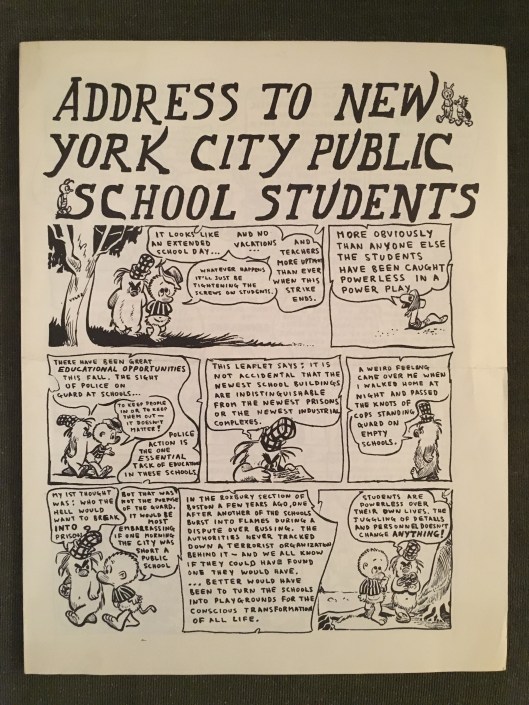
Stunning detourned Pogo comic by Bruce Elwell and Robert Chasse, published by the American section of the Situationist International in late 1968.

A translation of this comic into French is available  courtesy of Editions CMDE here . It is worth noting that CMDE issued the first French-language translation of the writings of the American Section of the Situationist International (2012).

In his preface to the French translation, translator Fabrice de San Mateo explains the context behind this comic: “At the moment that Chasse joined the SI, Elwell prepared a comic strip, “Address to New York Public School Students,” [created] in the vein of the comic-strips detourned by the [European] situationists. He composed these four-page comics with images borrowed from three anthologies of Pogo. The subject of this detournement was the union-led strike of the teachers in New York in the autumn of 1968, of which the Council had made a review in its text “The Newest School Buildings Are Indistinguishable From the Newest Prisons or the Newest Industrial Complexes”…These detourned comics appeared on 12 November 1968 as a publication of the Situationist International.At the same time, Elwell became a member of the SI in his turn.” (translation borrowed from http://www.notbored.org/ecrits-preface.html)

Not in Ford. We locate a single OCLC copy at New York University’s Tamiment Library, where it can be found in the “Ben Morea and Aldo Tambellini Papers” archive (TAM.530, Box 1, Folder 63)

2016-03-20 19.20.562016-03-20 19.21.142016-03-20 19.21.262016-03-20 19.21.38


Maurice Wyckaert [INVITATION CARD] [1961]

Maurice Wyckaert [INVITATION CARD]. Milano: Galleria Del Naviglio, n.d. [December 1961]. 16 x 11.5 cm.; black ink on thick yellow stock.

Invitation card for Maurice Wyckaert’s show at Galleria D’Arte Del Naviglio in Milan on 9 December 1961.

Painter Maurice Wyckaert was a member of the Belgian section of the Situationist International through April 1961, when he was excluded “following an attempt to meddle in the SI’s affairs by the art dealer Otto Van de Loo, who had hoped to influence its politics by making threats and promises to several situationists with whom he had personal relations” (http://www.cddc.vt.edu/sionline/chronology/1961.html). Wyckaert  is best known for having been chosen to read the Declaration in the Name of the Fourth SI Conference to the Institute of Contemporary Arts, at the Institute of Contemporary Arts on 28 September 1960. Often viewed as a relatively “minor” figure in the SI, Wyckaert’s works and contributions were brought to light in Gérard Berréby & Danielle Orhan (éds), L’Œuvre peint (1947-1996). Paris: Allia, 2012.

Not in OCLC.

cartolina-invito-mostra-maurice-wyckaert-galleria-arte-91659855-5389-47cf-ad60-26fa9e4c3299

The End of Music [1978]

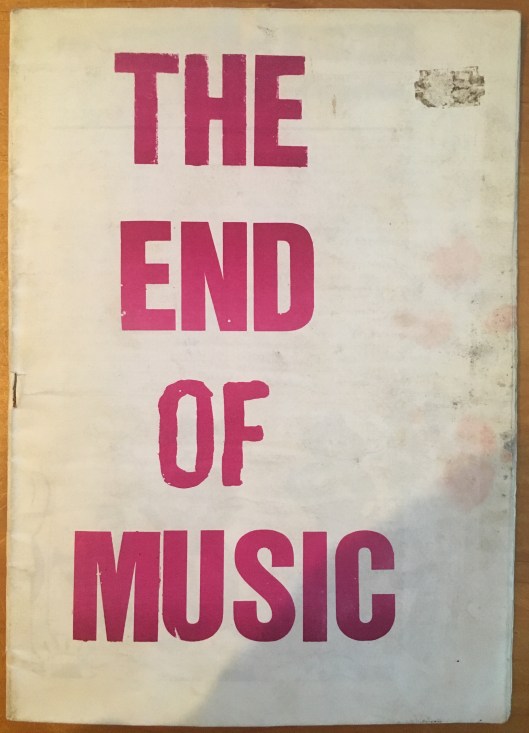
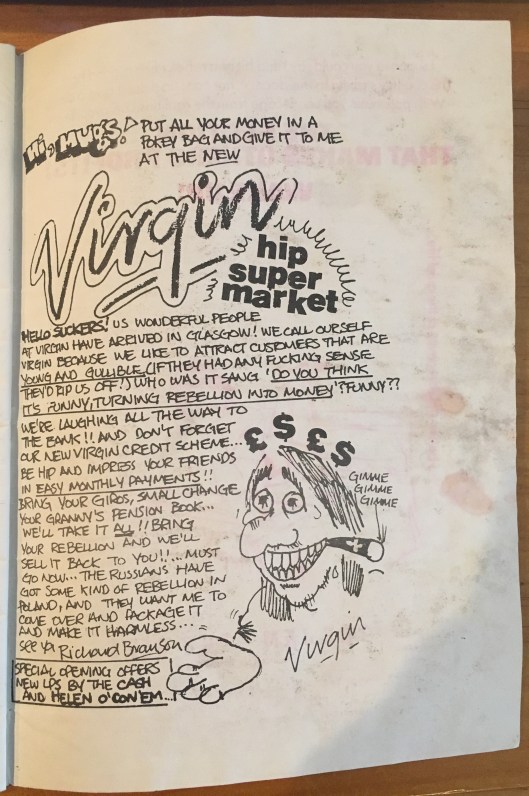
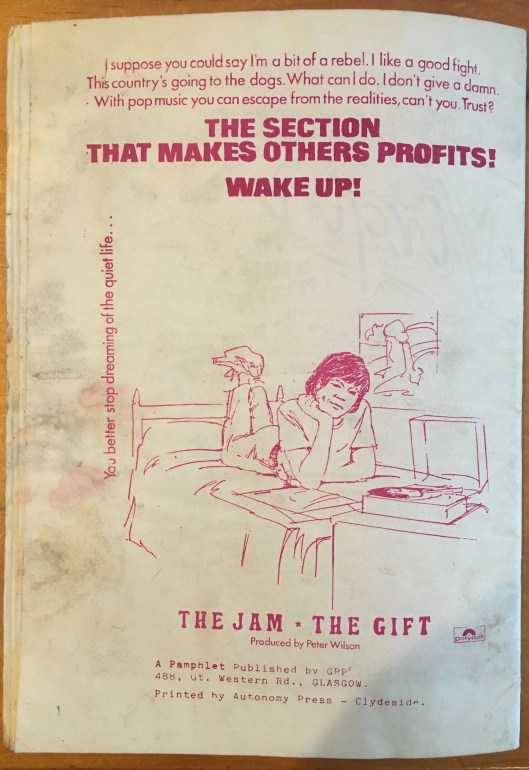
[Wise, David] The End of MusicGlasgow: GPP, n.d. [1978?]. 36p.; ill.; 18 x 26 cm.; white wrappers with text in pink.

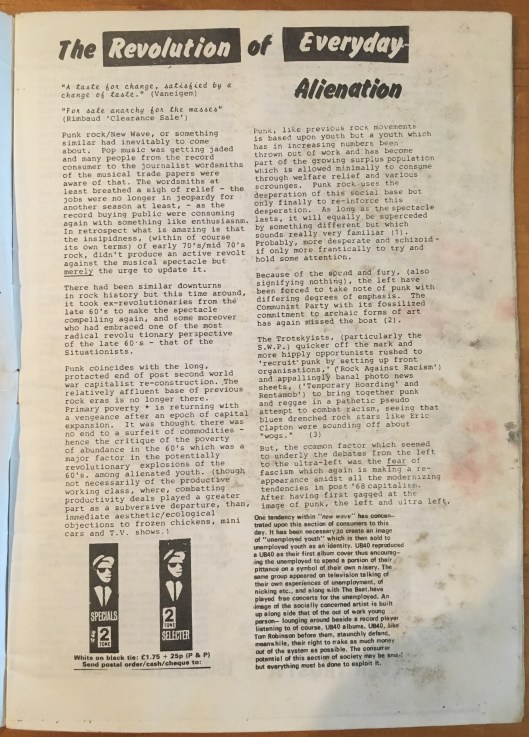
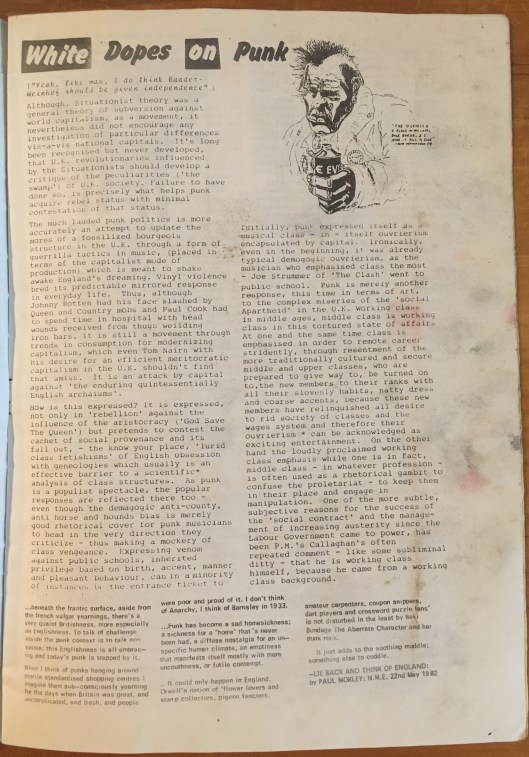
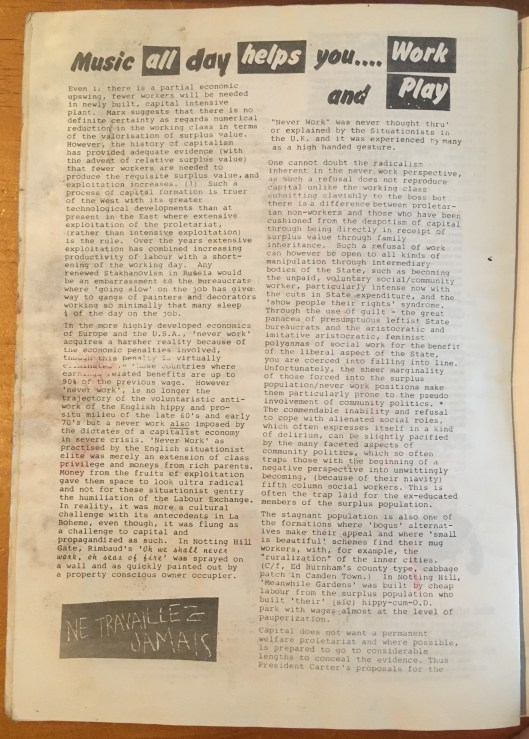
Contents:  “The Revolution of Everyday Alienation”; “White Dopes on Punk”; “Rebel Music and State Morality”; and “Music All Day Helps You…Work & Play”

Written by David Wise (formerly of King Mob), this is an important pamphlet that lays out the problematic relationship between Punk music and Situationist ideas. “Part of the genesis of punk goes back 10 years to the English section of the Situationists and the subsequent King Mob group, a loose affiliation (hardly a group) of disparate though confused revolutionary individuals in England in 1968”

Initially published in a typescript format, “this text was written around 1978 and came to be circulated in the U.K. by an informal network of revolutionaries who used the text as a focus for discussion in order critically to uncover the ‘social glue’ that maintains capitalist society.” (p. 34).

This “pirate” reprint is interesting in that, laid-in within the facsimile reproduction of the original typescript is a smaller-sized pamphlet that reproduces part of the content with a critical assessment by the authors of this edition: “We have indicated our differences with the author’s formulations at this time, in terms of an attachment to Marxist categories. While those passages dealing with the evolution of the English ‘pro-Situ’ scene are, in our opinion(s), among the most interesting in the text, we don’t view the pamphlet as accounting fully for the development of Punk or Reggae. Like Council Communism, ‘Situationism’ is the creation of a particular era in social struggle, and nostalgia bordering on mystification can only act as a brake on the re-vision of new revolutionary perspectives” (p.34).

“The End of Music” was later reprinted as part of Stewart Home’s “What is Situationism” (AK Press, 1990). It was also reprinted as part of David Wise’s “King Mob: a Critical Hidden History” (Bread and Circuses Publishing, 2014). The full text can be found on David and Stuart Wise’s website at http://www.revoltagainstplenty.com/index.php/recent/216-the-original-copy-of-the-end-of-music.html

For Stewart Home’s (very critical) assessment of the pamphlet, see https://www.stewarthomesociety.org/ass/punk.htm

Ford 318. We locate 4 OCLC copies (Leeds, National Art Library, University of London Research Services, IISG), none of which of this particular edition.


2016-03-19 17.17.492016-03-19 17.18.072016-03-19 17.18.422016-03-19 17.19.002016-03-19 17.19.482016-03-19 17.20.012016-03-19 17.20.092016-03-19 17.20.18

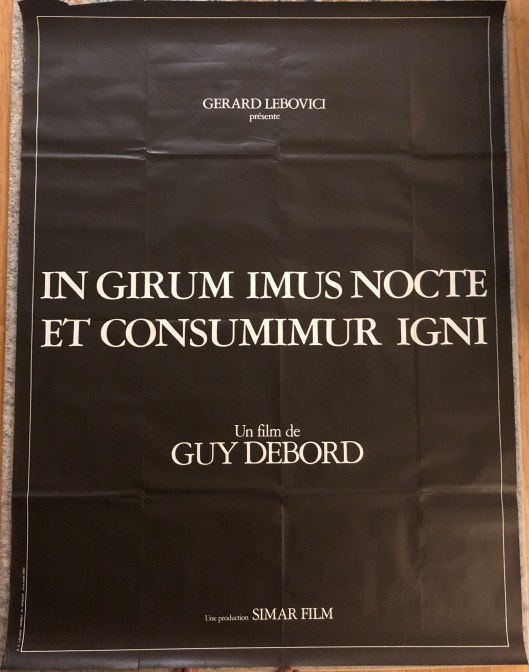
Gerard Lebovici presente: In girum imus nocte et consumimur igni [1981]

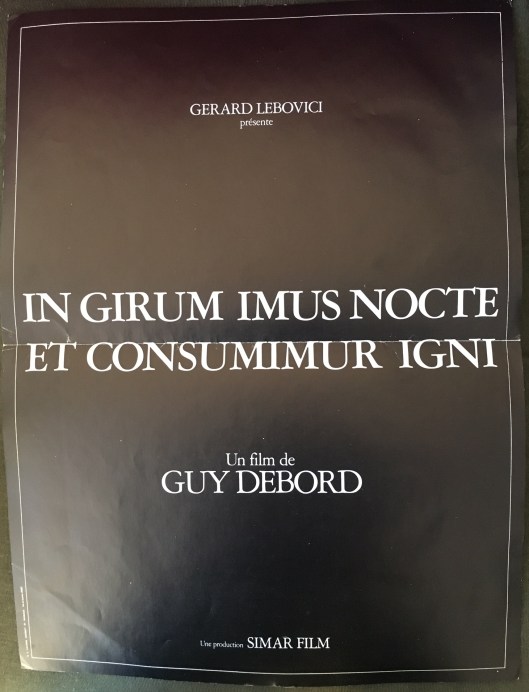
Debord, Guy. Gérard Lebovici présente : In girum imus nocte et consumimur igni.  n.p. [Paris]: Simar Film, n.d. [1981] 38.4 x 51.5 cm. White ink on thick black stock.

Original film poster for Debord’s 1978 film In girum imus nocte et consumimur igni (95 min.; black and white) which was released in theaters three years later (1981). The title is borrowed from latin’s longest palindrome, which can be translated as “we turn round and round in the night and are consumed by fire.”

“The film opens with an excoriating attack on the cinema-going public and its world, and on conventional cinema itself. However, the bulk of the film is given over to Debord’s quite personal reflections on his life, loves and times, taking in his early pre-situationist years in the Sant-Germain-des-Prés district of Paris, the Situationist International, and the various European locales in which he lived after the dissolution of the International in 1972” (Ubuweb)

Several film scholars view the deeply autobiographical film as Debord’s most personal production. It was re-released as part of a boxed set of Debord’s complete cinematographic works by Gaumont in November 2005.

Full feature available online at Ubuweb

We locate no OCLC copy

IMG_4982

EDIT: We have now located the larger (but identical poster), as shown below.

Debord, Guy. Gérard Lebovici présente : In girum imus nocte et consumimur igni.  n.p. [Paris]: Simar Film, n.d. [1981] 156 x 116 cm. White ink on thick black stock.

IMG_1609


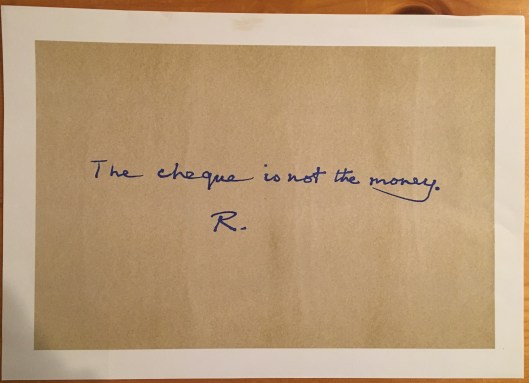
The cheque is not the money [2016]

Rumney, Ralph and Berreby, Gerard. The cheque is not the money. Marseille: Editions Salon du Salon, 2016. Risograph print on A3 (29.7 x 42 cm.) Munchen Lynx Rough 150g paper. One of 50 signed and numbered copies.

Gerard Berreby’s homage to his friend Ralph Rumney, whom he visited regularly in his Manosque apartment while the two of them collaborated on Le Consul (Paris: Allia, October 1999). Once, then-bedridden Rumney asked for a small sum of money, and Berreby complied. In return, he received a small handwritten note with the following text: The cheque is not the money.

As Berreby notes, Rumney’s text is a clever allusion to Marcel Duchamp’s Tzanck Check in 1919: Out of money, Duchamp offered to pay his dentist with a handwritten check, stamped by him – a unique piece of art. The note also alludes to Korzybski’s celebrated The Map is not the Territory.

More than fifteen years later, Berreby  chose to enlarge the note and create a limited edition print.  It is available at http://editionsdusalon.com/047-g_berreby-R_rumney_the-cheque_salondusalon.htm

IMG_4951IMG_4952

SdS #8 - Reprise 1, 15 janvier 2016, signature The cheque is not the money, édition risograph A3, par Gérard Berréby, (Allia) en résidence au Salon du Salon pour la préparation du livre : Histoire d’un (vrai) faux ( à paraître aux éditions Salon du Salon - Printemps 2016).Commande de l’édition Risograph : http://www.editionsdusalon.com/047-g_berreby-R_rumney_the-cheque_salondusalon.htm


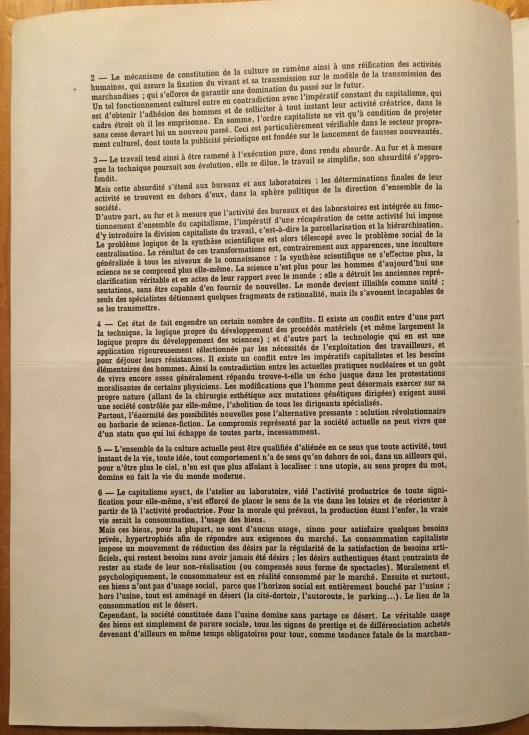
Préliminaires pour une définition de l’unité du programme révolutionnaire [1960]

Debord, Guy and Canjuers, P, [pseud. Daniel Blanchard]. Préliminaires pour une définition de l’unité du programme révolutionnaire. Paris: n.p., 20 July 1960. 4 p.; 26 x 19.5 cm.; black ink on off-white paper.

Important text meant to serve as a shared theoretical between the groups Internationale Situationniste and Socialisme ou Barbarie (S&B). Led by Cornelius Castoriadis, S&B was a radical libertarian group active from 1948 to 1965. Rejecting Leninism, it embraced and advocated for council communism. At its peak, the group had about a hundred members, including both workers and intellectuals. Popular figures who militated with S&B include French linguist Gerard Genette, (future) negationist Pierre Guillaume, Vietnamese Trotskyist Ngo Van, Philosopher Jean-Francois Lyotard, Marxist activist Henri Simon and, of course, both Daniel Blanchard and Guy Debord.

Debord joined Socialisme ou Barbarie in 1960 and left the following year. This brief membership is important because it constitutes an early manifestation of Debord’s desire to make the SI more of a political movement (by 1962, the bulk of the artists had been excluded from the organization).

A detailed account of the relationship between Debord and S&B, as well as how S&B might have influced Debord (and vice-versa) can be located here: https://collectiflieuxcommuns.fr/120-socialisme-ou-barbarie-et-l?lang=fr


The text was reprinted a number of times: in Notes critiques no.3 (1962), Mirella Bandini’s L’Estetico il politico. Da Cobra all’Internazionale Situazionista 1948-1957 (1977, 1999), Daniel Blanchard’s Debord, dans le bruit de la cataracte du temps, suivi de “Préliminaires pour une définition de l’unité du programme révolutionnaire” de P. Canjuers & G.-E. Debord [1960] (2000, 2005). In this latter text, Daniel Blanchard discusses the relationship between Debord and S&B in some detail.

The original text is available online at http://www.left-dis.nl/f/debart.htm. An English translation by Ken Knabb is available at the Bureau of Public Secrets (http://www.bopsecrets.org/SI/prelim.htm)

Gonzalvez 112. Raspaud & Voyer 11. BnF 134 & 219.

We locate two OCLC copies, at Yale and the Bibl. Nationale de France (BNF) in Paris.

2016-02-14 18.57.222016-02-14 18.57.452016-02-14 18.58.042016-02-14 18.58.18

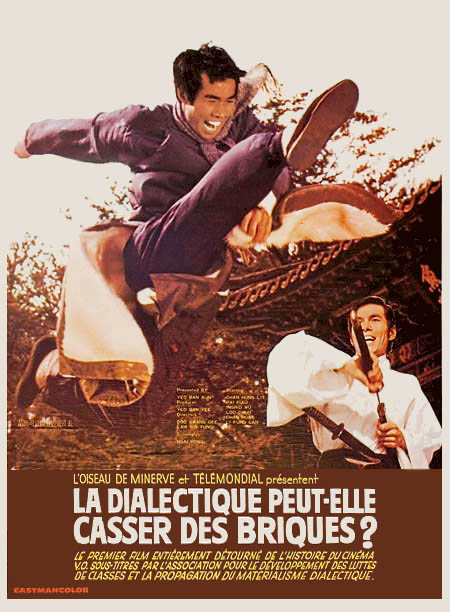
Crush Karate AKA La Dialectique peut-elle casser des briques [ALTERNATE POSTER] [1973]

Vienet, Rene. Crush Karate [aka La Dialectique Peut-elle Casser des Briques?] Paris: n.p., 1973. 160 x 120 cm; ill. poster with screenshot from the film.

Film poster for Vienet’s famous detourned film. “Le premier film entièrement détourné de l’histoire du cinéma, v.o., sous-titres par l’Association pour le développement des luttes de classes et la propagation du matérialisme dialectique” (“The first completely detourned film in the history of cinema, original soundtrack, subtitles by the Association for the promotion of class warfare and dialectical materialism”).

This is an alternate version of the poster that was made using the original film title. We were not aware of its existence until it surfaced in the trade recently.

We locate no OCLC copy

Untitled

Compare to the original, and better-known poster:

la-dialectique-peut-elle-casser-des-briques-1973

De Spektakelmaatschappij / La Societe du Spectacle [1976]

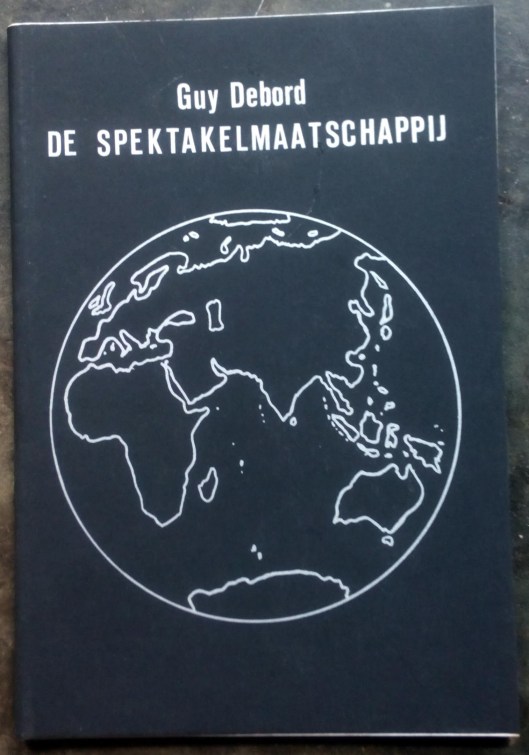
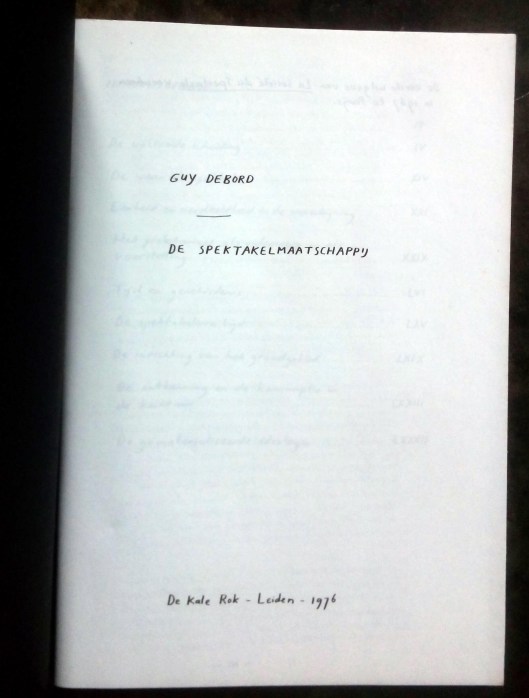
Debord, Guy. De Spektakelmaatschappij. Leiden (Netherlands): De Kale Rok, n.d. [1976]. 84 p.; 20.5 x 30 cm.; ill. Black silk screened cover with metallic grey text and world map

Debord’s seminal text. Pirate Dutch edition released the same year as the official Dutch translation (trans. Jaap Kloosterman; published by  Baarn : Het Wereldvenster). While no definitive information exists, it is believed this edition was part of a run of 100 or 200. The handwritten feel and silk screen give it a luxurious feel seldom found in such pirate reprints.

We locate a single OCLC copy at the International Institute of Social History (IISG) in Amsterdam

unnamed

unnamed (3)

unnamed (2)

unnamed (1)

Internationale Situationniste 2 – First and Second Printing [1958, 1962]

[Internationale Situationniste] Internationale Situationniste: Bulletin central des sections de l’Internationale Situationniste 2. Paris: Internationale Situationniste, December 1958. 34 p.; ill.; 24.5 x 16 cm; silver metallic wrappers with text printed in black

[Internationale Situationniste] Internationale Situationniste: Bulletin central des sections de l’Internationale Situationniste 2. Paris: Internationale Situationniste, 2nd trimester 1962. 34 p.; ill.; 24.5 x 16 cm; silver metallic wrappers with text printed in black

The second issue of Internationale Situationniste is the only one to have been reprinted. Originally issued in December 1958, the aluminum foil used for the wrappers was of such poor quality that the majority of copies did not survive the printing process. A second printing was thus realized in the Spring of 1962. It is unknown how many copies of the first printing survive, but they are very rarely seen in the trade.

As stated in the colophon, the content of the second printing is indeed identical to that of the first printing (Tous les textes sont rigoureusement conformes a leur edition originale). However, there are numerous differences in layout, particularly as relates to the size of illustrations, the choice of upper/lower case fonts in titles, and more.

Astute readers can judge for themselves, as we have put the two printings side-by-side to allow a detailed comparison where the differences were most striking. The left-hand side of the picture is the first printing, with the right-sand side is the later reprint.

Full PDF scan of the facsimile reprint by “La Bibliotheque Fantastique” is available at http://www.larevuedesressources.org/IMG/pdf/internationale_situationniste_2.pdf

2016-02-02 18.25.012016-02-02 18.28.012016-02-02 18.28.372016-02-02 18.30.072016-02-02 18.30.512016-02-02 18.31.342016-02-02 18.32.012016-02-02 18.32.082016-02-02 18.32.18

Click to access internationale_situationniste_2.pdf

Mani di Ferro [1973]

Vienet, Rene. [La Dialectique peut-elle casser des briques?] Mani di Ferro [FILM POSTER]. n.p. [Italy]: n.p., 1973. 140 x 100 cm. ; ill. poster on white stock with text in red.

Original large-scale poster for the Italian release of Crush Karate (original title: Tang Shou Tai Quan Dao), the 1973 Hong Kong Kung-Fu film detourned by Vienet to create “La Dialectique peut-elle casser des briques?” The aesthetics are very similar to those Vienet used for his own “original” release.

We locate no OCLC copy.

$_57$_57