WOLMAN = Lettrism + Detournement [2015[

As of late, Lettrisme scholar, sound artist and experimental composer Frederic Acquaviva has been busy bringing Gil J. Wolman back to the forefront of (art) history. Earlier this year, we discussed “Et des Hommes…”, a comics collage  by Wolman made available to the general public for the first time courtesy of Editions Acquaviva. We now wish to mention a Wolman exhibit put together by Acquaviva at “La Plaque Tournante” (a likely reference to the psychogeographic concept of “rotating plates”) gallery in Berlin:  http://www.laplaquetournante.org/03-5.html

WOLMAN = Lettrism + Detournement [INVITATION CARD]. n.p. [Berlin, Germany]: n.p. [La Plaque Tournante / Frederic Acquaviva], n.d. [2015]. 15 x 10 cm. double-sided postcard. Invitation card to the opening of the “WOLMAN = Lettrism +  Detournement” exhibition at “La Plaque Tournante” in Berlin from September 20 to November 13, 2015. FRONT: Photograph of Wolman. BACK: Logistical details and short blurb about the exhibition (“For the first time in Berlin, an exhibition of key artist Gil J. Wolman (1929-1995), historical member of Isidore Isou’s Lettrism since 1950 and co-founder of the Letterist Internationale and ‘Mode d’Emploi du Detournement’ with Guy Debord. More than 200 artworks, books, documents, photos, ephemeras, prints and soundworks from 1950 to 1995.”

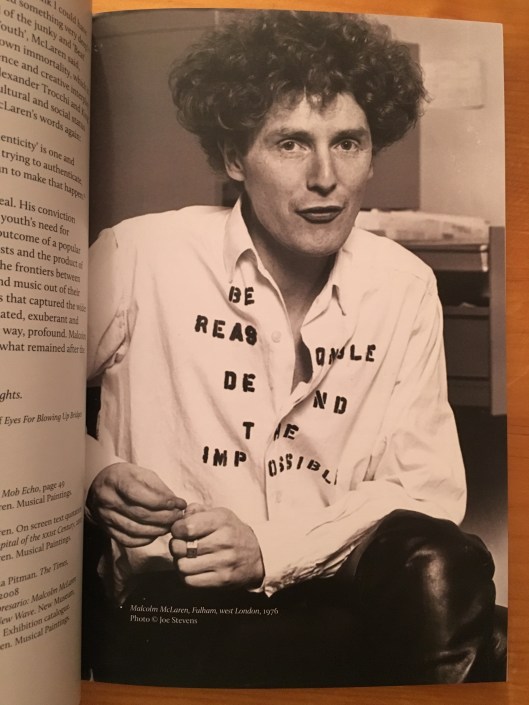
Eyes For Blowing Up Bridges: Joining the Dots from the Situationist International to Malcolm McLaren [2015]


Today, a series of items that relate to the recent exhibition “Eyes for Blowing Up Bridges: Joining the Dots from the Situationist International to Malcolm McLaren” held at the John Hansard Gallery in Southampton, UK from 26 September to 14 November 2015.

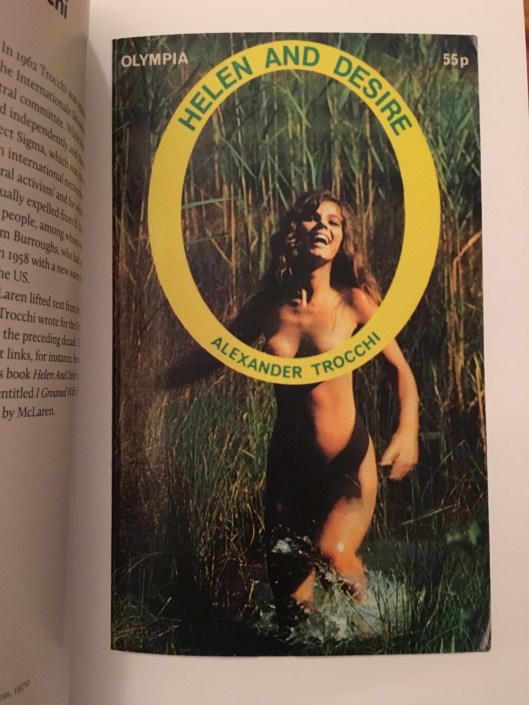
Gorman, Paul et al. Eyes for Blowing Up Bridges: Joining the Dots from the Situationist International to Malcolm McLaren [CATALOG]. Southampton, UK: John Hansard Gallery, 2015. 96 p.; ill.; 16 x 24 cm. Catalog of the exhibition held at the John Hansard Gallery, University of Southampton, from September to November 2015. The exhibition brings together the likes of King Mob, Guy Debord, the Internationale Situationniste, Alexander Trocchi, Asger Jorn, William Burroughs and attempts to create a link all the way through Malcolm McLaren. Includes a foreword by Stephen Foster & Ros Carter, an Introduction by Paul Gorman, and essays by David Thorp  (“Joining the Dots”) and Fred Vermorel (“Blowing up the bridges so there is no way back”). The title of the exhibition is inspired by Debord’s phrase, “de beaux yeux pour faire sauter des ponts”, taken from correspondence between Guy Debord and his friend Hervé Falcou.

2015-12-22 01.20.012015-12-22 01.20.322015-12-22 01.21.102015-12-22 01.21.302015-12-22 01.22.50

Eyes for Blowing Up Bridges: Joining the Dots from the Situationist International to Malcolm McLaren [LEAFLET]. n.p. [Southampton, United Kingdom]: n.p. [John Hansard Gallery], n.d. [September 2015]. Ill. two-sided leaflet, 52 x 42 cm (folded into 13 x 21 cm sheet). The leaflet unfolds into a map that recalls Debord and Jorn’s Naked City (1957), with the following instructions “Drift…You are invited to enjoy this exhibition in the manner of the deriveur. Drift, so that you may become repelled or enchanted by what you find, and return home having noted the ways in which the areas traversed resonate with particular moods and ambiences. Paul Gorman + David Thorp, Curators”. On the flip side, an extract from the catalogue essay by Fred Vermorel as well as mini-bios of Malcolm McLaren, William Burroughs, Alexander Trocchi, Guy Debord, and Asger Jorn.

Eyes for Blowing Up Bridges: Joining the Dots from the Situationist International to Malcolm McLaren [PRIVATE VIEW CARD]. n.p. [Southampton, United Kingdom]: n.p. [John Hansard Gallery], n.d. [September 2015]. Ill. two-sided card; 21 x 15 cm. Private view invitation card for the “Eyes for Blowing Up Bridges” exhibition at the John Hansard Gallery, University of Southampton. Front: Naked City inspired detourned map with the names of the key artists and political movements featured in the exhibition (King Mob, Malcolm McLaren, William Burroughs, Guy Debord, Alexander Trocchi, Asger Jorn, Situationist International). Back: Relevant logistical details for the private view (Saturday 26 September, 1pm-3pm).

2015-12-22 01.14.472015-12-22 01.15.18

 John Hansard Gallery – What’s On – September-November 2015. N.p. [Southampton, United Kingdom]: n.p. [John Hansard Gallery], n.d. [September 2015]. Ill. leaflet; 42 x 21 cm. Leaflet for the October/November 2015 program at the John Hansard Gallery, University of Southampton. This includes the “Eyes for Blowing Up Bridges” exhibition (26 September – 14 November), as well as events and workshops and future exhibitions.

For more information and catalog purchases, see http://www.hansardgallery.org.uk/event-detail/188-eyes-for-blowing-up-bridges-joining-the-dots-from-the-situationist-international-to-malcolm-mclaren/

Philobiblon talk on collecting the Internationale Situationniste (Dec. 8)

Dear readers,

Please excuse the shameless self-promotion, but for those of you living in (or traveling through) the Philadelphia area, please come and listen to me talk about my collection around the Internationale Situationniste and its aftermath. Please leave me a note if you’d like to attend.

————————————————————-

THE PHILOBIBLON CLUB OF PHILADELPHIA

Collecting the “Spectacular-commodity:” the Internationale Situationniste and its Aftermath

Tuesday, December 8, 2015

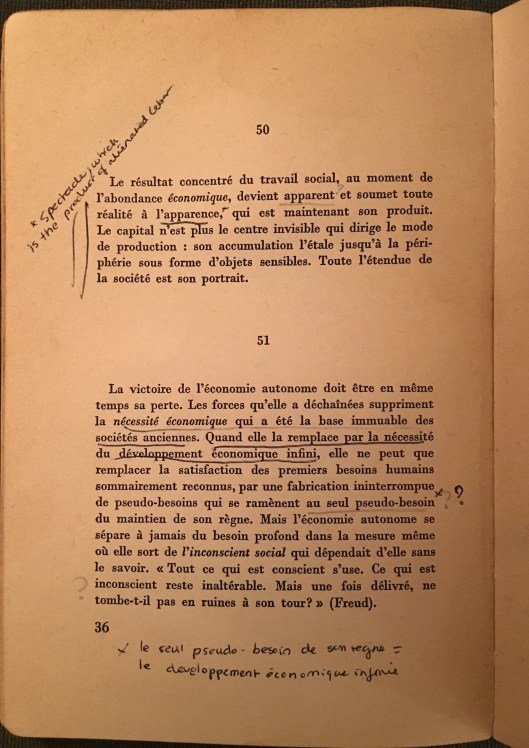
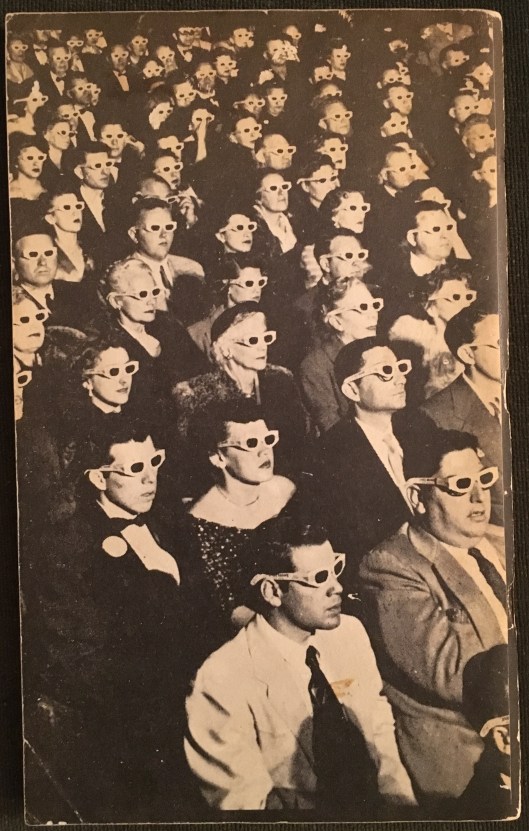
Founded in 1957, the Internationale Situationniste was one of the foremost Post-war European avant-gardes. Its leader, Guy Debord, posited that “in modern societies… everything that was directly lived has moved away into a representation.” In a sense, the opening sentence of the Society of the Spectacle (1967) – Debord’s magnum opus and the movement’s key theoretical foundation – encapsulates the Situationsists’ unique take on traditional Marxo-Hegelianism. According to Debord, alienation does not lie in workers’ lack of agency (as Marx believed) but – and this is a simplification – in the fact that, in modern societies, social interactions are mediated by (distorted) images.

Collecting the Internationale Situationniste is, in many ways, a duplicitous, even counter-revolutionary, act. The Situationist movement rejected the accumulation of material goods and attacked the concept of copyrights, viewing the former as a noxious byproduct of the “spectacular-commodity” economy and the latter as a means to constrain ideas within controlled, commercialized distribution channels. Unsurprisingly, then, the group’s eponymous journal opens with a statement that “all texts published in Internationale Situationniste may be reproduced, translated, or adapted without indication of origin”.  Many took the Situs to their word – their writings can be purchased for a small price at most anarchist bookstores or downloaded free of charge from the internet.

This talk will provide an introduction to the Internationale Situationniste through the prism of book collecting. It will also address some of the joys and challenges of acquiring material whose materiality actively rejects its collectible status (e.g., endless pirate reprints, no imprint information, unknown run, poor quality paper, etc.).

More about the collection can be found on Public Collectors, a project to make public “cultural artifacts that public libraries, museums and other institutions and archives either do not collect or do not make freely accessible” (http://publiccollectors.org/SituationnisteCollection.html). Unique or otherwise unusual items from the collection are shared on a regular basis through a dedicated blog (https://situationnisteblog.wordpress.com/).

Fin de Copenhague [1957]

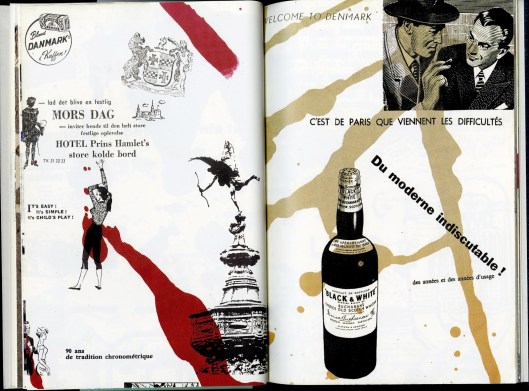
Jorn, Asger and Debord, Guy. Fin de Copenhague. Copenhagen: Bauhaus Imaginiste , May 1957. n.p. [36 pp.]; ill.; 24.5 x 17 cm.; ill. blue-gray publisher bindings impressed with a page “liberated” from the Danish newspaper Politiken (each copy was made with a different page, and is thus unique). Color reproduction of text and picture collages.

Our copy is among a handful of unnumbered copies reserved for the artists beyond the commercial run of two-hundred numbered and signed copies. This presentation copy was personally gifted to Ole Jorn by his father,Asger Jorn,  who warmly inscribed it as such (“To Ole, from Papa”).  An extraordinary provenance indeed.

fin de copenhague010

fin de copenhague008

Fin de Copenhague is the product of a collaboration between Guy Debord and Asger Jorn immediately preceding the foundation of the Situationist International. “The book was printed within 24 hours as an artistic experiment. Having just arrived in Copenhagen, Jorn and Debord rushed into a newsagents, stole a huge amount of magazines and newspapers, and spent a drunken afternoon collaging elements together. The next day they arrived at the printer with 32 collages, which were transferred to lithographic plates. Jorn then sat at the top of a ladder over the zinc plates, dropping cup after cup of Indian ink onto them. The plates were then etched and printed over the black texts and images.” (Bruun Rasmussen). The book was produced by legendary printer of avant-garde movements Permild & Rosengreen, whom Jorn and other COBRA artists had trusted with several of their works.

Since its original publication in 200 copies, Fin de Copenhague was reprinted a few times. It was first included in Documents Relatifs a la Fondation de l’Internationale Situationniste, pp. 553-592 (Paris: Allia, 1985), which is now out of print. A standalone facsimile was released by Allia in 1986, and reissued in September 2001 (under the collection “Contributions a l’Histoire de l’Internationale Situationniste et son Temps”) with a preface by Gerard Berreby. Finally, It is now available over the internet; a full PDF facsimile of the first edition can be found online at  http://monoskop.org/images/7/75/Jorn_Asger_Fin_de_Copenhague.pdf

We locate 13 OCLC copies: 6 in Europe (Danish Union Catalogue and National Library, State and University Library in Aarhus, Bibliotheque Nationale de France, Universite Libre de Bruxelles, Bibliotheque Nordique, Bibliotheque Litteraire Jacques Doucet) and 7 in the United States (Berkeley, Getty, MIT, Northwestern, Stony Brook, Yale, Columbia).

Gonzalvez 84. Hansen 166.

Sincere thanks to Tommy K. for his help in securing this exceptional copy

Further reading:

Nolle, Christian. Books of Warfare: The Collaboration between Guy Debord & Asger Jorn from 1957-1959.http://virose.pt/vector/b_13/nolle.html

Poynor, Rick. On my Shelf: Fin de Copenhague.  http://designobserver.com/article.php?id=37720


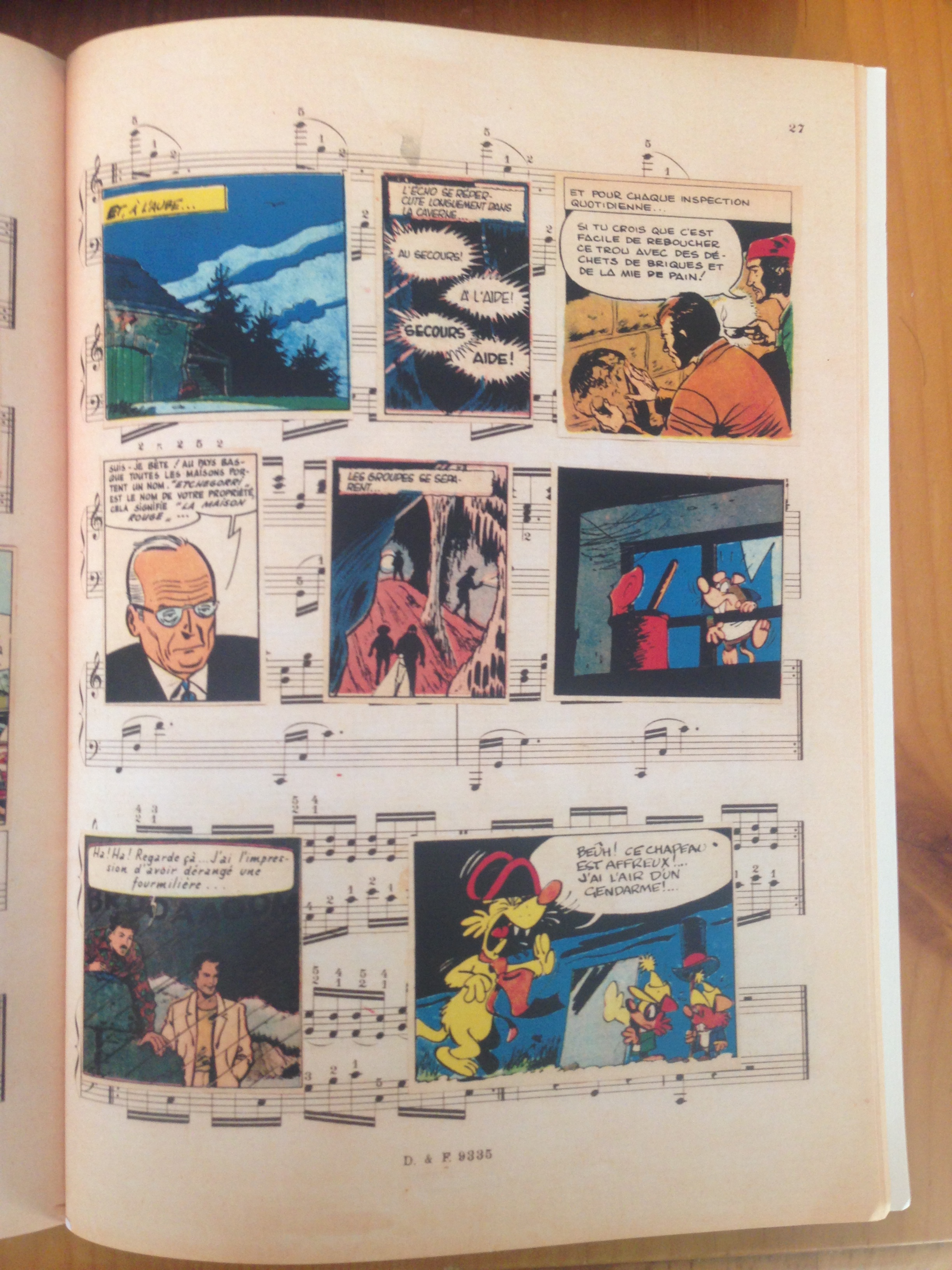
Et des Hommes…by Gil Wolman [1973 / 2015]

Wolman, Gil. Et des Hommes. Berlin: Editions AcquAviva, 29 September 2015. n.p. [32 p.]; ill.; 20 x 28 cm.; ill. Wrappers with comic strips.

First edition of Wolman’s work of comics collages on a piano, released on the occasion of the exhibition “Woman = Lettrism+Detournement” at “La Plaque Tournante” in Berlin While the original work dates from ca. 1973, it is made available to the general public for the first time, courtesy of Lettrisme scholar, sound artist, and experimental composer Frederic Acquaviva (who also edits this volume) as well as the Gil J. Wolman estate.

This limited edition of 100 is priced competitively (20 Euro) and available directly from the publisher (info@laplaquetournante.org) or avant-garde book dealer LecointreDrouet (www.lecointredrouet.com) in Paris.

For those able to attend, the exhibit features “more than 200 artworks, books, documents, photos, ephemera, prints and soundworks from 1950 to 1995”. La Plaque Tournante is at Sonnenallee 99, 12045 Berlin, Deutschland. Through November 13, 2015.http://www.laplaquetournante.org/03-5.html

2015-10-18 16.25.48 2015-10-18 16.25.57 2015-10-18 16.26.23 2015-10-18 16.26.41 2015-10-18 16.27.04 2015-10-18 16.27.28 2015-10-18 16.25.27

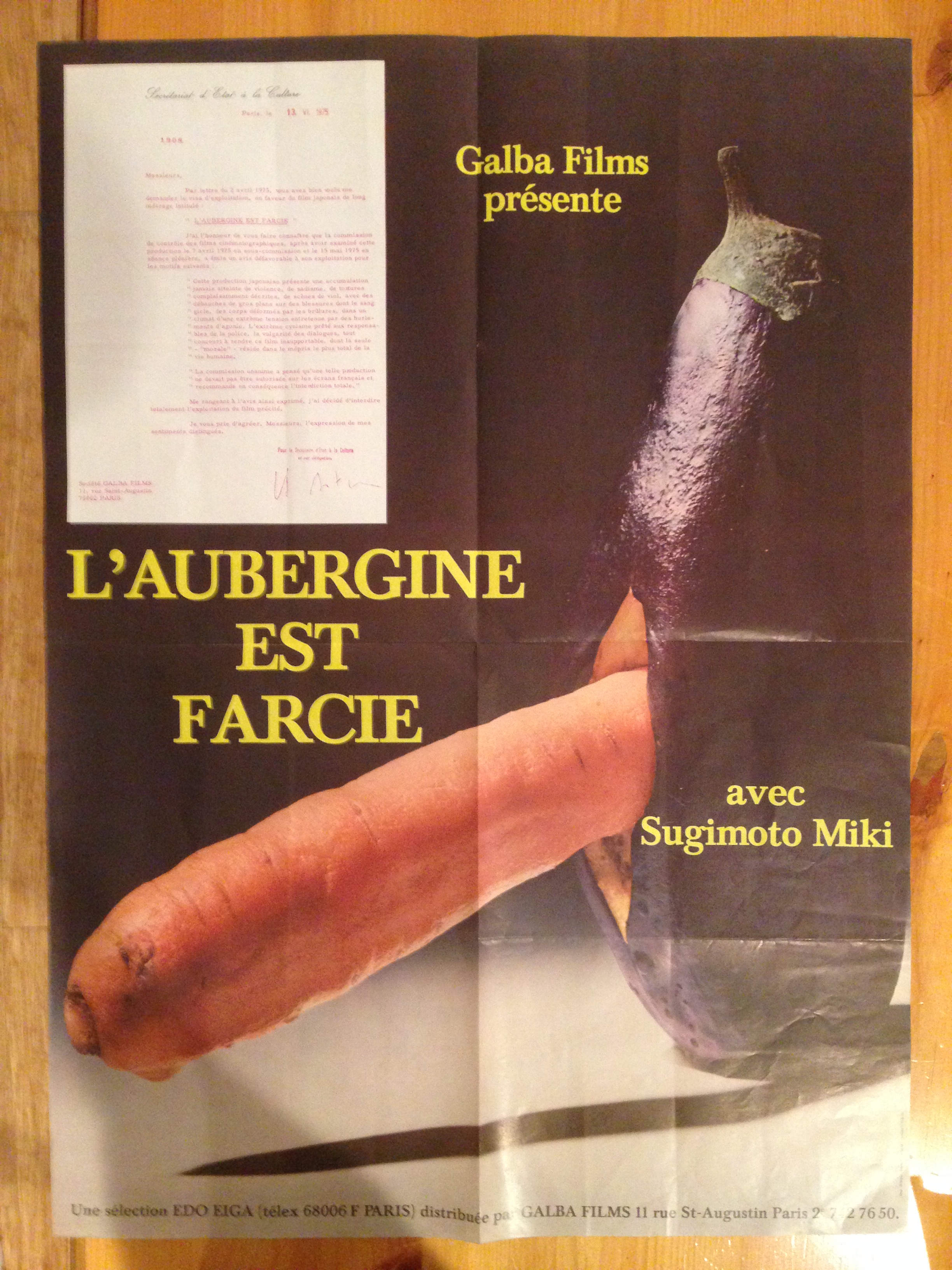
L’Aubergine est Farcie [POSTER] [1973]

Vienet, Rene. L’Aubergine est Farcie. n.p. [Paris]: Imp. BRICOUT, 1975. 60 x 80 cm.; ill. offset-printed.

Original film poster for Vienet’s detourned film. Originally released in Japan as “Zeroka no onna : Akai wappa” in 1974, the film was directed by Yukio Noda and featured Miki Sugimoto and Eiji Go. It was “adapted” by Vienet the following year.

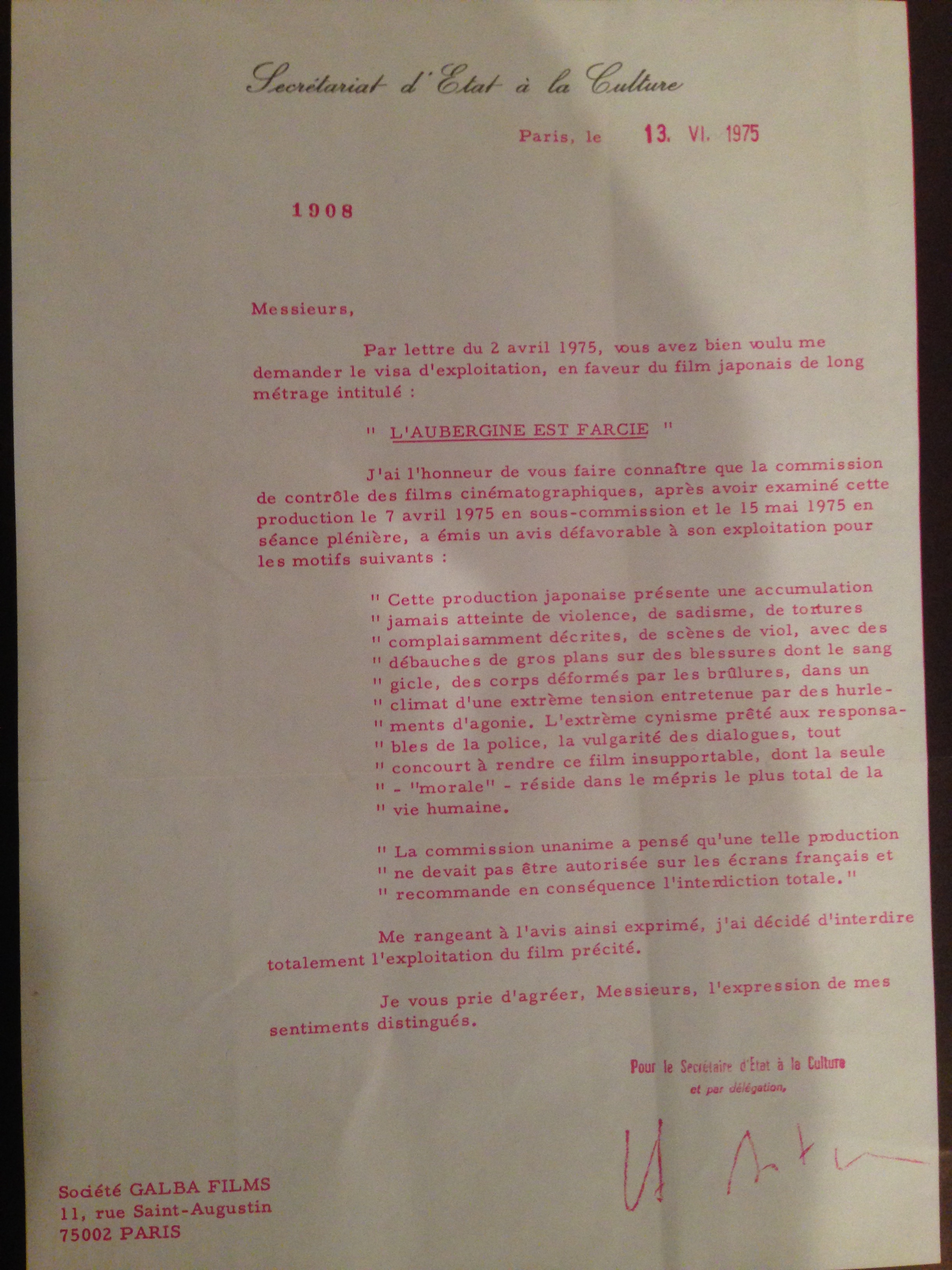
Vienet’s adaptation was not released, as the film was struck with a complete ban by the French authorities on May 15, 1975. The French Ministry of Culture offered the following explanation for its decision: “This Japanese production presents an unprecedented accumulation of violence, sadism, complacently described torture, rape scenes, bloody close-up debauchery scenes, charred and deformed bodies, in a climate of extreme tension sustained by screams of agony. The extreme cynicism of police forces, the vulgarity of dialogues, all contribute to making this an unbearable film, whose sole “morality” lies in its most absolute contempt for human life. The commission unanimously agreed that such a production ought not be authorized on French screens and thus recommends a complete ban.” (Translation is mine). For contemporary accounts of the censorship decision, see Écran n° 40 page 2, cinéma & société [October 1975] and Image et Son – La Revue du Cinéma n° 298 page 23, cinéma & société [September 1975]

The film was never officially released – it was only screened privately to a handful of journalists. As such, that a film poster survives is indeed something of a miracle.

For the poster of the original (pre-detourned) Japanese release, see http://www.encyclocine.com/index.html?menu=72608&film=43573. For film photos, see http://photobuste.blogspot.com/2015/06/zeroka-no-onna-akai-wappa-1974-yukio.html

Rare. We find no copies on OCLC or in the trade.

2015-10-03 18.57.10 2015-10-03 18.57.39

[INTERLUDE] The Line Between: Ben Morea Paintings of the Early 90s

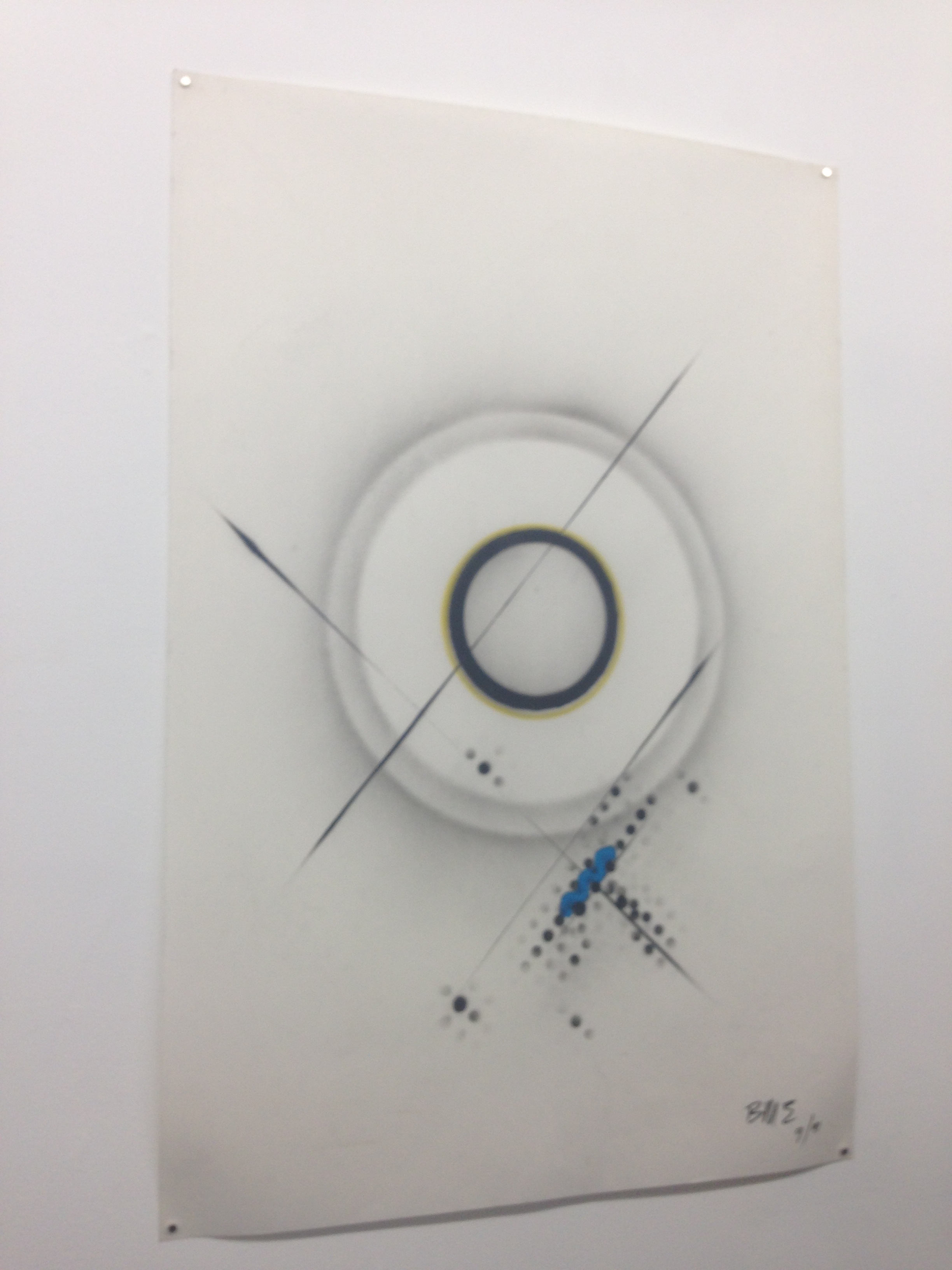
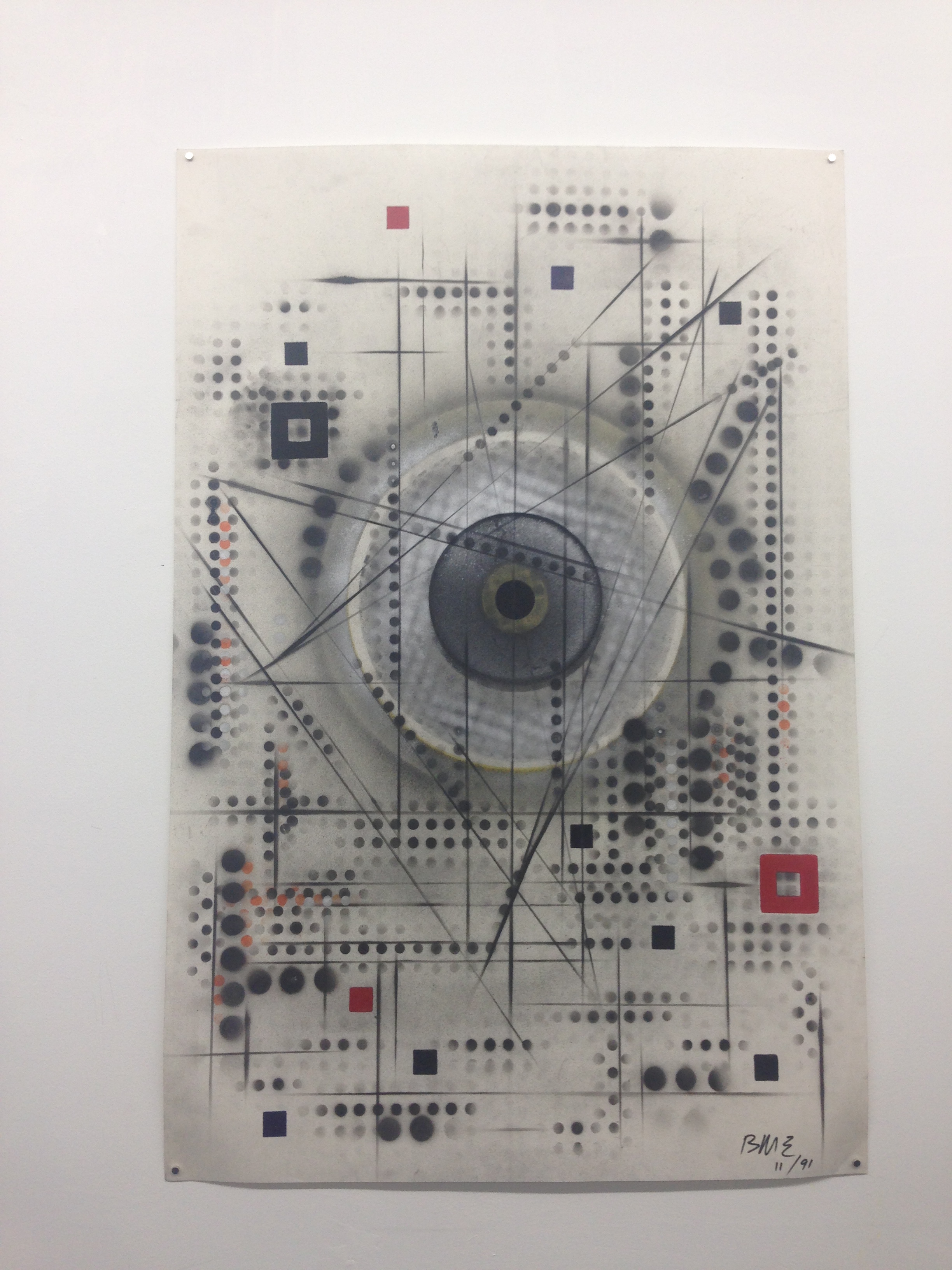
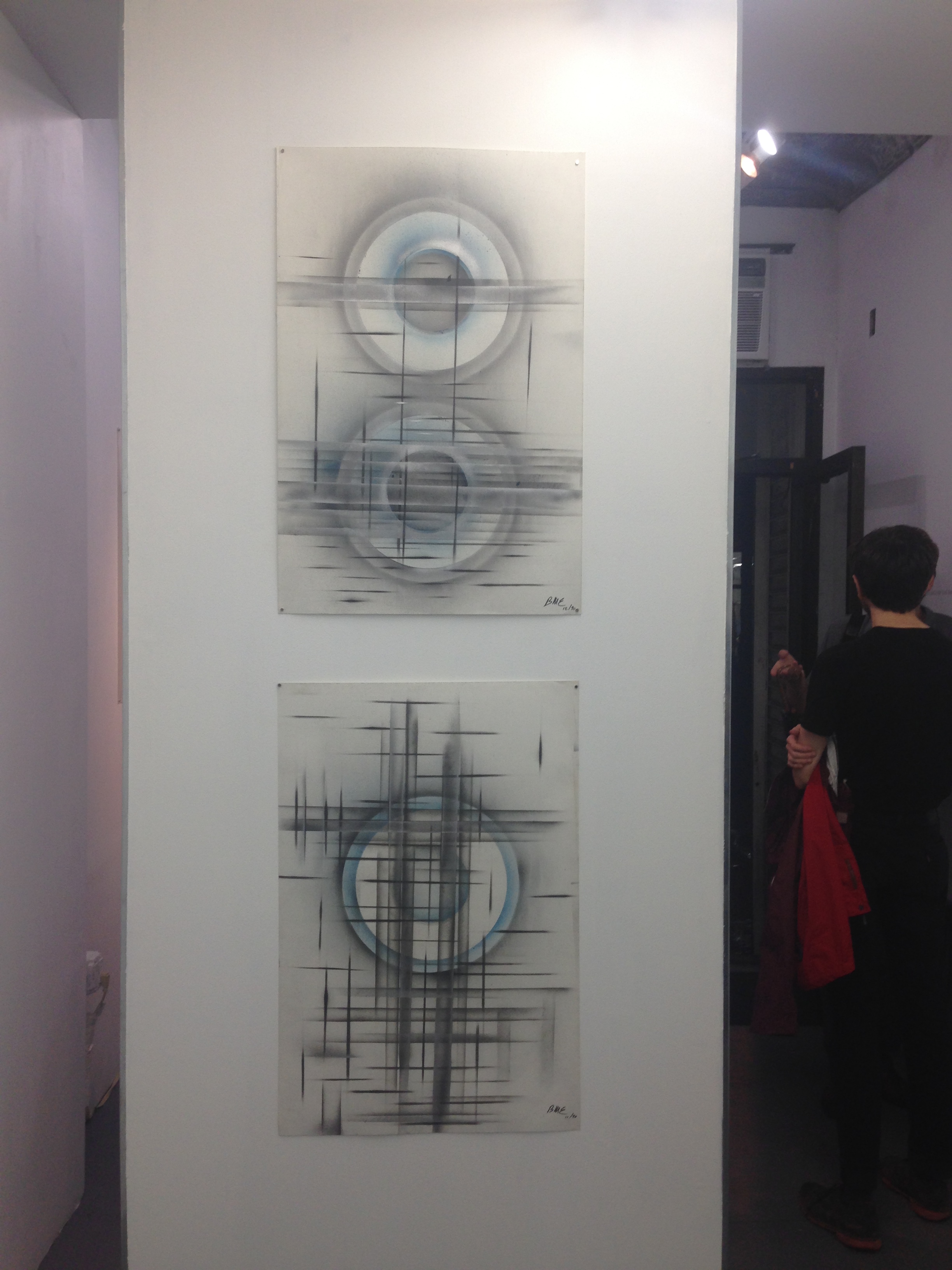
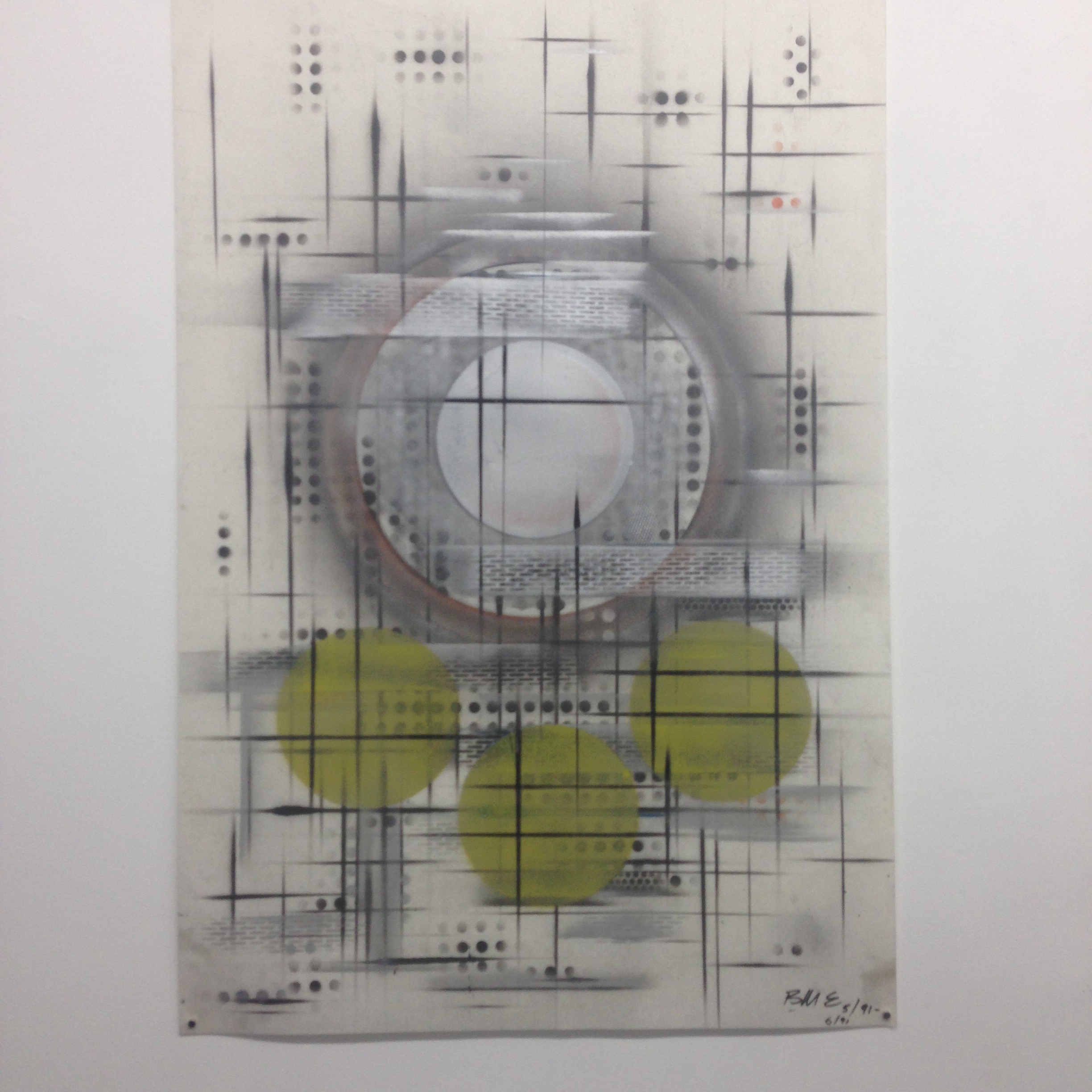
A brief interlude to tell my readers about a current exhibit at 33 Orchard in New York. Jointly organized by Envoy Enterprises and Boo-Hooray, “The Line Between: Ben Morea Paintings of the Early 90s” showcases about two dozen paintings from the former Black Mask leader.

The opening reception was held on September 10. The exhibit will close on October 4.

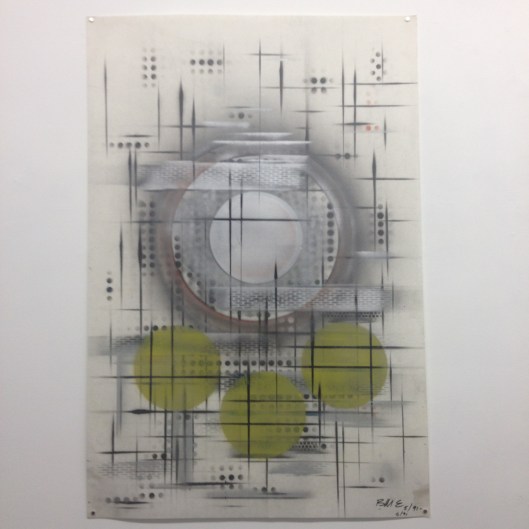
Below is a description from Envoy Enterprises’ website as well as a few pictures. Higher resolution pictures are available through their website as well.

Ben Morea is a painter, publisher, and direct action political figure. As the unseen hand of the 1960s revolutionary underground, Morea is infamous for shutting down MoMA, forcibly entering the Pentagon, occupying the Fillmore East and Columbia University, and dumping the neglected garbage of the Lower East Side into the fountains of Lincoln Square. He was the force behind the 1960s art/anarchist collective Up Against the Wall Motherfucker and and the legendary anarchist zine/broadside ​Black Mask​.

Morea’s paintings have one foot firmly in a Suprematist camp while the other remains grounded in a playful use of composition. Traversing mid-century abstraction that utilizes basic geometric shapes and a primitive approach to mark making, and inspired by the spiritual as much as intellectual, ​The Line Between ​is comprised of work Morea made in the early 1990’s after abandoning painting for decades.

Picking up where he left off in the mid-‘60’s, Morea utilized spray paint as his primary medium to make a series of works on paper that he considers a rebirth and a continuation of his artistic explorations. The work asks the viewer to consider that there are no conclusions artistically or philosophically, but rather a series of loose answers to immediacy. Exhibiting only a few times since he began making art again, Morea had a show of paintings and graphic work from the ‘60’s with Boo-Hooray in ​‘Unseen 50 Years: Paintings By Ben Morea 1964-65’ in the Summer of 2014, and an earlier Boo-Hooray exhibition of his work as a publisher, illustrator, and direct action political figure, ​‘Opposition: Black Mask, Ben Morea, & U.A.W.M.F.’ ​in January of 2014

2015-09-10 19.21.12

2015-09-10 20.05.54 2015-09-10 19.48.14 2015-09-10 19.48.19 2015-09-10 19.48.432015-09-10 20.05.48-2

Tarzan contre la vie chere [2015]

Trapier, Stephane. Tarzan contre la vie chere. Paris: Matiere, October 2014. 136 p.; ill.; 21 x 15 cm.; yellow and white cover with drawing of Tarzan and a Lenin look-alike.

A bit of an interlude to promote a book that is only indirectly related to the Situationists. But hear me out: what Stephane Trapier does in his wonderful “Tarzan contre la vie chere” is apply the Situationist technique of detournement to modern age comic books. The book’s cover tells it all: what could Tarzan and Lenin possibly have to do with each other? But just wait until the characters speak their mind – topics discussed include phone sex, women’s liberation movement, campaign finance, cell phone reception, the dictatorship of the proletariat, and more. Absolutely wonderful.

The book can be purchased directly from Editions Matiere on their website (http://www.matiere.org/livres/tarzan-contre-la-vie-chere/) for 27 Euro, which includes shipping to the United States.

Pictures below courtesy of Editions Matiere and Shige Gonzalvez, who was kind enough to introduce me to this fantastic comic book artist. (http://leblogdeshige.com/2014/11/connaissez-vous-stephane-trapier/)

tarzan-contre-la-vie-chere

TRAPIER_Tarzan_contre_la_vie_chere__macarena

comptes-de-campagne

allo

chevalier-pride

TRAPIER_Tarzan_contre_la_vie_chere__gender_ideal

rythme-scolaire

King Mob 3 – A Motherfucker is a Werewolf!

King Mob. King Mob 3: A Motherfucker is a Werewolf!. London: BCM/King Mob, n.d. [1969]. 16 p.; ill.; 35x 21 cm.; ill. wrappers with large black & white drawing of a werewolf.

Third issue of the legendary UK counter-culture magazine put out by the Wise brothers and British Situationist member Christopher Gray. Retracing the history of King Mob, its evolution, and its linkages with Black Mask / Ben Morea would be too long for a blog post. I thus encourage all readers to learn more by reading Tom Vague’s “King Mob Echo: From Gordon Riots to Situations & Sex Pistols” (London: Dark Star, 2000; in print) or the Wise Brothers’ own “King Mob: A Critical Hidden History” (available online at http://www.revoltagainstplenty.com/index.php/archive-local/93-a-hidden-history-of-king-mob.html). Both are subjective histories, though.

This issue reprints extensive content from Ben Morea’s Black Mask journal and advertises its actions in the United States (“The first year Black Mask seized every possible opportunity of fucking up culture”). It includes the famous action to close the Museum of Modern Art in New York. As always, the illustrations are stunning and speak to the group’s radicalism and nihilistic outlook

Scarce in the trade, with about a dozen copies on OCLC.

IMG_3689 IMG_3690 IMG_3691 IMG_3692 IMG_3693 IMG_3694 IMG_3695 IMG_3696

Elements de Banalyse [2015]

Clavreul, Marie-Liesse and Thierry Kerserho (Ed.). Éléments de banalyse. Caen: Editions Le Jeu de la Règle, June 2015. 1 vol. (561 + XLIV p.); profusely illustrated.; 29 x 20 cm.; purple wrappers with text in white. With a preface by Pierre Bazantay and Yves Helias, co-founders of the Congrès Ordinaire de Banalyse.

This is the first book published on the (artistic/political/otherwise uncategorizable) movement known as the Banalyse. As stated in the Avertissement by the editors: “This first work on the banalyse movement is published over twenty years after the last meeting in Fades. [This is] a truly remarkable fact in our era of speed and saturation: to this day, with the exception of the banalystes themselves, few are those who have been able to get some first-hand information [on the Banalyse], while many others certainly believed that this movement had left only a few traces. Everything seemed in place for a legend to be perpetrated amongst a few amateurs, or for forgetfulness to win over. This book seeks to defeat both alternatives.” (p. XI, translation is mine)

But what is the Banalyse, and why does it matter? I have translated a short introduction from the publisher (it can be found here; http://www.lejeudelaregle.fr/skin2014/frame3.php): “Under the auspices of the Cahiers de Banalyse, Pierre Bazantay and Yves Helias founded, in 1982, the Ordinary Congress of Banalysis. The principle was such: participants were to join the Congress, which took place on the tracks of a small train station called Les Fades, in the Puy-de-Dome (France). However, the only activity scheduled for the aforementioned Congress consisted in waiting for other participants who had yet to arrive via train…In accordance with the upfront commitment, the Congress occured every year for 10 years, on the third weekend of June. The Congress stood as the first example of a type of propositions that combined  an experimental perspective on the banal and critical outlook of institutions” (translation is mine)

Ralph Rumney was one of the most noteworthy participants in the Banalyse. In many ways, the movement was heavily inspirated by psychogeography. In fact, at a conference on psychogeography, Situationist scholar Pierre Marcolini gave a talk called “pychogéographie et banalyse” where he explores the parallels between the two movements. For more about Rumney’s involvement with Banalyse, one may read “Sur le Passage de l’invite 889 a travers la banalyse” (http://www.homme-moderne.org/images/peintr/rrumney/helias99.html) You may also consult my earlier post on Rumney’s “Pourvu que ca dure” sur le passage de quelques idees a travers le temps”, published in 1999 by the Bureau des Inspections Banalytiques: https://situationnisteblog.wordpress.com/2015/08/16/pourvu-que-ca-dure-sur-le-passage-de-quelques-idees-a-travers-le-temps-1999/

The book is available from Editions Le Jeu de la Regle. 1,300 copies were printed. http://www.lejeudelaregle.fr/skin2014/frame3.php

IMG_3671 IMG_3672 IMG_3673 IMG_3674 IMG_3675