Contributions Serving to Rectify the Opinion of the Public Concering the Revolution in Underveloped Countries [1973]

Tags

, ,

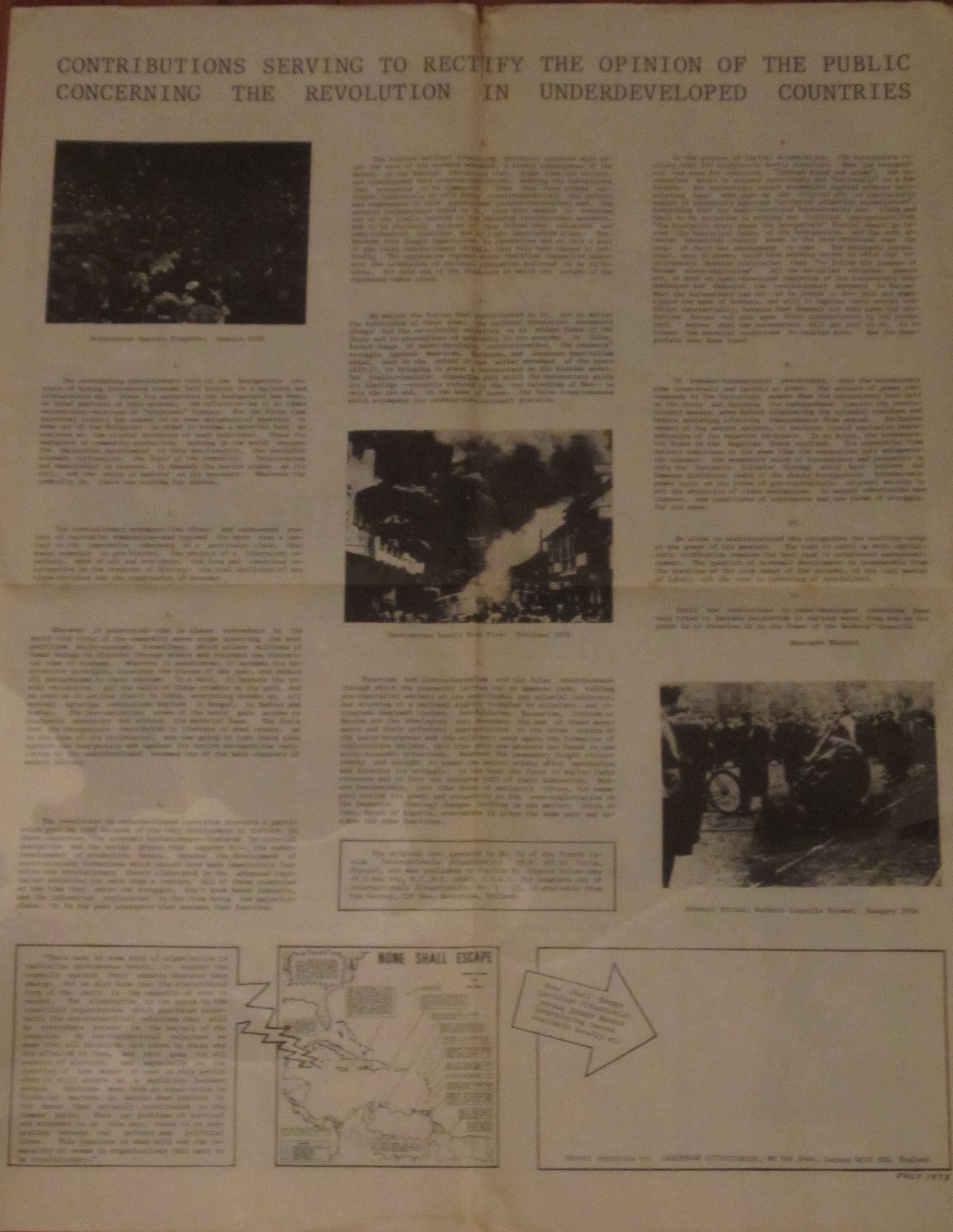
[Caribbean Situationist] Contributions Serving to Rectify the Opinion of the Public Concering the Revolution in Undeveloped Countries. London: Caribbean Situationist, July 1973. 60 x 46cm; white lithographed poster with black print

This beautiful poster – seemingly absent from institutional holdings – reproduces a translated text by Mustapha Khayati published in Internationale Situationniste no.11.The text had already been published as a brochure in 1971 by Create Situations, a US-based pro-situ group, under the title The Poor and the Superpoor: Contributions Serving to Rectify the Opinion of the Public Concerning the Revolution in Underdeveloped countries (see Ford 167).

Here, however, the text is produced in poster form and richly illustrated with black and white images that give a taste of the the uprising in the Hungary, Trinidad, and Jamaica. “The lower part of the poster advertises an LP entitled “None Shall Escape”, along with a blank space intended to denote a record shop where the LP would be available, here blank” (Division Leap) Overall, “a rare propagandizing poster from English situationists hoping to capitalize on Caribbean-emigre concerns about recent riots in their home countries” (Heart Fine Art)

Not in Ford, Vienet, and others
Image

Image

Bureaucratic Comix [1970]

Tags

, , , , ,

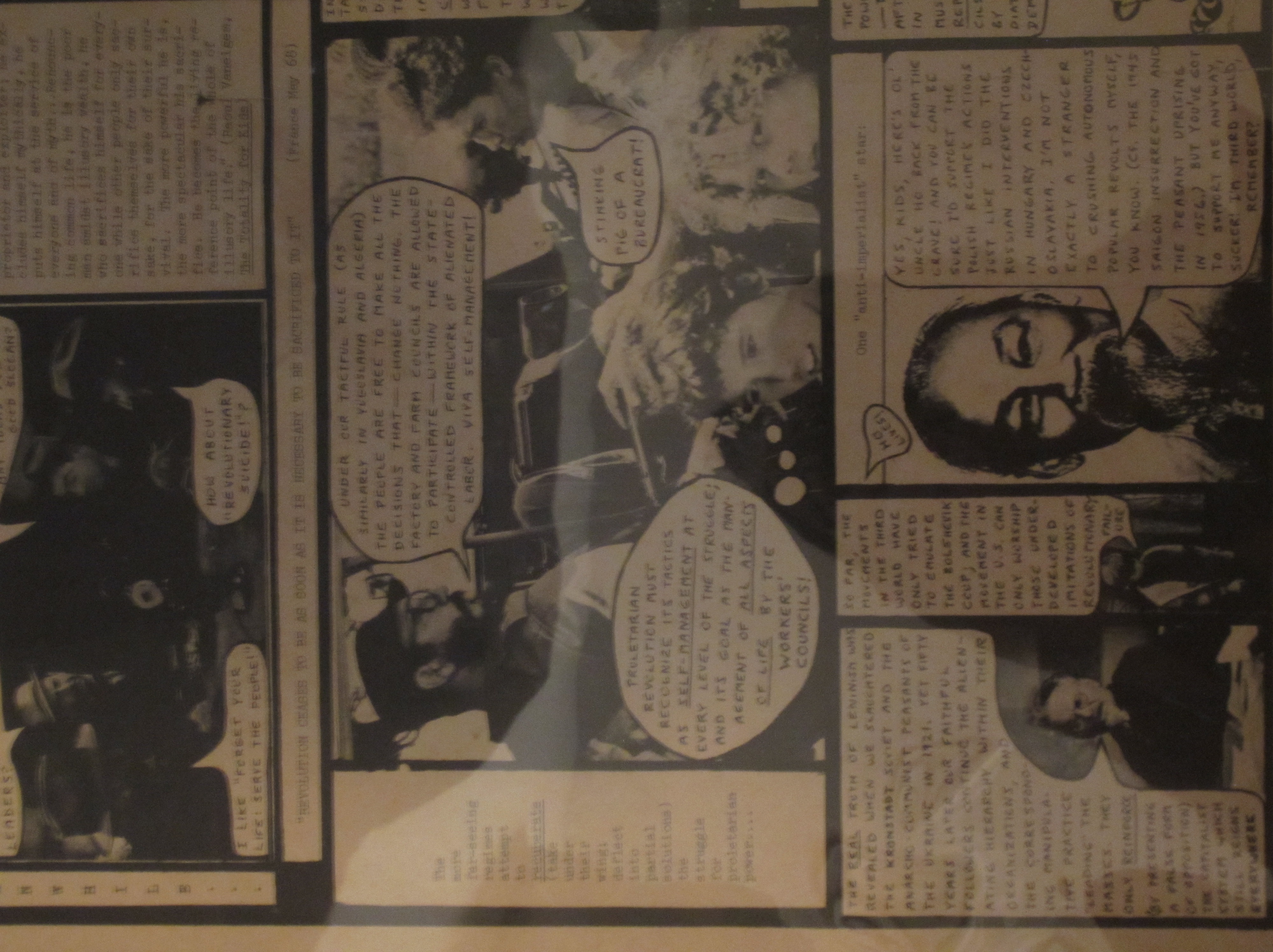
POWERS OF COUNCILS [Ken Knabb], Bureaucratic Comix. Berkeley, Jan. 1970. Illustrated poster. 45 x 57 cm; white paper with text and illustrations in black.

An early poster by the group Contradiction/ For the Power of Councils, to which Ken Knabb – who later went on to launch his Bureau of Public Secrets – belonged. The poster is not accounted for by Ford in his Suppression and Realization of the Situationist International (1972-1992), but appears in a recent bibliography of American Situationists and pro-situ groups (http://www.notbored.org/american-situs.html)

From a formal standpoint, this comix is of a great interest, as it draws from both comic strips and photographs. Issued following the December 1969-January 1970 worker revolt in Poland”, this poster also stands out in its critique of a wide range of communist leaders (Lenin, Castro, Trotsky, Ho Chi Minh and others. ), very much in the Situationist vein.

The text and comic can be found in a legible format at the Bureau of Public Secrets: http://www.bopsecrets.org/comics/bureaucratic.htm

Image

Image

Image

Image

Image

Situationist Times [1962-1967]

Tags

, , , ,

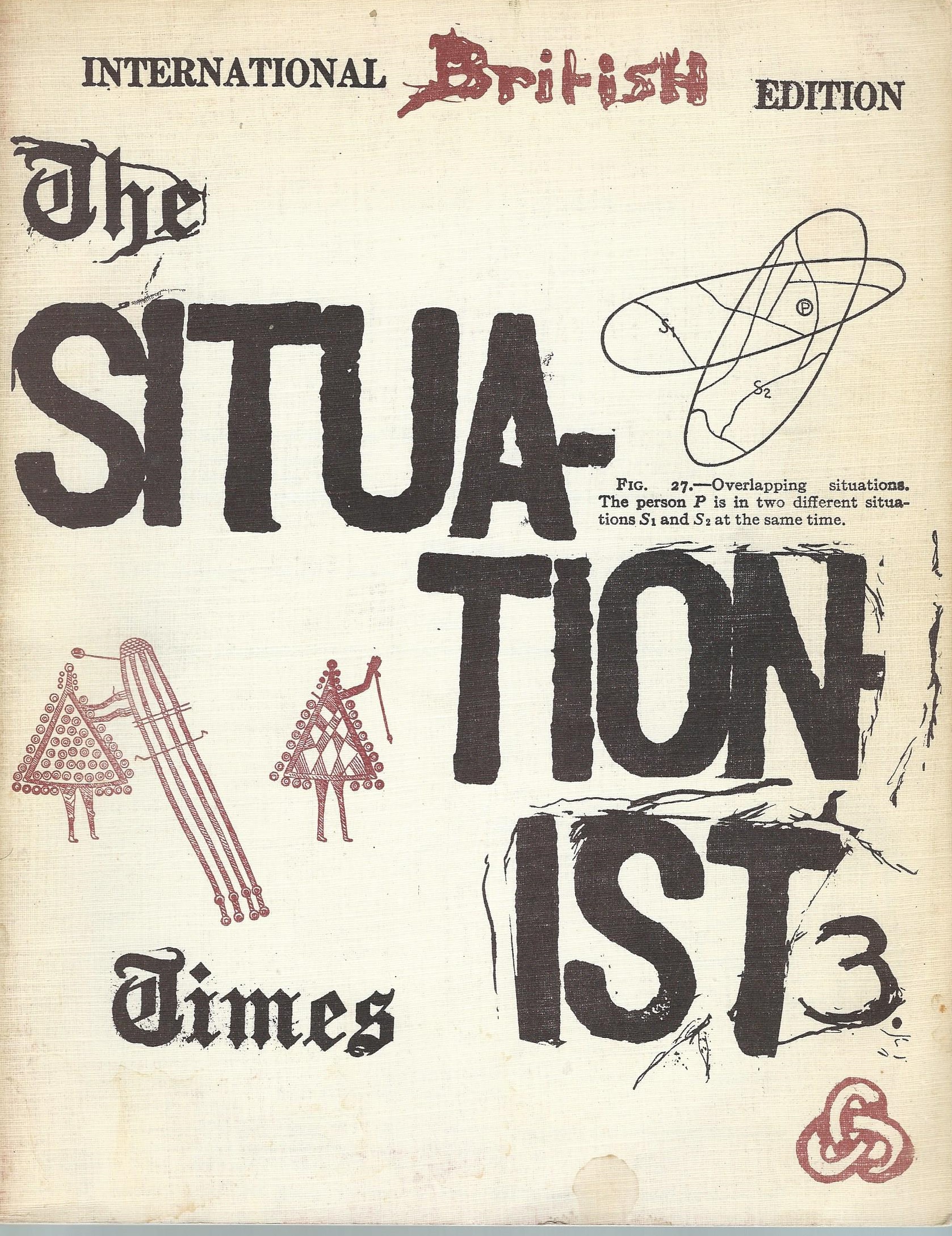
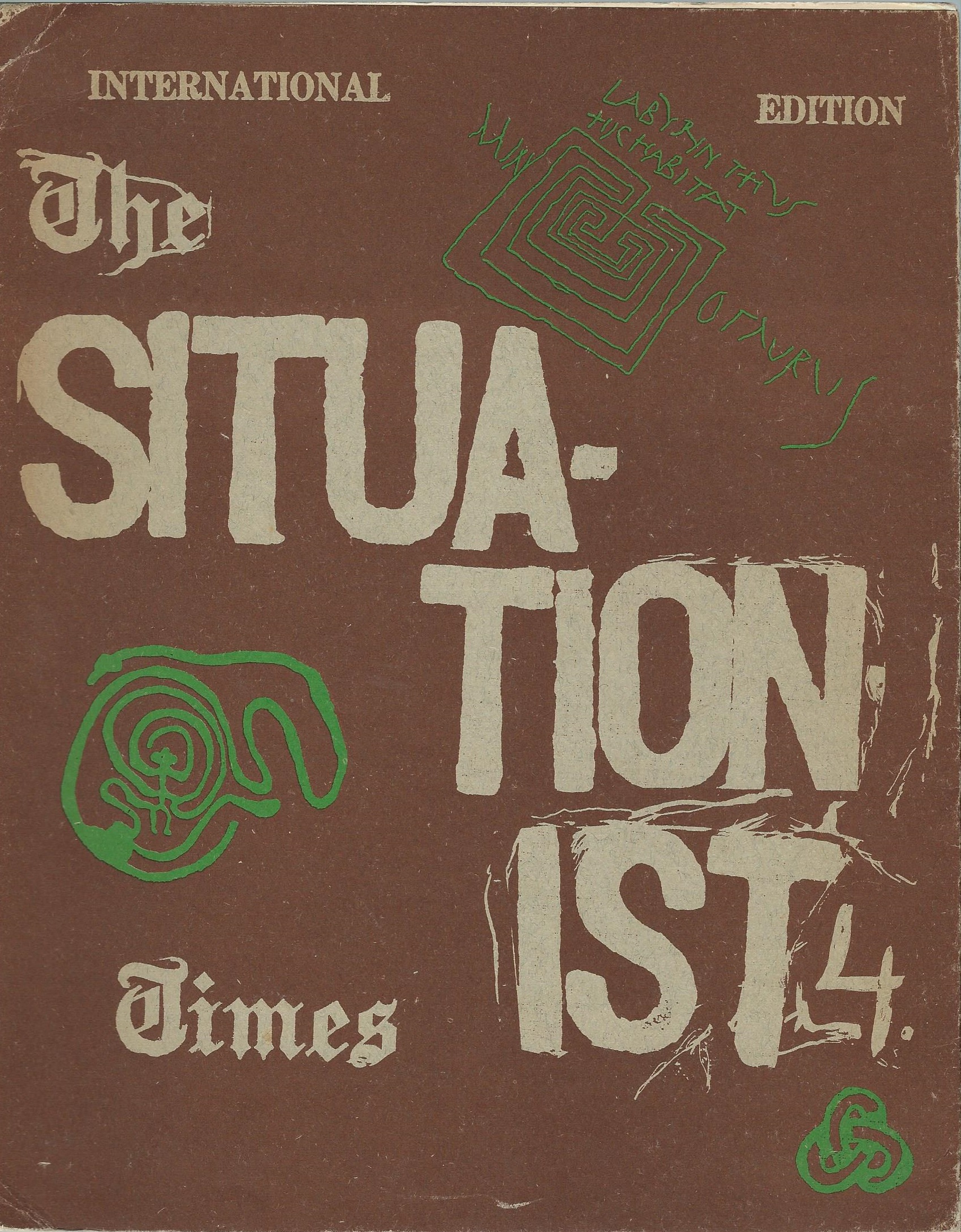
De Jong, Jacqueline (Ed.) Situationist Times 1-6. Hengelo, Copenhagen and Paris: Rhodos / International Science, 1962-1967. 64-200 p..; ill.; 22 x 28 cm; illustrated wrappers in different colors
The Situationist Times was originally intended as an orthodox Situationist periodical to run alongside IS, but at Goteborg, it was decided that a second paper would be too expensive, besides presenting the problem of translation into English. Jacqueline de Jong, after her expulsion, launched and edited the magazine single handed, though many of the photographs and ideas were supplied by Jorn (Ford). Contributors included: Theo Wolvecamp, de Jong, Armando, Vanderkamm, Gruppe SPUR, de Boer, Edle Hansen, Singer, Gordon Fazarkely, M. Bucaille, G. Hay, Asger Jorn, P. Schat, Noel Arnaud, Pierre Alechinsky, Boris Vian, and many others.

Issues were published in runs of 1,000-2,000 copies, with some focused on specific topics. Issue no.3 dealt with the Typology of Knots, Issue no.4 with labyrinths, and Issue no.5 with rings and chains. and Issue no.6 was simply comprised of 33 color lithographs. An issue no.7 was to be published, but lack of funds prevented it release

To commemorate the 50th anniversary of Situationist Times, Boo-Hooray Gallery released a facsimile reprint of all six issues in a limited-edition box of 1,000. While De Jong initially supported effort – led by Johan Kugelberg – she later expressed her disappointment and is working on creating an errata (http://jacquelinedejong.com/internationale-situationniste/) . Nonetheless, this reprint makes this long out of print magazine available to the general public

Featured below are all six original issues, as well as a leaflet advertising the publication of the fourth issue

ImageImageImageImageImageImageImage

Internazionale Situazionista [1969]

Tags

, , , ,

[Internazionale Situazionista] Internazionale Situazionista 1. Milan: Internazionale Situazionista, July 1969. 144 p.; ill.;  24 x 16 cm; green wrappers with text in black.

The Italian section of the S.I. only published a single issue of their review. The editorial board included Claudio Pavan, P. Salvadori and Gianfranco Sanguinetti. Includes an Italian translation of the chapter “le proletariat comme sujet et comme representation” of la Societe du Spectacle as well as a translation of Le Point d’Explosion de l’ideologie en Chine…(Gonzalvez). According to Raspaud, 4000 copies were printed.

A French translation (the work of Joel Gayraud and Luc Mercier) was published in Paris by Contre-Moule in 1988  under the title Section italienne de l’Internationale Situationniste: Ecrits complets [1969-1972]. This edition includes 4 additional texts: “Avis au proletariat italien”, “Les ouvriers d’Italie et la revole de Reggio de Calabre”, “Le Reichstag brule-t-il?”, and “Correspondance avec un editeur (Feltrinelli)”

Image

Situationistisk Revolution 1-3 [1962-1970]

Tags

, ,

[Situationistisk International] Situationistisk Revolution. Randers [1]  then Copenhagen [2,3] : Situationistisk International, 1962-1970. Pamphlet. 40-72p.; 24 x 15 cm; metallic or off-white wrappers with text printed in black or blue.

The Scandinavian section of the S.I. published 3 issues of their review from 1962 to 1970. Martin was the editor of all three issues, with contributions from Michele Bernstein, Guy Debord, Attila Kotanya, Uwe Lausen, Raoul Vaneigem, Alexander Trocchi and Rene Vienet. Texts published were a mix of translations from Internationale Situationniste and originals.

Here shown: Number 1 and 3. Number 2 and its special edition (Ny-Irrealisme) are very scarce

Image

Image


Situationist International 1 [June 1969]

Tags

, , , , ,

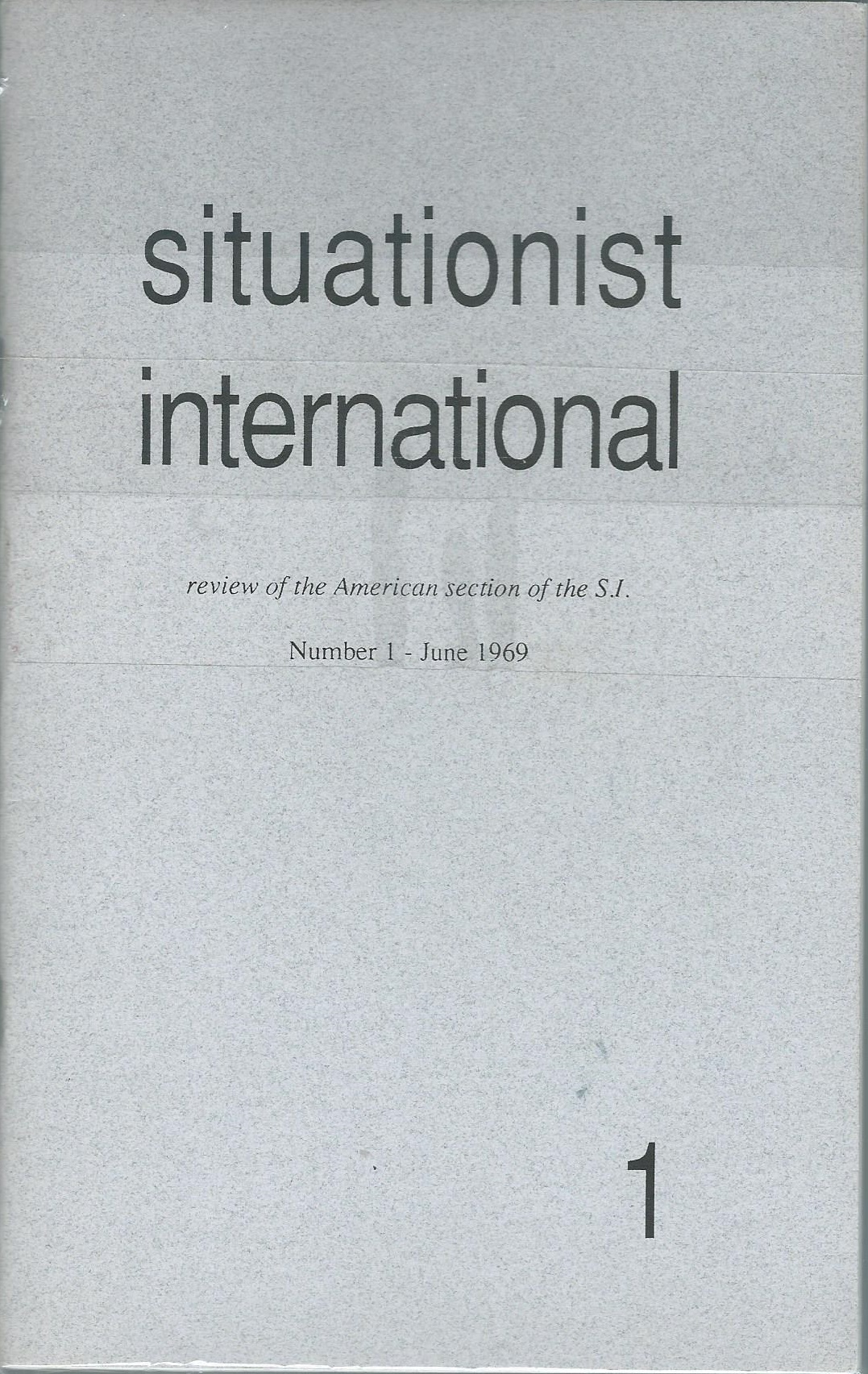
[Situationist International] Situationist International: Review of the American Section of the S.I., number 1. New York: Situationist International, June 1969. Pamphlet. 46 p.; 24 x 15 cm; off-white wrappers with text printed in blue.

The first and only issue published by the American section, following its admission to the S.I. in 1968. The editorial committee is comprised of Robert Chasse, Bruce Elwell, Jonathan Horelick and Tony Verlaan. Includes are the texts “Faces of Recuperation” (unsigned); Certain Extraordinary Considerations Contributing to the Understanding of the Devolution of Capitalism and Bureaucratization of Existence (Chasse);  Territorial Management (Debord); And Population Control (unsigned); and The Practice of Theory. 5,000 copies were printed (Raspaud 125-26), but this original edition has become extremely rare.

A facsimile edition was released by Extreme Press (Portland, Oregon) in 1993. A French translation – the work of Fabrice de San Mateo – was finally released in 2011 by CMDE (Toulouse, France) under the title Post Mortem Ante Facto Suivi De Internationale Situationniste Numéro Un Et Unique.

The Full text (in English) is available at http://www.cddc.vt.edu/sionline/si/si1.html. For a detailed account of the activities of the American section around the review, see http://www.notbored.org/american-review.html

Image

Image

Internationale Situationniste 1-12 [June 1958 – October 1969]

Tags

,

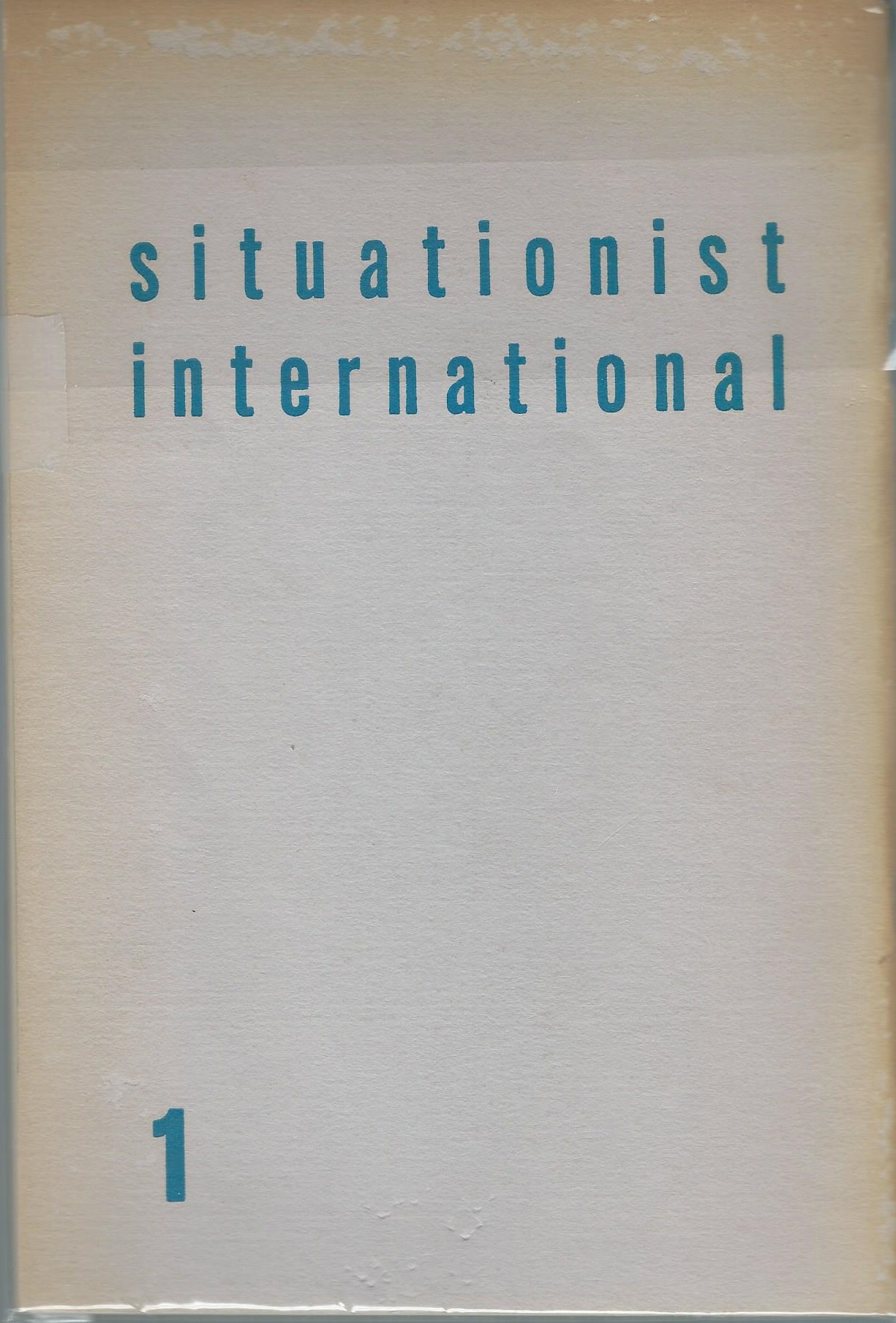
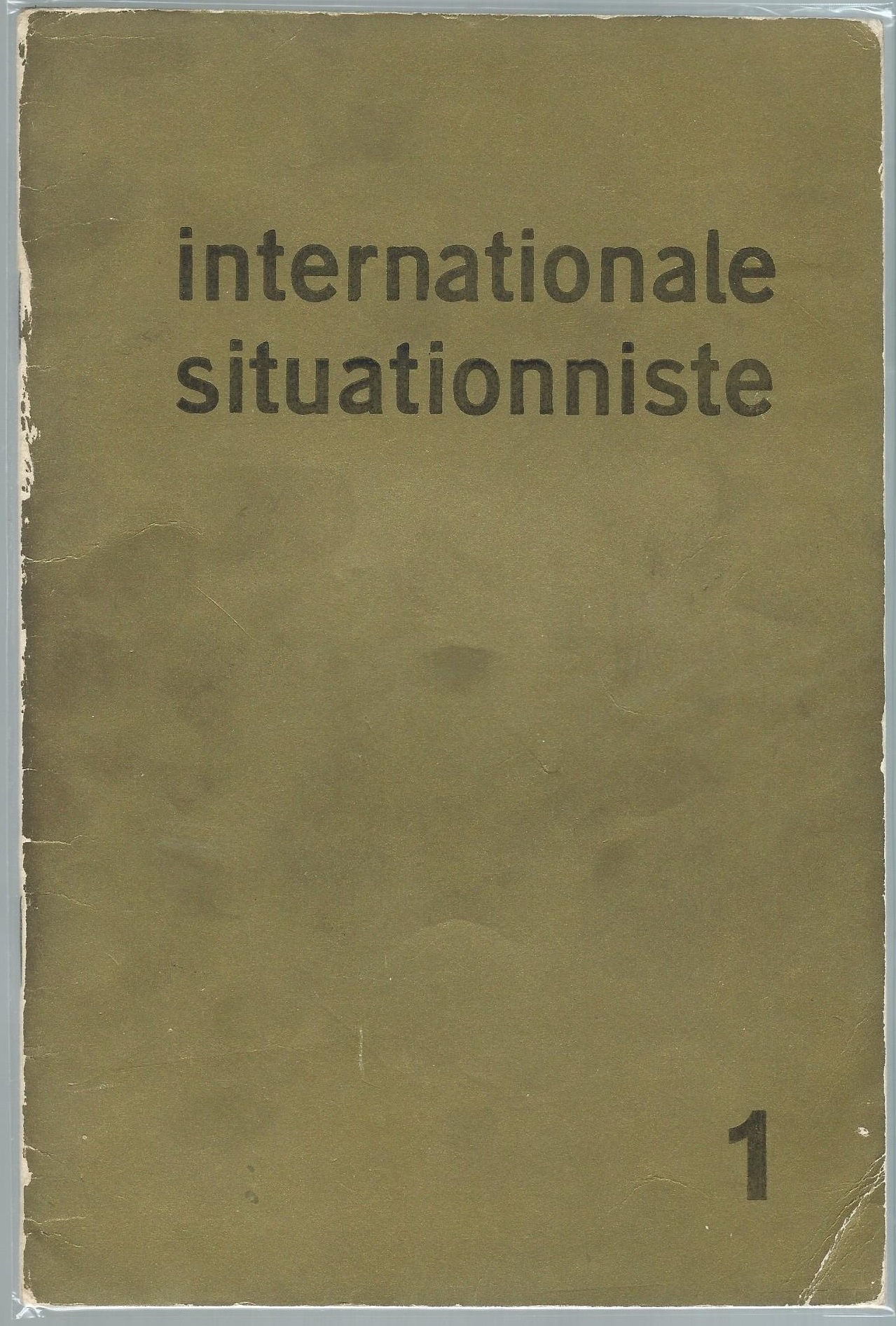
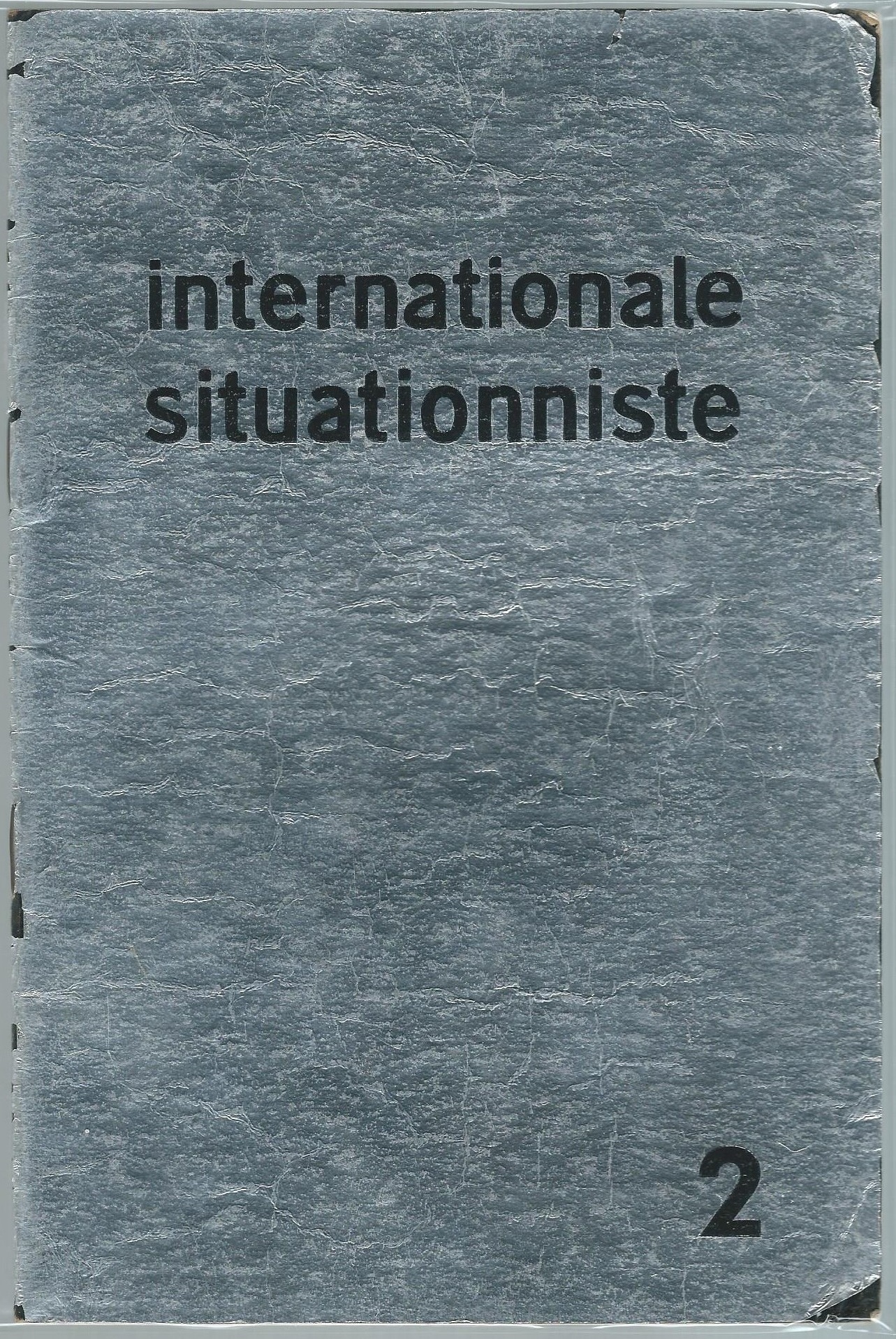
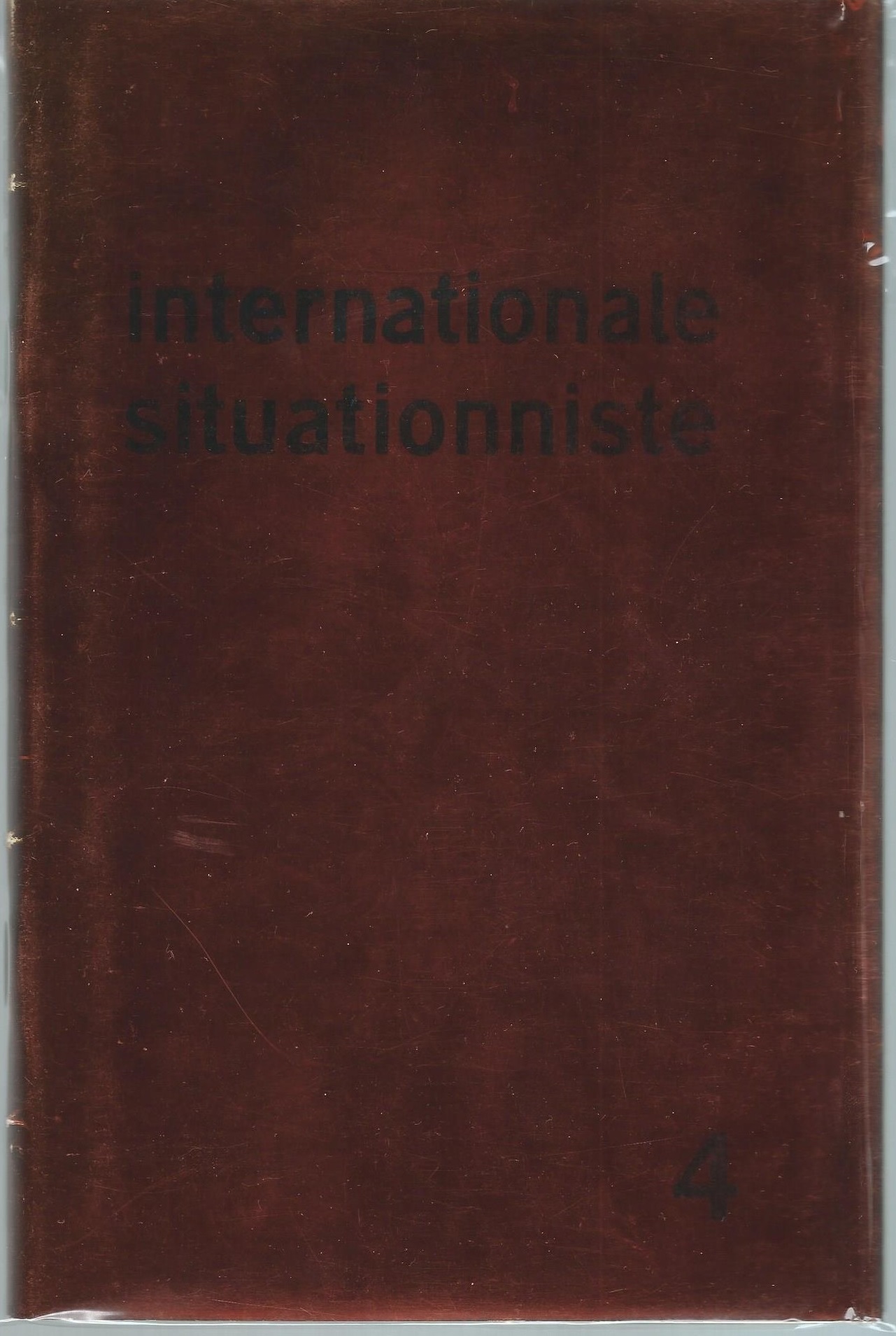
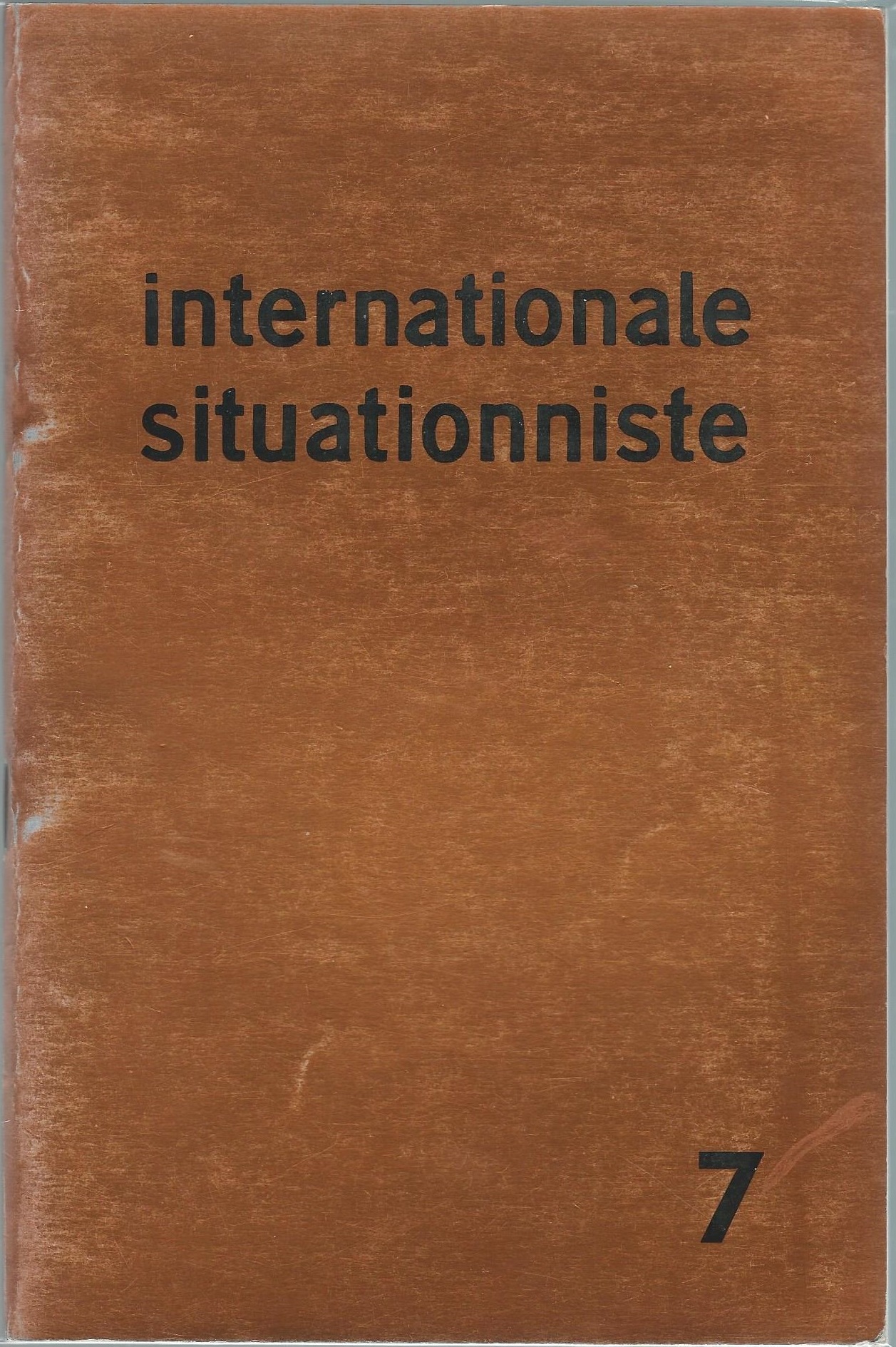
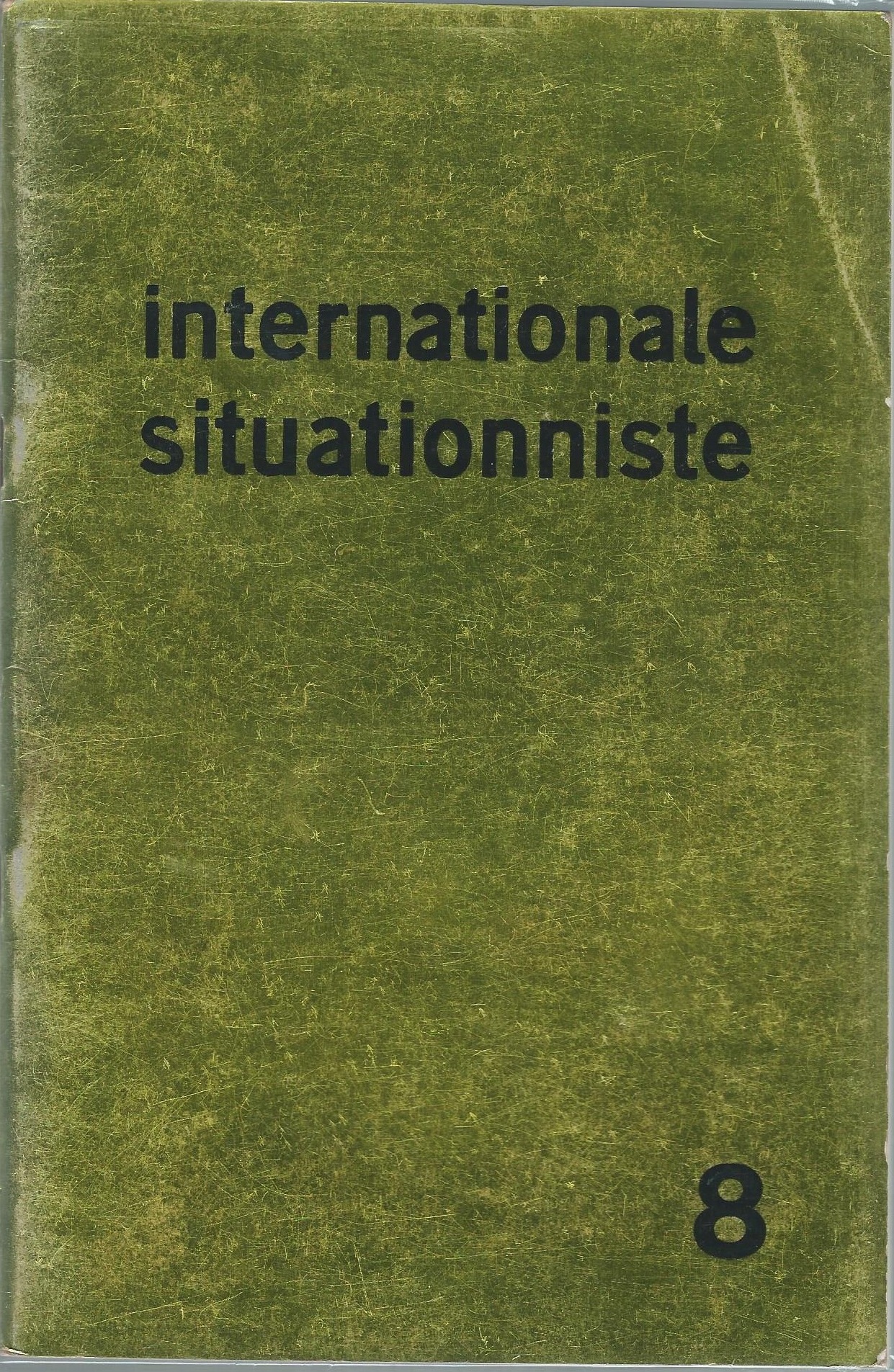
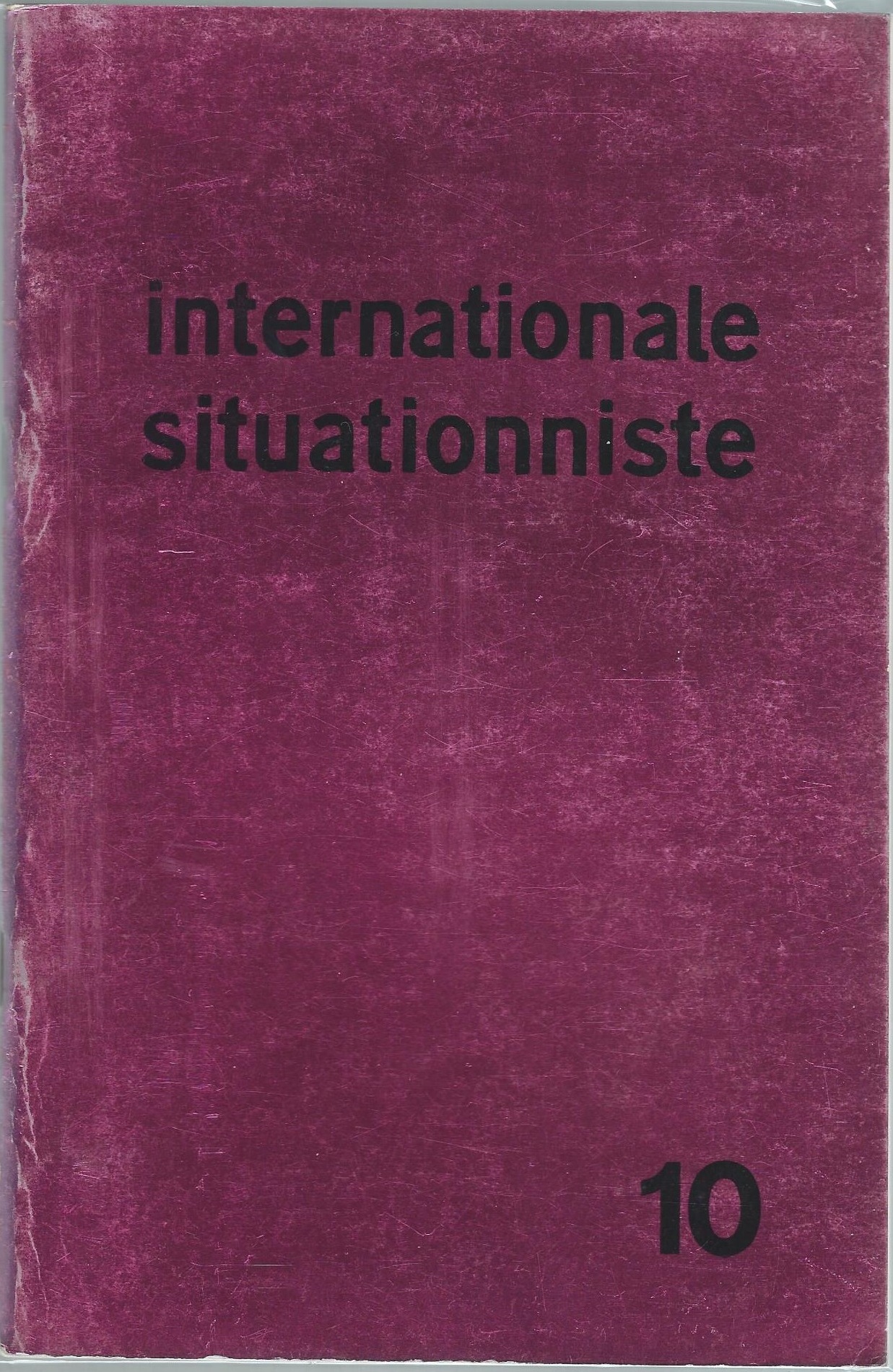
[Internationale Situationniste] Internationale Situationniste: Bulletin central des sections de l’Internationale Situationniste (no.1-8) then “Revue de la section francaise” (no.9-12).
Paris: Internationale Situationniste, 1958 to 1969. 24.5 x 16.5 cm stapled pamphlets, 33-116 p. Metallic covers of different colours with text in black.

Internationale Situationniste was the main vehicle used by the I.S. and its members to carry the organization’s theoritical messages, as well as its view on current events and society at large. The publication initially had a small to medium run but, as the movement gained visibility starting around 1967 – when Debord released La Societe du Spectacle and Vaneigem his Traité de savoir-vivre à l’usage des jeunes générations – it increased substantially. As such, Issue 11 was printed in 5,000 copies and issue 12 in 10,000 copies (Raspaud & Voyer, 120-126)

Complete sets of the original review are difficult (and often expensive) to come by. Thankfully, facsimile reprints of all 12 issues were made available by Van Gennep (1971), Champ Libre (1975), Fayard (1997) and la Bibliotheque Fantastique (2000s). Since “All texts published in Internationale Situationniste may be freely reproduced, translated and adapted, even without indication of origin” (Internationale Situationniste no.2), the full text is also available online. See, for instance, http://i-situationniste.blogspot.com/ImageImageImageImageImageImageImageImageImageImageImageImage

Potlatch no. 29 [Nov. 1957]

Tags

, , ,

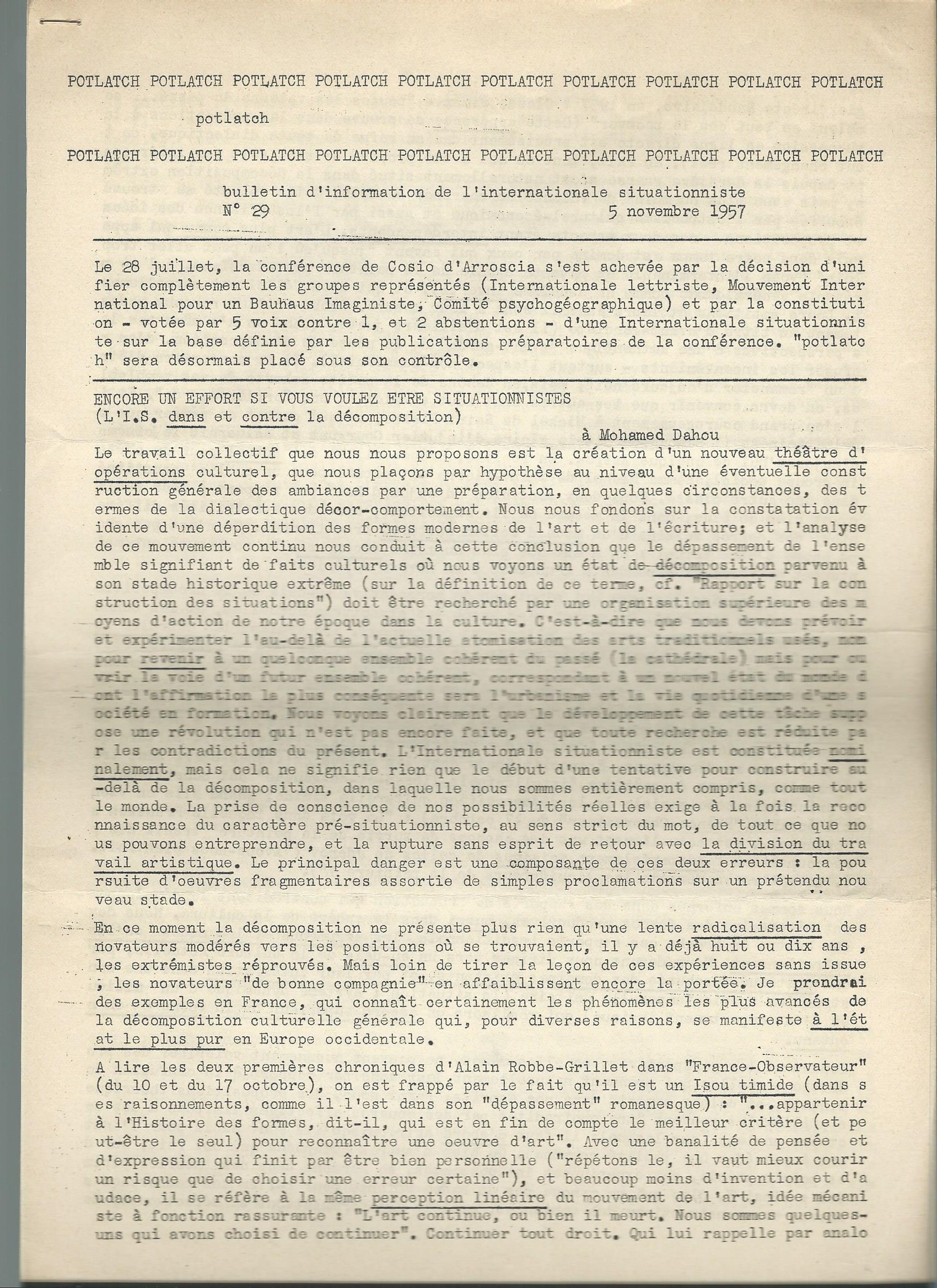
[Internationale Lettriste] Potlatch no.29: Bulletin d’Information de l’Internationale Situationniste. Paris: Internationale Situationniste, 5 Nov. 1957. 21 cm x 29.5 cm. 2 stapled brown sheets, printed both sides in black.

Potlatch was the newsletter of the Internationale Lettriste. 29 issues were published in Paris between 1954 and 1957. The newsletter’s title refers to the economic system practiced by some indigenous tribes, and which operates on the basis of the gift rather than market-based exchange (Ford). Indeed, Potlatch was never meant to be sold, only distributed to friends.

Issue 29, featured here, is particularly important. Whereas other issues state “Bulletin d’Information de l’Internationale Lettriste”, this penultimate issue is described as “Bulletin d’information de l’Internationale Situationniste”. This is because it was published in the aftermath of the Cosio d’Arroscia conference (28 July 1957), which marked the merger of the I.L. (and other movements) into the I.S. This key event is announced at the top of the first page.

Issue 29 includes the famous text “Encore un effort si vous voulez etre situationnistes”, signed G-E Debord. It also announces the publication of two very important pieces by Jorn and Debord: Fin de Copenhague and Guide Psychogéographique de Paris.

ImageImageImageImage

“L’Illusion Tragique Illustree: Gadget [1965]

Tags

, ,

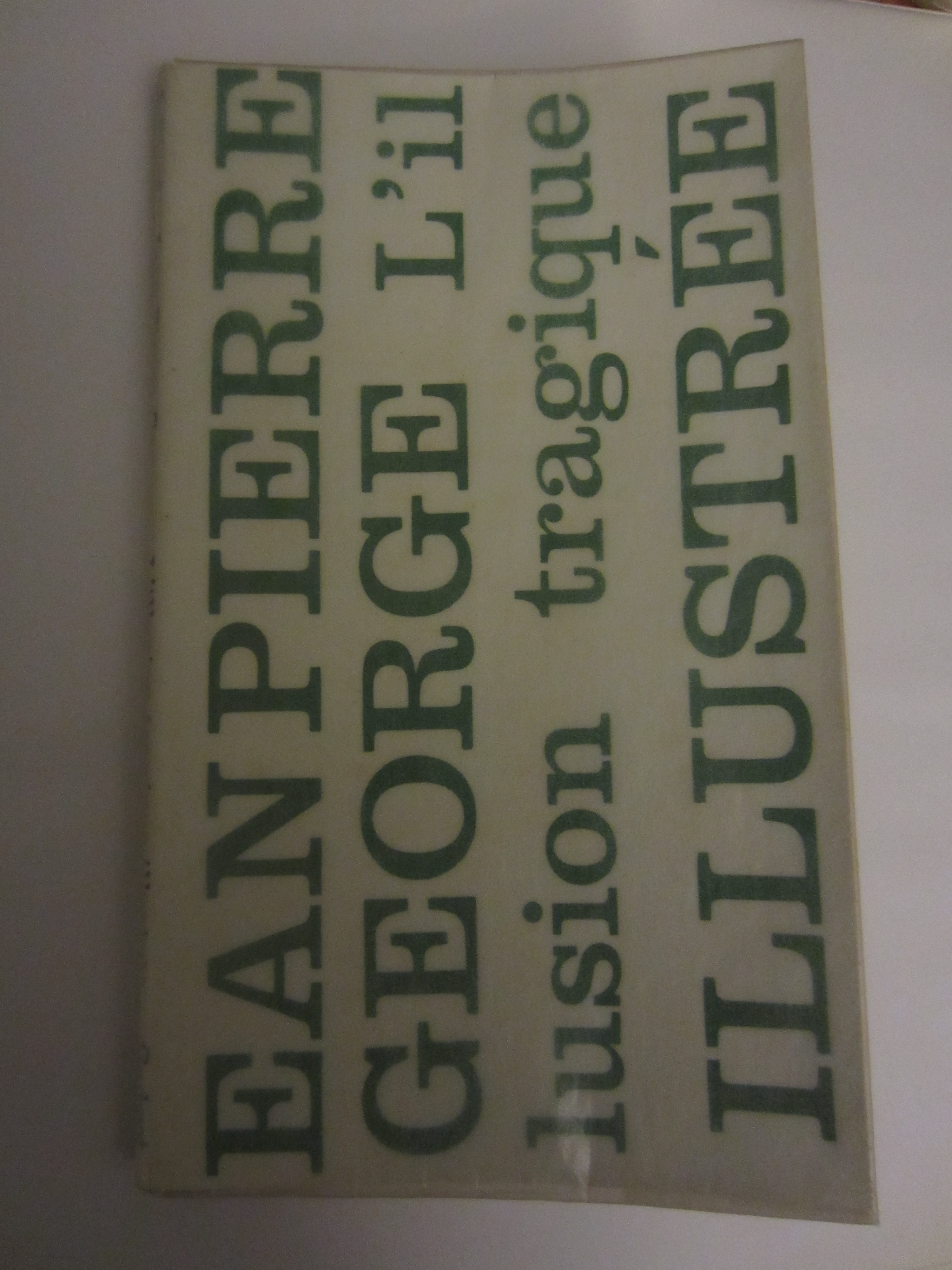
George, Jean-Pierre. L’illusion Tragique Illustree: GadgetParis: Julliard, 1965. Book. 21 cm x 12 cm; printed cover in white with text in blue (front cover) and green (back cover). Inside text and illustrations printed in black on pink paper.

Jean-Pierre George was influenced by Debord and the Internationale Situationniste in the 1960s, which was not very common at the time. The use of detourned comics, among other devices, is reminiscent of the I.S. However, the appreciation was far from mutual: Raspaud & Voyer describe J-P George as  “incohérent, à l”échine trop souple, signe à côté de Jean Cau” (43) The book’s covers are reproduced by Laurent Chollet in “L’Insurrection Situationniste” (336).

In a short biography, Jean-Pierre is described as having flunked the baccalaureate twice (before passing on the third attempt) and never graduated from University. He refuses to work (“Ne Travaillez Jamais”?) and does not preach any morale. “Autopsie de Dieu” is his other Situ-influenced novel.

ImageImageImageImage